I always wanted to have a quick look at A&O and was finally motivated again reading about it several times in my Twitter timeline. In my All Danish Stocks series, A&O didn’t make the cut because I had already Solar in the portfolio, but still I want to look at them as this often yields some insights into the other company.
Both companies are headquartered in Denmark and in principle distribute supplies for craftsmen/installers.
From what I understand, Solar Group is focused a little more on electrical equipment, A&O has a broader assortment but focused on renovation and remodeling. A&O Johanson has a small B2C segment that makes up ~12% of sales but less in profits, as margins in B2C are smaller.
A&O is active in Denmark, Sweden and Norway, however 90% of sales seem to be in Denmark. A&O has a dual share structure, with “super voting” shares owned by the family and CEO giving copntrol to the family. Also Solar Group has a dual share class structure, with the majority of the votes owned by the heirs of the original founder (4th generation).
Tamburi Investment Partners (TIP) is kind of a “secret star” in the area of European Holding companies. I looked at it briefly within my Italmobiliare write-up friom last week. The stock price has performed extremely well especially over a 10 year horizon:
Disclaimer: This is not investment advice. PLEASE DO YOUR OWN RESEARCH !!!!
What better day to publish a post about an Italian company than Ferragosto, the Italian Public Holiday where virtually any Italian family is somewhere close to a beach and Italian offices only are staffed with the most junior person to take up the telefone in order to say: “No one here, please call next week/next month”.
With Italmobiliare, I fell deeply into a rabbit hole, which lead to a quite extensive analysis. Due to some problems with the WordPress editor, I wrote it with a different Editor and have attached the PDF with the full version. In the blog post I’ll focus on the executive summary, the Pro’s and Con’s and the return expectations. The rest of the gory details can be read in the attached PDF document.
Italmobiliare (IM) is an Italian Holding company with a market cap of ~1 bn EUR that underwent 2 pivots in its 40 year history as a listed company. The first pivot, in the 1990s, from conglomerate to Cement (Italcementi) and then once again in 2017 after a 2 bn sale to Heidelberger into an Italy focused, “Quality-growth small/mid cap PE” style investment company.
What makes the company very attractive to me, is a very interesting portfolio (including at least two potential “Super Star” holdings), decent value creation, good strategy/transparency and especially a 50% Discount to NAV.
In essence, BAFIN said that The Social Chain’s Operating Cashflow did contain ~60 mn EUR of non-operating cashflow items that should have classified either as Financing and Investing Cashflow.
Why is that important ? Many investors (myself included) consider “Free Cashflow” as a very important metric. Free cashflow consists of Operating Cashflow minus Capex and is generally considered to be less easily manipulated than accounting numbers (“Adjusted EBITDA before costs to build the product”).
Looking at the headline numbers from the 2021 annual report, we can see that despite the “adjusted pro-forma” numbers, the +22 mn Operating cashflow compares to -23mn EUR in EBITDA and -82 mn EUR Net income and seems to generate the impression that the underlying business is cash generating, as the investment cashflow was mostly M&A:
Dislaimer: This is not investment advice. PLEASE DO YOUR OWN RESEARCH !!!!
Background:
Some of my readers might remember, that I bought into a “Freedom energy” basket in March 2022 in order to “hedge” against potentially catastrophic effects from the Russia/Ukraine war. After a first nice run, I sold 3 out of the initial 4 (7C Solar, PNE, Energiekontor and ABO Wind) and only kept ABO Wind because I considered it the most undervalued stock.
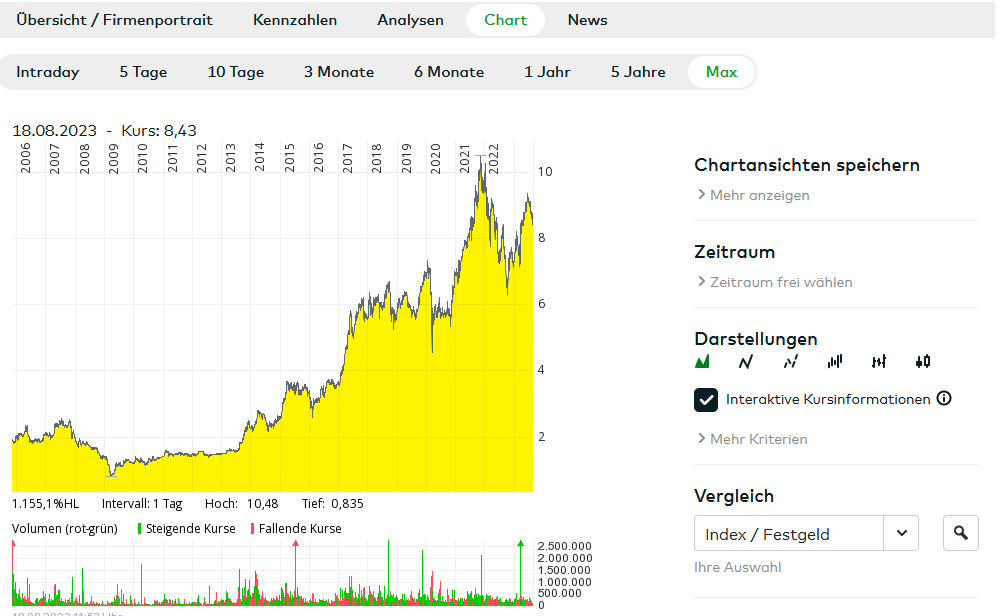
Looking at the chart we can see that for some of the stocks of that basket, not so much happened, only PNE is still significant above the level of March 2022 (ABO Wind is the solid Yellow chart):
This has become a quite long and somehow rambling post. If you look for “actionable investment advice”, then you don’t need to read this.
Background: Handelsbankon on the blog since 2015
One of the great things of an Investment Blog/Journal is that one can easily revisit everything that one has written years ago when I want to look at a stock again.
Handelsbanken is a stock that I have covered quite often since 2015. Initially, I compared Handelsbanken to Deutsche Bank in 2015, claiming that Handelsbanken is a much better run “quality bank” compared to Deutsche Bank and that Deutsche Bank, despite the much cheaper valuation, most likely the worse investment. This is how Handelsbanken has performed against Deutsch Bank and the European Banking index.
Disclaimer: This is not investment advice. PLEASE DO YOU OWN RESEARCH !!!
Some days ago, I made the case for a significant increase in demand for insulation in Europe for the next several years. In this post, I want to dig a little bit deeper into the main listed players and which I find more interesting. In general, even only for the German speaking region there are many companies that offer insulation, among them very large, diversified groups such as BASF, Dow Chemical and St. Gobain.
However, the following listed companies are those who do the majority of sales in insulation to my knowledge:
Kingspan, Irleand/UK Rockwool, Denmark Recticel, Belgium Steico, Germany Sto SE, Germany
Sto, Rockwool and Recticel are already in my portfolio with relatively small weights.
Before jumping into the companies, I have compiled a table with a few KPIs that i find interesting. One quick coment upfront: As Recticel is undergoing a signifcant transformation, their numbers are curently not comparable.
Disclaimer: This is not Investment advice. PLEASE DO YOUR OWN RESEARCH !!
Summary:
If you would ask me about the most boring stock of my generally very boring portfolio, I would possibly name Schaffner Group. I had bought a first position back in 2021 during my “All Swiss Stocks” series.
However, I have never written a more detailed write-up despit my annual summaries (2021/2022 ,2022/2023), maybe becasue I always got bored when I started writing about it ? Over time I added to the position and after the most recent 6 months numbers, I decided to increase into a full position. Time to explain the investment case a little bit better.
Disclaimer: This is not investment advice, PLEASE DO YOUR OWN RESEARCH !!!!
For all readers that found my SFS write-up from February as too exciting, I have good news: I have found a stock that looks at least as boring as SFS, maybe even more so: Logistec, a maritime terminal operator from Canada.
Background/Intro:
This is the first investment idea that I initially found on Twitter, a big Hat tip to Sutje who brought this up on my radar and of course to the author of the original write-up “Wintergem Stocks”. The Wintergem Substack has a 3 part write-up that I can only recommend to read first:
For some time now, many market pundits were pushing the idea that Banks and Insurance companies would be basically “no brainer” investment as higher interest rates mean higher profits for these players.
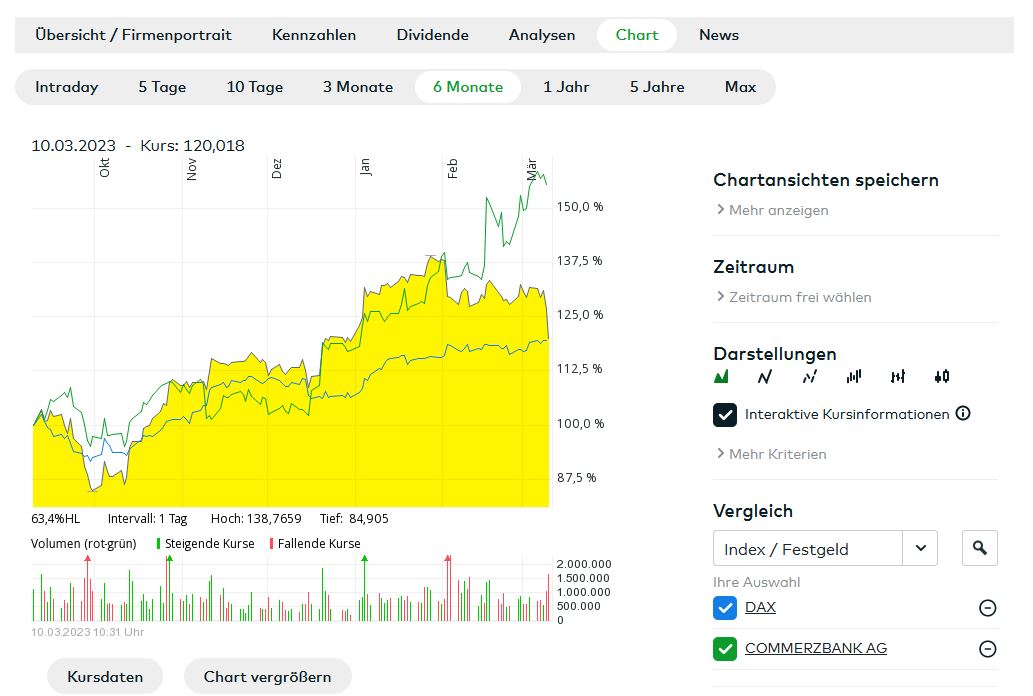
And indeed, historically one can observe that higher interest rate levels allow for higher spreads, both for banks and insurers. Subsequently, even low quality institutions like Deutsche Bank and Commerzbank saw decent rises in share prices, even significantly better than the respective indices:
The main problem: existing assets and liabilities
The main problem however with the “higher interest rates are good” for banks and insurance companies is the fact, that they cannot start from a clean sheet. Every financial institution has a starting Asset pool and liability structure. Increasing interest rates eat themselves through the financial system at a relatively slow but unstoppable pace and different mismatches will be revealed at different stages during that process.
Early victims: Liquidity mismatches
The earliest victims will get caught if the underestimate the liquidity of their liability side and are then forced to liquidate assets at (very) unfavorable prices.
First “Liquidity risk victim”: Uk Pension funds
Very early in the current interest rate cycle, we saw the first casualty: UK Pension funds, which used large amount of derivatives in order to extend their asset duration which in turn led to high collateral requirements and forced sales of liquid long term governemnt bonds which in turn pushed interest rates higher. Only a massive intervention from the Bank of England prevented that UK meltdown. In the case of the UK Pension funds, the potential liabilities of the derivatis were not adequatly matched with uncorrellated liquid assets which caused the systemic problem. Due to the instant collateral requirement, the problem surfaced very early in the crisis
Second “liquidity risk” victim: “Liquid real estate funds” Blackstone
Blackstone, the US PE giant had arount 70 bn USD in real estate funds that invested into illiquid real estate but offered investors to get their money back at regular intervals. As the prices for the funds still went up, some investors thought it might be better to get the money out which in turn required Blackstone to “gate” withdrawels. In this case, Blackrock had actualy the opportunity to stop withdrawals, which in the short term of course helps them a lot, but in the mid- to longterm will create some reputational issues with their investors.
Third “liquidity risk victim”: Silicon Valley Bank
In a situation that is currently developing, among other issues, Silicon Valley Bank thought that it was a good idea to invest a significant part of short term deposits into long term Mortgage Backed Securities (MBS).
This week it seems that its institutional depositor base seems to have became worried and satrt to ask for their deposits which in turn will require SVB to sell thes bonds at a loss and therefore deplete capital which could easily turn into a death spiral in a few days.
It will be interesting if and how the situation develops over the week end. My best guess would be that a few Silicon Valley VCs/Teck billionaires might step up and rescue SVB as the Bank is super important for the Silicon Valley ecosystem.
The market now will clearly try to identify and “hunt” banks that have similar mismatches. I could be very wrong, but I do think that most of the larger players, both in the US and Europe have managed their liquidity risks a lot better than SVB, but some smaller and more “innovative” players could be equally vulnerable.
Mid- to long term victims: Credit troubles – Example Commerzbank
However, liquidity risk is something that usually shows up at the early stages of an interest rate cycle. The other, much slower but at least equally big risk for any financial institution is credit risk. Higher interest rates mean higher expenses for borrowers. Over time, more and more highly leveraged borrowers will start to default. For banks, in principle this could be manageable, as the usually have collateral that they will seize and sell. But if the collateral is also negatively effected by rising interest rates (e.g. real estate), another death spiral could be created.
The credit cycle normally moves a lot slower than the initital liquidity cycle and to be clear, for the last 20 years or so there was actually not a “real” credit cycle. The first credit cycle, after the financial crisis was mostly mitigated through central bank intervention. The second potential cycle following Covid was neutralized via direct transfers from the Government. I think it is fair to assume certain interventions again this time, but it would be very optimistic to again assume no real credit cycle this times with high fefault rates over a couple of years.
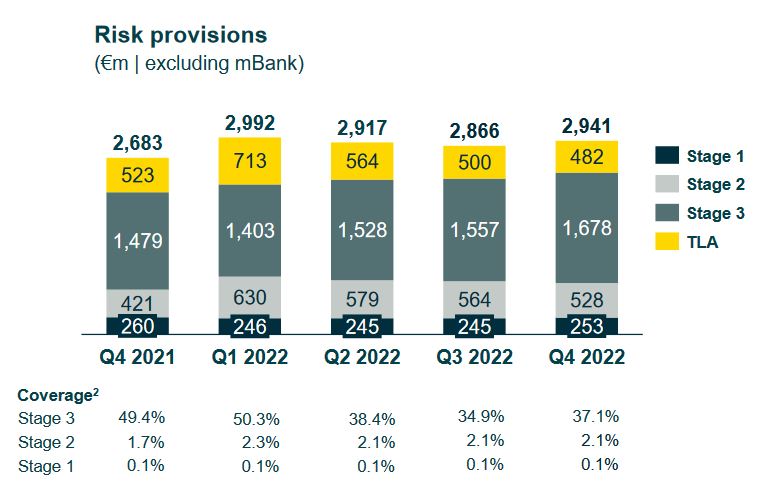
Interestingly, some banks seem to see this very differently and do not prepare themselves for a more harsh climate. Commerzbank for instance, who proudly reported “record results” for 2022 did not increase loss reserves very much in 2022 as shown in this slide from their investor presetnation and seem to cover their existing exposures at a lower level than at the end of 2021:
This clearly allowed them to increase compensation for Managwment significantly but I do think that there is significant potential for nasty surprises in the next few years. Commerzbank might be facing increasing write-offs in the very near future if more creditors get into trouble and therfore I find it very aggressive to actually lower the coverage of the existing exposure.
Interestingly the mortgage sector for them is not a concenr, as they write the following:
The automative sector however, who just recorded record profits, is mentioned as a risk sector. I am not saying that Commerzbank is the worst offender, but assuming that it can only go up for them from here due to higher interes rates is very naive. Maybe Commerzabnk can create one good more year if the credit cycle moves slowly or interest rates would go down quickly, but at some point in time they have to face reality.
So when looking for potential financial services companies to invest, one should look especially if and how and institution prepares for the coming necessary adjustments.
Summary:
In my opinion, we are currently in the early stages of a longer adjustment process that high interest rates will be “adequatly reflected” on the balance sheets and the P&L of financial companies. This adjustment process will very likely lead to significantly higher default rates than we have seen in the last 20 years which in turn is a big issue for every financial institution.
Those companies who had conservative balance sheets before this recent devlopment and prepare themselves with adequate provisions will have much better chances of being long term winners than those who do not.
One should be especially careful with companies that were already in troule before interest rates shot up so quickly (Credit Suisse for instance).



 value and opportunity