Category Archives: Bilanzanalyse

Some thoughts on High Interest Rates and Financial Services Companies (Silicon Valley Bank, Commerzbank)

For some time now, many market pundits were pushing the idea that Banks and Insurance companies would be basically “no brainer” investment as higher interest rates mean higher profits for these players.

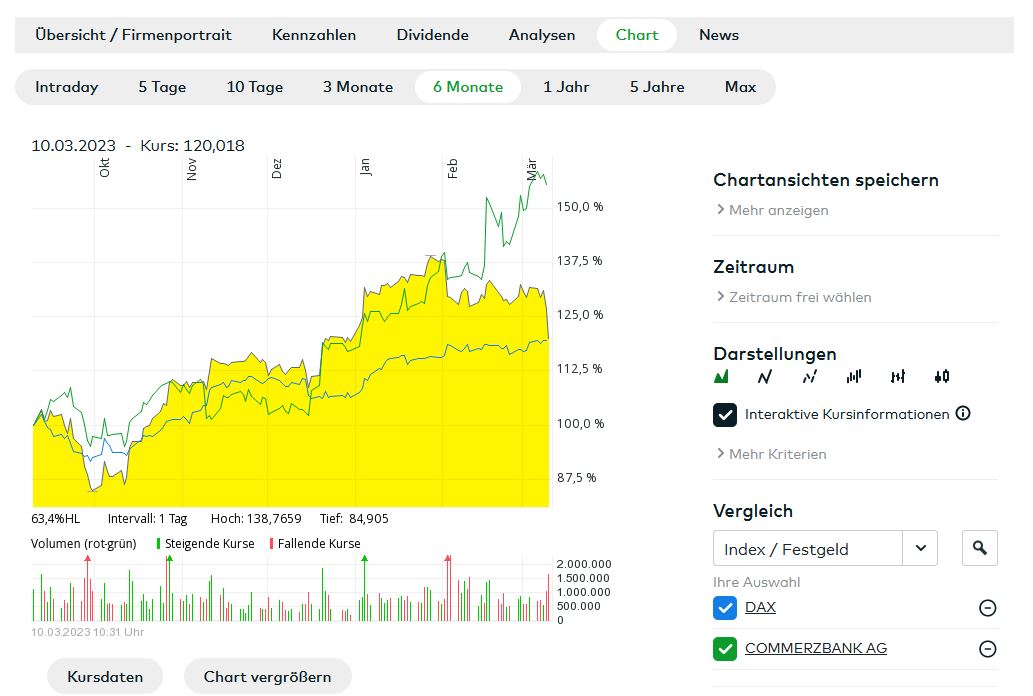
And indeed, historically one can observe that higher interest rate levels allow for higher spreads, both for banks and insurers. Subsequently, even low quality institutions like Deutsche Bank and Commerzbank saw decent rises in share prices, even significantly better than the respective indices:
The main problem: existing assets and liabilities

The main problem however with the “higher interest rates are good” for banks and insurance companies is the fact, that they cannot start from a clean sheet. Every financial institution has a starting Asset pool and liability structure. Increasing interest rates eat themselves through the financial system at a relatively slow but unstoppable pace and different mismatches will be revealed at different stages during that process.

Early victims: Liquidity mismatches

The earliest victims will get caught if the underestimate the liquidity of their liability side and are then forced to liquidate assets at (very) unfavorable prices.

First “Liquidity risk victim”: Uk Pension funds

Very early in the current interest rate cycle, we saw the first casualty: UK Pension funds, which used large amount of derivatives in order to extend their asset duration which in turn led to high collateral requirements and forced sales of liquid long term governemnt bonds which in turn pushed interest rates higher. Only a massive intervention from the Bank of England prevented that UK meltdown. In the case of the UK Pension funds, the potential liabilities of the derivatis were not adequatly matched with uncorrellated liquid assets which caused the systemic problem. Due to the instant collateral requirement, the problem surfaced very early in the crisis

Second “liquidity risk” victim: “Liquid real estate funds” Blackstone

Blackstone, the US PE giant had arount 70 bn USD in real estate funds that invested into illiquid real estate but offered investors to get their money back at regular intervals. As the prices for the funds still went up, some investors thought it might be better to get the money out which in turn required Blackstone to “gate” withdrawels. In this case, Blackrock had actualy the opportunity to stop withdrawals, which in the short term of course helps them a lot, but in the mid- to longterm will create some reputational issues with their investors.

Third “liquidity risk victim”: Silicon Valley Bank

In a situation that is currently developing, among other issues, Silicon Valley Bank thought that it was a good idea to invest a significant part of short term deposits into long term Mortgage Backed Securities (MBS).

This week it seems that its institutional depositor base seems to have became worried and satrt to ask for their deposits which in turn will require SVB to sell thes bonds at a loss and therefore deplete capital which could easily turn into a death spiral in a few days.

It will be interesting if and how the situation develops over the week end. My best guess would be that a few Silicon Valley VCs/Teck billionaires might step up and rescue SVB as the Bank is super important for the Silicon Valley ecosystem.

The market now will clearly try to identify and “hunt” banks that have similar mismatches. I could be very wrong, but I do think that most of the larger players, both in the US and Europe have managed their liquidity risks a lot better than SVB, but some smaller and more “innovative” players could be equally vulnerable.

Mid- to long term victims: Credit troubles – Example Commerzbank

However, liquidity risk is something that usually shows up at the early stages of an interest rate cycle. The other, much slower but at least equally big risk for any financial institution is credit risk. Higher interest rates mean higher expenses for borrowers. Over time, more and more highly leveraged borrowers will start to default. For banks, in principle this could be manageable, as the usually have collateral that they will seize and sell. But if the collateral is also negatively effected by rising interest rates (e.g. real estate), another death spiral could be created.

The credit cycle normally moves a lot slower than the initital liquidity cycle and to be clear, for the last 20 years or so there was actually not a “real” credit cycle. The first credit cycle, after the financial crisis was mostly mitigated through central bank intervention. The second potential cycle following Covid was neutralized via direct transfers from the Government. I think it is fair to assume certain interventions again this time, but it would be very optimistic to again assume no real credit cycle this times with high fefault rates over a couple of years.

Interestingly, some banks seem to see this very differently and do not prepare themselves for a more harsh climate. Commerzbank for instance, who proudly reported “record results” for 2022 did not increase loss reserves very much in 2022 as shown in this slide from their investor presetnation and seem to cover their existing exposures at a lower level than at the end of 2021:
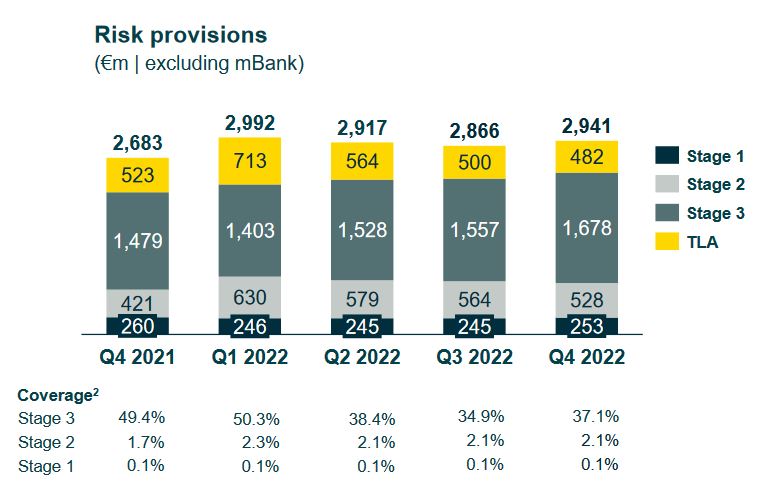
This clearly allowed them to increase compensation for Managwment significantly but I do think that there is significant potential for nasty surprises in the next few years. Commerzbank might be facing increasing write-offs in the very near future if more creditors get into trouble and therfore I find it very aggressive to actually lower the coverage of the existing exposure.

Interestingly the mortgage sector for them is not a concenr, as they write the following:

The automative sector however, who just recorded record profits, is mentioned as a risk sector. I am not saying that Commerzbank is the worst offender, but assuming that it can only go up for them from here due to higher interes rates is very naive. Maybe Commerzabnk can create one good more year if the credit cycle moves slowly or interest rates would go down quickly, but at some point in time they have to face reality.

So when looking for potential financial services companies to invest, one should look especially if and how and institution prepares for the coming necessary adjustments.

Summary:

In my opinion, we are currently in the early stages of a longer adjustment process that high interest rates will be “adequatly reflected” on the balance sheets and the P&L of financial companies. This adjustment process will very likely lead to significantly higher default rates than we have seen in the last 20 years which in turn is a big issue for every financial institution.

Those companies who had conservative balance sheets before this recent devlopment and prepare themselves with adequate provisions will have much better chances of being long term winners than those who do not.

One should be especially careful with companies that were already in troule before interest rates shot up so quickly (Credit Suisse for instance).

Be careful, stay safe !!!

SFS Group AG (ISIN CH0239229302) – Super boring but sexy “Hidden Champion” from Switzerland

Disclaimer: This is not investment advice. PLEASE DO YOUR OWN RESEARCH !!!!!!

Summary:

In my relentless effort to create the most boring and unremarkable stock portfolio imaginable, I think I identified an ideal  candidate with SFS Group from Switzerland.  Despite having a market cap of ~4 bn CHF, this majority family-owned company is not very well known and its products and B2B business model look similarily unremarkable.

The company doesn’t have an easily identifiable moat, doesn’t pay high dividends or buys back stock, is not super cheap and also not super profitable, doesn’t grow like crazy and doesn’t have sexy products that one can see in the supermarket.

Nevertheless I do think it is an great addtion to my portfolio as it is attractively priced and both, the business as well as the management are of high (Swiss) quality. Based on my own estimates, the stock trades at a PE of ~12x for 2023, despite having delivered EPS growth in EUR of around 15% p.a. since its IPO in 2014 and maintaing double digit EBIT margins across the cycle.

Read more

Reinsurance follow up: SCOR SE- Too cheap to ignore a P/E of 6x for 2023 ?

Disclaimer: This is not investment advice. PLEASE DO YOUR OWN RESEARCH !!!!

Background:

After looking at Hannover Re and Munich Re a few days ago, I decided to include also Swiss Re and Scor in my analysis. Unfortunately, for both of these players, the CAGRs for profit etc. are meaningless as they were making losses in 2022. However, especially for SCOR I found a few numbers very interesting:

Read more

DCC Plc (ISIN IE0002424939) – Extremely unsexy Business meets sexy Track Record at a super sexy Valuation

Disclaimer: This is not investment advice. PLEASE DO YOUR ON RESEARCH !!

As this post has become quite long, here is the Elevator pitch:

DCC Ltd, a 4,3 bn market cap UK listed, Ireland based company at a first look like a very boring, unremarkable collection of very boring distribution businesses. A second (or third) glance however, reveals a very stable , well managed distribution company that has been compounding EPS at double digit growth rates for the last 28 years and can be bought for a very modest valuation of ~10x earnings. The company clearly faces some challenges but this might be more than outweighed by very good capital allocation, company culture and growth opportunities.

  1. History

DCC has a very interesting history. It was founded actually as some kind of Venture Capital company in 1976 in Ireland and was led for 32 ears by founder Jim Flavin. After turning into an operating company, DCC went public in 1994. Over the years they acquired a lot of businesses, many of those where distribution businesses from oil majors but also in other areas such as health care and technology components.

What I find extremely impressive is their track record since they listed in 1994 and is available in each annual report:

Read more

Royal Unibrew (ISIN DK0060634707) – A High Quality Beverage Compounder at a reasonable price ?

Disclaimer: This is not investment advice. PLEASE DO YOUR OWN RESEARCH !!!!

The company:

Royal Unibrew logo

Royal Unibrew is a Danish Beverage company that I “discovered” during my journey through all Danish shares some weeks ago (too expensive back then but “watch”). I had also seen them some months ago in the Profitlich&Schmidlin portfolio.

The company is mostly active in Scandinavia and the Baltics where they have offerings in all areas (including a contribution agreement with Pepsi), whereas in some countries (France, Germany, Italy), they are running a focused niche strategy. Despite the name, Beer is only around 35% of their offerings (as of 2021), the other 65% are mostly non-alcoholic drinks from soft drinks to water and energy drinks.

Read more

Hypoport AG Part 1: : Great Business but experiencing a “Wile E. Coyote moment” ?

Background:

Hypoport logo

Hypoport has been one of the sore points in my investing history. I have been looking at this company several times, quite intensively in 2013 but never “pulled the trigger”. Hypoport has been a “FinTech” before this expression has been used. The business is not so easy to explain and comprises 4 different segments with several companies within these segments.

Recently, the share price of the company has been hammered after they gave a profit warning, despite having decreased already -75% from their peak before that profit warning. Time to look at Hypoport again.

Business:

  1. Loan platform “Europace”

This is clearly the flagship product of Hypoport although it doesn’t seem to be well understood or known. Europace is a B2B market place that gathers different mortgage offerings and combines these offerings combined with other useful tools to professional advisers who then actually make the deal with retail customers.

Read more

Knorr Bremse AG: German Mittelstand”Hidden Champion” with a few issues

Intro:

Knorr is a company I have been looking into now for some time. It is one of those “hidden Champions” that Germany is famous for. As I drive by their HQ on a regular basis, I decided to have a deeper look into them.

History:

Knorr logo

Knorr Bremse has a very interesting history. The company was founded in 1905 in Berlin and for a few years, BMW (in its original form) was actually a subsidiary of Knorr. In 1985, Karl Herrmann Thiele, who initially joined the company in 1969, took over the majority from the Knorr family and developed the company into a Global Player. The company is now headquartered in Munich and only went public for 80 EUR/share in October 2018.

Karl-Herrmann Thiele

Thiele died quite surprisingly in early 2021, the heirs still own around 59% of the shares via a foundation.

Read more

Admiral Plc – Deep Dive and Re-underwriting the Stock

Disclaimer: This is not investment advise but some rather incoherent ramblings of an extremely incompetent former value investor. DO YOUR OWN RESEARCH AND NEVER TRUST ANONYMOUS DUDES ON THE INTERNET!!

On “re-underwriting” an existing position

While writing part 1 of the UK Insurance update and even earlier, during the analysis of Naked Wines, I realized that my investment process has (among other issues) one serious gap: I have no systematic way to reassess or “re-underwrite” a position, especially for those who are in the portfolio for a longer time.

I do a short review every year in my “xx stocks for 20xx” series, but I do not seriously analyse my longer term holdings unless there is a problem.

In some cases that works well, but in other cases, I have been missing things or the case goes far away from the original case. Due to time constraints, doing this every year is not realistic, but going forward, I plan to do this on a 3 year rolling basis for each long term holding.

Review of my initial Admiral case

My original Admiral investment case was from 2014 and can be read here. The initial “underwritten business case” was as follows:

Read more

Naked Wines ($WINE) update – The Good, The Bad and the Ugly

Disclaimer: this s not investment advice. PLEASE DO YOUR OWN RESEARCH !!!

Naked Wines released their full earnings last week and the result was a full disaster with the share price down a whopping -43% despite the fact that the headline numbers were already known. It is a good reminder that even being down more than -60% from its top, a stock can still fall another -40% on one day. Although the stock was only a 2,9% position prior to that drop, it still warrants a deeper dive than usual.

The signs were already obvious

Before moving to the actual numbers and the report, I have to criticize myself for not acting on the stock despite the following issues that I had identified already some time ago:

Read more

Inflation vs. Pricing Power for Chemical companies & Nabaltec follow up (ADD)

Disclaimer: This is not investment advice. PLEASE DO YOUR OWN RESEARCH !!!!

Inflation & Pricing power

One of the obvious strategies for for investors in an inflationary environment is to pick companies that have “Pricing power”. Pricing power means that companies should be able to raise prices at least as quickly as costs rise.

Now one could try to do some deep thinking if and how different business models react to inflation. As I am a more “hands on” guy, my solution is to look at actual numbers and then try to draw my conclusion.

For any company that is producing material goods, the best indicator for pricing power in my opinion is Gross profit, i.e. the difference between selling price of a product minus the direct costs to produce them.

A company with pricing power should keep the gross margin or ideally even improve gross margins in an inflationary environment.

Read more

« Older Entries Recent Entries »