Category Archives: Fundamentalanalyse

Housekeeping: rejected, sold and forgotten

Some weeks ago, there was a very good post over at Barel Karsan. I think he hit exactly the right spot here:

Some time after you’ve purchased a stock, you probably have a pretty good idea as to whether you made a good decision or not. This is because you likely follow the stocks you have purchased fairly closely. This feedback mechanism allows you to fine-tune your stock purchase criteria so that you don’t make the same mistakes again. But often, some of the best lessons to be learned come from the stocks you didn’t buy, but considered buying!

I would even add to this, that one should also still try to follow the stocks one has sold in order to find out if the selling decision has added value or not.

So I built up two tracking lists. The first list consists of the stocks which were in the portfolio at one pint in time but sold. I want to track the relative perfomance of the stock and the benchmark since the sale.

Tracking list stocks sold

Stock Date Sale price Current Perf Perf BM Delta
Ensco 23.02.11 53.12 56.5 6.4% -5.0% -11.4%
Sysco 08.04.11 28.0 29.8 6.3% -6.7% -12.9%
Apogee 19.05.11 9.4 13.0 38.1% -7.3% -45.4%
ENI 13.07.11 15.7 17.6 12.3% -5.6% -17.9%
Tesco 15.07.11 403.0 314.1 -22.0% -4.5% 17.5%
Tsakos 20.07.11 9.3 6.6 -28.7% -4.8% 23.8%
DEGI International 09.08.11 27.8 29.8 7.4% 14.9% 7.5%
CS Euroreal 09.08.11 51.9 41.6 -19.8% 14.9% 34.7%
Axa Immoinvest 09.08.11 37.3 27.6 -26.0% 14.9% 40.9%
Pargesa 17.08.11 63.9 66.5 4.0% 12.8% 8.9%
Medtronic 17.08.11 32.2 38.1 18.4% 12.8% -5.6%
Beneton 17.08.11 4.6 4.6 -0.3% 12.8% 13.1%
Noble 17.08.11 31.64 39.1 23.5% 12.8% -10.7%
Bijou 31.08.11 63.5 70.6 11.1% 13.9% 2.8%
RWE 27.09.11 27.8 35.2 26.5% 19.2% -7.3%
Einhell 02.11.11 32.3 33.0 2.1% 14.2% 12.1%
Microsoft 09.12.11 25.1 32.0 27.4% 13.4% -14.0%
Frosta 03.01.12 16.7 18.0 7.7% 9.7% 1.9%
Westag 03.01.12 18.3 17.1 -6.7% 9.7% 16.3%
Magyar 24.02.12 2.0 1.9 -5.6% -0.3% 5.3%
KSB vz 15.02.12 439.9 435.9 -0.9% 0.9% 1.8%
Autostrada 06.03.12 6.3 5.9 -6.3% 3.4% 9.7%
             
Avg           4.7%

A negative delta means the stock has outperformed since I have sold it, positive delta means the benchamrk has performed better. On avarage one can see that the sell decisions added value, outperforming the benchmark based on this simple measure by ~4.7%.

Analysed but rejected stocks

Stock Date Sale price Current Perf Perf BM Delta
Ameron 10.03.11 69.8 85.0 21.8% -4.0% -25.8%
UPM 16.11.11 8.2 10.4 27.5% 14.8% -12.7%
Home Retail 30.08.11 122.5 104.1 -15.0% 17.1% 32.2%
Hewlett Packard 22.08.11 24.5 24.6 0.8% 21.5% 20.7%
Delta Lloyd 15.04.11 17.7 13.4 -24.3% -5.3% 19.0%
Esso SAF 06.12.11 63.4 75.5 19.1% 12.2% -6.9%
April 05.01.12 11.5 15.7 37.2% 11.5% -25.7%
Creston 03.02.12 49.8 60.0 20.6% 0.4% -20.2%
Nintendo 10.02.12 10830.0 11380.0 5.1% 1.8% -3.3%
Lingotes 24.02.12 3.0 3.0 0.0% -0.3% -0.3%
Colefax 08.03.12 223.0 223.0 0.0% 0.0% 0.0%
 
Avg           -2.1%

Here, the rejected stocks have performed on average better than the benchmark. Of course I can not say if they performed better than the portfolio, but it tells me that my “filtering” at least throws out interesting stocks even if I do not finally buy them.

In parallel I try to keep a record why I sold them and why I didn’t buy them, but in theory I can search in my blog as well. This is by the wy one of the really nice things about blogging.

Summary: I think it is a great exercise to look at “past” stocks and keep an eye on them. There might be the time when they become interesting again and “refreshing” old knowledge is much easier than starting from the beginning.

Colefax Plc – Quick valuation exercise

As promised in the post comparing Colefax and AS Creation, I wanted to have a quick look at Colefax from a valuation point of view.

Mean reversion pricing

One very simple check I am always doing is the following: I look over a period of 10+ years at the following numbers:

– average P/E
– average profit margin

I then multiply current sales times avarage profit margin times average P/E to get a “reversion to the mean” pricing. The same can be done for EBITDA Margins and EV/EBITDA.

For Colefax, this results in the following “mean reversion” price targets (1999-2010):

NI/P/E: 172 pence
EBITDA/EV: 245 pence

So no big upside here compared to the current price of ~220 pence. The main reason is that Colefax was always cheap. Average P/E over those 12 years was 7 and average EV/EBITDA (ex leases) was 3.4. As current margins are also close or slightly above averages, there is no “mean reversion potential” in the stock.

Free Cashflow valuation

If we look at the Cashflows of the last 5 Years (2007-2011) we see the following picture:

2011 2010 2009 2008 2007 Avg
Oper CF AT 6,200 4793 3596 4647 6209 5,089
Delta WC -455 306 725 -815 -427 -133
Normalised OCF 6,655 4,487 2,871 5,462 6,636 5,222
Investing cashflow -2885 -1716 -1729 -1448 -1648 -1,885
Free CF norm 3,770 2,771 1,142 4,014 4,988 3,337
             
Depreciation 2,044 1,883 1,795 1,690 1,629 1,808
Share buyback 1,840 137 895 465 3,093 1,286
Dividends 486 412 592 604 600 539

On average, Colefax generated around 3.3 mn GBP free cashflow. I think it is clear that we should not assume a lot of growth going forward, apart from some potential cyclical recoveries which might be offset by cyclical down turns.

If we look how the “intrinsic” value developes using different growth rates and discount rates we can use the following table:

8% 9% 10% 11% 12%
0% 2.97 2.64 2.37 2.16 1.98
1% 3.39 2.97 2.64 2.37 2.16
2% 3.96 3.39 2.97 2.64 2.37
3% 4.75 3.96 3.39 2.97 2.64

We would need to assume a 3% growth rate under my “standard” discount rate of 10% to get a decent margin of safety. On the other hand, the downside seems to be limited to a certain extent as well. For the time being I would hesitate to use a low discount rate because of the difficulty to explain the relatively high operating leases.

So let’s make a quick summary:

– assuming no nominal growth at all, Colefax seems to be fairly valued using the standard discount rate of 10%
– if for some reason one could assume growth or the operating lease issue would be clearer, the intrinsic value could be significantly higher
– very positive is the shareholder friendly use of free cashflwo with significant share buy backs and dividends

For now, I think the stock is no screaming buy but definitely something for the watch list. For a semi-cyclical, housing related stock like Colefax I would like to see more “reversion to the mean” potential than what we see at current levels.

Lingotes Especiales SA – comparable European Auto part suppliers

In my first post about Lingotes Especiales, the spanish auto parts producer, Chiru made a very valid comment:

Lingotes Especiales looks like a typical cyclical auto supplier to me. Such cyclical companies trade most of the time below book value. So I wouldn’t say they are extremely cheap. It’s rather a normal valuation given that there is some downside risk in the european auto market.

I tried to collect a sample of “traditional” European auto part suppliers with a market cap between 10-100 mn EUR. If we look at the table, we see that Chiru is right:

Short Name P/B P/E EV/EBITDA Div.Yield
         
ACE 0.89 17.46 4.0 4.4%
SCANDINAVIAN BRA 0.00 4.53 5.6 0.0%
MGI COUTIER 0.90 4.41 2.3 1.3%
FRAUENTHAL HOLDI 0.92 4.69 5.4 1.1%
MONTUPET 0.42 3.78 3.7 2.1%
LE BELIER 1.01 4.05 2.6 0.0%
GEVELOT SA 0.42 4.75 1.7 2.8%
DELFINGEN INDUST 0.53 142.27 4.6 2.6%
STREIT IND 1.58 3.57 0.9 0.0%
         
Avg 0.74   3.42 1.6%

One can clearly see thath especially the French companies look really really cheap.

On that basis, Lingotes (P/E 6, EV/EBITDA 3.0, P/B 0.9) looks kind of “average”. Only the current 8% dividend yield stands out.

So we identified one of the reasons why Lingotes is cheap: This is that ALL the smaller traditional autoparts companies are relatively cheap. This is important, as my initial thesis was that Lingotes is cheap because it is a Spanish company.

One could argue that Lingotes might need to trade higher than the Peer Group, as most of the peers had at least 2 loss years over the last 10 years, but at the end of the day one would need to make the industry analysis first. Intuitively I would also agree that there are cyclical risks to th car industry and if the big car producers suffer, the suppliers suffer even more.

As a result, Lingotes and the other cheap autt part suppliers will move some positions to the back of my research pile.

What’s you competitive advantage (in investing) ?

There is a very interesting post at the (higly recommended) Psy-Fi blog about the general chances of small investors against institutional investors.

They compare it for short term trading to the “Sanzibar war”:

In terms of competitive advantage private investors engaging in short-term trading against financial institutions is the greatest mismatch since the Anglo-Zanzibar War of 1896 which lasted only 45 minutes – and which ended with the British being paid for the shells they’d fired into their opponent’s country.

They also correctly mention privileged information from companies available for institutional investors:

We find significant increases in trade sizes during the hours when firms provide off-line access to investors, consistent with off-line access providing selective access advantages. We also find significant increases in trade sizes after the presentation when the CEO is present, consistent with CEO meetings providing selective access advantages. … Finally, we find significant future absolute abnormal returns after the conference for firms providing off-line access, suggesting such access is potentially profitable for investors. While we cannot conclusively state that managers are selectively disclosing new information outside of the presentation, our evidence does suggest that investor conferences confer a selective access advantage on the buy-side investors that have been invited to attend.

Additionally they think that private investors ar much less likely to exploit statistical anomalies:

The ability of the securities industry to automate trading to capture the abnormal returns from any anomaly in the market (Pricing Anomalies, Now You See Me, Now You Don’t) means that anyone attempting to out-compete them is facing the hopelessly overwhelming odds of the Zanzibar Effect and, like the hapless Zanzibarians, paying them for the privilege.

So should we just stop messing around with managing our own money and hand over our hard earned money to the institutions ?

Psi Fi offers some hope: They stress that small cap investing with a longer time horizon could be one way to beat the institutions:

Our competitive advantages are elsewhere; the Law of Big Numbers dictates that smaller companies simply aren’t big enough to justify lots of institutional analysis, so the asymmetric informational advantages often lie with private investors prepared to put in the effort. One reader noted that he invests in smaller French companies because the reporting language rules out a lot of competition. Nor are private investors constrained to make quarterly or annual returns – we can buy companies with good business models but which are temporarily distressed and wait. Or we can make sure we’re ready to supply liquidity to the markets when institutions are forced to give it up in one of their once a decade panics.

I fully support their arguments, but I think in addition to long term contrarian small cap investing , private investors have much more advantages than they are aware of.

1. Asset class restrictions

Most asset managers are restricted to certain asset classes. Many large institutions (pension funds, insurance companies) employ either consultants or own employees who are supposed to be great allocators acrosss asset classes, leaving actual money managers with very narrowly defined mandates for only small sub sets of the investment world.

Anyone with some institutional knowledge can tell some stories how the supposedly superior asset allocation process works: Money almost always goes into the historically best performingasset classes which is the dominant “cover your ass” strategy in this area.

As a private investor, you have a big advantage here : you are not restricted at all. You can look at stocks if they are cheap, or bonds if they seem to be a better choice. In 2008 for example, it was relatively clear that the risk/return of subordinated financial bonds were much better than owning stocks. However as a typical stock portfolio manager you were not allowed to buy bonds.

In my opinion, this is also one of the underappreciated competitive advantages of Warrent Buffet’s Berkshire set up. Despite the whole “moat” thing, his structure allows him for instance to go to “pref shares + options” type of trades as well a selling options, buying distressed debt etc.

2. Instrument restrictions

Many money managers are further restricted with regard to instruments they can buy. So either they can buy only stocks or only bonds or only convertible bonds, but few can freely decide what instrument tob uy.

The best current example for this are currently in my opinion the now closed former open ended German real estate funds. I do not know any institiutional mandate which would allow this kind of investment.

The German Insurance regulation for example explixitely does not allow insurance companies to invest in open ended funds which have stopped taking back shares, meaning that if you owned them before they have closed, Insurance companies were forced to sellt hem.

So being abletoinvest in any instrument as aprivate investor,in my opinion opens up a lotof very attractive risk / return scenarios.

3. Reputational risks

As I mentioned in point 1., a lot of the activities in institutional asset management is based on “cover your ass” strategies. For every portfolio manager it is much easier to talk to his bosses, clients or to attractive persons on cocktail parties about “great” companies one owns and manages. If thegreat company turns out to be a not so great investment, this gets attributed very rarely to the money manager.

It is much harder to explain why one owns subordinated bonds of banks under Government control, shares in now closed investment funds or “obscure” Italian companies, where everyone knows from “Bild” that Italy goes down the drain. Many people think that those “special situations” are much riskier than the “great and easy to explain” investments andthis is exactly why they are often much more interesting from a risk return point of view.

4. Size & Control of funds and liquidity premium

As an institutional money manager, one has the following two problems if one wants to exploit illiquidity premiums:

a) you do not control in and outflows of money. So if you think a relatively illiquid market segment is an interesting opportunity and you invest, suddenly the clients wants out and you have to liquidate your positions at great losses. So even if you have a long time horizon as an institutional money manager personally, your time horizon in reality might be much shorter. This is by the way the second “institutional” feature which is in my oninion very important to understand Warren Buffet’s success.

b) many times, size is an issue. Even with my “modest” 10mn EUR virtual portfolio, I find it hard to enter and exit into smaller but interesting situations. For a 1 billion portfolio, it just doesn’t make a lot of sense to research a potential 1mn EUR investment which leaves a lot of ideas unexplored.

So summarizing this whole post, I would conclude the following:

For individual investors, the freedom to invest in any asset class, in any type of instrument, regardless of name, country of domicile and size creates a significant competitive adavantage to institutional money managers.

Combined with the control of the funds and a long time horizon, in my opinion this is almost unbeatable by any traditional money manager. Only money managers who manage to overcome those limitations (Berkshire, Private Equity funds, Hedge funds, family offices) can come close.

IMPORTANT: It is not a guarantee to outperform. There are many bad investments, value traps, frauds and semi-frauds out there, but mostly they can be avoided through thorough due dilligence and common sense.

“Risk free” rates and discount rates for DCF models

In the discussion to the Piquadro valuation, I quickly mentioned that the concept of “risk free” rates is a difficult concept at the moment.

Let’s have a quick look at the “academical” world:

CAPM

If we look at the CAPM (no matter if one beliefs this or not) we can see that the risk free rate of return plays an important role there. First, it is the basis return on needs to achieve with any investment, secondly it also influences the equity risk premium.

Risk free rate of return

The definition of the risk free rate itself is quite “fishy”. Investopedia for example states:

Investopedia explains ‘Risk-Free Rate Of Return’
In theory, the risk-free rate is the minimum return an investor expects for any investment because he or she will not accept additional risk unless the potential rate of return is greater than the risk-free rate.

In practice, however, the risk-free rate does not exist because even the safest investments carry a very small amount of risk. Thus, the interest rate on a three-month U.S. Treasury bill is often used as the risk-free rate.

This is of course not really applicable for any serious long term investor. Damodaran has a nice paper about “risk free rates” here.

His major points are as follows:

The first is that there can be no default risk. Essentially, this rules out any security issued by a private firm, since even the largest and safest firms have some measure of default risk. The only securities that have a chance of being risk free are government securities, not because governments are better run than corporations, but because they control the printing of currency. At least in nominal terms, they should be able to fulfill their promises. Even this assumption, straightforward though it might seem, does not always hold up, especially when governments refuse to honor claims made by previous regimes and when they borrow in currencies other than their own.

So this is important: No default risk !!! So it is wrong for instance to use current yields of Italian Govies for valueing Italian stocks, as considerable default risk is embedded in current spreads. The “country” risk could/should be embedded into the equity risk premium, not into the risk free rate. A hypothetical Italian company with 100% of its business in Germany for example, should only get a very small country risk charge if any.

A second point is the following:

There is a second condition that riskless securities need to fulfill that is often forgotten. For an investment to have an actual return equal to its expected return, there can be no reinvestment risk.

In theory, one should discount annual cash flows with the respective annual risk free rates. With a flat yield curve, this is not so important but for steep yield curves the differences can be significant. However in practice Damodaran recommends using the duration of the cash flows of the analysed investment as proxy for the risk free rate. As the best proxy if we don’t want to do this, he recommends the 10 year rate.

For the EUR, he recommends specifically the following:

Since none of these governments technically control the Euro money supply, there is some default risk in all of them. However, the market clearly sees more default risk in the Greek and Portuguese government bonds than it does in the German and French issues. To get a riskfree rate in Euros, we use the lowest of the 10-year government Euro bond rates as the riskfree rate; in October 2008, the German 10-year Euro bond rate of 3.81% would then have been the riskfree rate.

With regards to currencies he says this:

Summarizing, the risk free rate used to come up with expected returns should be measured consistently with the cash flows are measured. Thus, if cash flows are estimated in nominal US dollar terms, the risk free rate will be the US Treasury bond rate. This will remain the case, whether the company being analyzed is a Brazilian, Indian or Russian company. While this may seem illogical, given the higher risk in these countries, the riskfree rate is not the vehicle for conveying concerns about this risk. This also implies that it is not where a project or firm is domiciled that determines the choice of a risk free rate, but the currency in which the cash flows on the project or firm are estimated.

The most common mistake with currencies is usually to use current exchange rates for future cashflows which then results in a preference for projects in countires wiht high nomnal rates.

About Inflation, he is not really clear in my opinion. He argues basically, inflation does not matter because we get the same result if we use yields of inlfation linked bonds combined with inflation adjusted growth rates.

Especially the current situation, where we see negative real yields in many markets, one could argue about his appoach. A negative real yield means for an investor, that the “risk free” nominal asset would have a guaranteed loss in real purchasing power over the investement horizon.

Consider for instance the UK: 10 year gilts run at 2.158% yield, this would be the proxy for the risk free rate. Current inflation runs at 5%, UK 10 year implied inflation from inflation linked bonds is around 3%.

So if I would use the 10 year gilt as proxy as the risk free rate, I woul dalready accept a loss of -1% p.a. in real terms p.a. or almost -3% p.a. based on current inflation rates.

I think this topic might justify even a doctorate thesis, but in my opinion, one could go the following pragamatic way:

Proxy for risk free rate: Higher of 10 year risk free Govie Yield in currency or inflation ).

So in the case of the risk free rate for an Italian company I would compare:

a) 10 year risk free EUR rate = 10 year bunds = 1.89%
b) Inflation: Currently =3.4%

I would the use the higher of the two rates, 3.4 %. This would be a pragmatic way to avoid unnecessary country risk premium and still make sure, the risk free rate does not imply a guaranteed loss in real terms.

Piquadro SpA – Competitors, market analysis and strategies

Normally it is quite difficult for a private investor to get hold of comprehensive market information. One could try to google and try to collect some articles, but “hard data” is usually only available if you pay.

However, many listed companies include some market and competitor info in their analyst presentations. Piquadro provides us with a nice graphic of competitors in its 2011 April Analyst presentation:
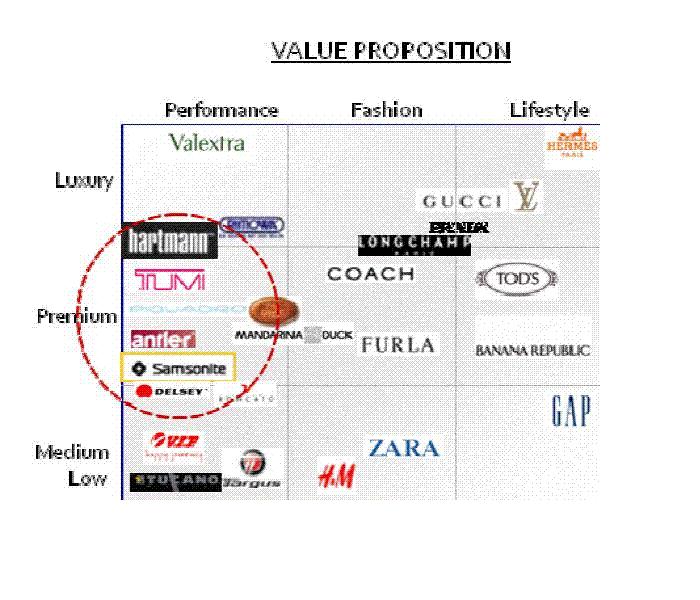
Interestingly, in it’s own presentation one can see that the “Premium / Performance” segment is also the most crowded one.

An even better source for market data are IPO filings. In an IPO prospectus, companies usually provide a lot more information than in annual reports, as they have to persuade new investors that this is a exciting market.

Luckily, competitor Samsonite actually was IPOed last year on the Hongkong stock exhange after filing bancruptcy in 2009 (and also in 2002 if I remember correctly). The Samsonite story also shows the biggest risk for those companies: Overexpansion and too much lease liabilites, in this case driven by a Private Equity owner.

Tumi, currently owned by PE firm Doughty Hanson is currently on the path to an IPO and has already filed its documents for an IPO. To make things more interesting, Samsonite already anounced its interest purchasing TUMI.

So we have to additional sources for market information in this case.

For Mandarina Duck, the other major competitor from the Piquadro Matrix, currently no financial information is available. It seems to be owned by a PE shop as well.

Let’s start with the “Competitor” section of the TUMI IPO prospectus:

Competition

We have a variety of competitors in the categories and geographic regions in which we operate. We believe that all of our products are in similar positions with respect to the number of competitors they face and the level of competition within each product category. Depending on the product category involved, we compete on the basis of a combination of design, quality, function, price point, distribution and brand positioning.

Our biggest global competitor in the travel goods category is Rimowa, a German company. We also compete with Samsonite in Europe, the Middle East, Africa and Asia-Pacific. In the premium luggage and business cases category, we compete with Bally, Dunhill, Ferragamo, Gucci, Louis Vuitton, Montblanc, Porsche and Prada. In the business case category, we also compete with smaller brands in specific markets. In the U.S., our main competitors are Victorinox and Briggs and Riley. In Europe, the Middle East and Africa, our key competitors are Mandarina Duck and Piquadro. In the Asia-Pacific region, competition is fragmented. In Japan, our two key competitors are Porter and Ace Brand. We also compete with Coach across the luggage, business cases and accessories categories.

We believe that our primary competitive advantages are favorable consumer recognition of our brand amongst our targeted demographic, consumer loyalty, product development expertise and widespread presence in premium venues through our multi-channel distribution. We may face new competitors and increased competition from existing competitors as we expand into new markets and increase our presence in existing markets.

So again, we do not see any “hard” moats but rather some fuzzy brand recognition and customer loyalty aspects.

Even more interesting is the very detailed IPO prospectus of Samsonite. This is a “treasue trove” of interesting market data.

The “1 million dollar quote” however can be found at page 95:

Barriers to Entry and Benefits of Scale and Leadership in the Luggage Market
Barriers to entry into the luggage market are generally low, which has contributed to the fragmented nature of the industry. Key challenges for an entrant or an existing company are investment in brand awarness, innovation in new products, access to quality producers, and developement of an effective national / local retail network.

So here the “market leader” tells us there are no barriers to entry. So no “moats”. Period.

The Industry overview section of the filing is really interesting and comprehensive (p-90).

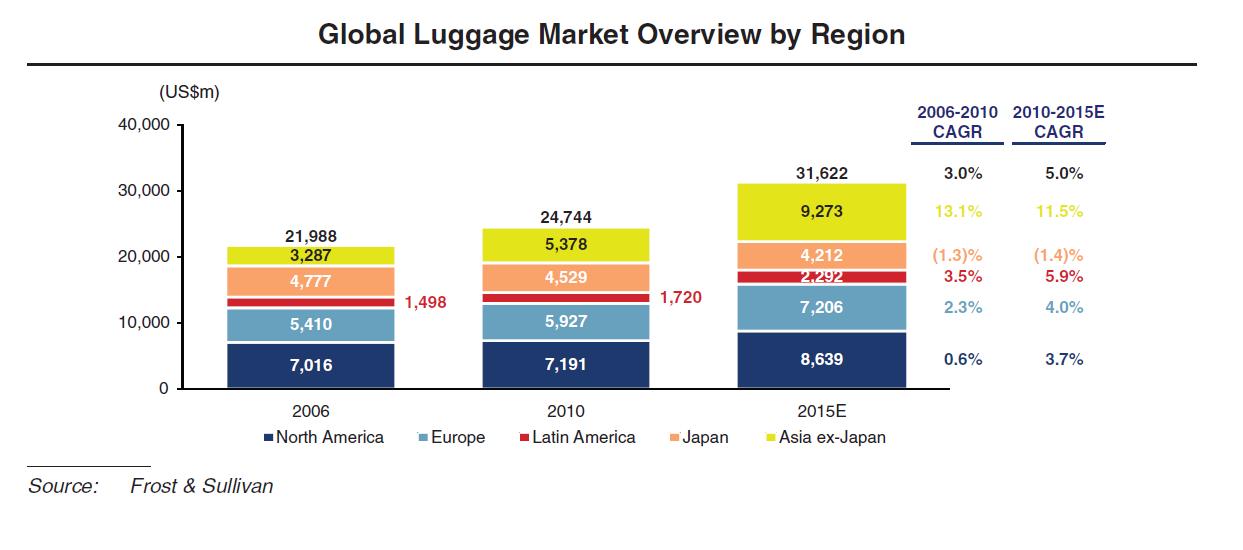
The market itself is supposed to grow at quite an attractive overall rate:
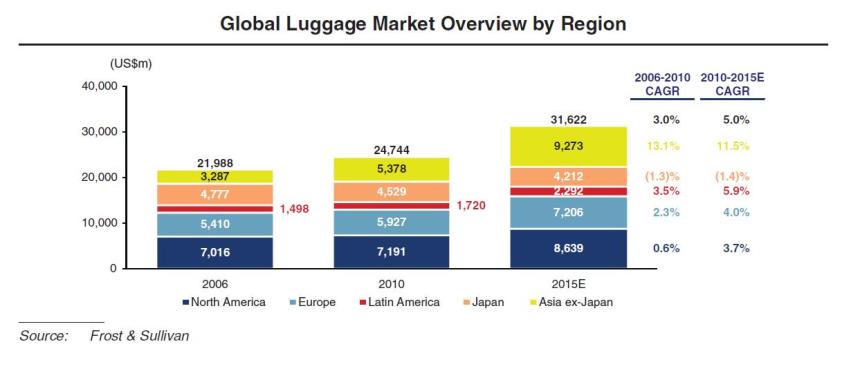
Samsonite itself does not yet realise Piquadro as competitor, neither Mandarina Duck. Piquadro and Mandarina Duck are only mentioned among others which are shown having a combined market share of 74.5%.

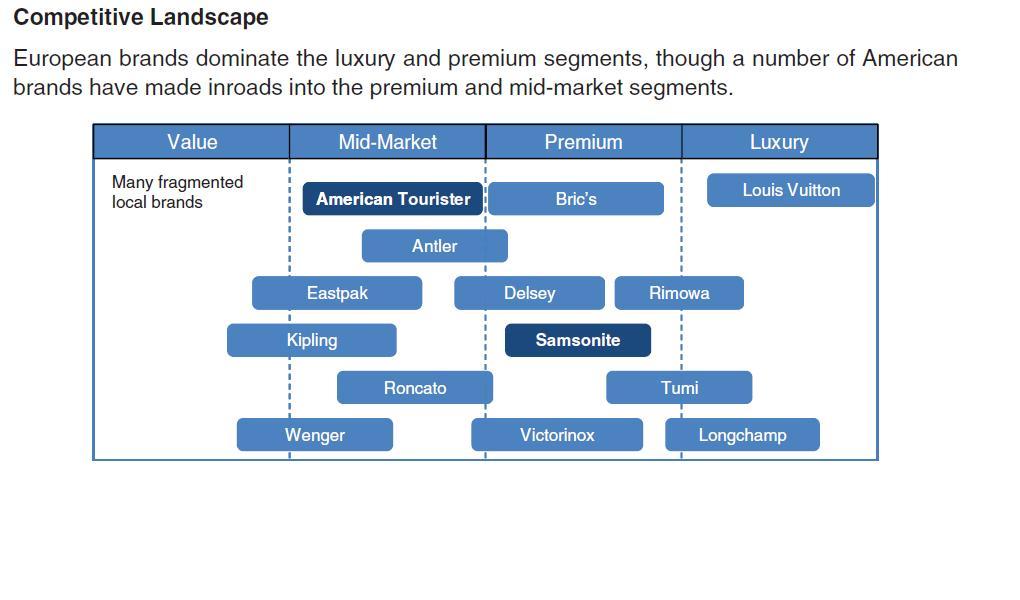
Howver, Samsonite places itself directly into the “Premium” category in contrast to Piquadro and Tumi themselves:
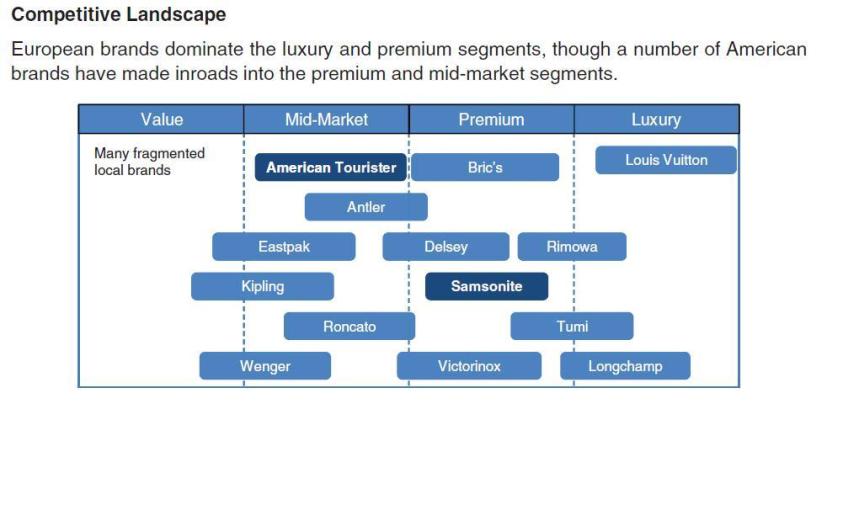
Side remark: Anyone who had the problem at an Airport baggage claim to find out which of the 25 identical black Samsonites is the own bag knows that this is more “mass market” than anything else.

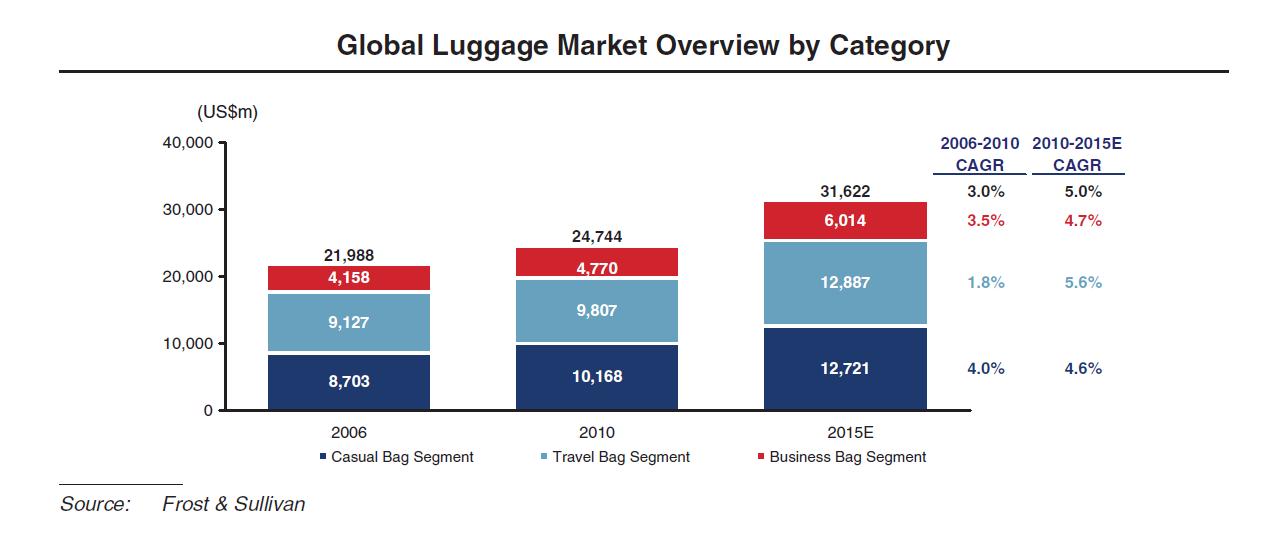
The luggage market according to Samsonite can be segmented into 3 product segments:
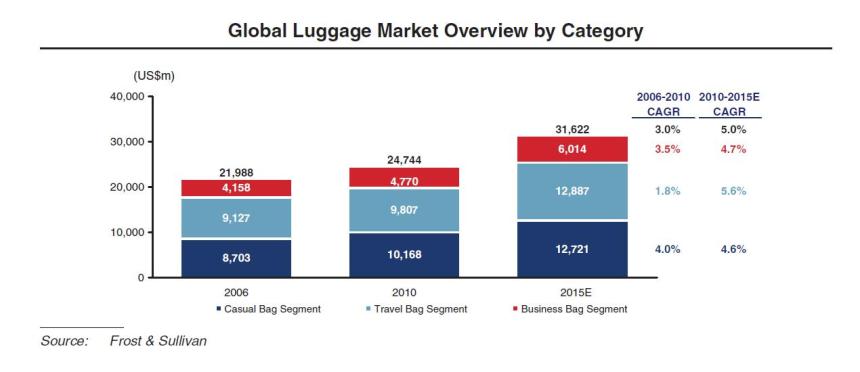
Samsonite also has an interesting “market share” slide for Europe which shows the high fragmentation:
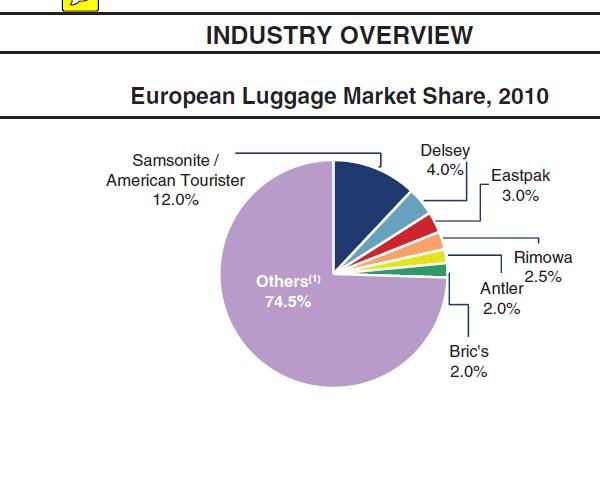
So the big question is now: Should I stop now with analysing Piquadro because there is definitely no “objective” moat ? I would say, no, because for some reason, Piquadro has been able to grow, maintain high margins and produce free cashflow. When we continue to evaluate the company we should however incorporate a certain “normalisation” of returns anad margins.

Also the whole market segment seems to be quite attractive as even in “good old Europe” some nice growth is expected in the coming years as indicated before which can be incorporated int he valueation to a certain extent..

Strategy

Tumi has a very interesting passage in its IPO filing regarding marketing:

We do not employ traditional advertising channels, and if we fail to adequately market our brand through product introductions and other means of promotion, our business could be adversely affected.
In 2010, we spent approximately 3% of our net sales on advertising and promotion expenses. Our marketing strategy depends on our ability to promote our brand’s message by using store window campaigns, product placements in editorial sections, social media to promote new product introductions in a cost effective manner and the use of catalog mailings. We do not employ traditional advertising channels such as newspapers, magazines, billboards, television and radio. If our marketing efforts are not successful at attracting new consumers and increasing purchasing frequency by our existing consumers, there may be no cost-effective marketing channels available to us for the promotion of our brand. If we increase our spending on advertising, or initiate spending on traditional advertising, our expenses will rise, and our advertising efforts may not be successful. In addition, if we are unable to successfully and cost-effectively employ advertising channels to promote our brand to new consumers and new markets, our growth strategy may be adversely affected.

Interestingly, the “Market leader” Samsonite spent almost 9% of revenues on marketing in 2010(see IPO fact sheet), Piquadro around 5%.

Samsonite focuses basically to almost 100% on the wholesale sales channel, Tumi has reached a 50/50 split between wholesale and single brand stores.

Very interisting is the fact, that Piquadro just hired a seasoned TUMI executive for international brand expansion.

Peer Group comparison

Let’s just make a quick comparison with regard to profitability. As one could expect for PE owned companies, both TUMI and Samsonite show quite a messy capital structure and “real profits” don’t really exist. So let’s work with what they call “adjusted” EBITDA (Samsonite & Tumi in USD, Pqiadro in EUR):

Samsonite TUMI Piquadro
Sales 1,215.0 252.8 61.8
Total assets 1,665.0 321.0 29.6
NWC 372.0 80.2 16.1
EBITDA adj 191.9 40.6 16.4
       
EBITDA/Sales 15.8% 16.1% 26.5%
EBITDA/Assets 11.5% 12.6% 55.4%
NWC/Sales 30.6% 31.7% 26.1%

This is really interesting. Piquadro is the most efficient and most profitable company of this “Peer group” based on “simple” metrics.

Summary: A quick view into the market and competitors show the following:
– the market is quite fragmented, no real barriers to entry exist and therefore no “classical” moats
– nevertheless all companies seem to be able to generate at least currently some decent returns on assets
– Picadro itself seems to be the most efficient of the 3 companies. It is therefore likely that no strong “economies of scale” exist in this market

I will follow up with a valuation approach in the next days.

Petroplus bankruptcy – sign of weakness or strength ?

Today, a big European oil refiner, Petroplus, filed for bankruptcy. This was not really unexpected.

Instead of analyzing if the bonds are an interesting investment (the Distressed Debt investing blog has a great post) I wanted to quickly focus on possible secondary consequences.

Zero Hedge in its typical style states the following:

What is scary is that instead of finding a resolution, banks decided to accelerate and seek to control the underlying assets, in what continues to confirm that all of Europe is desperately battling a wholesale collateral crunch, and banks will do anything to procure any viable assets, even send the obligor in bankruptcy court.

Out of my own experience, I would conclude the exact opposite. For me, this is rather one of the first signs that banks are not in the “extend and pretend” mode anymore, which means they just extend loans in order pretend that everything is fine.

Putting a company into bankruptcy in the first step locks up a lot of capital in the underlying assets (much more than in a bad but performing loan). Capital charges for a direct stake in a refinary or a non performing loan in bankruptcy are much higher than for any performing loan.

So the decision to let Petroplus go into bancruptcy is for me actually a sign of strength for the participating banks which is the first step in really cleaning up corporate loan books.

I am not yet “ready” to really analyse bank equity, but apart from all the headline noise, the underlying fundamentals seem to shift in favour of the banks.

Kabel Deutschland – How relevant is negative net equity combined with a lot of debt for a “wide moat” business ?

Background: Kabel Deutschland is one of the short positions of the portfolio and currently the only one which didn’t work out yet…

In one of the blog posts, reader Stairway commented with an interesting analysis.

I hope it is fair to summarize the argument as follows:
Read more

« Older Entries Recent Entries »