Category Archives: Value Stocks

Why comprehensive income matters – Dart Group Plc

I have mentioned a couple of times that in my opinion, the so-called “comprehensive income” is a much better indicator for shareholder wealth created than net income or earnings per share.

In my experience, almost no one cares to look at what happens after the net income line. Usually, comprehensive income is stated on a separate page anyway.

A good example to turn this into an interesting practical exercise is the most recent preliminary annual report from Dart Group, one of my Portfolio holdings

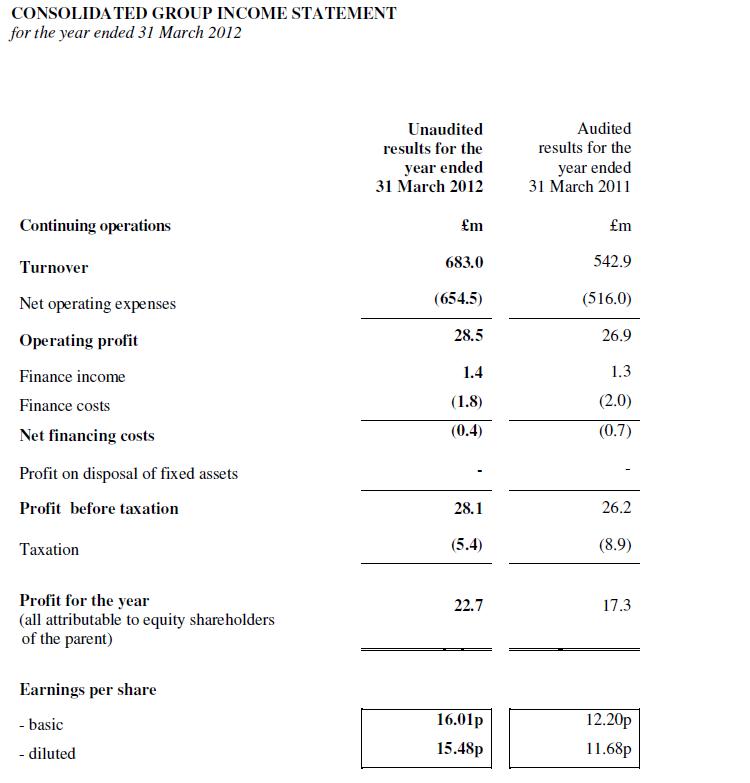
The first thought is of course “Yippie yeah”, a really significant earnings increase, P&E of 4 etc etc.

Richard Beddard at the excellent Interactive Investor blog even says the following:

The highest earnings yield ever calculated by the Human Screen is 35%. It’s so high, he’s wondering if air line and road-haulier Dart has bust his value yard-stick.

Highlights

Adjusted operating profit up 9%
Adjusted return on tangible assets: 4%
Net profit of £23m compared to net cash flow of £95m (£48m after net capital expenditure)
Net cash after approximate capitalised lease obligations of £125m is £34m, 5% of tangible assets
Per-share dividend up 7%

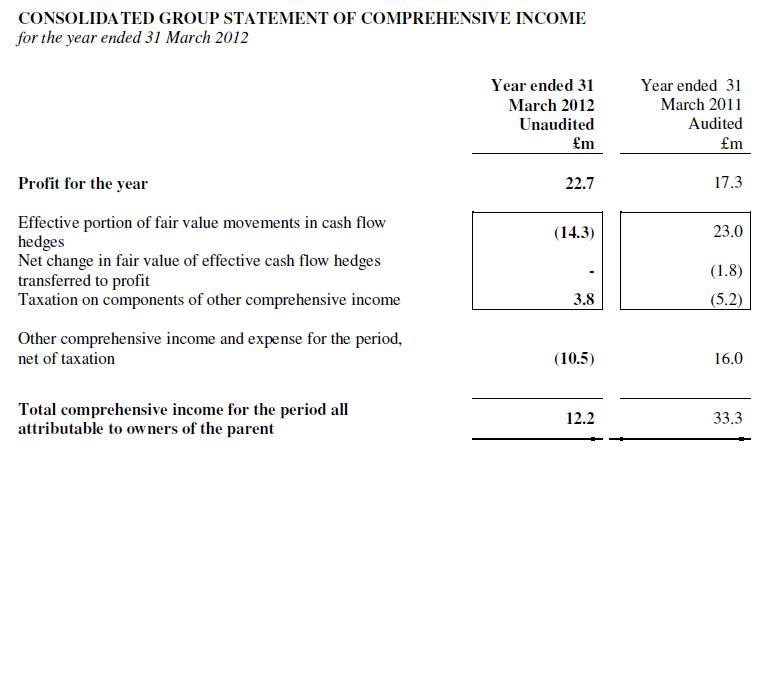
Not so fast. I guess that Richard stopped at page 9 of the interim report and didn’t bother to read that strange stuff at page 10 which looks as follows:

So we have additional items which significantly decreased shareholders equity but didn’t need to be recorded in normal earnings but comprehensive income. In this case we are looking at fuel hedges.

Items which can be recorded in comprehensive income are:

– Unrealized holding gains and losses on available for sale securities ( a trick often used by banks and other financials)

– Effective portion of gain or loss on derivative instruments (cash-flow hedge);

– Foreign currency translation adjustments (i.e. change in value of a foreign subsidiaries net asset value)

– Minimum pension liability adjustments.

Normally people would argue that those items are “non operating” and therefore not or less relevant. However, as it affects shareholder value, in my opinion it is very important to look at those item to determine real value creation for the shareholder.

Coming back to Dart Group: The fuel hedging is an essential part of the business model. Fuel costs are around 20% of sales and cannot be passed directly too customers, especially for the prepaid part. I will have a separate post on how to interpret the fuel hedges but for now the important point is:

The result of the fuel hedges should be treated as part of the normal business of Dart Group.

Therefore real 2011/2012 earnings for Dart are rather around 9 pence per share and not the 16 pence recorded in the income statement. Still cheap (PE of 9) but not “busting any value yardstick”.

Summary:

Any value investor interested in the total value creation of a company for shareholders should include all items of the comprehensive income statement into his valuation. Many companies are very good in shifting all unpleasant stuff into this section. Especially for financial companies, recorded earnings are more or less meaningless without the items in comprehensive income. Also fuel hedges for airlines or other fuel cost eexposed companies should be viewed as relevant.

Catching up: Praktiker, Aire KGaA, Tonnelerie, Fortum

Time to catch up on my portfolio shares…

Praktiker:

As announced, I sold out the Praktiker bonds right after the annula shareholder meeting. Including accrued interest, I realised 43.65%, a small gain against the initial (“dirty”) Price of 41.62%.

I will do a more detailed “post mortem” analysis later as I think that Praktiker implies some important lessons for senior bond investors.

AIRE KGaA

The AIRE KGaA tender offer was finally settled on July 17th for EUR 18.25. Cash quota for the portfolio is now above 20%.

Just right now, the bidder again increased the offer to 19.75 EUR per share

They really seem to want to delist the company. The nice thing about the offer is the fact that the increase applies also to those who have tendered the shares at 18.25 EUR !!! Thank you !

Tonnelerie

Tonnelerie issued a rather vague but positive outlook for the next year. s they ussually don’t do this at all, this might be the reason behind the recent positive stock price developement.

Fortum

Fortum issued relatively weak half year interim results. The stock price since then dropped by more than 20% bellow the 2009 lows. Buying opportunity or value trap ? Somthing I have to analyse further. However it is clear that my initial investment thesis (higher oil prices, higher energy prices, higher profit) didn’t really work out. Same for EVN and OMV.

WMF AG catalyst – lessons learned: Good idea but weak execution

Now the expected catalyst at WMF has happened:

Current majority share holder Capvis sells as exected. The only surprise in my opnion is that the buyer is KKR, another (and maybe the most famous) PE investor:

KKR pays 47 EUR per ordenary share (+25% premium), but only the 3 month average of ~32 EUR for the pref shares-

So with my pref shares, I earned some money but lost out on the take over premium. And this although reader JM recommended the switch already in February.

So despite being a quite good deal for the portfolio (~+40%), the switch would have made a great dea out of this (+80%).

So hopefully lessons learned: Only the ordinary stocks will be enjoying the take over premium, not necessarily the pref shares.

For the time being, I will keep the pref shares to see if KKR changes it mind at some time. If they want to take the compeny private, they need also to buy the prefs…..

Portfolio updates: AIRE KGaA, April SA, Cranswick, Dart, Installux

AIRE KGaA:

For AIRE KGaA, I decided to accept the tender offer at 18.25 EUR per share. There is not a lot of upside left and I guess the stock will be really illiquid after the offer.

Installux

Whereas the built up of Poujoulat goes really really slow, For some reasons, last Friday almost 2.500 Shares have been traded. That’s almost 1% of the market cap. Interstingly, in Bloomber a new fund called “Agicam” showed up at the end of April with a 0.99% position. Due to those sales, I could now already built up a stake of 1.8% of the portfolio in Installux shares, a lot faster than I thought.

DJE Real Estate

The sell down of this position is quite cumbersome. Up to know, I could only sell half of the position so far. However prices are relatively stable.

Dart Group & Cranswick

Both shares were relatively active over the past few days, so I could establish 2.5% positions fopr both. Dart Group issued their “preliminary annual” statement as of MArch 31st, a very good write up can be found here at ExepctingValue.

For Dart I will wait for the final annual report in order to determine if I increase the position to the full amount (5%).

April SA

Since I ahve increased my buying limit for April to 11,50 EUR, I could establish a small position in the stock (0.6% of the portfolio). Of course I got punished and bought ~2% higher than today’s share price……

Cash is now down to around 16.5% of the portfolio, but taking into account the AIRE Tender Offer, Cash is around 21.5% of the portfolio. So plenty of room for 2-3 new ideas…..

Italian updates – Piquadro, Sol Spa, Emak

Reporting season in Italy. Among my portfolio and watch list, several companies issued relevant material.

Piquadro:

Piquadro had a sort of “trading update” which for some reason cannot be found on the homepage but for instance here.

Although sales went up 4.3%, Profits declined from 9.1 mn to 7.8 mn (0.18 EUR per share to 0.156 EUR per share). And they are cutting the dividend from 0.10 EUR per share to 0.06 EUR.

Based on my initial valuation, Piquadro is still within the base case (20% EBITDA margin). So for the time being no action, but a reminder to check the annual report how non-Italien sales and own shops performed against the other segment.

Sol Spa

Watchlist stock Sol Spa has issued two interesting pieces of information. First of all, they were able to place a 12 year private placement bond at 4.75% in USD. With 12 year USD swap rates at around 2%, this represents a credit spread of around 2.75%. This is around 1.5% lower than Italy has to pay for the same duration. So we clearly see that a well managed Italian corporate can finance cheaper than the Italian Government !!!

Secondly, they have issued an investor presentation which shows that for some unkown reasons they are also investing in Hydro Power in Slovenia and Macedonia. I am not sure how this fits into the corporate strAtegy, but it explains part of the increase in Capex.

Q1 results are a mixed bag. Increasing sales but a reduction in margins. Capex still high as the aggressively move into Eastern Europe (Bulgaria, Albania).

Difficult stock. Still on watch.

EMAK

Emak had issued Q1 numbers already a couple of weeks ago. Interestingly again the acquired companies dare doing relatively well. Based on the first quarter, Emac could earn around 0.08 EUR per share which would result in a 2012 P/E of around 6.

Cranswick Plc (ISIN GB0002318888) – Business model and valuation

After the first post on Cranswick Plc, as promised some more thoughts about the business model and valuation.

Business model – peer company Frosta

As mentioned, Cranswick operates mostly in the private label market. Frosta AG a company I owned when I started the blog is a relatively similar company. They are also food producers (however frozen food and fish instead of “chilled” food and poork) and most of their sales are private label products for supermarkets.

Let’s look at a quick comparison table focusing on net margin, ROE and debt/assets for both companies:

Cranswick Cranswick Cranswick Frosta Frosta Frosta
  NI Margin ROE Debt/Assets NI Margin ROE Debt/Assets
31.12.2002 5.3% 22.0% 6.2% 0.8% 5.9% 31.9%
31.12.2003 4.7% 19.3% 12.6% -2.9% -23.4% 36.3%
31.12.2004 5.1% 20.1% 39.2% 2.9% 18.7% 26.1%
30.12.2005 5.2% 22.2% 35.7% 3.1% 14.3% 30.8%
29.12.2006 4.4% 18.2% 30.4% 3.4% 15.6% 30.9%
31.12.2007 4.6% 17.6% 31.6% 3.5% 16.2% 35.0%
31.12.2008 3.1% 11.8% 27.1% 3.1% 14.4% 37.6%
31.12.2009 4.4% 18.1% 17.7% 2.9% 13.2% 36.1%
31.12.2010 4.7% 17.0% 15.2% 2.5% 10.0% 30.1%
30.12.2011 4.6% 16.1% 11.0% 2.3% 8.4% 27.2%
 
Avg 4.6% 18.2% 22.7% 2.2% 9.3% 32.2%

One can easily see that Cranswick earns twice the margins and ROEs of Frosta. Additionally they are employing on average a lot less financial debt than Frosta.

So what are the reasons for this discrepancy ?

One thing which distiguishes many good companies from mediocre companies is capital management. The less capital a company needs, the better is not only the return on capital (and equity) but also the net margin.

So let’s have a quick look at how those to companies compare with regard to Asset (and capital usage)

First Frosta AG:

Frosta      
  2010 2009 2008 2007
Sales 392.6 411.3 391.8 348.7
NI 9.8 12 12.1 12.2
NI in % 2.50% 2.92% 3.09% 3.50%
         
Inventory 56.5 61 70.9 57.7
Receivables 68.2 67 68.9 62.9
Trade liabil- -40.6 -27.7 -44 -34.3
         
Net WC 84.1 100.3 95.8 86.3
In % of sales 21.42% 24.39% 24.45% 24.75%
         
PPE 77.9 78.9 84.5 71.8
in % of sales 19.84% 19.18% 21.57% 20.59%
Goodwill 1.2 1.1 2.2 1
         
Net WC+ PPE in % of sales 41.26% 43.57% 46.02% 45.34%
         
Net WC +PPE+GW in % of sales 41.57% 43.84% 46.58% 45.63%

I have concentrated on Working capital and fixed assets only. Frosta needs ~24% of sales in net working capital. Besides inventory, receivables are always much higher than payables which means that Frosta basically finances the supermarkets as they are not able to mirror their payment terms with their suppliers.

Fixed assets account for another 20% of sales on average, Frosta does not show any Goodwill as they haven’t made any acquisitions in the past.

So how does Cranswick look compared to this ?

Cranswick      
  2010/2011 2009/2010 2009 2008
Sales 758.3 740.3 606 559
NI 35.3 32.5 19.9 25.7
NI in % 4.66% 4.39% 3.28% 4.60%
         
Inventory 35.7 36 28.5 30.6
Receivables 78.7 84.1 73.7 77.3
Trade liabil- -84.9 -86.7 -75.2 -73
         
Net WC 29.5 33.4 27 34.9
In % of sales 3.89% 4.51% 4.46% 6.24%
         
PPE 123.3 106.1 91.7 92.7
in % of sales 16.26% 14.33% 15.13% 16.58%
Goodwill 127.8 128.7 117.8 117.8
         
Net WC+ PPE in % of sales 20.15% 18.84% 19.59% 22.83%
         
Net WC +PPE+GW in % of sales 37.00% 36.23% 39.03% 43.90%

The short answer is: Much much better !!!

Especially working capital management seems to be extremely efficient. They can basically finance their receivables out of payables and inventory is on average only 5% of sales compared to 15% at Frosta.

Also fixed assets are around 5% less compared to sales than at Frosta, however Goodwill adds to assets which have to be financed.

The interesting fact about this asset usage is also the impact on the P&L. More fixed assets mean higher depreciations charges and maintenance capex. Goodwill on the other hand doesn’t require depreciation nor a lot of maintenance capex.

When we compare the two companies, Cranswick showed around 1.8% of sales in depreciation over the last 4 years against 3.0% at Frosta. If we assume equal tax rate, this alone explains the difference in net income margins over the last 4 years !!!!

A second smaller effect where capital management influences net margins is the cost of interest. Currently interest rates are low, but nevertheless, Frosta had 0.2% higher interest cost compared to sales over the last 4 year on average. Especially for instance in 2010, where Forsta’s NI margin was 2.5% against 4.6% for Cranswick, the difference in interest expense (-0.7. ) and the difference in depriciation charges (-1.5%) fully explain the difference in profitablity.

Why is Cranswick managing capital so much better than Frosta ?

As we all know (now), competitive advantages are almost always local. If we look at Cranswick’s business locations, one can clearly see the regional concentration:

Most of theiz facilities are concentrated in and around the Yorkshire area. Due to their overall size one can assume that Cranswick has a dominating position in this local area with the local suppliers. Their suppliers are most likely several hundreds or thousands of pig farmers. Another aspect of this is that for a British farmer it is much more difficult to export living pigs to Europe for instance. I highly doubt that the Eurostar transports live pigs so you have to involve ships in the transport route which makes it much harder to transport the pigs than for instance driving them form Poland to Germany. If you just want to export just the meat, you will have to go to a Cranswick facility first……

In terms of payyments, it is most likely easier to negotiate “back to back” pamant terms than for Frosta which has to buy its suplies from fish markets or b2b traders etc. So this leaves Cranswick with a significant amount of negotiation power with its suppliers.

Another advantage of the regional concentration is of course inventory management. The longest distance between any of their sites is 250 kilometers, a distance which could be covered back and forth most likely within a day. With such short supply routes it is much easier to run “just in time” production than if you get your supplies from thousands of miles away by ships.

This was for instance also the problem of another company I used to own but sold, Einhell AG. They are sourcing most of their supplies in Asia but have to pay before the merchandise even gets shipped from China. Due to the relatively long time of ship travel, they have to finance 6-9 months of supplies upfront and then they have to wait another few weeks to get their money from the DIY stores.

Cranswick, on the other hand seems to have a quite powerfull local position, being able to pass through the payment terms of the supermarkets to the pif farmers, leaving it only with a relatively small amount of “just in time” invesntory to finance.

I am not sure how easy this is to copy, but it protects them at least also to a certain amount against cheaper imports.

Valuation:

As mentioned in the first part, the value in Cranswick doesn’t is not in its asset base or any mean reversion phantasy. It lies in a consistent business developement with stable and high ROEs.

If Cranswick would manage to deliver 20% ROE going forward, my Boss modell would indicate a fair value of around 2.000 Pence per share or an upside of 160%. If we assume going forward 15% ROE, Cranswick would still be a double with an Intrinsic value of ~1.550 pence per share. I think this is definetely possible over a time period of 3-5 years without any P/E expansion.

Risks

Of course, as any company, the busienss of Cranswick is subject to a lot of risks.

As Tobias mentioned in the comments, among them are:

Hygienic risks

This can kill food companies. One of the most recent examples is Mueller Brot in Germany. However at least in Germany, this is usually a developement over years. Normally, the authorities give many warnings before they really take actions. Of course in the interent age, this can go much quicker. But this is not only an issue for Cranswick, but for all food and beverage companies incl. the “Star” companies like Coca Cola and Danone as well (anyone remembering the Perrier scandal ?).

Customer power

The custumors of Cranswick are of course extremely powerfull, with a few names dominating the client list. But again, this is an issue for many food producers and other consumer product producers have, as retail is consolidating more and more. The loss of one client can harm the business significantly.

On the other hand, I highly doubt that any of the supermarkets can come up from scratch with such an efficient organization like Cranswick. As we have seen, they do not calculate crazy margins into their products but they are really great capital managers.

Subsitution

Of course, Pork products can be substituted through different meats. As we have seen, in the downturn, Cranswick has profited from substitution, so chances are high that in an upturn they will suffer from the tendency to buy more expensive products. It will be interesting to see how successfull they are with their other ventures, such as dried ham, olives, meat pastries etc. This should lower the risk of substitution to a certain extent.

Imports

If for some reason, for instance the EUR would depreciate strongly against the GBP, EU imports would be a lot cheaper than locally produced pork. Although I assume there is “sticky” demand for British pork, this could impact Cranswick’s margins to a certain extent. On the other hand this might be a good hedge against Dart Group’s off setting EUR exposure !! Howver Cranswick has proved that it can maintain margins in the past and I do not see any reason why this should suddenly change.

Summary:

Although Cranswick is no “cheapie”, I do think that Cranswick has some local competitive advantages which allow them an extremely efficient capital management and corresponding high returns on equity. As they have proved to maintain this through out the cycle, I will add a half position (2.5% of the portfolio) of Cransdwick Plc Shares to my portfolio.

The current valuation looks attractive enough, any take-over or recap upside is basically “for free”.

After the 2011/2012 report in July I will then decide if I double up to a full stake.

“Boss score” harvest part 1: Dart Group Plc (ISIN GB00B1722W11)

After having introduced the “Boss Score” in a series of posts, I have now build up a database of around 1000+ companies. o it’s time to look at results !!!

As I am looking for some UK exposure to add to the portfolio, I concentrate on UK companies first.

One of the best scores is achieved by a company called Dart Group Plc, a UK company which operates

1) a budget airline (Jet2)

2) a tour operator

3) a distribution / ground transport company (Fowler Welch)

The great thing about about potential UK value small caps is the fact that you find many great blog posts among the excellent UK based value logs about Dart Group.

So please read the following post on Dart Group at:

Kelpie Capital (very good blog by the way)
Expecting Value
Interactive Investor
Value Stock inquisition
Valuhunteruk

I would try to summarize the pros and cons for the company out of the blogs as follows:

+ cheap, asset rich company with a conservative (and improving) balance sheet
+ entrepreneurial management, founder holds 40% of company
+ competitive and regionally focused business model, profits from demise of competitors
+ business is growing

– unloved airline sector
– low margin business, exposed to oil price and consumer behaviour
– low dividend payout

Let’s have a quick look at the traditional valuation indicators of Dart Group at the current price of 0.67 GBP:

P/E: 4.7
P/B: 0.6
P/S: 0.1
Div. Yield 2%
Market Cap 97 mn GBP
Debt/Assets 2%
EV/EBITDA 0.02 (!!!!)

EV/EBITDA is tricky for Dart Group. Dart group has a lot of cash on its balance sheet but a lot of that cash is “restricted”. In one of the blogs someone said it is restricted because of the deferred income on prepaid airline tickets.

If we look into the 2010/2011 annual report, it says however the following:

16. Money market deposits and cash and cash equivalents
2011 2010
£m £m
Money market deposits (maturity more than three months after the balance sheet date) 8.5 —
Cash at bank and in hand 98.3 52.2
Included within cash is £81.1m (2010: £38.1m) of cash paid over to various counterparts as collateral against
relevant risk exposures.
These balances are considered to be restricted and collateral is returned either on the
maturity of the exposure or if the exposure reduces prior to this date.

This is something to be explored further, but I assume this has to do more with fuel hedging than prepaid airline tickets.

Historical volatility

Dart Group is a prime example how the Boss Score works in practice. Let’s look quickly at historical EPS vs. historical “comprehensive income”

EPS BV p. Share Dvd p.sh CI p. SH
2000   0.22    
2001 0.046 0.25 1.67 0.047
2002 0.036 0.27 1.70 0.038
2003 0.056 0.33 1.70 0.071
2004 0.037 0.36 1.75 0.054
2005 0.052 0.43 1.93 0.083
2006 -0.013 0.42 2.16 0.015
2007 0.062 0.53 2.31 0.132
2008 0.193 0.66 0.72 0.142
2009 0.111 0.82 1.19 0.168
2010 0.122 1.04 0.83 0.233
         
Total 0.70     0.98

We can see 2 important points here:

A) The comprehensive income over this 10 year period is significantly higher than the stated EPS (by almost a third !!)

B) the volatility of the comprehensive income is much lower than stated EPS, even in the loss year 2006, total comprehensive income was positive

Why is that ? The answer is relatively simple: Fuel hedges !!!!

In the annual report they state the following:

Aviation fuel price risk
The Group’s policy is to forward cover future fuel requirements up to 100% and up to three years in advance. The magnitude of the aviation fuel swaps
held is given in note 22 to the Consolidated financial statements. As at 31 March 2011 the Group had substantially hedged its forecasted fuel requirements for the 2011/12 year and a proportion of its requirements for the subsequent two years in line with the Board’s policy

So what happens is the following: If fuel prices move up like in 2010/2011, margins go down, because the cost increases. However an off setting effect takes place in Dart’s balance sheet because the hedges increase in value and increase equity. The effect is not perfectly correlated as they are hedging partly future years as well but nevertheless, on a combined basis, the total P&L is a lot less volatile than if one just looks at EPS.

Banks for example do exactly the opposite. A bank will always try everything to smooth earnings but to book everything unpleasant into comprehensive income.

If we look at the corresponding P&L lines we can clearly see the effect:

Fuel costs increased significantly from 95 mn GBP or 23.1% of total cost in 2009/2010 to 128 mn GBP or 23.8% of total cost in 2010/2011. Gains from hedging in 2010/2011 were 23 mn GBP. If we just deduct this gain from fuel costs, we would end up at 105 mn fuel cost or 20.3%. As they have mentioned before, they have “overhedged” for one period, but in general I would say that Dart’s results including the hedges are a lot less volatile than simple EPS would indicate.

Chart, relative strength and momentum
A comparison with the FTSE all share shows at least, that the stock doesn’t have a real negative momentum.

Compared to Halford’s, which is still in its free fall phase, the stock looks surprisingly strong

Also relative performance with the last 6 months or so is neutral or positive:

REL_5D REL_1M REL_3M REL_6M REL_1YR
dtg ln equity 1.2% -6.1% -0.3% 1.2% -16.8%

Current developements

In april 2012, Dart issued a cautious trading statement saying:

The Group continues to develop and grow its business base across its operations, although in the current challenging trading environment, limited profit growth is expected in the current financial year.

Based on the current valuation one might think that the market expects a significant profit drop, so for me that is actually good news.

Management / Founder

Philipp Meeson is a 63 year old trained RAF pilot

The CEO seems to be very hands on but also sometimes quite rude to his employees like this article from 2009 shows:

Philip Meeson, boss of budget airline Jet2.com, was warned by police after flying into a rage at his own staff after becoming annoyed at the length of time it was taking them to deal with a long queue of passengers.

Officers had to be called as the airline’s chief executive berated check-in workers during an early morning ‘spot-check’ visit to Manchester airport.
Police had to warn the millionaire about his conduct and behaviour after he used a string of four-letter words – even though his outburst was applauded by many of the 200 passengers.

Could be that clients like him better than employees….

A nice quote from the same article is that one:

But it’s not the first time Mr Meeson has attracted controversy.
Three years ago he condemned strike action by French air traffic controllers by writing an article on his company’s website which called for “lazy frogs to get back to work”.

Shareholders

Founder Philip Meeson holds around 39.6% of the shares, followed by Schroders (according to Bloomberg either 25% or 22%), Jo Hambro with 6.3% and Norges Bank with 3%.

For some strange reasons, no real “value shop” is invested, which might be a good thing after all after having read Nate’s blog post about shareholder structure at Oddball.

Interestingly, Bill Ackman form Pershing seems to have established a new position of ~0.4%, whereas Standard Life seems to have sold down more than 1% in the last few months.

EDIT: Bill Ackman was nonsense. I mixed upPershing Llc with Ackman’s Pershing Square.

Business model

There is an interesting discussion about the business model to be found here.

In essence within the airline business, their main competitive advantages seem to be

– regional focus (not fighting on the crowded London market)
– buying cheaper used airplanes for cash instead of leasing new ones (used aircraft buying seems to be one of the special abilities of the CEO..)
– higher flexibility due to ownership and contracts with Royal Mail
– differentiation with slightly better services as a “family budget” airline

I am not able to judge how this holds against Ryanair and Easyjet going forward, but so far the strategy seems to have worked OK and better than many of the smaller competitors.

Valuation

A few simple thoughts about valuation:

Dart Group will never be a P/E 15 company, but it could easily be a P/B 1 company. At the moment, you get a company which increases shareholder equity by something close to 20% p.a. at 0.6 times equity. If we assume for instance they manage to generate 15% ROE in the next 3 years and the company would trade at book at that time, we would have a fair value of 1.7 GBP per share or an upside of 150% over 3 years. More than enough for me.

Summary

After reading all the blogs and going through annual reports, the company grew on me. In the beginning I thought: Airlines – keep away. But the more I looked at the company the better I liked it.

The reason why its cheap is relatively clear, no one likes airlines, especially when fuel prices are increasing. On the other hand I think the market is exaggerating the implied volatility and is not giving credit to the hedging program, which I think is one of the “hidden stories” of the stock.

So to summarize the stock I would pick out the following aspects:

+ stock is really cheap and unloved and in an extremely tough sector (so no “feel good” value investment)
+ company is led and owned by an entrepreneurial founder which has proven that he can grow the business ( no “cigar butt” either)
+ underlying returns on equity are really good despite asset intensity and low margins

I will add Dart Group with a limit of 0.7 GBP to the portfolio as a “half position” (2.5%) under the usual rules (max 25% of daily VWAP). After the final 2011/2012 numbers in July I wull then decide if I increase it to a full position.
April SA and the momentum issue

I have written a couple of posts about April SA. In the last post, i decided the following:

At current prices (EUR 14,60 per share) and based on the underlying business developement, the risk/return profile is not attractive enough.

Now the stock price is close to last year’s lows and we certainly don’t see a lot of positve momentum:

After the reading of O’Shaughnessy’s book, momentum is such an important factor, that one should keep way from a falling stock. On the other hand I am quite sure that the business of April is worth much more than the current 10,80 EUR quoted on the stock exchange.

So should I wait until the stock gets more expensive and buy then ? This sounds still very counterintuitive for me. O’S strategy relies on not analyzing the companies but “data mine” for factors to produce historical outperformance.

Does a active value investor really have to wait until the stock gets more expensive before on invests ? I would agree for distressed or turn around companies. But in other cases this “negative momentum” might even create investment opportunities

By the way, April issued a relatively positive trading update for Q1 2012 and a comprehensive presentation in English for the 2011 results and the strategy.

As I really like April’s business model, I will ignore momentum and starting to build a position in APril from today. I will start with 1% and then increase in increments.

Edit: For some strange reason, the stock jumped immeadiately after my posting almost 9%

My limit was 11 EUR, so I did not get any shares and will wait for the time being.

EVN AG – Cheap stock and good news

In an interview, Steve Romick from FPA said something like” You can have either good news or cheap stocks”.

In the case of “core value” stock EVN AG it seems you can have both.

In the half year report issued today, they report significantly higher profits (1.16 EUR per share against 1.04 EUR previous period).

And this despite only so-so numbers from electricity generation.

The “kicker” comes from one of the famous “extra assets” EVN is hiding on its balance sheet, a company called “RAG”, short for “Rohölaufsuchungsgesellschaft”. This Austrian “on shore” oil upstream company seems to do quite well:

The main reason for this improvement was the increased income from investments in equity accounted investees, in
particular the higher earnings contribution from RAG, which rose by EUR 21.0m.

It looks like my valuation in my previous (German) replacement value analysis was much too conservative.

In the last few years, Q3 and Q4 for EVN were :

2008: -0.04 EUR per share
2009: +0.52 EUR
2010: -0.05 EUR
2011: +0.015 EUR

So if we assume a flat H2, we have a P/E of 8.3 which I find is still cheap compared to the quality of the Balance sheet.

Additionally they announced a 1 mn shares repurchase program (~0.55% of outstanding stock). Not much, but increases the total “shareholder yield” which we know now from O’S seems to be an important factor in the long run.

The stock chart doesn’t look pretty, but in this case I don’t care too much as the fundamentals are still strong:

All in all, EVN seems to be the cheap boring stock, howver with good news. So “strong hold” for the time being.

By the way, I think Verbund is now interesting as well. So I am actually considering adding some Verbund stocks to the portfolio as well.

Quick news: WMF, Walmart, Praktiker

WMF

According to a Boersenzeitung article, for some reason WMF is considering exchanging the Pref shares into ordinary shares (full article can be found in the W:O Thread)

I do not really understand how Capvis could profit from an exchange, unless they already have bought a lot of Pref shares. Then it would be a good deal for them.

Interestingly, the Pref shares now more or less are back to the level of the regular shares.

Maybe time to sell on good news ? Q1 numbers seem to have been really good. For the time being: no action.

Walmart

Walmart issued unexpected positive Q1 numbers today. Here I will definitely ue the momentum and sell the shares at today’s VWAP.

For some reason I do not believe in the US recovery story, at least not for “physical” retailers. Even if Warren is still buying…..It was never a “high conviction” play anyway, although it made good money.

Praktiker

Praktiker seems to have found an U Hedgefund for its “secured” loan, US Hedgefund Acnhorage. Although it is too early to assess, the downside scenario for the bonds would now be of course more severe, however the proabality of a deafult is lower. No action yet.

« Older Entries Recent Entries »