Some more thoughts on generic drug companies / EGIS & Krka

A few days ago, I introduced EGIS as one of my new positions (part 1, part 2).

At that point in time I did not spend so much time on the generic drug business in general. However I think its makes a lot of sense to look at this a little bit more closely as it seems to be quite interesting. As this collection is mostly a reminder to myself, I will start with a summary and then have the details afterwards:

Summary:
The generic drug secor seems to be in a secular tailwind which might explain the nice margins for the sector as a whole. I personally do not believe fully in the “common knowledge” that company size is key, as the large players look less profitable. Finally, the market in Russia, EGIS biggest single market, seems to be a great opportunity although the risks are clearly there as well.

General business model generics:

The general business model for generic drug companies is in theory quite simple: You have to copy expired patented drugs as quickly as possible and then try to sell them either as

a) the cheapest alternative
b) as a “generic brand”

So in order to be succesful, one has either to be a trusted brand (see all the Ratiopharm adverts in Germany) or the cheapest one. As we all now, advertising has significant effects of scale, so for a small player to become a trusted brand is quite difficult. Low cost in contrast is in theory easier to achieve as a smaller player. As generic companies have to produce a lot of different products, I would assume that it is possible to become cost efficient in some drugs if one concentrates on those which have maybe a similar prodcution process.

Clearly, distribution plays a role as well. A generic drug company has to get into pharmacies. Usually, large pharmaceutical wholesalers (Celesio etc.) try to control that part of the supply chain. A big Generic company may have advantages here as well.

Interestingly, at least some of the big players do not have better margins than EGIS. Teva for instance has on average around 13% NI margin and 11% ROCE vs. EGIS 11.9% net margin and 12% ROCE for the last 15 years. So at least in hard numbers the size advantage does not look so significant. Maybe big players like Teva are not so interested in small markets like Serbia, Bulgaria and Romania ? Also some of the big US players (Actavis) are a lot less profitable than the smaller players.

Additionally, I think many people greatly mistake size and competitive advantage. Size can be a competitive advantage in some cases, but often, “diseconomics” of scale dominate, especially in companies which are the results of frequent mergers. This leaves a lot of room for smaller, more agile players to gain ground.

A further difference in business models is the fact, that some generic companies actually produce the so-called Active pharmaceutical Ingredients (API) themselves like for instance EGIS. other, like Stada buy them and only “mix” the drugs. Maybe this is the reason why Stada scores so badly both in margins and ROCE against EGIS ?

“Pay for delay”
An even more interesting business model has developed for some generic companies in the last years, the so-called “pay for delay” market. Here, R&D pharamaceuticals pay directly to Generics companies to delay their start of production and distribution. This almost seems to good to be true: You get paid for doing nothing. As often, things which are too good to be true will go away quickly. In this case, both in the US and Europe courts have already indicated that they consider this practice as illegal to a large extent.

Secular tailwind

The generic drug business has a strong secular tailwind. Medical costs skyrocket in most countries. One of the “quick fixes” for Governments is to make life easier for generics and harder for patented drugs in order to drive down costs for drugs.

Clearly, in many countries also Generic drug makers suffer, such as in EGIS home market Hungary. However, I think they can adapt better than “research companies” who need to invest a lot more into the development of new drugs.

All in all, it is better to invest into a sector with secular tailwinds than in a distressed sector.

Special Case Russia

Russia is currently the biggest single market for EGIS and the main driver for growth. The major driver here seems to be a Government led program established in 2009 to increase the supply of medication to Russian people significantly until 2020. Part of that program is also to increase the percentage of domestically manufactured drugs. So it might make some sense for EGIS to find a local partner or m&A target. Nevertheless, this will of course be risky. Stada for instance tried to take over Russia’s Pharmstandard, but ultimately failed to do so.

“Biosimilar” generics
This seems to be a big “buzz word” in generics at the moment. Biotech drugs cannot be as easily copied as “normal” drugs. Generics companies will have to invest a lot more money and effort into producing socalled “biosimilar” drugs. EGIS has already ligned up a deal with a Korean Biotech company, but as far as I understand it is only a distribution deal. Clearly an area to watch.

Krka (ISIN SI0031102120)- Slovenian Generics company

Krka is another Eastern European generic company based in Slovenia. It is nominally more expensive than EGIS, but it is more profitable as well. It might even be a “special situatioN” as the Slovenian Government which currently control the company, might be forced to sell their stake.

More to come on Krka….

Interesting Interview with the EGIS CFO 2 years ago:

Click to access Finance-EE-02-2011-PharmaInterview.pdf

When the business cycle goes down, public budgets go into the red and governments need to cut spending. This significantly affects the health sector as a major area of public spending. Thus, through the reimbursement system, a macro-economic crisis hits the pharmaceutical business usually with a delay of approximately two years.

Finally a big link dump from where I have compiled my “knowledge” above:

http://www.bostonglobe.com/business/2013/06/17/supreme-court-rules-pay-delay-generic-drug-deals-can-illegal/hACmkw0e8i00KLmJn90cSN/story.html

Click to access newport-deals.pdf

http://www.alvogen.com/Company/Strategy2016/
http://gabi-journal.net/the-generic-pharmaceutical-industry-moving-beyond-incremental-innovation-towards-re-innovation.html
http://www.economist.com/node/14742621
http://www.reuters.com/article/2011/12/21/us-actavis-generic-drugs-idUSTRE7BK1BQ20111221
http://www.nytimes.com/2012/12/04/business/generic-drug-makers-facing-squeeze-on-revenue.html?pagewanted=all&_r=0
http://www.ft.com/intl/cms/s/0/75224ab8-e8ef-11e0-ac9c-00144feab49a.html#axzz2VVMtjZCi

http://beta.fool.com/pharmteam/2013/05/02/generics/33156/

http://www.statista.com/statistics/205057/percent-of-generic-prescriptions-dispensed-by-corporation/

http://finance.yahoo.com/news/global-opportunity-generic-drug-players-152200943.html

http://jnci.oxfordjournals.org/content/93/24/1838.full
http://198.170.119.137/gen-geneurope.htm
http://blogs.terrapinn.com/total-biopharma/2012/11/21/big-generic-medicines-market-central-eastern-europe/

Click to access EFPIA%20Figures%202012%20Final.pdf

Russia

http://expo.rusmedserv.com/articl2.html

Click to access Zasimova%20final%20netti.pdf

http://de.slideshare.net/Shepherd12/russia-pharmaceutical-market-summary
http://pharma.about.com/od/Sales_and_Marketing/a/Pharmaceutical-Companies-Test-Opportunities-In-Russia.htm
http://www.reuters.com/article/2012/03/14/us-stada-russia-idUSBRE82D17R20120314

Click to access 0895_0895.pdf

Book review: The hedge fund mirage – Simon Lack

The author of this book is a former JPM banker who ran an “in-house” fund-of-fund hedge fund pool of money.

The big idea of the book is the fact that if you calculate a “money weighted” performance for hedge funds, the sum of all returns hedge fund investors have earned since the 1990ties is less than if they would have invested in treasury bills.

The “Money Weighting” return method does not adjust for in and outflows of money into a fund. “Money weighting” is usually used for Private equity funds and real estate funds because there the fund managers can control the in and outflow of money. For open-ended investment funds, the “time weighted” series is a better proxy because here the fund manager has no control on money flows.

Simon Lack argues that for Hedge funds, the money weighted method is much more appropriate because hedge funds to a very large extent can control their in and outflows. However in “standard” asset allocation models and performance measurements, hedge funds calculate their returns time weighted.

The author uses only broadly available data and then calculates a money weighted return for the hedge fund industry since the early nineties and comes to the quite sobering result as mentioned above.

This low return for investors basically results out of two main factors:

1. Returns for the hedge fund industry were much higher when the industry was small ( 100 bn USD in the early 90ties).
2. Returns for the hedge fund managers have been gigantic

As in the book “Where are the customer’s yachts” the author asks: Where are the rich hedge fund investors ? There are plenty of billionaire hedge fund managers but apart from the Harcard and Yale foundation, few investors really made money with those hedge funds over time.

According to the author, there are some good hedge funds, especially small ones with “hungry” managers, but those funds are difficult to find and hard to get in.

Summary:
Overall, I find it a good book, written from an insider with a very simple but powerful idea. I guess this book will not be very popular with the asset consultant and hedge fund industry. It clearly shows that hedge funds as a group are not the great asset class which will save pension funds but rather a brilliant marketing trick to make some people very rich.

Rhoen Klinikum special situation – Nice suprise

Rhoen Kliniikum was a special situation, where I took a half position last year. The simple idea was that the failed take over attempt by Fresenius would “revive” at some point in time plus the stock was solid and relatively cheap.

Now it seems that this is paying of sooner than expected. In today’s shareholder meeting, the existing poison pill which killed the take over was effectivly removed according to this article:

The existing requirement that 90% of shareholders have to approve a merger was changed into 75% requirement. This means that the current players which tried to block the take over by Fresenius (Braun and Asklepius, 5% each) either will have to give up or buy some more shares.

Both should e very positive for the shareprice.

AFter hour, the shareprice jumped already ~20%:

If the price gets near the old offer (22,50 EUR), I would sell the position.

Note to myself: Check TNT Express again…..

Kabel Deutschland & Vodafone reloaded

One of my two remaining short position gets “smoked” today. Kabel Deutschland is up ~7% to a new ATH:

The reason is once again the (now somehow confirmed) rumour that Vodafone wants again to take over KAbel Deutschland:

It started (again with the “rumour” as last time:

(Reuters) – Vodafone Group Plc has made an informal takeover bid within the past week for Germany’s biggest cable company, Kabel Deutschland Holding AG, Bloomberg reported, citing people with knowledge of the matter.

In the meantime, to my surprise, Vodafone confirmed the talks:

LONDON—Vodafone Group PLC said it has approached Germany’s biggest cable operator Kabel Deutschland Holding AG about a possible takeover, a move that would mark the U.K. mobile-phone company’s largest acquisition in Europe in more than a decade and add more customers to its triple-play offering of TV, mobile and broadband.

“There is no certainty that any offer will ultimately be made, nor as to the terms on which any such offer might be made,” Vodafone said in a brief statement Wednesday.

Kabel Deutschland confirmed it has received a preliminary approach from Vodafone, but also said there is no certainty an offer will be made.

So this is clearly against my expectations when I made the short. I have to admit that I don’t understand Vodafone. Why would they start such talks again with the danger of a leak again when the exact same thing happened a few months ago.

My only explanation is that they are either extremely desperate or extremely stupid. Or both.

Vodafone shareholders didn’t seem to be too enthusiastic either. So lets wait and see what happens. One first lesson is clear: Never underestimate the stupidity of others. Vodafone has done already one horrible overpriced German acquisition (Mannesmann) in the past. However, most likely most of those people who did this back then were already fired and now they make the same mistake again.

Clearly I also made a mistake here. It is definitely much more risky to short stocks with no majority shareholder in an industry which is famous for overpaying for M&A transactions.

EDIT: Real time comment for a quite “famous” Vodafone investor:

Vittorio Colao the urbane but seemingly incompetent CEO of Vodafone is the new Sir Fred Goodwin.

Update Greek GDP Linker (ISIN GRR000000010) – research mistake or by-product of value investing principles ?

Last year I had a couple of posts about the (in)famous Greek GDP linker (introduction, valuation approach) a result of the “restructuring” of Greek debt last year.

I concluded that the security is fundamentally worthless and criticised in August 2012 a post by FT’s John Dizzard recommending the linker at 33 cents. In the last few weeks and months, I recognized increasing clicks on my old articles and I even got an Email from a UK based hedge fund manager asking for the prospectus.

So its time to look at the score between me and the FT since I wrote that post:

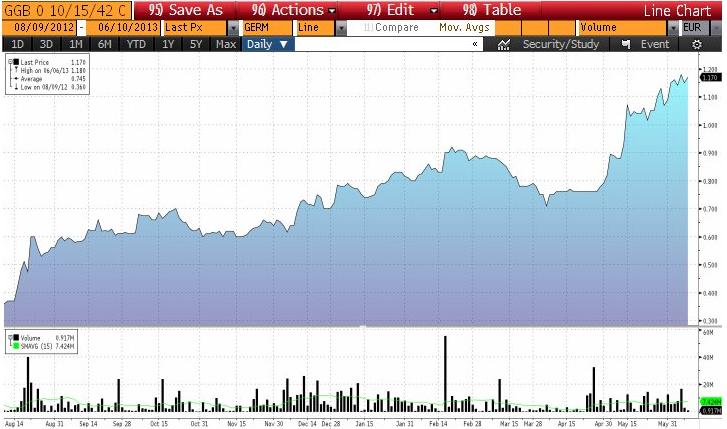
Holy cow !!! The price of this security tripled since I made fun of the FT. guy, so I would say 3 for the FT, nil for me.

First lesson learned: I was clearly wrong on that one for the time being. If you followed the FTs advise, you made big bucks in only a year. if you have followed my advice you made nothing.

So whenever I see one of my analysis going wrong so horrible, I keep asking myself: Was I wrong or ist the market (price) wrong ?

Let’s go back to the fundamental analysis and see if something has changed to the better in the meantime ?

Well, the Greek stock exchange doubled, but as we know for the analysis, for the GDP linker the only two things that count are: Nominal value of GDP and GDP growth rates. Let’s look at the hardest hurdle which in my opinion is nominal GDP.

Those are the levels of nominal GDP required to get a single cent out of this security:

year nominal GDP yoy
2014 210.1  
2015 217.9 3.71%
2016 226.4 3.90%
2017 235.7 4.11%
2018 245.5 4.16%
2019 255.9 4.24%
2020 266.47 4.13%
therafter 266.47 0.00%

So again, let’s go to the original Greek statistics website and do a quick update on Greek GDP including 2012:

Year GDP
2000 136,281
2001 146,428
2002 156,615
2003 172,431
2004 185,266
2005 193,050
2006 208,622
2007 223,160
2008* 233,198
2009* 231,081
2010* 222,151
2011* 208,532
2012* 193,749

So we can clearly see that nominal GDP decreased quite dramatically. For 2013 it doesn’t seem to get much better. If we look at the last quarter, we can see that in Q1, Greek GDP decreased ~ 7% on market prices basis.

So lets just assume that things pick up in the rest of the year and the Greek GDP shrinks only by -5%. That would leave us with a GDP of around 184 bn. Now we can easily calculate what kind of compound annual growth rates (CAGR) Greece needs in order for the GDP linker to “jump” the nominal GDP hurdle:

Hurdle Actual CAGR required
2013   184  
2014 210.1   14.2%
2015 217.9   8.82%
2016 226.4   7.16%
2017 235.7   6.39%
2018 245.5   5.94%
2019 255.9   5.65%
2020 266.47   5.43%

This table can be read as follows: In order to hit the GDP hurdle in 2014 (and receive money in 2015), Greek GDP has to rise 14% in 2014. Or: in order to hit the hurdle in 2015 (and get paid in 2016), the Greek GDP has to have a compound growth rate of 8.8% in 2014 and 2015.

Now it is clearly open to discussion how likely that is. I would however argue fundamentally this is more or less impossible because Greek is under a lot of deflationary pressure.

So the fundamental outlook didn’t really improve from last year, but why the hell did the linker trade up so much ?

I have a few explanations:

a) The linker looks optically cheap. It “officially” trades at 1.1% of nominal value, so for many investors that means it trades “for almost nothing”. In the post last year I mentioned, that the quotation is highly misleading. As the maximum cash (undiscounted) you get is around 18% of the stated “nominal”, the linker is in fact trading rather at 1.2/18= 6.7% of nominal, not adjusting for coupons. So still “cheap” but not so cheap as some investors think.

b) Argentinian experience: Argentinian GDP linker have been a very good investment. However part of that was that Argentina could inflate its economy because they have their own currency. Greece can not inflate in EUR, instead they have to deflate salaries, costs etc. This is fundamentally different to Argentina.

c) People are betting on some kind of Greek recovery and use the GDP linker as a levered proxy for a Greek recovery without really understanding it.

Of course, my fundamental analysis could be all wrong and I missed something. However I woudl need to read something fundamentally justified to accept this. If someone knows something about such a piece of research, please let me know !!!

Summary (and implications for value investing):

I was clearly wrong about the future price of the GDP linker last year. However I am still convinced that I am right on the ultimate “value” of this GDP linker which is close to zero. So one could see this as a weakness of the “value investing” approach because I never consider that someone might pay a higher price despite the value of this security being close to zero.

And clearly, as a value investor you rarely share in “speculative gains” but on the other hand, you also avoid many speculative losses if you really stick to your strategy.

This is also one of the biggest mistakes (and one of the hardest parts of the startegy) I see with some value investors: It is really hard to resist the urge to “speculate” at some point in time. Our mind often plays tricks on us that we can recall great trades much easier than bad trades. But i think that mixing in speculations (investments not based on intrinsic value but based on the hope that someone buys it even more expensive) into a value investing strategy might be the biggest “detractor” for a superior long term performance.

For every GDP linker you miss out as a value investor, you also miss out a couple of “bad trades” and in my experience the balance of those missed out trades is negative (or positive for your performance) over the cycle.

There are clearly people who are great “speculators” and got rich with that (Soros & Co), but for every successful speculator, there is a large graveyard of bankrupt losers. Whereas I don’t know that many bankrupt value investors…..

Book review: Poor Charlie’s Almanach – Peter D. Kaufmann

This was one of my few “souvenirs” from my pilgrimage to Omaha some weeks ago.

The book can be basically divided in 2 parts:

1) The first 150 pages or so is some “Almanach style” collection of quotes, interviews, observation and general concepts of the “Munger style”
2) The remaining part then are transcripts/manuscripts of talks, Charlie Munger had given over the years

The speeches themselves are of course most interesting, as this is Charlie’s original work.

Those are the 11 talks / speeches

1) Harvard school Commencement Speech (1986)
Major concepts: Reliability, inverting problems

2) Talk at USC (1994)
“Worldly wisdom”, combining knowledge from many different areas, multiple mental models
Economics of scale / dumb bureaucracy, specialisation
Airlines vs. cereals, when does technology help or kill a business ?
Incentives

3) Stanford Law School 1996
make systems cheating proof, large companies shouldn’t produce football helmets

4) Practical Thought about Practical Thought (1996)
Mental model, Coca Cola case,

5) Harvard Law School reunion (1998)
Academic multidisciplinary

6) Investment Practices of Leading Charitable Foundations (1998)
Bernie Cornfeld, deficiencies of professional money management

7) Breakfast meeting of the Philanthrophic Roundtable (2000)
“febezzlemant”

8) The great Financial Scandal of 2003 (2000)
Option accounting at Tech companies

9) Academic Economics, USC (2003)
Raising prices often raises sales opposite to classical economic theory

10) USC Law School Commencement address (2007)
constant learning, acquisition of wisdom.LEarning machine”

11) The Psychology of Human Misjudgement
25 psychological “mental models”

At the end of the book, there is also a recommended reading list. The one from Charlie Munger himself can be found for instance here.

Summary:

I think it is a “MUST READ” for any serious disciple of the “Value Investing” School. It is basically the only book where you can find a lot of knowledge about the “number 2” guy at Berkshire Hathaway. For many people, the success of Berkshire is the success of Buffet. I am pretty sure, Buffet would have done well without Charlie, but I would not underestimate the contribution of Munger to the “Later stage” success of Berkshire.

The book is not an easy read and I will have to read it again. Although the author tried to compile it in a coherent way it is clearly not a “Bruce Greenwald” style step-by-step book or a “how to get rich quickly” publication.

One warning: It is a real heavy (1 kilo) big book. I “schlepped” this one back from Omaha and no, I will not take orders if I go to Omaha again next year.

Performance review May 2013 – Comment “Position sizing”

Performance:

May has been s surprisingly good month for the portfolio. Despite ~15-20% cash, the portfolio gained +4.9% against +4.5% for the benchmark (50% Eurostoxx, 30% Dax, 20% MDax). YTD this results in +19.6% against +12.0% for the Benchmark. Since inception (Jan 1st 2011), the score is now +57.7% against 22.1%. As I have said many times, this is still highly unusual if the portfolio outperforms in such a strong month, especially now with the high cash percentage.

Main drivers were: EMAK (+27%), Dart Group (+22%), April (+16%) and Tonnellerie (+13%)

Portfolio activity

May has been an unusual active month. As discussed, the following transactions took place:

– sale of IVG convertible with a total loss of -16,3%
– sale of Buzzi with a total gain of +34% (incl. dividends)
– Sale of KPN shares & rights with a gain of 11.1%
– Purchase of IGE & XAO
– Purchase of EGIS
Edit: – Short Position Focus Media has actually been bough, exit with a loss -11.9%

Portfolio as of May 31st 2013:

EDIT: Buy out of Focus Media updated

Name Weight Perf. Incl. Div
Hornbach Baumarkt 3.7% 3.4%
AS Creation Tapeten 4.3% 49.3%
Tonnellerie Frere Paris 5.7% 83.3%
Vetropack 4.1% 9.7%
Installux 2.7% 10.1%
Poujoulat 0.8% 6.4%
Dart Group 4.7% 171.2%
Cranswick 5.4% 33.8%
April SA 3.6% 19.4%
SOL Spa 2.7% 35.8%
Gronlandsbanken 2.1% 23.2%
G. Perrier 3.0% 11.3%
IGE & XAO 2.0% 4.1%
EGIS 2.5% 0.4%
     
KAS Bank NV 4.6% 27.6%
SIAS 5.5% 59.5%
Bouygues 2.4% 7.0%
Drägerwerk Genüsse D 9.2% 186.2%
DEPFA LT2 2015 2.7% 64.1%
HT1 Funding 4.6% 58.2%
EMAK SPA 5.2% 64.9%
Rhoen Klinikum 2.2% 10.8%


Short: Prada -1.0% -20.4%
Short Kabel Deutschland -1.0% -5.7%
Short Lyxor Cac40 -1.2% -15.5%
Short Ishares FTSE MIB -2.0% -14.0%
     
Terminverkauf CHF EUR 0.2% 7.9%
     
Cash 21.0%  


Value 47.5%  
Opportunity 36.4%  
Short+ Hedges -4.9%  
Cash 21.0%  
  100.0%

Comment “Position sizing”

One topic which constantly bugs me is how to size positions.

There are two extremes:

On the one side, Modern Portfolio Theory (MPT) says that the only kind of “free lunch” available is diversification. Adding additional positions means more or less the same returns but with lower risk.

On the other side are very succesful investors, including of course our heroes, Warren and Charlie, argue that one should concentrate on the big ideas only as those are the ones which drive the returns. Similar results come out of the “Kelly criterion” which says that you should bet overp proportionally more if the odds ar in your favour.

Personally, as a “part time” investor, I have the following problems:

1) I can oversee only a limited amount of companies&investments, my max is around 25-30 based on experience. So further diversification on a single investment level does not make sense

2) As I am in general very sceptical and commit only a limited time per day on research, I never really came to a stage where I was 100% sure about any investment. Even if I am 95% sure I have the nagging feeling that I missed something

3) I usually find my “edges” only in small cap stocks or smaller special situations. Small companies have much more unique risk factors than large caps. It is a real difference in risk if you invest lets say 40% into a small French software company than investing 40% of your portfolio into an international company like American Express

Point 2) is really the major issue why I hesitate to commit more than 10% of my portfolio into a single stock. I am just not confident enough in any company or investment to do so.

Looking back, my historical best investments, like for instance German bank hybrid in 2009 was made under a lot of uncertainty and I didn’t really know for sure if it plays out the way it did. The same goes for Draeger. Yes it was a multi bagger, but at least for me I was never really sure about it.

On the other hand, some small ideas where I didn’t really have a lot of conviction, performed outstanding, like Dart Group which was rather a kind of “mechanical” buy. Also sometimes a basket approach to risky or very illiquid small caps (France) makes sense.

In general, I think that there is no single optimal strategy for postion sizes. As every part of the investment process, this has to fit with the overall character of the investor, including risk tolerance, investment style and time available. With regard to the “kelly formula”, I have the fundamental problem that I neither determine the payouts nor the probabilities, so this is not a big help eithet.

For the time being, I do not have a better system for my personal situation than my current one which looks like this:

–> Full positions at 5% (increase via peformance until 10%)
–> half positions at 2.5% if I buy into a stock
–> plus a basket approach for my illiquid French small caps.
–> occasionally small position for “half baked” ideas
IMPORTANT: Weed out weak conviction positions if overall numbers of investments get close to 30 single stock investments (long & short, ex index hedges)

So far it has worked quite well, but there is always room for improvement.

Some more thoughts on EGIS

Following the first post two days ago, some more thoughts on EGIS:

Servier Group Diabetis drug scandal

One commentator mentioned, that Servier Group, the French parent is part of maybe the biggest pharmaceutical scandal in France ever. According to this article, at least 500 deaths are linked to a Diabetis drug of Servier.

Interestingly, already in 2011, EGIS denied having distributed or licensed this Drug from Servier. However they admitted, that they manufactured some of the ingredients and delivered them to Servier.

If Servier really gets fined heavily for this case, then in some aspect or another, EGIS will feel the impact. As we have seen, the internal business with Servier might be at risk.

Forinth/Hungarian interest rates

Standard CAPM tells you that you should use the risk free rate of the country a company is located as a basis to determine cost of capital. Although for EGIS this would clearly be a mistake as only 20% of their business is in Hungary. Nevertheless, I expect some tailwinds from the decrease of 10 year Hungarian Government yields from ~8.50% to 5% over the period of the last 12 months. This week, the Hungarian Central bank cut the short term rate for a 10th consecutive month.

If we compare for instance the performance of the Hungarian BUX Index for the last 12 months (+17%) against Italy (+34%), Spain (+34%), we can see that the Hungarian Index does not look extremely overvalued and with a level of 19000 would still have 50% upside to the ATH from 2007. So at some point in time there might be some kind of “catch up rally” for the Hungarian market as well.

Management/Reporting/Shareholder orientation

I cannot say anything about management so that’s neutral. Same for shareholder orientation. Ok, no buy backs or big dividends, but on the other side no negatives. Communciation is good. The annual reports. quarterly reports and analyst presentations are clear and easy to understand.

Other stuff

In March, EGIS and its US Partner Actavis settled a court case with AstraZeneca, which, according to some reports has a value of around 50 mn USD for EGIS starting in 2016.

Relative valuation

Lets look at the German generics company, Stada AG.

Stada Trades at the following multiples:

P/B 2.1
EV/EBITDA 10
P/E Trailing 19.5

ROE/ROCE have been a lot weaker in the past than EGIS, around 7% ROCE, and 8% ROE. Even if one considers that Stada is a potential take over target, I do not understand why Stada is trading roughly on 3 times the valuation of EGIS despite being less profitable over a long time period.

Looking at a more comprehensive list of generics companies, we can see that EGIS is by far the cheapest one. Only the Russian companies are at least comparable cheap. As EGIS does now a third of its business there, one should keep this in mind. Personally, I highly prefer to invest into a Non-Russian company doing in Russia than directly into a Russian company. C

Name Curr Adj Mkt Cap P/E Curr EV/T12M EBITDA Price/Sales FY2 P/FCF P/B
 
KRKA 1788.66 10.4 6.29 1.30 15.22 1.3
PHARMSTANDARD-CLS 1959.3 7.7 5.17 1.31 7.92 2.13
TEVA PHARMACEUTICAL IND LTD 25510.28 19.65 7.88 1.58 8.79 1.46
EGIS PHARMACEUTICALS PLC 562.52 7.82 3.75 1.04 8.23 0.85
HIKMA PHARMACEUTICALS PLC 2218.16 28.48 13.58 1.98 29.26 3.44
STADA ARZNEIMITTEL AG 2015.25 19.7 10.01 0.93 11.13 2.14
DEVA HOLDING AS 221.38 14.28 8.77   0 1.37
VEROPHARM 171.07 6.01 5.15 0.70 0 0.83

Absolute valuation

I think one doesn’t need to be to sophisticated here. A decent company like EGIS with a solid, non cyclical business should not trade at a P/E of 5 and P/B of 0.8. A fair price in my opinion, taking into account some issues from above should be a P/E of 10 or 1.5 times book, which would be still significantly below western peer companies.

Stock price

The stock price went up quite a bit since EGIS published quite positive 6m results a few days ago. Although one should mention that part of the positive development was driven by a positive FX result in the second quarter.

Summary:

EGIS combines some aspects which I personally find very attractive in “real” value stocks:

+ it is a very solid unspectacular business with solid returns over the cycle
+ the balance sheet is rock solid
+ valuation is extremely low both absolute and relative to peers
+ low valuation can be explained at least to a large extent by negative headline news which in EGIS case are not really justified

For me it looks a bit similar to Total Produce 2-3 years ago, where it was considered an Irish stock. If I have the choice, I actually prefer to invest in solid companies in troubled countries compared to more troubled companies in solid countries.

There is clealry some risks like

– Hungarian politics and tax risks
– court trial for Servier Group
– potentially bad/risky acquisitions

As a result, I will make EGIS a new HALF POSITION in the portfolio with 2.5% portfolio weight at a price of HUF 20.000 (*) per share..

DISCLAIMER: Please do your own research. The author might own the stock discussed already prior to posting it on the blog. Never follow blindly any tips, especially from internet sites. The information provided on this blog represents the subjective opinion of the author. Important issues might be interpreted wrong or even missing.

(*) It took me some time to finish the blog posts about EGIS. When I made my decision, the share traded at 20.000 HUF.

EGIS Pharamaceuticals PLC (ISIN HU0000053947) – Why is the stock so dirt cheap ?

Company description:

Egis Pharamaceuticals is a Hungarian based producer of Generic pharmaceuticals. Interestingly, according to their homepage, the company was founded in 1913 as a Swiss company. In 1993 it was privatised, in 1995 the majority was taken over by a French company Servier.

Valuation
Valuation based on traditional metrics looks cheap at a current price of ~ 20.000 HUfs

Market Cap ~540 mn EUR
P/B 0.8
P/E 7.5
P/S 1.0
Div. Yield: 1.3%

Taking into account ~5500 HUF net cash per share (~25% of market cap), the stock is ridiculously cheap:

EV/EBITDA: 3.0
EV/EBIT: 4.6
adj. P/E (trail 12 m): 5.5

Profitablity

On top of the cheap valuation, the company is consistently profitable, with double-digit margins:

NI margin ROE ROE cash adj
31.12.2002 9.2% 11.6% 12.7%
31.12.2003 7.0% 8.5% 8.7%
31.12.2004 8.1% 9.9% 10.2%
30.12.2005 11.9% 14.0% 14.0%
29.12.2006 15.2% 18.1% 18.5%
31.12.2007 6.5% 7.3% 7.9%
31.12.2008 11.0% 10.6% 11.6%
31.12.2009 11.8% 10.9% 12.2%
31.12.2010 14.1% 11.9% 12.5%
30.12.2011 10.5% 8.7% 9.7%
31.12.2012 14.0% 10.9% 13.6%
 
Avg 10.8% 11.1% 12.0%

Why is it so cheap ?

If a company looks so cheap, especially in today’s market environment, the first question is: Why ? So lets look at some obvious potential problems:

“Dictator discount”:
As a Hungarian company, one might think that a lot of investors are shunning Hungary because of the dictator like current government. In my portfolio, I experienced the unpredictability already once with Magyar Telekom. Although I managed to get out with a small profit, it was quite sobering to see how the company got punished by the Government via extra taxes, additional licences etc.

For Egis, this is clearly an issue. On top of price controls they are also subject to special taxes like Magyar Telekom. On the other hand they seem to be able to set off those special taxes against R&D expenses. This is from the last report:

Semi-annual drug price reductions, triggered by the price and reimbursement system that has been effective since October 2011 (the so-called blind bidding), strongly affected also this quarter, despite the fact that there was no further round at the beginning of the quarter. In addition to the blind bidding process, also the quarterly adjustment of reimbursement keys of medicines falling into the same INN category (so-called fixing) prevailed. However, price cuts focused on the blind bidding processes, consequently, the rate of price reductions effected on January 1, 2013 by Egis was negligible.
Payment obligation of drug producers on grounds of the reimbursements allocated to their drugs was raised to 20% from 12% as from July 1, 2011. In the second quarter, the total amount payable by the Company according to the turnover came to HUF 562mn. As from July 1, 2011 the rate of registration fee on medical representatives has been HUF 10mn/medrep/annum instead of HUF 5mn. On such grounds HUF 250mn payment obligation was accounted over the quarter.
In December 2012, the Parliament confirmed the R&D cost related deductibility option of payment obligations for an indefinite period of time. Accordingly, 90% of the payment obligations debiting the calendar year preceding the given year may be deducted, provided that the Company’s R&D expenses exceed 25% of reimbursement (proportionate to manufacturer’s price) paid on their products and that, within R&D spending, personnel
expenses remain above 3% of the same reimbursement amount. Pursuant to the rules of law lower rates of R&D expenses trigger lower deductions.
Entitlement to the deductibility option for the Company for the present financial year is judged on the basis of the R&D spending in the 2012/2013 financial year, consequently, the deduction allowance is accounted in the given business year while the financial settlement can be performed in the subsequent year. Taking into account the R&D expenses incurred in the second quarter of 2012/2013, 90% of the payment obligation, including also registration fee of medical representatives and surtax proportionate to reimbursement, occurring in the second quarter of the calendar year 2012, HUF 727mn were accounted as allowance.

That sounds complicated, but in the end, EGIS only paid an effective rate of 6% in the first 6 months. I am not sure how sustainable this is, the normal corporate tax rate in hungary would be 19%.

However, as a percentage of sales, Hungary doesn’t play such a big role anymore. In the current 6 month period, Sales in Hungary are 20% of total sales. In contrast, sales into Russia are now 1/3 of total sales and growing.

So to summarize the “dictator” discount theory: I don’t think this is justified. Rather it looks like that EGIS is benefiting from a very good treatment with regard to taxes at the moment, compared to companies like Magyar Telekom.

Cyclical business / easy to spot problems ahead:

For most pharmaceutical companies, patent expiry is the most obvious problems. If blockbusters expire their patents, then often profits fall off a cliff. With EGIS, this seems not a problem. As far as I understand, EGIS is mostly producing generics and not doing any R&D on own developments.

The majority share holders, Servier Group in France itself is a pharmaceutical company which does the original research. EGIS is then licensing some of their products.

So in the case of EGIS, I don’t see patent expiries as a big problem, nor is the generic business very cyclical.

Nevertheless, we do see some volatility in margins, especially in 2007 and 2011. What happened there ?

2011: If we look at 2011 vs. 2010, we can see that 2 factors contributed to the significantly lower margins:

– losses in associated companies (~-1.5% net margin)
– contribution to the National Hungarian National health fund (~3% of net margin)

So without those non-operative charges, EGIS would have shown solid ~14% net margins for 2011 as well

2007:
This looks a little bit strange. from 2006 to 2007, “material type costs” jumped significantly. According to their 2007 investor presentation, this was a result of unfavourable exchange rates (the Forint gained significantly in that period), price cuts in Hungary and a different product mix.

The USD/HUF FX effect might have been the strongest effect and this most likely explains the improving margins once the Forint became weaker again. Today, EGIS hedges ~70% of their USD exposure which should prevent most of that volatility.

So in both cases I think the problem was not a underlying cyclicality of the business model but rather a result of unfavourable exchange rates and regulation.

Dependence from major shareholders – related company transactions

The majority shareholder with around a 51% stake is Servier Group, a privately owned french pharmaceutical group with around 4 bn EUR turnover.

If we look into the last annual report unde point 24. related party transactions, we can see that between 15.20% of sales go to other Servier companies. This is not insignificant, but so far I don’t see an indication that this is not done at arm’s length.

In contrary, having a subsidiary with only a tax rate of 2% or so, if there were no minorities, I would let this company earn as much as possible in intra group transactions.

Balance sheet quality (operating leases, pensions, guarantees)

No problems here. I didn’t find any disclosure of leases and they only have a tiny pension liability. Nothing about guarantees either.

Free Cashflow conversion / low dividend / acquisition

Over the last 10 years, EGIS only showed Free Cashflow of around 400 HUF per share on average, only in the last 2 years, this went up to around 1400 HUF per share. Historically, EGIS paid only a mini dividend of 120 HUFs, so less than 0.5% dividend yield. One factor for the low free cash flow has been the fact that in the past EGIS booked purchases of fixed income securities as “investments” even if they were actually short term cash like securities. They changed that in 2011.

This year at least, sitting on 5500 HUFs net cash per share they doubled their dividend, nevertheless the 1.20% dividend yield looks small compared to for instance Magyars 14% plus dividend yield.

I am sure that the historically low dividend yield is one of the reasons why many investors avoid that stock. However if we look into the past, the money that EGIS reinvested actually led to decent growth. Over 15 years, sales in local currency more than quadrupled in line with profit. ROEs and ROIC always remained around 10-12% which is not fantastic but very solid.

Personally, I can live very well with a company which reinvests at 10-12% ROCE and not paying dividends, especially when it is so cheap as EGIS. I think such low dividend paying solid stocks are in fact one of the few “pockets” in the market where the valuations are OK because the “yield hogs” are not interested in them.

In the last few months, EGIS announced several times that they plan to use their cash on an acquisition in Russia. This is of course a risk factor, but I I understand correctly, they are going for manufacturing capacity and not for expensive goodwill type acquisitions. This is clearly a risk, on the other hand, the company is already very active in Russia for a long time and should know the market quite well.

From a free cash flow reporting perspective, acquisitions of course look a lot nicer than building you own, although the result is the same.

Preliminary summary:

So far, one can see that there are some factors why the stock trades at such low multiples. Most of those factors however are not a problem for me, so it definitely makes sense to take an even closer look in a coming post.

Buzzi revisited – time to SELL

Buzzi was part of our initial portfolio. In our initial investment thesis (German), the main reason was simple:

The stock, especially the Pref shares were significantly below book value, Buzzi had never made a loss in the past, “normalized” earnings and p/E ratios were low and it had a nice dividend yield.

We bought into the pref shares share at around 5,50 EUR

Additionally, the fact that Buzzi was only to a small extent an Italian company but rather a very international company due to the Dyckerhoff take over with large exposures in the US and Germany was maybe underappreciated.

Since then, a view things happened:

– Buzzi showed a loss twice, for 2010 and 2012 with only a mini profit in 2011
– when the price of the shares dropped in autumn 2011, I increased the position at 3.28 EUR per share
– the share price of the more expensive common shares performed a lot better than the cheap “Risparmo” shares. The difference since 01.01.2011 is a staggering 28% including dividends
– howver, both, the pref shares and the common shares outperformed the Italian stock index FTSEMIB by 17% resp. 45%

The more interesting question is: How did Buzzi perform against our initial expectations ?

In different posts I came up with different “reversion” to the mean approaches, among others

Reversion to the mean net income/PE
Initially: average P/E for the pref shares of 6. net margin of 9.6% (12 year average)
Now: After 15 years, average net margin decreased to 7.11%. Based on current sales of ~14 EUR per share results in 1 EUR per share normalized profit, so with an average PE of 6, the pref shares are fairly valued. I would argue to common shares are even overvalued.

Reversion to the mean EV/EBITDA
Initially: Assumption EV/EBITDA of 5.5 and EBITDA Margin of 26% (12 year average)
Now: 14 year EBITDA Margin is 24.8%. With current debt, the fair value of a Buzzi share would be around 13 EUR. This means the common shares are fairly valued, the upside in the pref shares without any other catalyst would be that the relative underperformance would be compensated at some point in time.

Free cash flow:
I had assumed free cash flow to equity of 200 mn EUR as “normal” level based on a 7 year history. “Adjusted” free cashflow both in 2011 and 2012 are more like 100 mn EUR, bringing down the average to 175 mn EUR. If I use this as a basis and the same discount rates I used back then (12-18% for a cyclical pref share), I end up with a fair value range of something like 4.75 EUR – 7.11 EUR per share. So the current share price would be rather in the higher part of the range.

Overall issues with mean reversion

Those three examples show a problem with “Mean” reversion plays: What is the mean ? In the Buzzi case, the mean now goes down every year, reducing the fair value for the mean reversion valuation.

Clearly, the current down cycle is a very severe one, but maybe the previous up cycles used for the mean were above the mean ?

What to do now ?

For me this is a typical situation where one should sell. Initial expectations have not been met, fair value has gone down and share price has gone up. Of course one could argue that the “mean” will go up and the sentiment is getting better with recent buy ratings among others from Deutsche bank.

In recent times, some US funds actually built up meaningful positions like Marketfield Asset Mgt. with ~2.9% of the common shares, and another, Mackay Shields with around 2.1%.

Nevertheless, I don’t think that at current levels and based on the current situation that there is a lot of “margin of safety” left in Buzzi. I will therefore sell the complete position at today’s VWAP. At the time of wirting, this would be a total gain of ~36%, mainly attributed to the second purchase at 3.28 EUR in late 2011.

« Older Entries Recent Entries »