A few thoughts on Banking Stocks (Lehman 2.0, Deutsche Bank)
History repeats itself, at least it looks like this in the banking sector at the moment.
Stock prices are dropping like stones and CDS spreads are “exploding”:
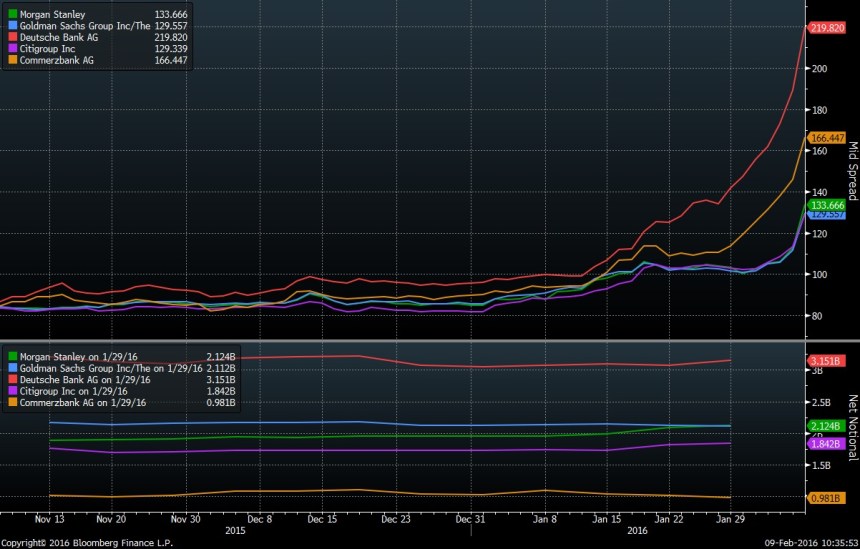
History repeats itself, at least it looks like this in the banking sector at the moment.
Stock prices are dropping like stones and CDS spreads are “exploding”:
Graham & Doddsville Winter 2016 issue (Edit: the Craig Effron interview is a MUST READ)
TGV Partners Fund 2015 letter explaining the Mutui Online investment plus thoughts on Tech stocks and Oil & Gas from a value investor perspective
Cliff Assness vs. Eugene Fama (on momentum)
Pipeline companies, distress, long term contracts and more
The “indiscriminate” sell-off of European Banks (WSJ, google for Headline)
AIG vs. MetLife from Aleph blog
Some fun with probabilities and Russian Roulette
Gaztransport – Dodged the bullet..
Well, that was quick. 2 weeks after I reviewed Gaztransport, they have dislosed the following:
2016-01-29Paris, 29 January 2016 – GTT (Gaztransport & Technigaz) announces that it received today a notification from the Korea Fair Trade Commission informing the company that an inquiry has been opened into its commercial practices with regard to its Korean shipyard clients.
The result: The stock price dropped ~20% in two days:
I am happy to present one of the infrequent guest posts. This time a very interesting general post on RoCE (Return on Capital Employed) and Brand value by contributor Knud Hinkel.
Executive Summary:
The RoCE is an important ratio for value investors. However, as it regularly relies on balance sheet data, the concept is susceptible for at least two inconsistencies: (1) Items on balance sheet are not correctly reflected in the EBIT, and (2) items that contributed to EBIT are not reflected in the capital employed. My hypothesis is that the RoCEs of industries with significant self-created intangibles like consumer and software companies are subject to a systematic upward bias and this might light lead to a wrong judgment of (1) the underlying company performance, (2) acquisitions, and (3) the capital intensity of the business model.
Why drivereless cars might become reality more slowly than we think
A great inside story of a bank trader who was down 200 mn USD on a single oil trade
Rob from RV Capital has released his 2015 letter. +46,7% in 2015 and a new stock: Trupanion
The Punchcard blog on Ackman’s Q4 letter and “platform value”
Rare interview with “Big Short” Steve Eisman
Interesting matrix on relevant types of moats per sector (H/T Valuewalk)
Wertart goes “deep value” in Australia with LogiCamms
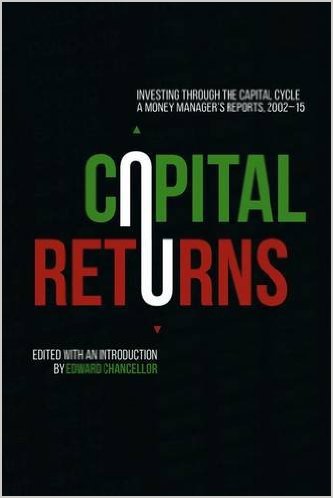
“Capital Returns” is an edited collection of investor letters from UK based Marathon Asset Management. Before reading the book,I actually didn’t know much about Marathon.
On their website, they summarize their strategy as follows:
At the heart of Marathon’s investment philosophy is the capital cycle approach to investment. It is based on the idea that the prospect of high returns will attract excessive capital (and hence competition), and vice versa. In addition, an assessment of how management responds to the forces of the capital cycle and how they are incentivised are critical to the investment outcome.
This capital cycle approach is very interesting. As mentioned above, the book has no direct narrative. The investor letters are however clustered together in chapters with similar main topics:
The book is not so easy to read because the letters themselves, despite very well written, are very condensed with a lot of deep insights. I always had to take a kind of a mental break after one or two letters in order to digest everything
Overall, I would characterize their approach as follows:
Essential personal learning experience
The main take away for me was that their supply focused capital cycle model enabled them to see and avoid many of the problems (CDOs, housing, commodities, PIIGS, China) well in advance. Most analysts focus on the demand side only and forget about supply.
This is something to keep in mind for the future. As a bottom up investor, I think their approach can improve decision making without going into useless macro analysis. If you just look at single companies, one might miss some of the overarching issues in the sector (TGS Nopec…..).
Marathon Track record
The question always is: Talk is cheap, how about their returns ? At least from their website, it seems that their funds made 3-5% outperformance p.a. constantly on a 3, 5, 10 and 20 year basis. This is very remarkable for a manager with a couple of billion under management.
For me it was also interesting to see that they not only share many of my personal opinions about investing, but that there is also a nice overlap of companies I find interesting and what they found interesting, for instance Lloyds Banking, Admiral, Handelsbanken and Koc as a well managed family owned company. Clearly there is some “confirmation bias” at work from my side, but still interesting.
Recommendation:
Overall, the book is an essential”MUST READ” for any investor. The major drawback is that it is currently only available as hard cover at around 37 EUR.
The “value option” is to be found on their webpage where they published some of their investor letters for free.
There is also a similar book on the time period from 1993-2002 called “Capital Acocunt” which costs around 80 EUR on Amazon.
Overall, for me Marathon is clearly one of the “Gurus” in investing and it makes a lot of sense to pay attention to what they are doing. Especially if and when they re-enter oil and commodities.
P.S.: the editor, Edward Chancelor has also written one of my all time favourite financial books: “The Devil took the hindmost” from 2000. If you like financial history, this is also a “must read”:
Greenlight Re
Following the E.On discussion, I really asked myself if it was such a good idea to invest into Greenlight Re.
My argument was as follows:
After the E.On discussion however, I recognized the follwoing: Whenever I looked at a stock that Einhorn bought (Delta Lloyd, AerCap, SunEdison, Consol, E.on), I never understood why he did it or I thought it was not a good idea. Even if I look at his 20 bigest disclosed positions, I don’t find any stock that I would buy on my own:
APPLE INC AAPL US
GENERAL MOTORS CO GM US
ISS A/S ISS DC
CHICAGO BRIDGE & IRON CO NV CBI US
TIME WARNER INC TWX US
MICHAEL KORS HOLDINGS LTD KORS US
AERCAP HOLDINGS NV AER US
CONSOL ENERGY INC CNX US
ARKEMA AKE FP
AECOM ACM US
ON SEMICONDUCTOR CORP ON US
BANK OF NEW YORK MELLON COR BK US
TAKE-TWO INTERACTIVE SOFTWR TTWO US
GREEN BRICK PARTNERS INC GRBK US
MICRON TECHNOLOGY INC MU US
MARKET VECTORS GOLD MINERS GDX US
VOYA FINANCIAL INC VOYA US
LIBERTY GLOBAL PLC-SERIES C LBTYK US
DILLARDS INC-CL A DDS US
APPLIED MATERIALS INC AMAT US
That in effect lead me to the conclusion that I am most likely the wrong kind of shareholder for Greenlight Re. If things go really bad, I am not sure if I would have enough trust to keep the position or if I would get really nervous because I could not identify with the manager.
Secondly, I honestly don’t have much insight, how Einhorn generated his fantastic past track record.
Together with not liking his long position, I think it was a mistake to invest in Greenlight and I sold my stocks as mentioned in the comments at around 18,45 USD per share with a tiny profit of around +2,5%.
It could well be that Greenlight maybe has a spectacular 2016 but as I have mentioned above, one should not allocate money to someone where you don’t understand what that manager is doing. Conviction is important to withstand all kind of behavioural traps in investing.
Finally, I am not sure if there could be some isues on the Reinsurance side. AIG surpisingly disclosed a pretty massive reserve strengtening for Q4 and it looks like that this is mostly “long tail” exposure from long ago which is also the “bread and butter” business of Greenlight Re.
Handelsbanken
Following the market turmoil, I began to establish a first (2%) position in Handelsbanken. Purchase price was on average ~98 SEK per share. Valuation wise they are now at a level where I would expect to earn around 16-17% p.a. long term which looks atractive to me despite potential short term head winds.
I plan to increase this to a full position over the next months. I funded this position by selling some of the HT1 bonds, as I want to keep some cash (~10%) in order to be flexible if some of my watch list shares become really cheap.
Bill Ackman
Bill Ackman came out with his Q4 letter to investors just a few days ago. His results were similarily bad than Einhorn’s with -20,5% after fees for 2015.
There was already good coverage on his letter for instance from Matt Levine.
My 2 cents on this:
On a personal level, I do think there might be already TOO MANY activists. Many of them only care for short term payouts which, in many cases, might not be benefitial for long term share holders.
All in all, if I would have money invested with Ackman, I would really ask myself if I would trust a guy who only blames others for his misfortunes.
As this has turned out to be a very long post, a quick “Executive Summary”:
David Einhorn has published that German utility E.ON is one of his major new long positions. Based on what I have written in the past about E.On, I do think his summary investment rational has some serious flaws, mainly:
- buying management’s “spin” that the recent share price decline was only caused by uncertainties about nuclear provisions
- assuming a quick and very benefitial (for E.ON) solution for nuclear liabilities
To me it looks like that he tries to come up with some short term, rather risky “bets” in order to make good on his horrible 2015 performance as quickly as possible.
As a new shareholder in Greenlight Re I have to seriously rethink if I want to stay invested, however as a German tax payer I might also be biased in this case.
John Hempton (Bronte) is out with his December 2015 letter
Wertart likes SHL Telemedicine
Clark Street Value analysis of Howard Húghes
A writup + video on Judges Scientific from Frank Weipert (H/T Nils)
Tyler Cowen on driverless cars
John Huber looks at Fastenal’s last quarter
Quarterly earnings call IBM style (Jeff Mathews)
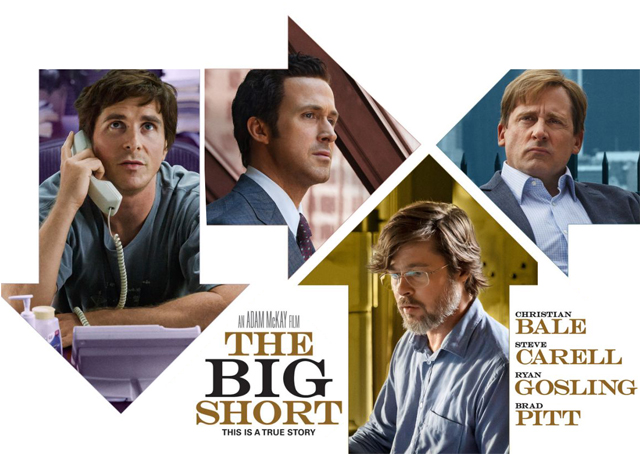
This is a clearly a first for the blog: A movie review and not a book review.
I had read the book from Michael Lewis a couple of years ago and it was clearly the best of many books trying to explain the sources of the “financial crisis” 2008/2009.
Honestly, I could not imagine how you can make a Hollywood movie out of this book.
The story is mainly about a couple of fund managers who discovered at the same time around 2006/2007 that the US mortgage market was deeply flawed especially in the subprime area and that it was only a matter of time until everything would break down.
Most of those fund managers were “ousiders”, so not mainstream super star hedge fund managers but strange guys like Michael Burry, the now famous medical doctor turned fund manager with the Asperger Syndrom or the 2 guys who founded their fund as students with 100k start capital in a garage.
Another important role was played by a Deutsche Bank investment banker Greg Lippmann (in the movie the guy is called Jared Venett) who tried to sell the instruments to bet against sub prime mortgages.
Overall I found the movie extremely entertaining and very good. Why ?
First of all the actors are really really good. Especially Christian Bale (M. Burry) and Ryan Gossling (DB trader) play extremely well.
Secondly, the movie gets surprisingly almost all the facts right. They do explain the underlying concepts very well and often in surprisingly funny ways. One of my favourite scenes is when Selena Gomaz and Richard Thaler explain the conceptof CDS/CDOs at a Las Vegas Black Jack table.

Of course they made some compromises to turn it into a Hollywood movie. Nevertheless I do think that the movie actually shows a pretty acurate picture of investment banking back in the heydays of 2006/2007.
Best learning experience: negative carry & patience
Of course the characters in the book and the movie were not the only ones who predicted the subprime crisis. Back then a lot of people were sceptical with regard to mortgages banks etc.
But I think what the movie really showed was how difficult it is to actually bet significantly on a “doomsday prediction”. Betting against subprime CDOs required those guys to pay signifcant amounts of “insurance premium”. In Michael Burry’s case, the “negative carry” was something like -20% p.a. for the full portfolio. In all cases the managers were not credit specialists and investors clearly didn’t like what they saw at first and in Burry’s and Iceman’s case tried to force them out of their positions because very few people are willing and able to sacrifice yield in order to make big returns.
It is very similar to what I wrote a couple of months ago: A great idea or a great strategy alone is worth exactly nothing. Yes, you can maybe sell some books as the guy “who predicted the last 5 crashs”. But if you manage money you have to actually execute it well in order to create value.
And I do think that this is the main lesson form the book and from the movie: It takes a lot of guts and a kind of “outsider” status to actually be succesful when you bet against the overall consensus. Talk is cheap, actions matter.
The second lesson was that patience also plays a big role in actually scoring big. All the portrayed fund managers were early with their trades and the position went against them at first. In Eismann’s case all his partners for instance wanted to sell quickly after they were back in the green, but he insisted on waiting.
Another good example of this rare persistence in adverse situation was Bill Ackman who at the same battled mortgage guarantee company MBIA on their role within suprime mortgage business. Hi fought them over years until he had finally his big pay off. There is a good book about this story as well, “Confidence Game”

So my recommendation for anyone at least partially interested in finance is clear: Go and see the movie !!!!
I actually think the movie should be a mandatory part of any finance course at schools and universities like the original “Wall Street” movie.

