Birkenstock – Cheap enough to be interesting or is it the next Dr. Martens “Fashion Fiasco” ?

Management Summary:
This is a more superficial look into Birkenstock, a much hyped IPO from 2023 which now trades at 12,5x NTM P/E. Despite still growing at “mid teens”, I could not build up the conviction to start a position, as it is really hard to judge for how much longer the “Birkenstock hype” will continue. I also took a quick look at Dr. Martens, which is a prime example for a broken fashion trend. Maybe not directly comparable to Birkenstock, but still a warning sign.
The 2023 IPO “flip”
Birkenstock, the famous German “health sandal” maker went public 3 years ago. The IPO price was USD 46 (upper end of the range) and already on day 1, the stock dropped to around 40 USD.
Interestingly, the PE investor L. Catterton only bought Birkenstock in 2021. Back then it was estimated that the purchase price was ~4 bn EUR. So IPOing in 2023 is a pretty “quick flip” in PE terms.
In between, things looked a little bit better and the stock reached ~60 USD in 2024. Fast forward to today, and the stock trades at around 32 USD at quite cheap multiples:
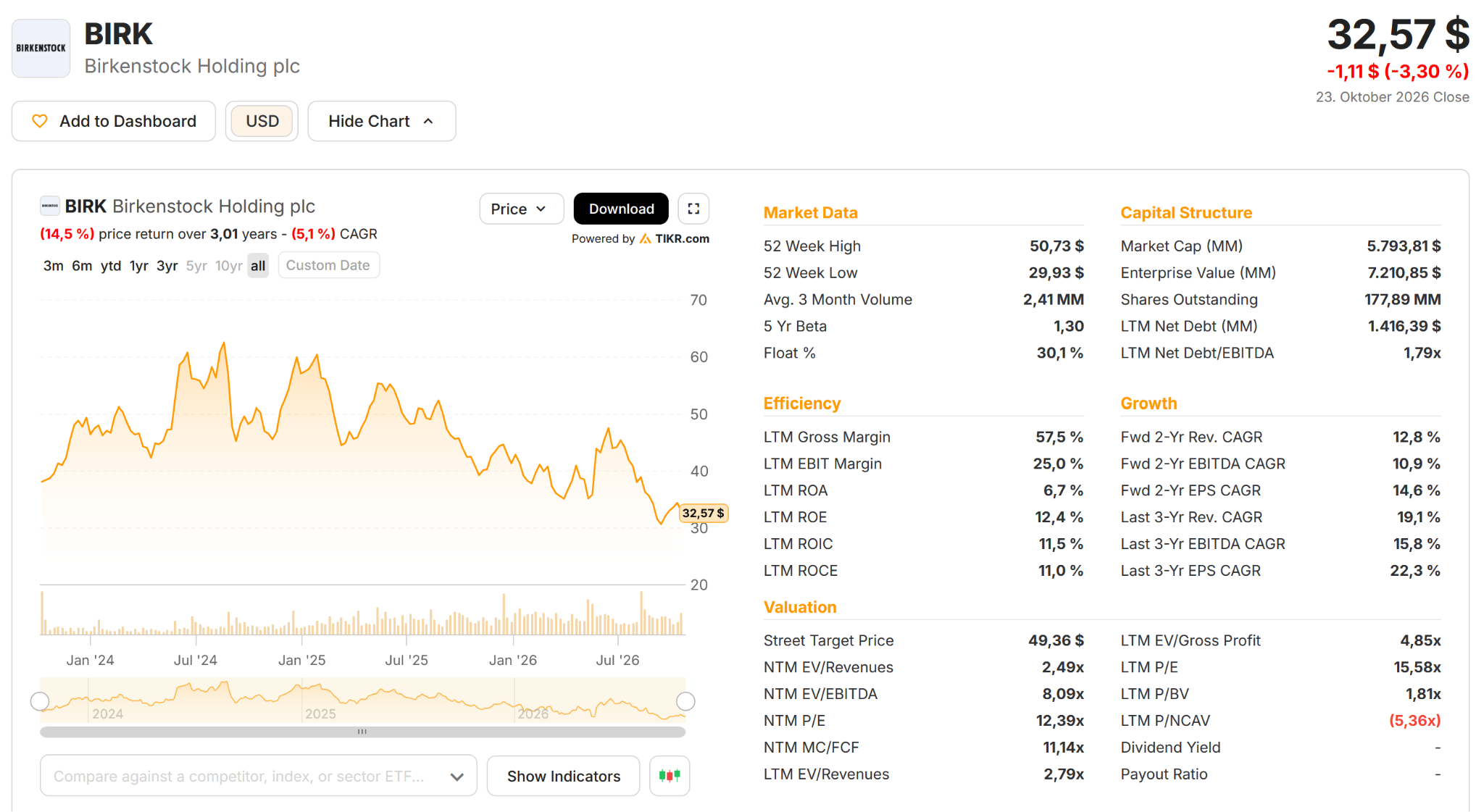
TIKR says next year’s P/E is only 12,5x. Looking at the financials, we can see that since 2023, both sales and profits increased significantly, however, things have been slowing a little bit lately.
L. Catterton, the Private Equity arm of LVMH owner Bernard Arnault still owns 43% and Arnault’s family holding, Financiere Agache another 6%, but they have been selling shares. A few weeks ago in August, L. Catterton sold shares for around 1 bn EUR, of which Birkenstock bought back a relevant amount.
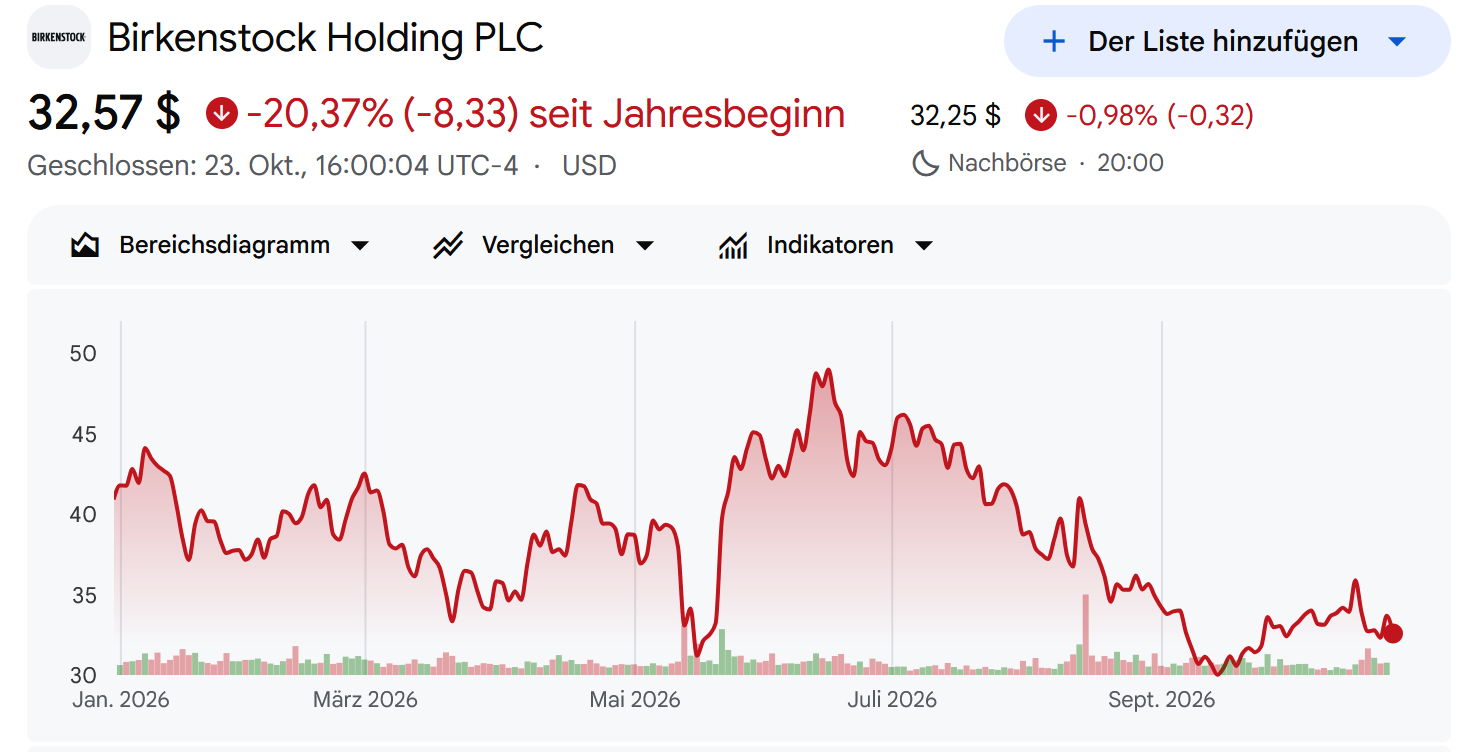
Looking at the shorter term share price, this sale by L. Catterton clearly did not infuse a lot of confidence in other Brikenstock shareholders which leaves the share price very close to all time lows:
Interestingly, according to their latest investor update, sales are still strong and growing in the “mid teens”, both in their own retail channel (DTC) and wholesale:
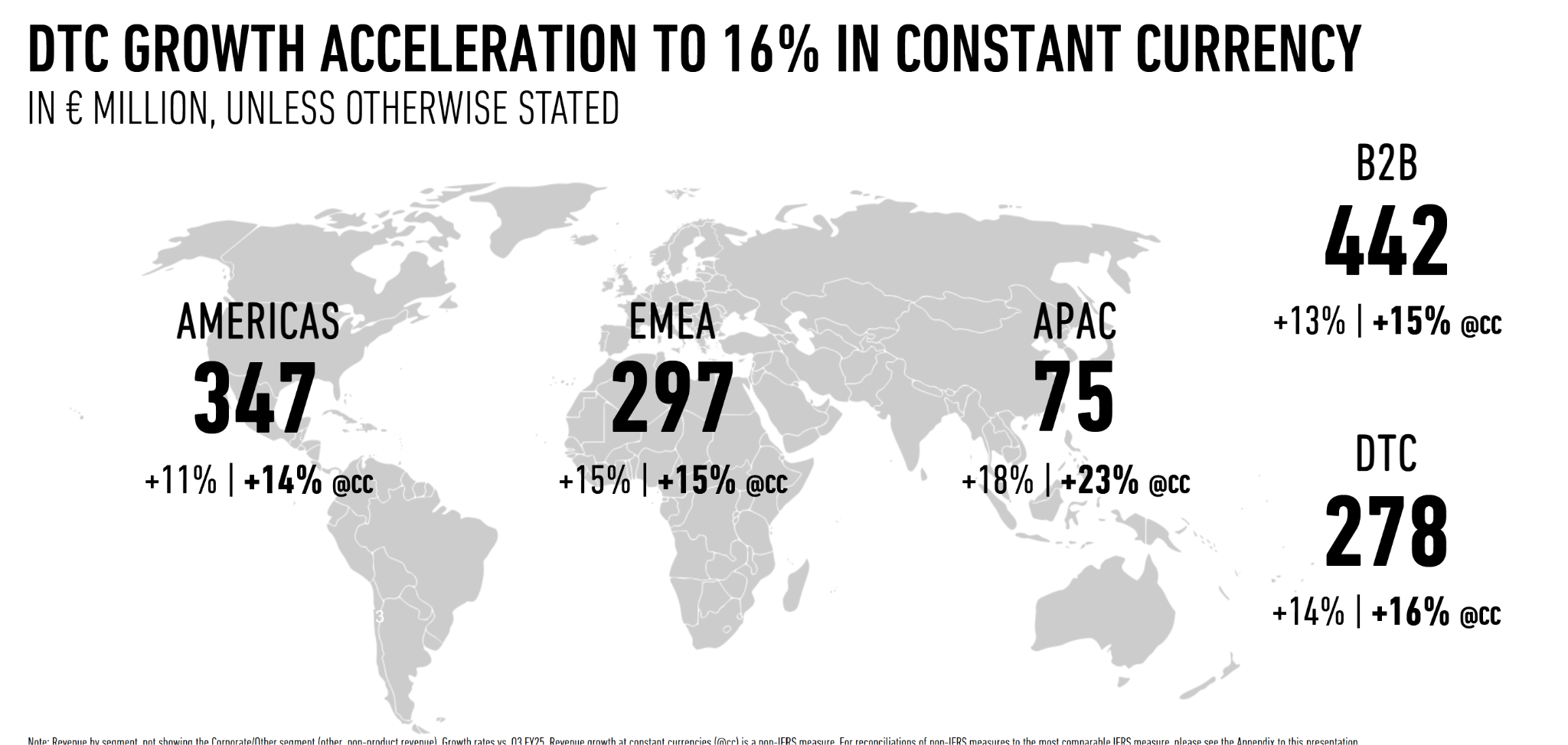
In contrast to other more high end luxury brands, the exposure to Asia and specifically China seems to be rather limited.
One point one has to give L. Catterton is that they managed to increase sales by +50% within 2 years as this chart from the IPO prospectus shows:
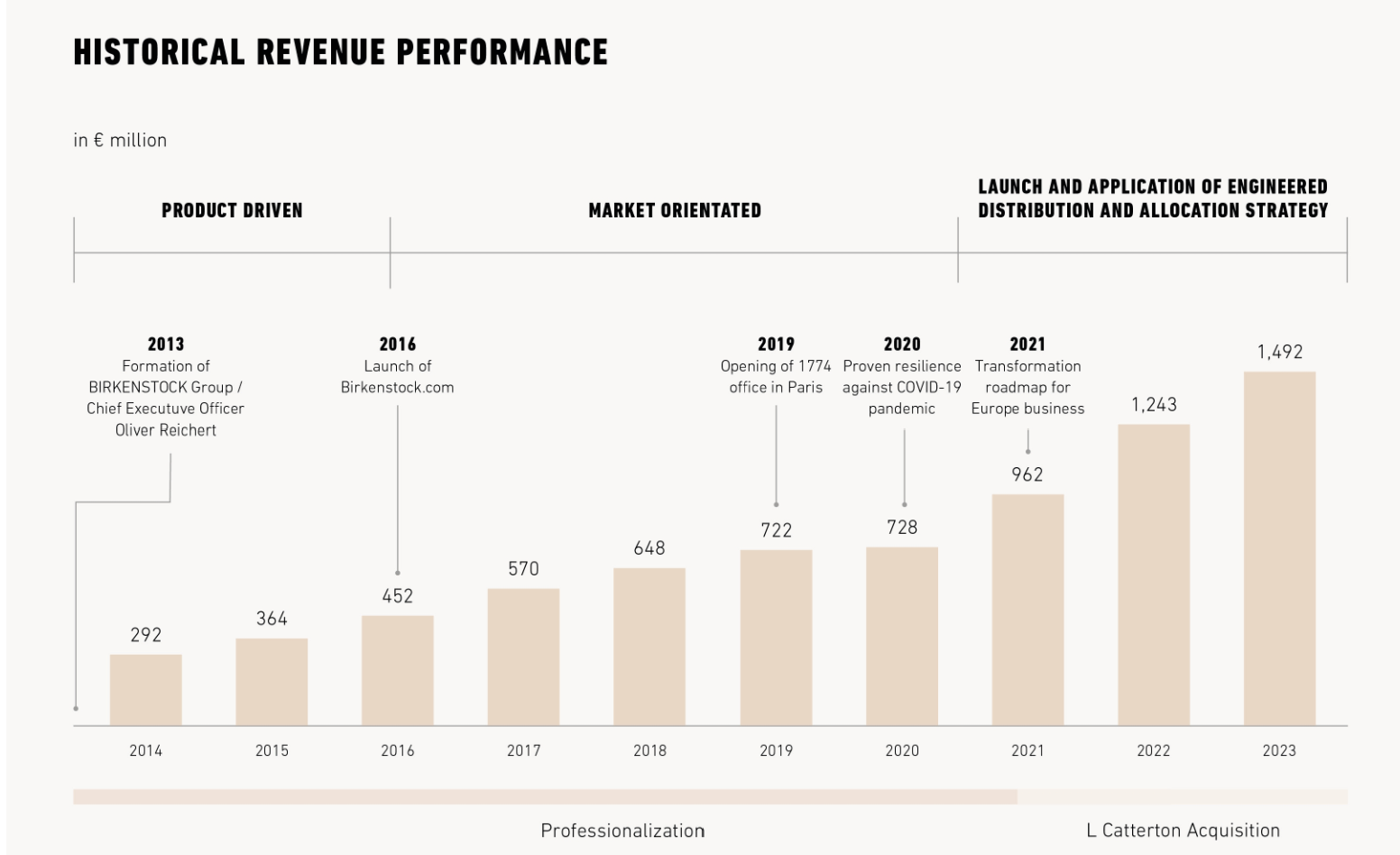
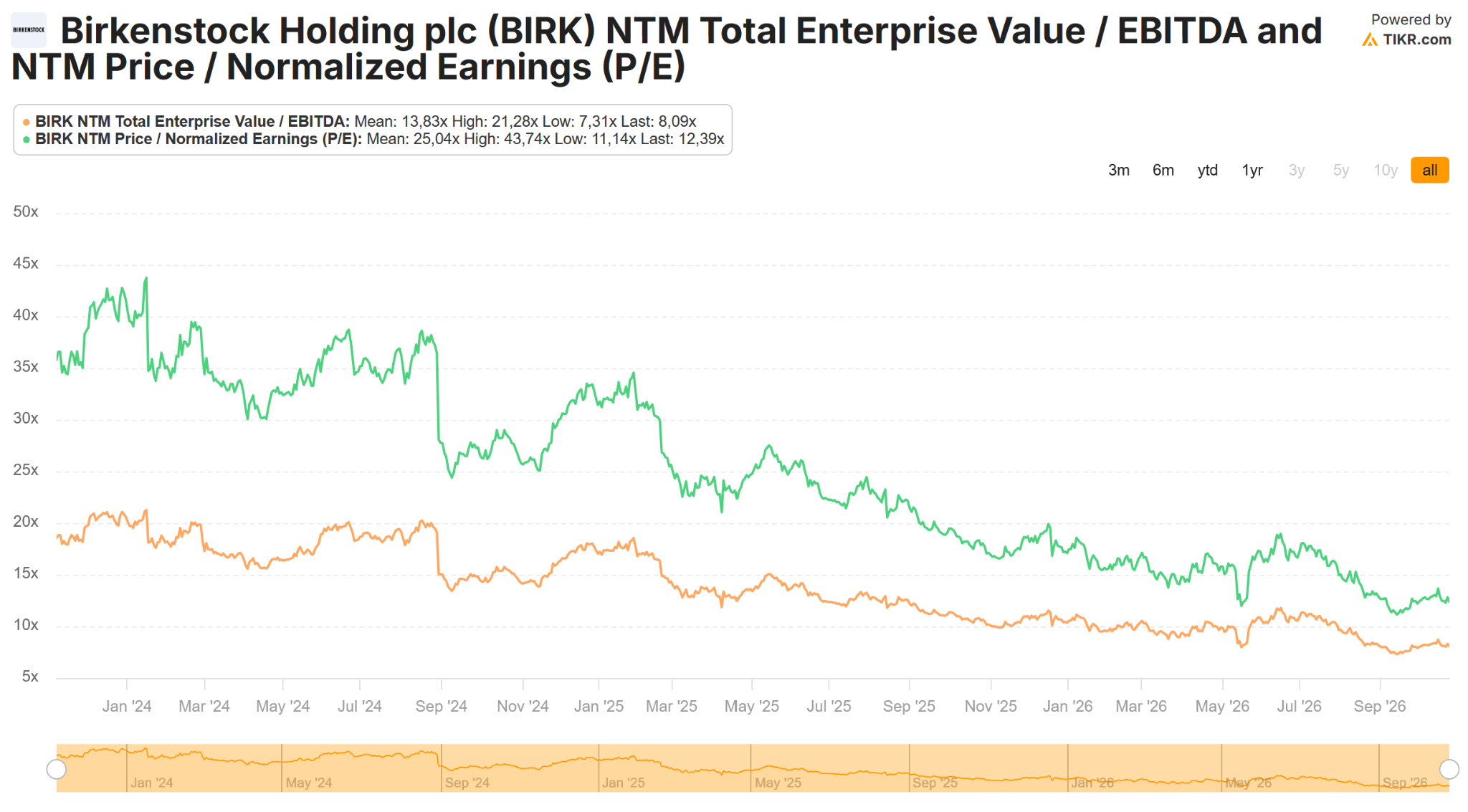
The problem of course was that the valuation at IPO which, in true PE fashion was north of 20x EV/EBITDA, was clearly too high. Now, at a much compressed 8x NTM EV/EBITDA, this looks more reasonable.
This Chart from TIKR nicely shows how multiples have been compressed since the IPO:
Will the Birkenstock “Fashion Trend” continue ?
A big issue is clearly if the “Birkenstock fashion trend” will run out of steam at some time.
Originally, Birkenstocks were nerdy “health sandals” often worn by office workers in technical professions like engineers or programmers.
When I was a student, I did an internship at Siemens and I remember that a lot of the engineers had (white) Bikenstocks at their desks in which they changed in the morning and would walk around all day in the office. That looked quite odd especially with those who actually wore a suit.
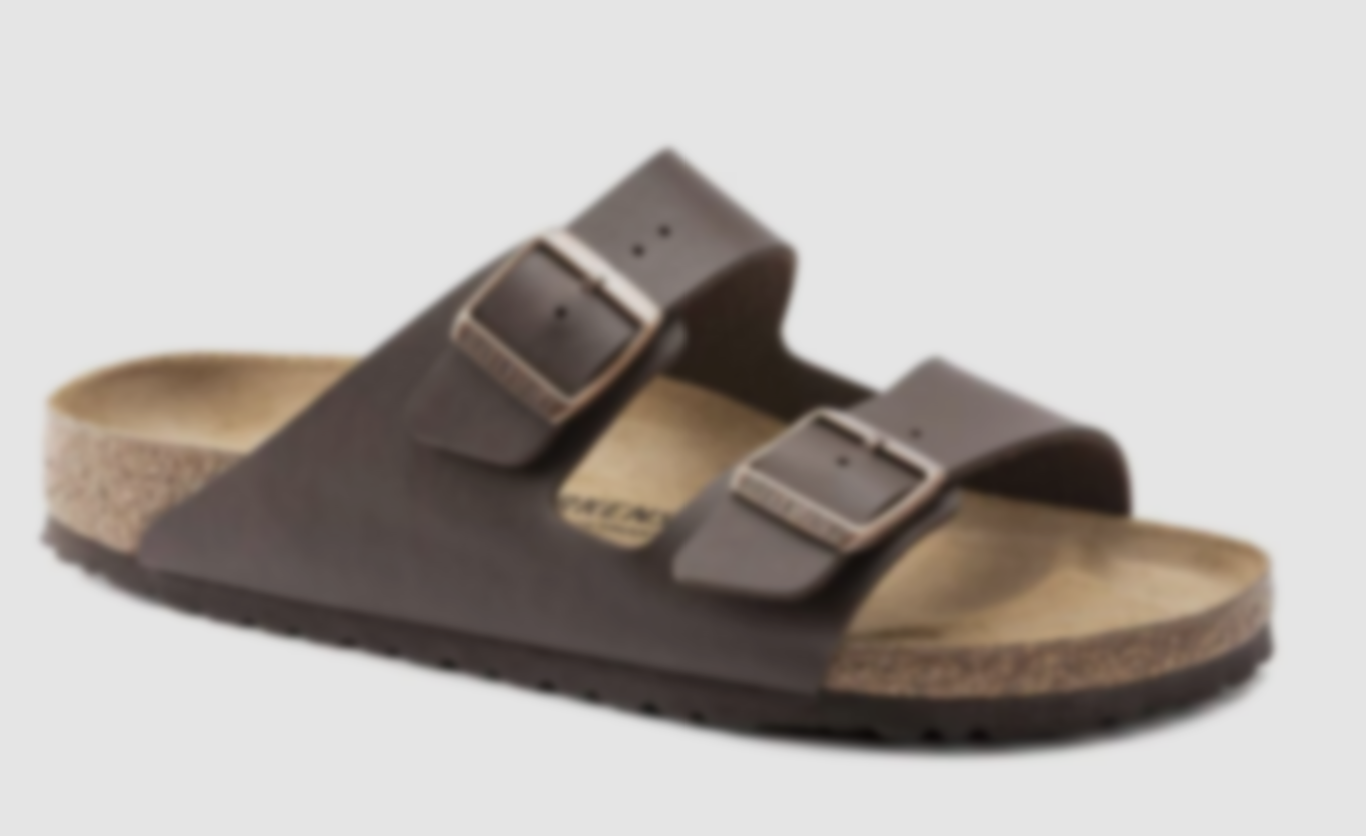
This is a picture of a classic Birkenstock sandal:
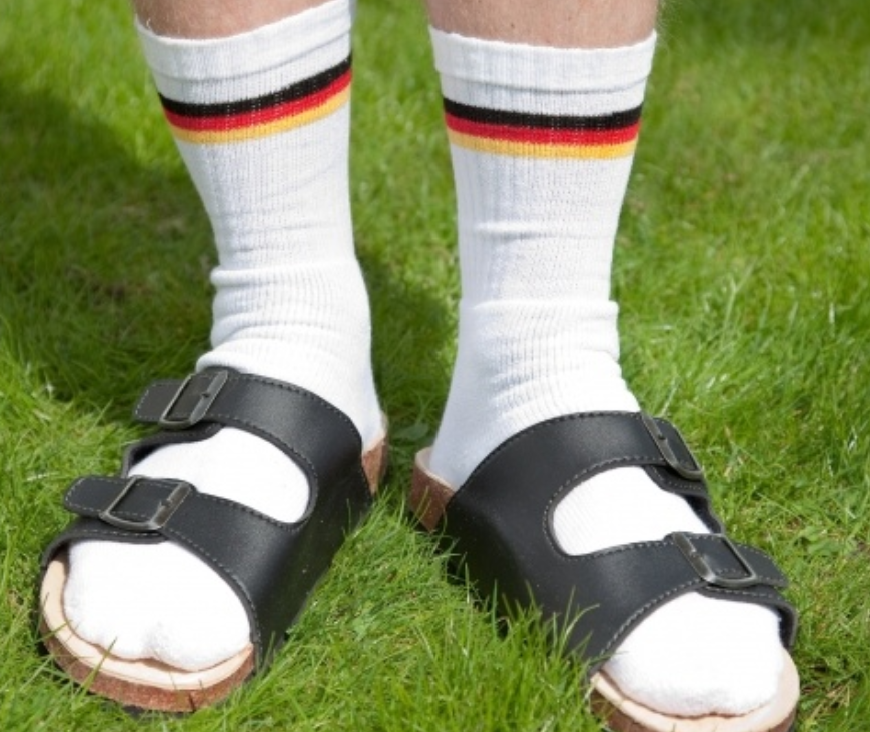
And if you ever were on vacation with a lot of Germans in the summer, this look might be familiar to you:
Birkenstock became fashionable in the Mid 2010s. Before that, especially in the US, Birkenstocks were considered “hippie style” but that changed when Birkenstock teamed up with famous design labels to create more fashionable versions.
Interlude: Dr. Martens – the famous example for a footwear fashion brand that is not so fashionable anymore
A famous example for an explosive run-up and spectacular drop of an iconic shoewear brand is UK footwear brand Dr. Martens.
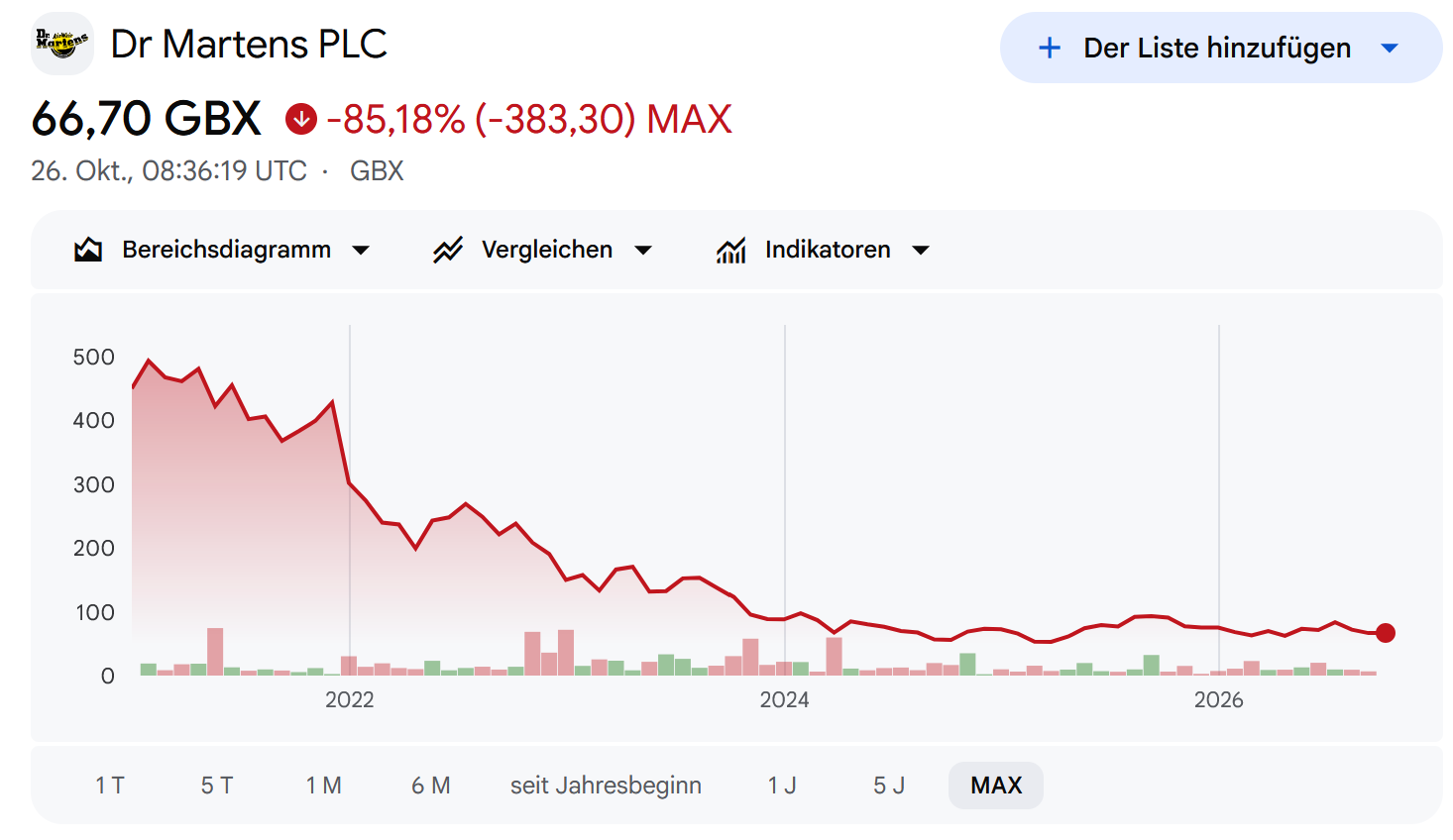
Dr. Martens was IPOed in January 2021 by PE shop Permira, which owned the company for 7 years. As we can see in the chart, after the first day “pop”, the stock went south pretty much soon thereafter and has now lost -85% from the initial IPO price:
Looking at the financials, we can see that Dr. Martens only managed to show 2 more years of double digit growth after the IPO before sales declined significantly and profits even more so:
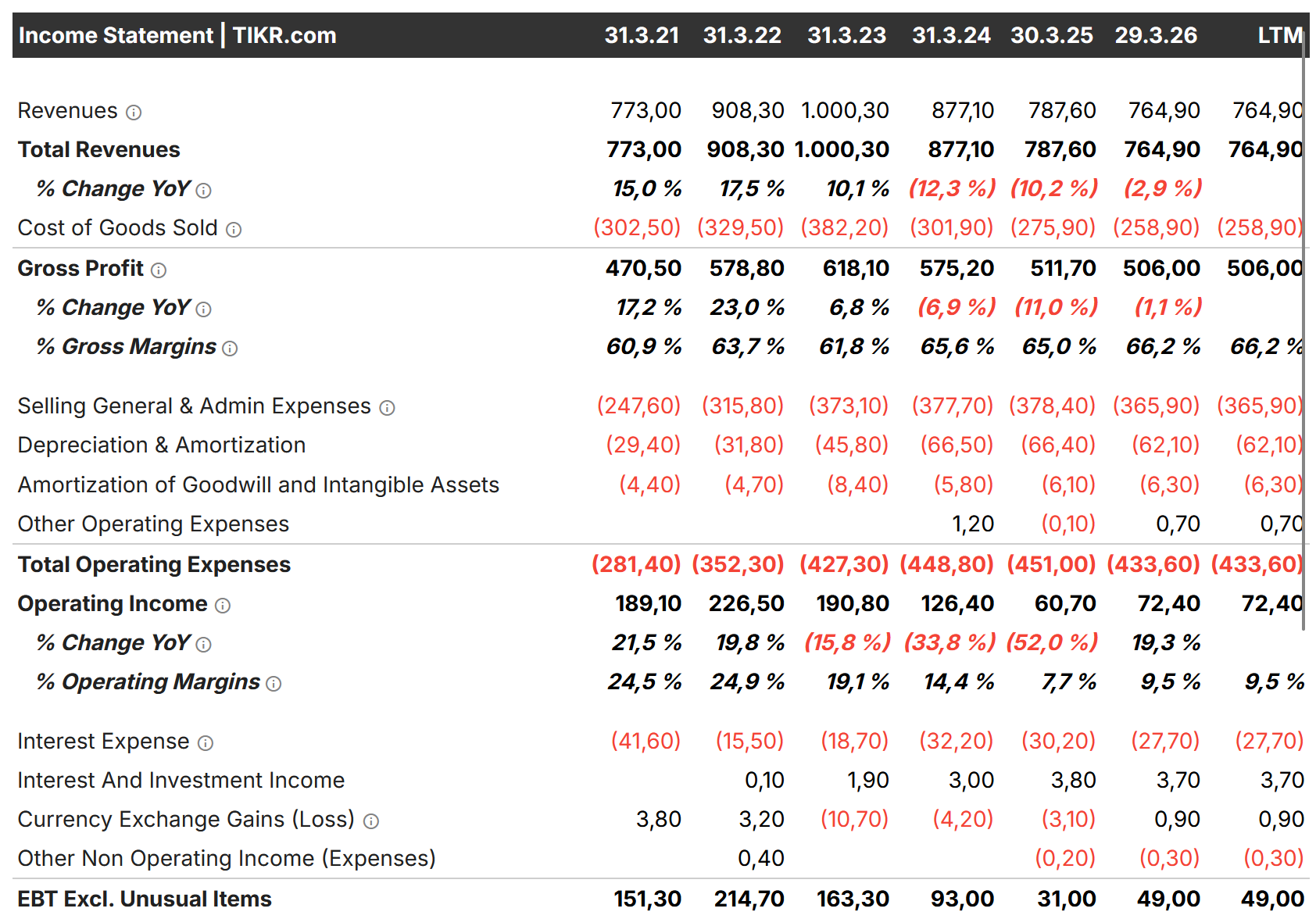
That’s clearly not enough if you IPO a company at 20x EV/EBITDA which Permira did. Interestingly, Permira still owns ~38% of the company.
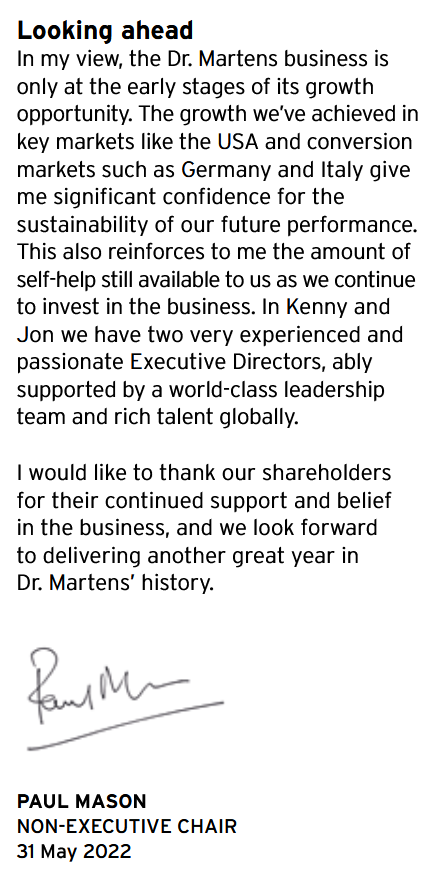
Reading the 2022 annual report, where they show 18% sales growth, the growth story still seems to be intact:
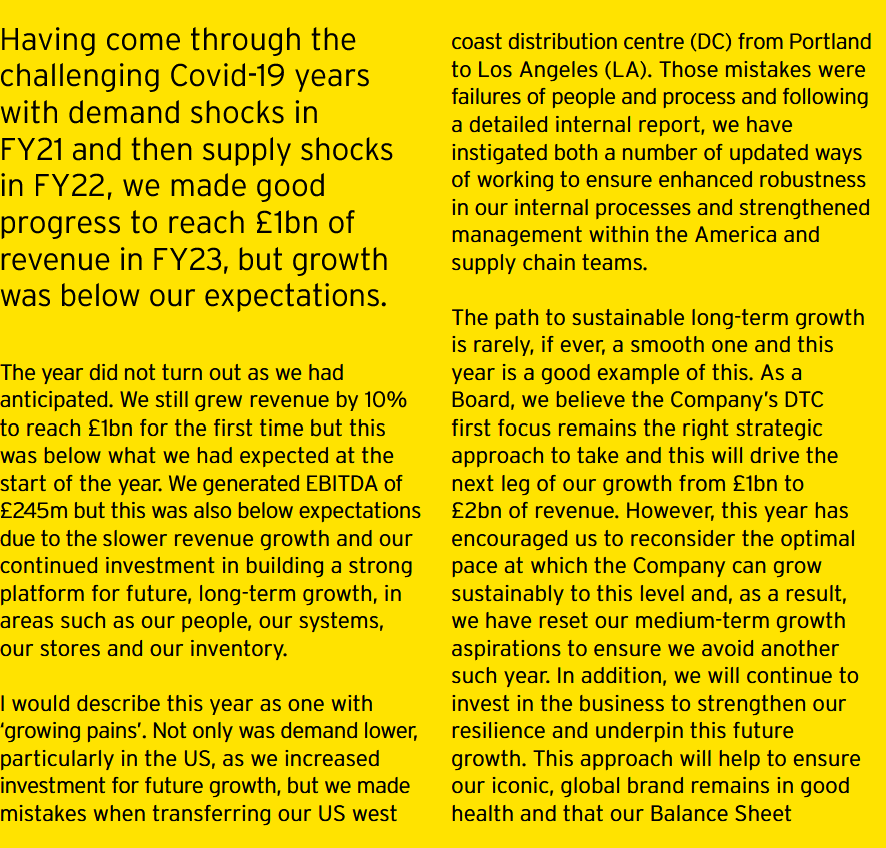
In 2023, lower than anticipated growth was blamed on the botched transfer of a US distribution center:
In 2024, the sales decline was blamed on cautious wholesale customers:
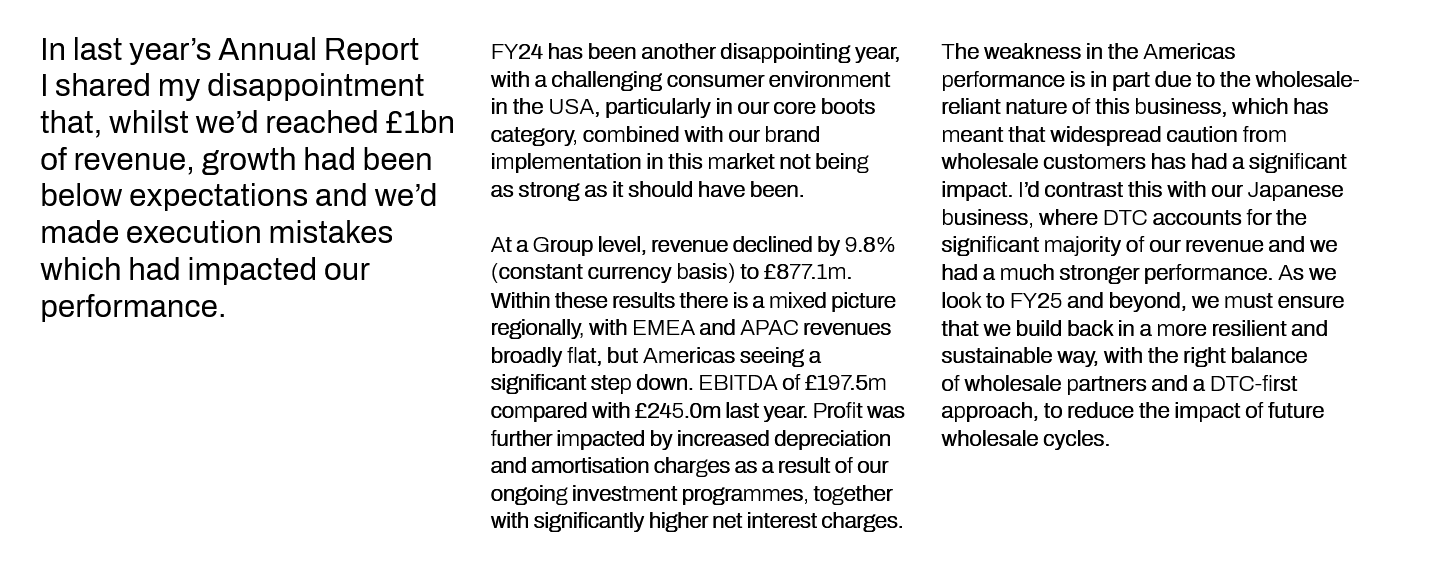
However, looking at the previous year report, one could already see that wholesale had declined and the brand only grew by opening a lot of new stores.
There are a couple of articles on why Dr. Martens became unpopular especially in the US. Overstocking after Covid and heavy discounts is one reason, but also moving the production from the UK to Asia is often mentioned (although that seemed to have happened long time ago in the early 2000s).
There seem to have been challenger brands like Solovair and Blundstone. Solovair boots interestingly seem to be manufactured in Dr. Marten’s old factory in the UK.
Their latest report from May 2026 still shows a decline in sales but a certain recovery in (adjusted) profits:
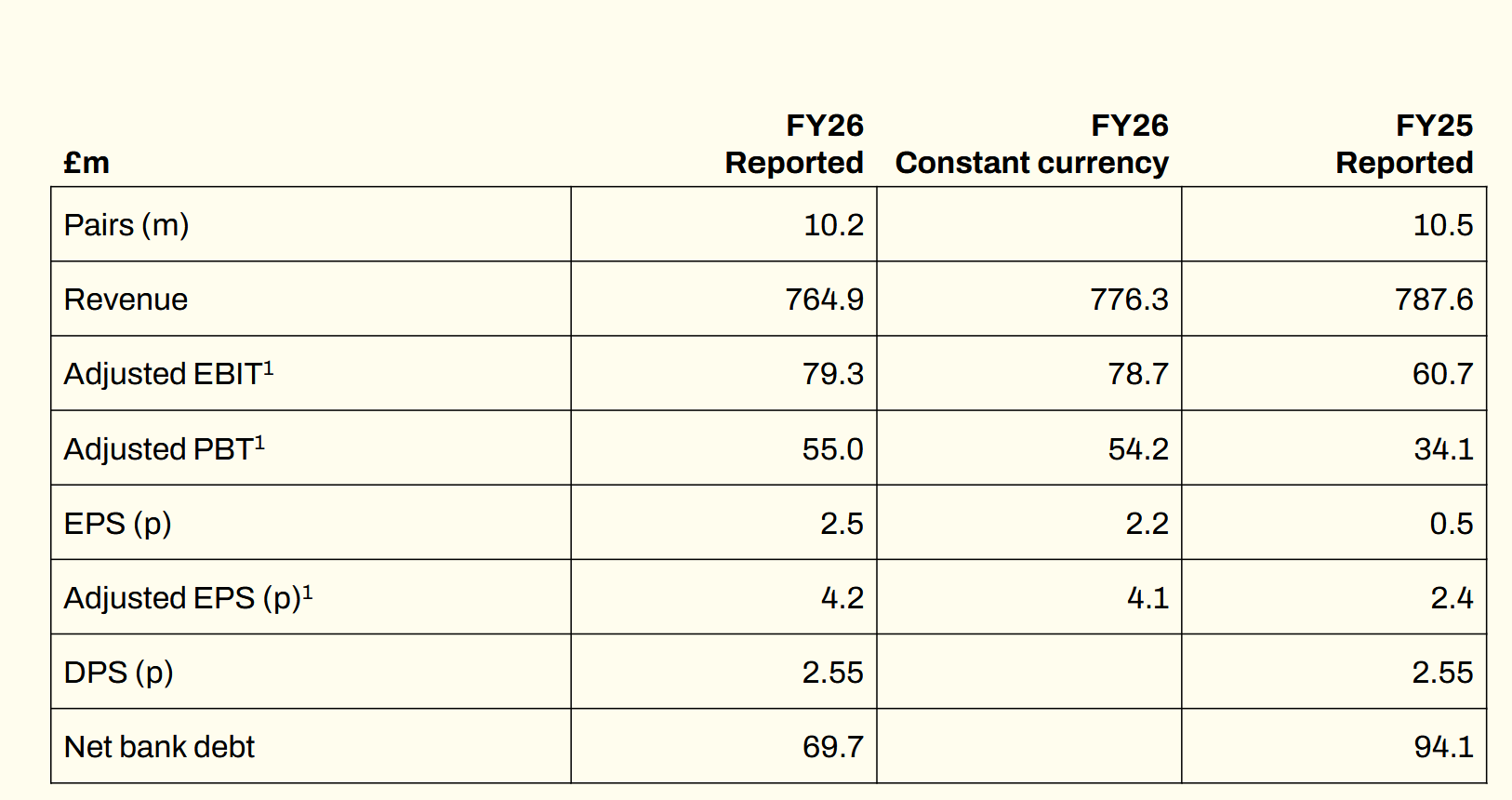
So turning around a once hyped but then struggling footwear brand is clearly not that easy.
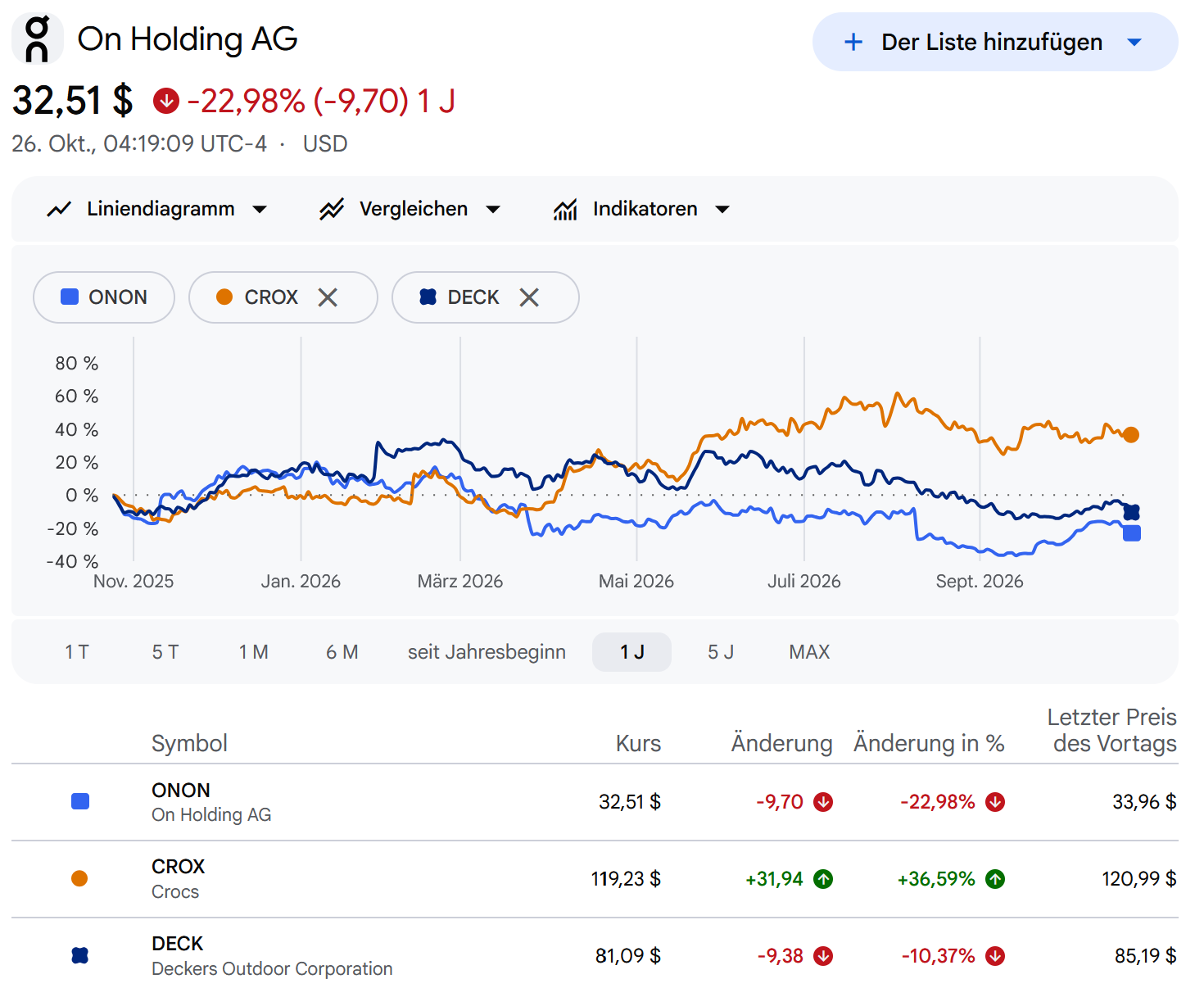
It doesn’t help that a lot of other footwear brands have very weak stock charts, too, with the exception of Crocs:
Back to Birkenstock:
Overall I find Birkenstock quite interesting but it is clearly not an easy stock. For full transparency, I am not a “Birkenstock person”, I have never owned a pair and will most likely never own one. But still, it could be a potentially interesting “broken IPO” story as long as growth remains in the mid teens.
My gut feeling tells me that Birkenstock is less “fancy” than Dr. Martens and compared to Dr. Martens for instance, Birkenstocks are still produced in Germany, not in Asia.
However, there are already a lot of similar smaller brands that sell similar shoes for much lower prices than Birkenstock, for instance this one or even Sandals that are manufactured in German prisons.
Dr. Martens clearly shows that when a trend breaks, it can take a very long time to recover, if at all.
The comparison of Dr. Martins and Birkenstock is also a great use case for an AI analysis/report. In this case, I asked Claude to research the similarities and differences between Birkenstock and Dr. Martens and I have to say that the result was quite interesting.
This is Claude’s summary:
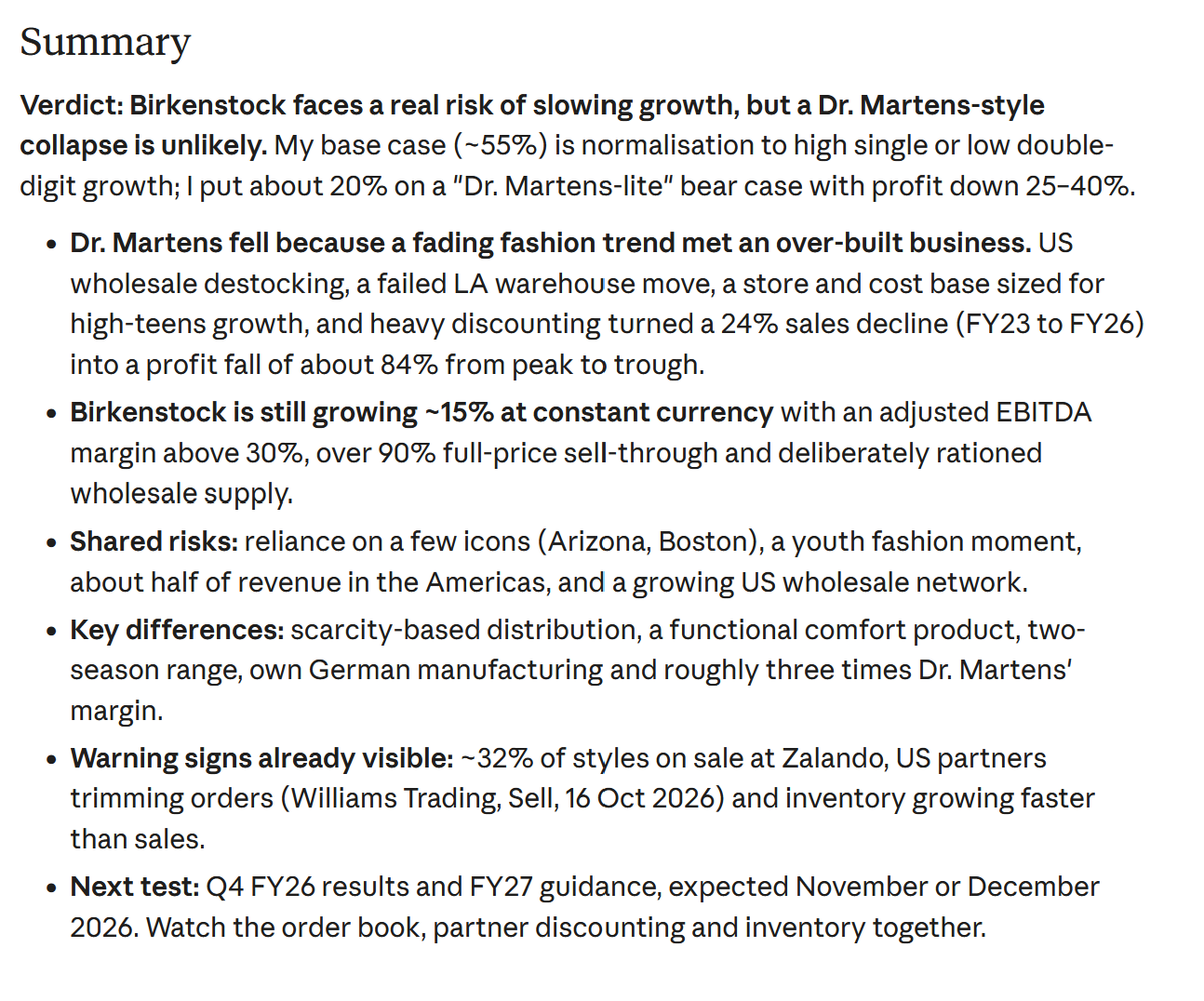
I would certainly not base any investment decision on this, but it confirms my feeling that Birkenstock is not exactly on the same trajectory as Dr. Martens a few years earlier. But clearly there is a risk that they might not grow at 15% for many more years, which the current share price seems to expect as well.
A big learning in any case is (and this is no surprise) that you should avoid investing into PE sponsored IPOs of some hot footwear brands at a valuation of 20x EV/EBITDA or more.
The PE guys definitely know when to sell and as an investor, you should not try to outsmart PE guys at an IPO. Maybe there is one out of 10 that is doing really good, but the probability is slim.
When you look at Private Equity portfolios which often have average valuations of 16-18 x EV/EBITDA, it is clearly not a surprise that IPOing or selling them at these valuations are not easy.
For Birkenstock, I will watch the company but at the time of writing, I could not build enough confidence to start a position despite the quite attractive valuation.
I think especially the massive sales of L. Catterton just a few weeks ago does not create a lot of confidence that growth will remain at mid teens levels for that long.

