Category Archives: Opportunities

Gronlandsbanken AB (ISIN DK0010230630) – Sleepy eskimo bank or moat company with natural resource option ?

Sometimes the only reason why I research a stock is because I find it interesting for some reason, not because it will be a good investment or so.

Gronlandsbanken AB is such a stock. Although it showed up in my Top 25 Scandinavian stocks, normally I would discard that because it is a bank. With Gronlandbanken however, the fact that this is the only listed stock of a company from Greenland got me interested.

Before looking into the bank, a few facts about Greenland from Wikipedia:

– Greenland has arond 60 tsd inhabitants spread over 2 mn square kilometers, however only 400 k square kilomoters are not permanent ice (Germany has ~350 k Square kilometers)

– politically, Greenland is mostly independent since 1979, however strong ties to its former “Colonial master” Denmark remain, among others the offical currency which is the Danish Krone
total GDP is estimated to be around ~2 bn USD
– However, basically 50% of the countries GDP are transfer payments from Denmark
– Greenland left the EU in the 80ties but still enjoys free trade and other preferred treatments via Denmark
– most people basically work for the Government, the second largest sector is fishing
– Last but not least, Greenland could become one of the prime beneficiaries of climate change, as its vast natural resources could become much easier to access

The Bank:

Grondlandsbanken has been founded in 1967. In 1997 it merged with the only other bank in Greenland, Nuna Bank and is therefore the only bank based in Greenland. However it doesn’t seem to be the only bank with branches in Greenland as this post shows:

Banking
There are 2 banks in Nuuk, Greenland Bank and BankNordik. However, the latter has no cash function. There are ATMs in both banks in Nuuk, and cash in advance and Visa Card can be used in all stores and the like.

Anyway, it looks like competition is currently quite limited in Greenland in the banking sector.

Gronlandsbanken valuation looks Ok, but not very exciting:

Market cap: 830 mn DKK (~110 mn EUR)
P/E Trailing ~14
P/B 1.0
Dividend yield 6.5%

Around 65% of the shares are held by large shareholders, among them with 14% the Government of Greenland. So “free float” is around 30-35% or 35-40 mn EUR only.

Interestingly, value shop Sparinvest has a 0.44% stake . Another value fund which I didn’t encounter yet, Nielsen Global Value holds 5% as well. For them it seems to be a quite significant position with 5% portfolio weight according to the latest fact sheet.

Thankfully, no sell-side analyst has discovered the stock yet.

The stock is up 56% YTD, however this is still less then 50% of the peak price back in 2007:

Not surprisingly, the stock has a very low beta of ~0.55 vs. the Danish stock index.

But why buy a bank at book value if you can get banks for 0.3 times book ?

Well, there are a few things which are “not normal”:

– Gronlandsbanken has an equity ratio of 17.3% (that’s right, not Tier 1 ratio or such crap)

– their net interest margin is around 4%-5%, Return on assets is around 1.7% If we compare this to the most profitable banks like HSBC (1.9% – 0.6% and Standard Chartered (2.4% and 0.9%) or DNB (1.4% -0.6%), we can see that Gronlandsbanken is at least twice as profitable as the most profitable European bank.

Due to the high ratio of equity, ROEs do not look spectacular, but still my model calculates ~15-16% total ROE with a relatively low volatility. According to my model, the fair value for such a company should be around 1.3 times higher than the current market price.

Especially interesting for me was the 2011 annual report from Gronlandsbanken.

The pages 8-16 are definitely the best summary of the economic situation in Greenland I have been able to find. Most interesting was the following passage:

Greenland at a Cross-Road
Looking forward the economy of Greenland will come to a cross-road because most likely the economy will follow one of the following paths:
1. If one or more of the major projects are built, enormous pressure will be exerted on the economy of Greenland with concurrent high rates of growth and pressure on inflation. Based on current analyses, a great deal of the required labour force will be from abroad.
2. If none of these major projects is built, the major challenge in Greenland will be to create jobs and to ensure economic growth.
Within a few years, we can be expecting either very high rates of growth or zero-growth, or perhaps even negative growth. On the other hand, it is harder to imagine a middle-of-the-road scenario with reasonable and sustainable rates of growth since there are few growth-drivers in the economy (except for metals and minerals).

So this is fundamentally a very interesting “Binary” situation with a clear “trigger”.

Some of those “projects” mentioned are relatively interesting as well:

– Oil: Uk Cairn Plc seems to have drilled for oil but has found nothing yet
– a public listed company called London Mining Plc is trying to develop a large iron ore mine
– ALCOA seems to be interested in building a large Aluminium plant
– there seems to be a “rare earth” project buy an Australian listed company called “Greenland Mineral and Energy”, the so called Kvanefjield deposit.

Additional interesting articles form the Web about the natural resources developement in Greenland

Natural resources and Oil in Greenland
Cairn’s drilling results in Greenland
Chinese interest in Greenland
Chinese workers to be “Imported” ?

So it seems to be that the Government in Greenland seems to “warm up” to the natural resources projects. Maybe this is the reason why Management is buying shares since end of October. The amounts are not huge but every other day one can see purchases.

Summary:

Although I wish I had discovered Gronlandsbanken some months ago, I still think it is a really interesting stock:

– as it is the only bank in Greenland, its margins are around twice as high as the best global banks and the balance sheet is rock solid. One could call this a natural moat
– even based on the current state, current valuation implies significant upside to fair value
– the Greenland resource story could add significant growth going forward, even with maybe other banks entering Greenland
– finally, Management has started to buy shares after surprisingly good Q3 numbers
– although there is no direct catalyst, an indirect catalyst could be if some of the projects proceed well and Greenland will move inte the spotlight. Gronlandsbanken is the easiest (and only) way to invest into Greenland without project specific risk

As a result, I will start with a 1% position in order to further track this interesting “opportunity” stock.
Rhoen-Klinikum (DE0007042301) – or why merger arbitrage is a really hard business

The Story of the takleover fight for German hospital operator Rhoen Klinikum has been in the news quite often lately.

I try to summarize it in a few short sentences:

Fresenius AG the big German healthcare group launched a bid at 22.50 EUR contingent on getting 90%
– in the meantime, some of the German competitors bought large stakes (Asklepios, Braun) of 5% to block the deal
– additionally some M&A arbitrage specialists (John Paulson) took stakes as well, hoping for a higher bid
– on the weekend, Fresenius then declared that they will not pursue the offer and the stock price drops almost 30%

Rhoen is now back or even below the level before the offer:

This shows that merger arbitrage is not an easy business. I have to confess that i was tempted to speculate on the Fresenies offer as well, but thanks to not having time to write a blog post, I didn’t jump into it as I would have done before I started the blog.

Fresenius is a big player and I would have thought that they might make at least one more attempt to gain 90%, which under German law would give them the right to squeeze out monrity shareholders.

However, now it is a different situation.

Rhoen is a well managed company and scores quite well in my Boss model. On top, we know that the private market value of the company is 22,50 EUR and one could theoretically buy it at a nice discount. Rhoen is one of the few German companies which do not have a majority shareholder although the fuender with his 13% holding still has a big influence but obviously not enough.

However, Rhoen is now clearly “in play”. I am considering really hard, if I should not open a half position for my “special situation” bucket.

Any opinions on that one ?

Draeger Genußscheine (ISIN DE0005550719) Update

No real news but a very interesting developement at my largest portfolio position, Draeger Genußscheine.

As a refresher: The “Genußscheine” include the right to receive 10 times the dividend of the pref shares (DRW3, ISIN DE0005550636). I started the position as a long Genußschein / Short pref shares “carry trade”. I decided to cover the short when Drager issued a EUR 210 offer and keep the Genußscheine as this put a floor under the price.

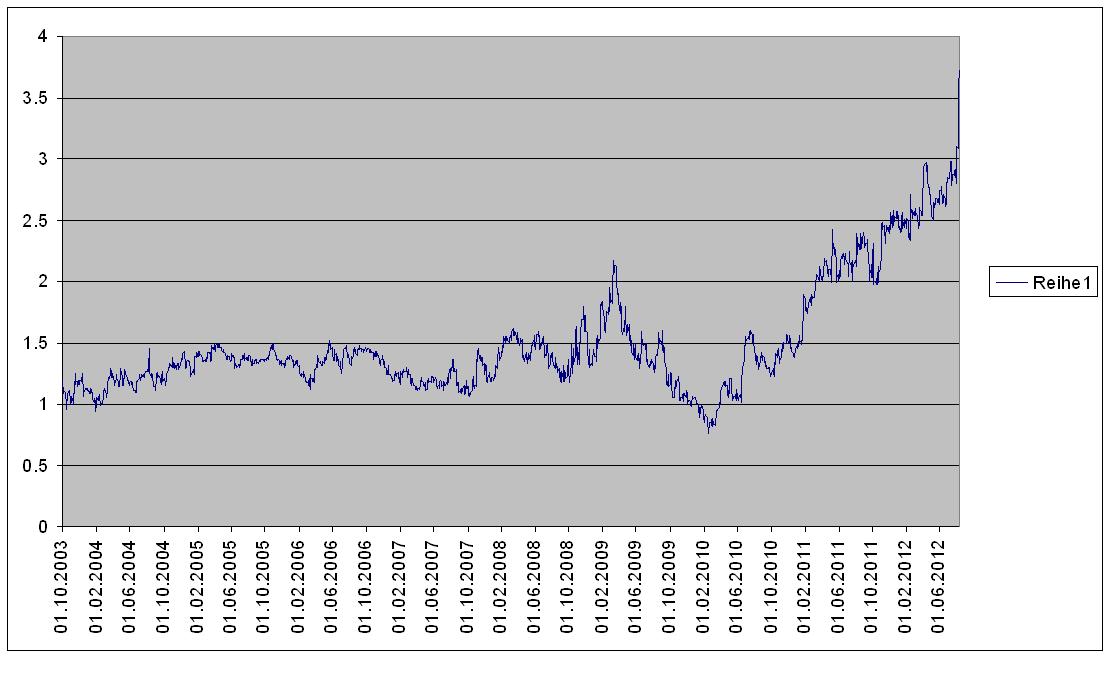
Now, in the last view days one can see something interesting happening: The Pref shares trade lower while the Genußscheine jumped.

If we look at the 10 year history of price of the Genußscheine divided by price of the prefs , we can see that the relation has increased significantly to a 10 year high at currently around 3.7 times.

I didn’t find any real news, however in some internet boards there is a speculation that either Draeger might increase the dividend or even come out with a higher offer. I am not sure about that if they will really do something.

Back then I wrote the following:

For the patient investor, I think the Genußscheine will be still an intersting medium term investment. For the portfolio I will hold them unless I find something better, there is no need to sell.

I think this is the same lesson as from the AIRE KGaA example as well as with the Bertelsmann Genußschein: If someone really wants to have a company or a certain share class / security , it usually pays off to wait and not jump on the first offer.

In the past, I often used to sell at the first offer, being happy to make a nice gain quickly. But as those two example show (so far), the risk /return relationship of just doing nothing and wait further seems to be quite good.

The only “problem” now is that the position is currently 10.2% of the portfolio. a ~10% is kind of the maximum I can stand for a single position, I will have to decide to sell if the Genußschein moves further.

Portfolio updates: AIRE KGaA, April SA, Cranswick, Dart, Installux

AIRE KGaA:

For AIRE KGaA, I decided to accept the tender offer at 18.25 EUR per share. There is not a lot of upside left and I guess the stock will be really illiquid after the offer.

Installux

Whereas the built up of Poujoulat goes really really slow, For some reasons, last Friday almost 2.500 Shares have been traded. That’s almost 1% of the market cap. Interstingly, in Bloomber a new fund called “Agicam” showed up at the end of April with a 0.99% position. Due to those sales, I could now already built up a stake of 1.8% of the portfolio in Installux shares, a lot faster than I thought.

DJE Real Estate

The sell down of this position is quite cumbersome. Up to know, I could only sell half of the position so far. However prices are relatively stable.

Dart Group & Cranswick

Both shares were relatively active over the past few days, so I could establish 2.5% positions fopr both. Dart Group issued their “preliminary annual” statement as of MArch 31st, a very good write up can be found here at ExepctingValue.

For Dart I will wait for the final annual report in order to determine if I increase the position to the full amount (5%).

April SA

Since I ahve increased my buying limit for April to 11,50 EUR, I could establish a small position in the stock (0.6% of the portfolio). Of course I got punished and bought ~2% higher than today’s share price……

Cash is now down to around 16.5% of the portfolio, but taking into account the AIRE Tender Offer, Cash is around 21.5% of the portfolio. So plenty of room for 2-3 new ideas…..

Italian updates – Piquadro, Sol Spa, Emak

Reporting season in Italy. Among my portfolio and watch list, several companies issued relevant material.

Piquadro:

Piquadro had a sort of “trading update” which for some reason cannot be found on the homepage but for instance here.

Although sales went up 4.3%, Profits declined from 9.1 mn to 7.8 mn (0.18 EUR per share to 0.156 EUR per share). And they are cutting the dividend from 0.10 EUR per share to 0.06 EUR.

Based on my initial valuation, Piquadro is still within the base case (20% EBITDA margin). So for the time being no action, but a reminder to check the annual report how non-Italien sales and own shops performed against the other segment.

Sol Spa

Watchlist stock Sol Spa has issued two interesting pieces of information. First of all, they were able to place a 12 year private placement bond at 4.75% in USD. With 12 year USD swap rates at around 2%, this represents a credit spread of around 2.75%. This is around 1.5% lower than Italy has to pay for the same duration. So we clearly see that a well managed Italian corporate can finance cheaper than the Italian Government !!!

Secondly, they have issued an investor presentation which shows that for some unkown reasons they are also investing in Hydro Power in Slovenia and Macedonia. I am not sure how this fits into the corporate strAtegy, but it explains part of the increase in Capex.

Q1 results are a mixed bag. Increasing sales but a reduction in margins. Capex still high as the aggressively move into Eastern Europe (Bulgaria, Albania).

Difficult stock. Still on watch.

EMAK

Emak had issued Q1 numbers already a couple of weeks ago. Interestingly again the acquired companies dare doing relatively well. Based on the first quarter, Emac could earn around 0.08 EUR per share which would result in a 2012 P/E of around 6.

CS Euroreal closed as well

Already yesterday’s news but here ist the link (German).

So not really a surprise, the price chart showed already clearly the outcome:

In the wake of this process, also the other funds lost further, which kind of makes sense as now even more real estate is hitting the market:

For instance the Axa fund lost even more:

As I have mentioned before, I think at some point in time, the funds could become interesting again, but there is no need to hurry now.

Edit: According to this article, business for the remaining open funds seems to be really good. So at some point in time we might see some selling activity from the closed funds.

AIRE KGaA – Increase of Tender offer to 18,25 EUR per share, Q1 report and Uncle Sam

What a day again for the AIRE KGaA stock.

As reader AS has commented already, AIG has increased the tender offer again up to 18.25 EUR per share.

To make the situation even more interesting, the Swiss fund Alpine Select filed that they have increased their share holding to close to 17%.

In parallel, AIRE published today the Q1 report 2012 which did not contain any news. Money is still coming back. Interestingly they showed on page 8 that 55% of the portfolio is residential real estate, I assume most of this in the US. Current NAV is around 20 EUR.

One funny aspect of the current situation:

I was quite confused that the US Treasury Department was disclosing a stake in AIRE KGaA, ut the i read this sentence:

These voting rights are to be attributed pursuant to sec. 22 para. 1 sentence 1 no. 1 WpHG via American International Group, Inc., United States of America.

As the US Treasury is still holding the majority in AIG, effectively one can sell now the AIRE shares to Uncle Sam.

I think I will soon start selling the shares as the upside seems to be now relatively limited. at the current price it will e the first real “Double”.

Update DJE Real Estate, SEB and CS Euroreal

DJE Real Estate

Thanks to a friend a received the link to the recording including the slides.

Most important points:

– cash payment of ~17-20% of NAV in Juli (1.30-1.50 EUR)
– however overall cash flow to fund holders much slower than initially thought

In the original post I wrote the following

A) around 2/3 of the fund’s investments (based on NAV) are relatively liquid. It should be no big problem for DJE to return 5 EUR or more within the next 12 months or so. This would mean that at current prices, the investment itself should flow back pretty soon and the discount to intrinsic value could decrease equally soon

This seems to be have been overly optimistic. As far as I understood, a couple of funds have extension options from the side of the fund and some of the still open funds need at least 12 months notice to get the money.

According to management, the secondary market for those funds seem to be very illiquid with large discounts.

So for the portfolio, I will start selling the fund from today on, as my investment case which implied signifcant cash flows in the next 12 months does not really hold.

SEB & CS Euroreal

As now already widely known, the SEB has closed for good beginning of last week.

The CS Eurreal is trying its luck now with Monday, May 21st as the last day where investors can ask for redemptions.

Current price action and price to NAV for the CS indicates a very low propability of reopening:

So potential real estate buyers will see a large pipeline of real estate offers from all those funds with sometimes quite similar objects.

One thing which is interesting is that as far as I know, the funds do not really have to sell all obejcts within the communicated timeframe (i.e. SEB 5 years, AXA 3 years). If they don’t manage to sell, the deposit bank has to take over.

As the deposit banks most likely will not want to be involved in those cases (there will be a wall of law suits along the way) they most likely will directly auction off the properties.

So the end could be quite ugly in the worst case. On the other hand, if prices fall further, the run off funds could become interesting again.

Catching up: Green Mountain, AS Creation and AIRE KGaA Tender offer at 17 EUR

What a week for the portfolio ….

Green Mountain

Green Mountain imploded (again) last week after they lowered their guidance.

Green Mountain had many attributes making it a “perfect short”:

+ shady accounting as revealed early by Sam Antar at WhiteCollarFraud
+ massive insider sales
+ negative free cashflows
+ pumped up growth through expensive acquisitions
+ expiring patents in 2012

David Einhorn, now credited for “revealing” the over-valuation was actually relatively late in the game. However one has to admire his timing capabilities. I was relatively early and hat to swallow a intermediate -40% loss on the position before I got into the money.

The question is now, how low can the stock go ? If GMCR is a “real business”, then the current valuation seems to be fair. If they are a real fraud, the stock could go down much further. Also one should remember that momentum always goes in both directions. Nevertheless, as the easy money on the short seems to have been made, I will exit (cover) the short on Monday.

AS Creation

AS Creation reported surprisingly good Q1 numbers which show that at least with a certain time lag, the company does have some pricing power in its core business. The outlook is mixed as they expect losses when they ramp up the Russian JV.

Nevertheless, I think the first quarter gives credibility to the managment as they always told investors that on an annual basis they are able to pass cost increases onto clients.

AIRE KGaA Tender offer EUR 17 per share

After I was already happy that my special situation investment AIRE KgAA offered to buy back 10% of the shares at 14 EUR, suddenly AIG real estate issues an offer for 17 EUR per share for the whole company.

Luckily, I only sold relatively small amounts of AIRE at around 14 EUR. As someone said before: Sometimes it better to be lucky than smart.

What I find interesting about the offer are two things:

– first, they seem to have already 31.8% of shares under their control, so from their existing 7.85% the have bought 24% through option contracts

– second, based on the official NAV of around 21 EUR, the 17 EUR offer in theory does not leave a lot of upside for AIG. However one has to remember, that AIRE KGaA owns a lot of highly leveraged equity positions in US developements which were pretty aggresively written down to zero over the last few years. So there is lot of positive optionality in the legacy portfolio. If some of those projects are “coming back”, the NAV could be significantly higher. AIG Real estate as the previous manager should know those projects pretty well.

If I remember correctly, they were active in residential, multi tennant developements. Maybe this has to do with AIG’s decission from early April to go back into real estate investments on a larger scale. I had actually read this but didn’t really make the connection.

For the time being, I will wait for the final offering documents to decide what to do, however I will continue to sell down to 5% of portfolio weight.

As Green Mountain was the ideal short, AIRE KGaA was the ideal special situation:

+ unusual vehicle (listed, closed real investment fund, US and Asian real estate, only German listing)
+ difficult to analyse (lot of debt, but non-recourse)
+ bad name / scandal, however no direct exposure (AIG)
+ early entry of “activist” investors (Grevenkamp, Swiss guy)

From a timing perspective, I was very lucky in the portfolio, getting in at a very low point in January 2011. The chart shows that with such investments, one usually has time to analyse and invest. It doesn’t reallypay out to invest driectly after the drop:

After the big drop in 2008/2009, the stock was “sleeping” now for almost 3 years before something happened.

That is something to keep in mind for investing in such situations. I t takes some time until the value will be (hopefully) realised by someone.

AIRE KGaA – annual report published

AIRE KGaA published their annual report 2011 yesterday.

The NAV slightly increased from Q3 2011 to EUR 21.30 per share.

The most interesting news however is to be found on page 5: From the initial 65.6 mn EUR potential investment commitments, only 2.4 mn EUR seem to be now relevant, as most of the other commitments did expire or will expire soon.

At year end 2011, AIRE had almost 22 mn EUR in cash on hand, representing around 5,20 EUR per share. The buyback announced this week, will use only up to 5 mn EUR, so we can expect some further buy backs soon.

So for the time being, despite the insider issues discussed, I think the value of the shares should be strongly protected to the downside.

For the portfolio, I will continue to sell down until a 5% weight is achieved (from ~7%). However, due to the low volume this might take a while.

« Older Entries Recent Entries »