Celesio Merger Arbitrage – follow up (and exit)

On Thursday, acquirer McKesson and Elliott agreed on a slightly increased offer 23.50 EUR (vs. 23 EUR) per share which Elliottt promptly accepted.

Interestingly,the stock trades now higher than the offer:

Apparently, during Wednesday some people already anticipated the increased offer. Technically, the acceptance period has not been extended and closed on Friday, January 9th according to the official statement. Honestly, I do not understand this. If I read §21 of the German take over law correctly, any late change in the offer automatically extends the offer period by 2 more weeks. I will need to double-check this.

The offer for the 2018 bond was also increased to 123.4 according to the amended bond offering document.

So what to do now with the price of he shares trading above the 23,50 EUR offer ?

Going back to the initial post, that’s how I valued the shares back then:

Now if we want to speculate on a top up, we have to make two assumptions: How likely is a top up and how large will it be ? In order to keep it simple, I would assume a 50/50 chance for a top up and as I like “round” numbers, I assume 5 EUR per share or a final offer at 28.

This leads us to the following expected value under those assumptions:

Exp. value Celesio share = (3.4% x 17) + (48.3% *23) + (48.3%*28)= 24.25 EUR or around 10.6% higher than the current share price.

So if we leave aside the rather bad mistake in calculating the upside potential, the price is now where I saw the “fair value” before, although I was totally wrong about the size of the “top up”. The reason that I still can make some money was that I bought below the initial bid price and the stock price did overshoot the offer.

Now we do have a very different situation compared to some weeks ago:

a) It is almost 100% assured that the bid goes through, there is now a “floor” under the stock price at 23,50 EUR
b) on the other hand it is a lot less likely that the bid will be further increased.

I can think of two reasons why the stock is currently trading above 23,50 EUR:

1) People are hoping that Elliott might have one last trick up in its sleeve to increase the offer within a relatively short time
2) Speculation that McK wants to quickly achieve a squeeze out and will buy more shares and/or have to pay some compensation for implementing the profit and loss transfer agreement (similar to MAN).

Overall, the “new” situation for me is harder to grasp and the time frame is more difficult to estimate. One should also expect, that Celesio will show most likely a lot of extra charges etc. in the next few quarters in order to both, build some buffer for Mckesson in the future and to discourage shareholders bidding up the remaining shares.

So for the portfolio, I will exit the position at current prices with a modest gain of around 6.5% for the shares and a little less for the bonds. Not spectacular but also not bad for a 4 week and relatively low risk investment.

One final remark on such M&A Arbitrage situations:

I have written above that this was a “Low risk” bet. In reality, I do not know if it was high risk and I was very very lucky or if it was indeed low risk. In statistics, one would call this a “beta error”, assuming that one was right but in reality the probabilities were very different. For me the best way to handle this is to do only small “bets”, keep track of assumptions and outcomes. Systematic “beta errors” in investing in my opinion are very dangerous as this will inevitable lead to some disastrous outcomes in the long run (Bill Miller).

Ackermans & Van Haaren – Mini Berkshire from Belgium ?

Ackerman’s and Van Haaren is a diversified Belgian company which was on my research pile for quite some time. Bloomberg describes the company as follows:

Ackermans & van Haaren NV is an industrial holding company. The Company’s holdings are in the contracting-dredging environmental services, financial services, staffing services, and private equity investing.

Looking onto their participations overview on the (very informative) homepage, one can easily see that this is a quite diversified company. From oil palms in Asia (SIPEF) to old age homes, port service companies, real estate investments and an Indian cement company are among the 30 or more participations.

The largest investments are however a 78.75% Stakes in Delen Investments and Private Bank J. van Breda and a 50% stake in DEME, a marine engineering Group.

The DEME stake itself shows that Ackermans is rather an active holding company. This year they surprised everyone by striking a deal with Vinci and traded their 50% stake in DEME (valued at 550 mn EUR) with a 60% stake in CFE, the listed Belgian company which owns the other 50% of DEME.

The stock itself is not really cheap:

P/B ~ 1.3
P/E 2013 ~15
Market cap: 2.8 bn

The stock gained nicely in 2013 and is trading at an ATH:

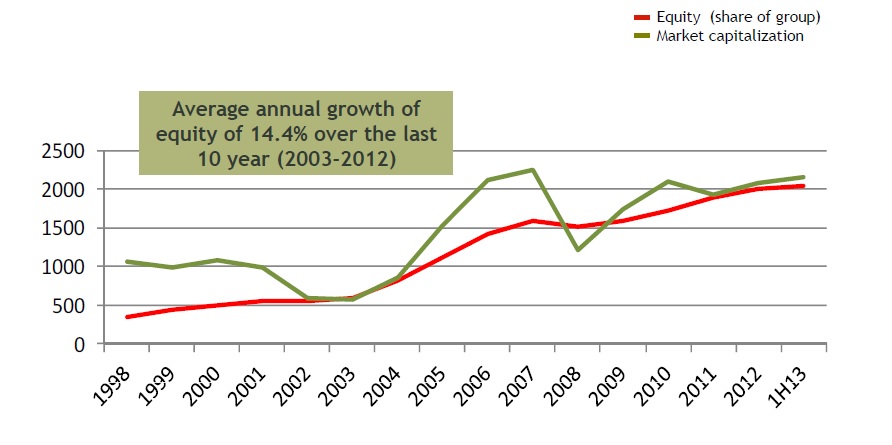
Why did I call them a potential “Mini Berkshire” in the beginning ? Well, that’s what they are showing in their latest Q3 presentation:

avh cagr

14.4% CAGR of book value is not bad over the last 10 years. Just for fun, I calculated Berkshires 10 Year CAGR from 2003-2012 based on the disclosure in the latest letter to shareholders:

Berkshire  
   
2003 21%
2004 10.5%
2005 6.4%
2006 18.4%
2007 11%
2008 -9.6%
2009 19.8%
2010 13%
2011 4.6%
2012 14.4%
   
10 year CAGR 10.60%

So at least for the last 10 years, AvH has clearly outperformed Buffet by almost 4% p.a. which is really a lot.

Step 1: “Quick and Dirty” sum of parts

When I look at a company like AvH, i generally try to do a quick and dirty “sum of part” analysis first. AvH makes it quite simple by providing a net cash figure at holding level which is required as the consolidated accounts include non-recourse debt as well.

The only thing I was not sure was the fact that the holding segment borrowed money from the private equity part in an amount of 120 mn EUR. I decided to play it save and deduct it from the private equity NAV.

So this is the “quick and dirty” result:

Value Method
DEME 550 Implicit valuation takeover
Van Laere 26 0.75 book
rent-a-port 5 at book
Maatschappi 20 At book
Sipef 130 market cap 482
Delen 522 1.5 book
van Breda 336 1.2 book
Extensa 80 0.8 book
Leaseinvest 108 Traded
Financiere duval 40 at book
AnimaCare 40 2x book
MAx Green 70 10x Earnings
Telemanod 30 10x Earnings
Sofinim 255 75% of NAV minus cash to holding
     
Net cash holding 148 Q3
     
     
Total 2,361

The result of this exercise is higher than stated book equity of around 2.05 bn EUR, but on the other hand, significantly lower than the 2.8 bn market value.

If I haven’t made a big mistake, then even if some of the holdings like Delen are worth more than I assumed, AvH looks as it is trading at a premium. Although I think the company is a good one and can create value, I would not want to pay a premium, so one can stop at this point and move on.

Summar:

Ackermans & Van Haaren seems to be an interesting company with diverse holdings and a good culture and some very good and interesting businesses. The track record over the last 10 Years looks impressive and is better than Berkshire. Nevertheless, the stock looks overvalued from a sum of parts point of view, offering no margin of safety.

Valmet Spin off – No action

Yesterday, Valmet was spun off from Metso and trading for the first day.

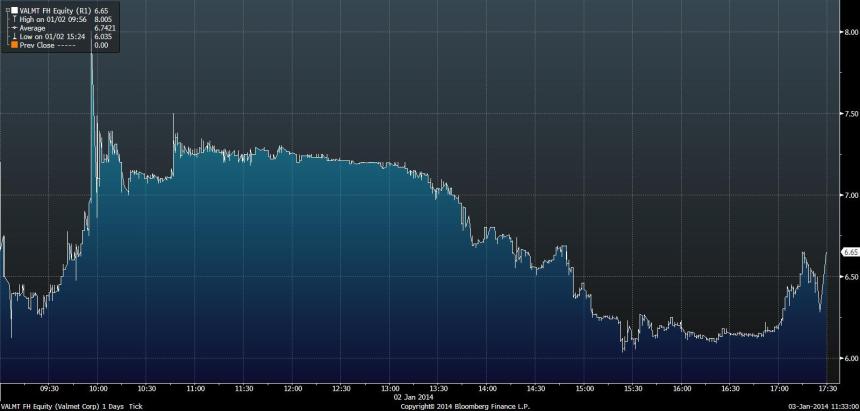
The price action on the first day was quite interesting. The first trade was around 7,20 EUR, far above my threshold of 5 EUR, then the price went down to ~6,30 before rocketing up to 8 EUR. ending up at around 6,65 EUR. Today, the stock is trading at 6.80 EUR.

For me, this is too expensive, but it is still interesting, how volatile such a first day of a spin off really is. Intraday fluctuations of ~30% clealry show that this can’t be fully efficient and price discovery is not that easy. Trading Volume on the first day was around 45 mn EUR, or less than 5% of market cap.

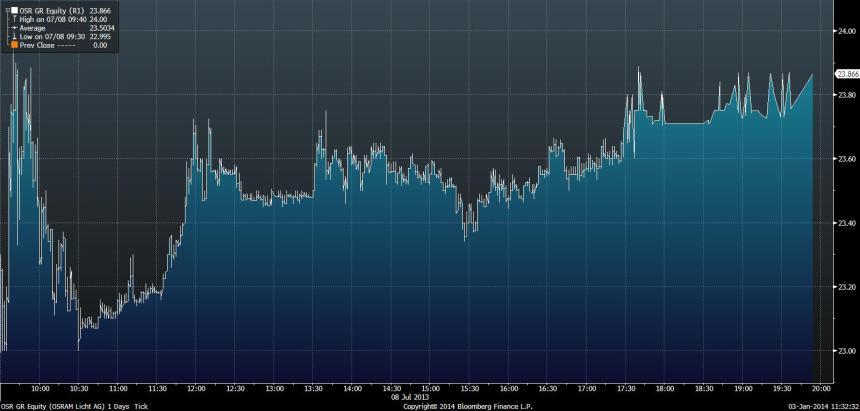
It is interesting to see that at the first day for the Osram spin off, volatility was lower and the stock price ended higher than in the beginning:

Trading for Osram on the first day was around 25% of market cap. I guess, that Siemens had much more index investors than Metso. In this case it would have been better to buy Metso pre spin off

Annual Performance Review 2013

Performance:

Performance for the month December was +1.2% vs. +1.3% for the benchmark, an underperfomrance of -0.1%. For the year, this resulted in +32.8% vs. +29.0% for the Benchmark (50% Eurstoxx 50, 30% Dax, 20% MDAX), an outperfomance of +3.8%.

Since inception (1.1.2011), the score is now +75.0% for the portfolio (20.5% p.a.) vs. 40.7% (10.4% p.a.) for the Benchmark.
Read more

Value and Opportunity “Design poll”

Dear readers,

a few weeks ago, I changed the design of the blog. I got mixed feedback since the change. Some did welcome it, some complained about the colors, some have problems reading it on mobile devices.

Personally, I like the colors of the new layout but I think the posts get too big on my screen. The old design was much more compact.

So it would be great if you could take a few seconds to answer the following 5 questions. Many thanks in advance !!!

Some links

10 interesting stocks for 2014 from moatology (I don’t know a single one of them….)

Frenzel & Herzing with the second part of their STo AG valuation

A nice “best book” list for 2013 from Farnam Street

Very interesting story about th movie “A wonderful life” and the guy behind the Bankers anonymous blog

Value Investing France with a (too) short summary of 2013

Jim Chanos, last bear standing, thinks it is a good time to raise fresh money for his short fund.

Finally, the free Winter issue of Grant’s interest rate observer (via Canadian Value)

My 24 (boring) investments for 2014

December is always a good time to look at the portfolio and revisit the initial investment case in order to decide if all the investments are still “on track”. I did sort out a few already some weeks ago, so this is kind of “double checking” on the ones I decided to keep.

Warning: Almost all of my 24 positions are pretty boring. So anyone looking for “hot tips” might skip this post. As most reader might know, I prefer rather “boring” stocks. In order add a little excitment, I added the company logos this time….. 😉

Before jumping into the stocks, looking back at last year’s 22 for 2013, 14 of last year’s selection are still “in”. This is in line with my goal to have an average holding period of at least 2-3 years for the normal value stocks. The number of stocks has grown by 2 but this is well within my range of 20-30 positions I am targeting. I am not a big fan of extremely concentrated portfolios.

1. Hornbach Baumarkt

A stock which is in the portfolio since the beginning. Had to fight several headwinds in 2013 like bad weather in the all important first half-year, a (now bankrupt) competitor who was selling for cash flow (Praktiker) and of course the internet. Nevertheless in my opinion a very good, ultra solid long-term holding. Could surprise to the upside next year.

2. Miko BV

Plastics packaging and Coffee distribution. Strange combination, but again ultra solid and cheap stock with relatively good growth over the years. Could surprise to the upside because of lower input costs (Coffee.

3. TFF Group (formerly Tonnellerie Francois Freres)

Despite the good performance still a very attractive French stock. Typical, family run solid and long-term oriented business. As one of the biggest Oak barrel manufacturers, TFF did clearly profit from rich people in BRIC countries buying expensive French wines and Whisky. They did take over the number 2 producer Radoux some time ago and seem to harvest the benefits now. A “luxury stock in hiding” so to say.

4. Vetropack

Swiss based, ultra solid producer of glass bottles. Currently struggling both, with high energy prices and low growth in some of its main markets, esp. Eastern Europe. Nevertheless a solid position. Some potential upside via a new thinner but equally solid type of glass bottle which might even replace PET bottles.

5. Installux

Very cheap and unspectacular French aluminium parts manufacturer with large cash pile. Surprisingly resilient business despite the weak home market. More like a “deep value” stock. 4.3% dividend yield.

6. Poujoulat

Another unspectacular French small cap, specialist for chimneys of all sorts. Large top line growth via entrance into wood pellet business, however large depreciation reduced overall margins. If margins recover, stock could have a lot of upside.

7. Cranswick

UK-based “pork centric” food group. Again, nothing spectacular but very solid performance. Still cheap compared to the quality of the business

8. April SA

French based insurance broker / specialist insurer. Currently struggling with French health care regulation. Nevertheless still one of the most attractive business models for financials.

9. Sol Spa

Technical gases and healthcare related gas business. Very well run, good growth in the Healthcare sector. True strength not shown in the numbers due to large upfront write-offs. Long term holding.

10. Gronlandsbanken

Basically only bank in Greenland with high margins and good return. Potential upside if rare earth mining projects and other natural resources projects get started. Potential “Global warming” beneficiary. 8.3% dividend yield makes waiting easy.

11. G. Perrier

Interesting French specialist for electrical installations. Growing business especially in the nuclear power area. Barriers for competitors due to certification requirements.

12. IGE & XAO

French based software specialist for electrical CAD. Quasi monopoly in France. Good margins and good growth plus large cash pile. Shareholder structure might make some “corporate action” possible.

13. Thermador

Very interesting French home building and improvement supplier company . Unique “outsider style” business model and corporate culture. Currently struggling a little due to low domestic French demand but very good company at an attractive price. 4.6% dividend yield.

14. Trilogiq

French production optimisation company. Based on Japanese production philosophy, company provides solution and know how to optimise production. Active mostly in the car industry. Net cash, good margins and still cheap.

15. Van Lanshot

One of the leading Dutch Private banks. Did make some strategic mistakes in the past. Now with CEO trying to focus on “traditional” private banking. If turnaround is succesful and “normal” private banking margins can be achieved, stock has good potential. Additional tailwind because of tax crack down on Swiss private banks.

16. TGS Nopec

Seismic data company with an “outsider style” business model. Doesn’t own ships, was very disciplined in “Underwriting” explorations in the past. Currently more competition from struggling “traditional” competitors with ships and oil companies. If business stays “normal” significant upside. 5.6% dividend yield and share buybacks.

17. KAS Bank

Dutch bank, specialising in securities services. Due to low-interest rates, profitability under pressure. Will benefit if short-term rates start to rise. In the meantime, 6.7% dividend yield “sweetens” the wait.

18. SIAS SpA

Italian toll road operator. Very cheap infrastructure asset, “under leveraged”. Paid large special dividend but also reinvested in additional toll roads. If traffic in Italy stabilizes, stock has good upside.

19. Draegerwerk Genußscheine

Capital structure arbitrage. One Genußschein is equal to 10 preference shares but trades only at a multiple of 4-5 times. Patience required.

20. Depfa LT2 2015

Lower tier 2 bond of nationalised Depfa bank. At the current price solid 7% expected return p.a. until maturity 2015 with relatively low risk.

21. Commerzbank HT1 Funding

Tier 1 Commerzbank bond with a twist: Coupon is guaranteed by a third-party. At the current yield level of around 7% still a good “hold” until I have better ideas.

22. Rhoen Klinikum

I bought the stock after the first failed take over attempt. Now it looks like that the sale of the majority of the business to Fresenius will be cleared. To be sold if my price target of EUR 22.50 is hit.

23. MAN SE

Another special situation, betting on Volkswagen having to pay more than the 83 EUR compensation initially proposed after implementing a profit and loss transfer agreement.

24. Celesio stock /Convertible 2018

Newest addition to the portfolio. Speculation that acquirer Mckesson will have to pay more than the 23 EUR offer due to Elliott (Paul Singer) blocking position.

Current Watchlist:

1. Valmet, Metso Spin off January 2014
2. Portugal Telecom: Merger with Brazilian OI in 2014
3. Maisons France: Potential “outsider style” company in tough market.

Special Situation: Celesio AG / McKesson take over – “Swimming with sharks”

DISCLAIMER: The securities discussed in this post are very risky and the author might have already bought some before publishing the post. The overall situation is tricky and not really recommended for “normal” investors due to the involvement of some well known capital market “sharks”.

Celesio, the German pharmaceutical wholesaler has received a takeover offer a few days ago from US giant McKEsson at 23 EUR per share under the condition that at least 75% of shareholders will tender their shares

A few facts/background:

– majority owner Haniel (also largest shareholder of Metro) needs money and committed to tender their controlling block of 50.01% for around 2 bn
– in the meantime however Elliott, the US Hedgefund acquired more than 25% and threatened yesterday to block the deal
– under German law, 75% is the threshold to establish a profit & Loss transfer agreement which gives full control to the acquirer as well as tax benefits

As a result, the share price of Celesio dipped slightly below 23 EUR after hitting 23.70 EUR earlier.

The offer
McKesson has actually created a dedicated website for the offers with all documents, some videos etc here including the detailed offer document.

The acceptance period runs until early January with a potential extension period until end of January. Similar to Vodafone/Kabel Deutschland, talks about the take over become public already several weeks before the official offer. I think this is clearly part of the game from the seller in order to get a good price.

Nevertheless I found it surprising that since the first announcements of the deal, McKesson’s share price surged and dropped when Elliott said that they want more. Elliott is even using this as their main argument according to this article:

The surge in McKesson’s value by $7.7 billion since early October, when reports on a takeover offer appeared, was a clear sign the Celesio acquisition offers high synergies for the U.S. group and is a bad deal for minority shareholders, Elliott said.

Celesio looks clearly expensive at 23 EUR. However even without operational synergies there is a lot of potential for improvement. Celesio pays ~150 mn interest on 2bn loans, a 7.5% interest charge. McKesson is able to refinance below 2%, this alone is more than 100 mn p.a. savings.

Elliott Management

Elliott Management is a well known US hedgefund ran by Paul Singer. They are most famous for their over a decade long fight with the Argentinian Government, where some months ago, the even went so far to seize the sailing ship of the Argentinian Naval forces.

In Germany, they were already active in two similar Deals, Demag Cranes and Kabel Deutschland. At Demag Cranes, they already cashed out with a nice profit (~+30%), after blocking the threshold at 90% which allows a complete squeeze out. At Kabel Deutschland, the hold 11%, again blocking the squeeze out which works only if the acquirer has more than 90%.

With Celesio they seem to slightly change the tactic by acquiring 25% and actually threatening to block the entire bid. However, one aspect remains the same: They involve themselves only when Anglo-Saxon bidders are in the game. I guess they don’t want to involve themselves with potential unpredictable players in “Local feuds” like in the Rhoen case.

Anyway, one thing is clear: Elliott is clearly not a player which gets pushed around easily. On the other hand, they are in to make money. This is the main difference to the Rhoen case, where some of the players (B. Braun) wanted to block the deal at any cost.

Simple “Valuation exercise”:

I would assume that the “undisturbed” Celesio share price in the months before the offer was around 17 EUR. So if the deal falls through, at the current price one would experience a loss of -25%.

If we assume that there will be no “top up”, than we can easily calculate the implied current probability that the deal will not happen based on a simple “binary” model:

x = (current price-offer price) / (undisturbed price – current price) = (22.80-23)/(17-22.80) ~ 3.4%

Now if we want to speculate on a top up, we have to make two assumptions: How likely is a top up and how large will it be ? In order to keep it simple, I would assume a 50/50 chance for a top up and as I like “round” numbers, I assume 5 EUR per share or a final offer at 28.

This leads us to the following expected value under those assumptions:

Exp. value Celsio share = (3.4% x 17) + (48.3% *23) + (48.3%*28)= 24.25 EUR or around 10.6% higher than the current share price.

Not a monster undervaluation but still a very attractive “bet” as the time horizon is rather short until the end of January.

A Twist: The Convertibles

Up until recently, Celesio had to struggle to refinance their debts. So they had to offer two convertibles in the past, each with an amount of 350 mn EUR which convert each into 17 mn extra shares (current total shares out: 170 mn).

The 2014 convertible will mature in 2014 nd is not a big issue with regard to the take over. However, the 2018 convertible is in my opinion much more interesting. First of all, the official strike price of 22.49 EUR will be adjusted down in case of a take over to compensate bondholders for the conversion premium paid at issuance.

Unfortunateley, I could not locate the full prospectus, only the 4 page summary from Celesio’s homepage. One 100 k EUR bond allows the holder to convert into 4.448 Celesio shares at the initial conversion price of 22.49 EUR per share.

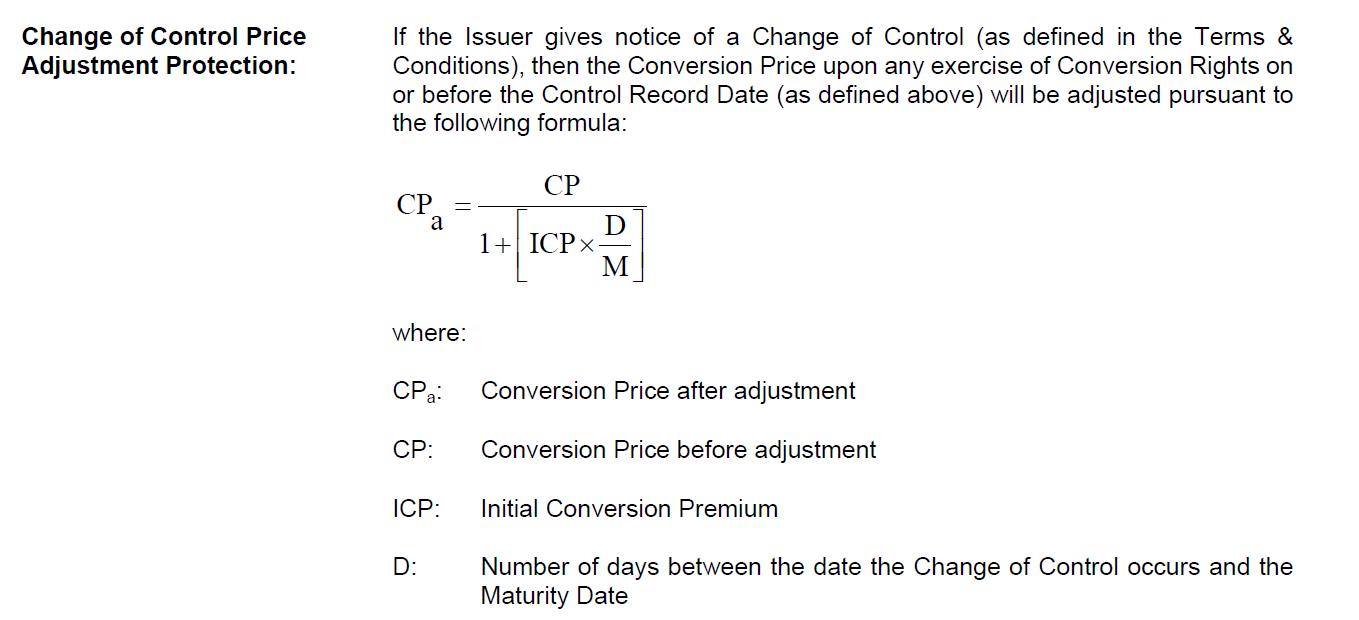
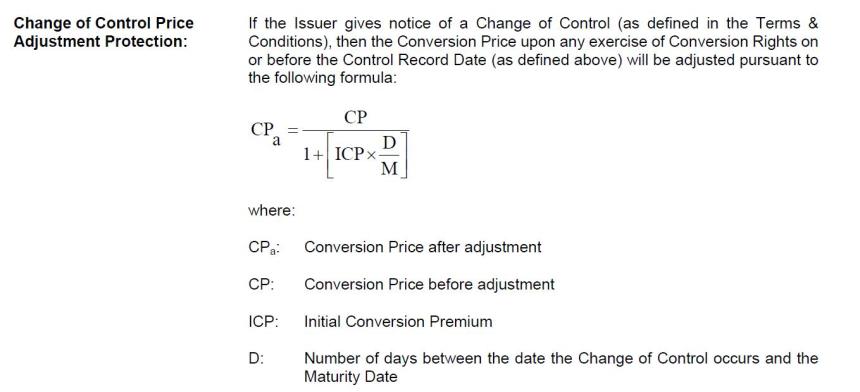
But now it gets interesting: In the case of a “change of control” event, the conversion price is adjusted downwards based on the following formula:
cls formel

This means that holders of the bonds now get more shares than before.

The “new” conversion price now would be now approx. 18.99 EUR, and the amount of shares accordingly 5.266 per 100k nominal. This in turn, multiplied with a share price of 23 EUR would mean a fiar value of the convertible of 121k or 121%, pretty much exactly where it is trading now.

In total, the 2018 convertible will be exchangeable into 19 mn shares, more than 10% of total outstanding shares at any time after the take over happens. However, this could turn out to be a big problem for McK. Any company doing such a takeover wants to get rid of minorities as quickly as possible and is therefore trying hard to squeeze out shareholders and delist the company.

With the 2018 convertible, this could be very difficult. Even if McK owns more than 95% of the shares, convertible holders could suddenly convert bonds into shares and then make a squeeze out impossible. The 2018 convertible therefore has a quite high “annoyance factor” for McK. In general, when a company has a more complicated capital structure, an “annoying” security can be a very good security to own.

In the case of the convertible, the only possibility for MCK to get rid of the convertible early, is the so-called “soft call feature”. This enables the issuer to call the bond, if the stock price is at or above 130% of the initial conversion price of 22.48. This would mean a stock price of around 29,20 EUR or an implict bond price of 154%.

EDIT: The soft call in the complete prospectus refers to the “applicable” conversion price. So in our case, after a change of control, it would be ~19 EUR and the call level would be around 24.70 EUR. This reduces the upside potential of the convertible, but it might increase the chances of a better offer overall.

That those thoughts are not totally without merit could be indicated via the disclosure int he offer documents that they seem to be already buying busily convertibles with the focus on the 2018 bond:

McKesson International Holdings IV S.à r.l., eine mit der Bieterin gemeinsam handelnde Person, hält 105 Anleihen 2014, welche zum regulären Wandlungspreis Wandlungsrechte in 233.437 Celesio Aktien gewähren, was 0,137% der derzeit ausgegebenen Celesio Aktien entspricht, und zum angepassten Wandlungspreis infolge eines angenommenen Kontrollwechsels am 17. Januar 2014 Wandlungsrechte in 242.494 Celesio Aktien gewähren,
was 0,143% der derzeit ausgegebenen Celesio Aktien entspricht, sowie 139 Anleihen 2018, welche zum regulären Wandlungspreis Wandlungsrechte in 618.327 Celesio Aktien gewähren, was 0,364% der derzeit ausgegebenen Celesio Aktien entspricht, und zum angepassten Wandlungspreis infolge eines angenommenen Kontrollwechsels am 17. Januar 2014 Wandlungsrechte in 730.042 Celesio Aktien gewähren, was 0,429% der derzeit ausgegebenen
Celesio Aktien entspricht.

Swimming with the Sharks

Why did I call this “Swimming with the sharks” in the headline ? Well, this is clearly not a small unknown company. We have Goldman Sachs (advisor McK) and Elliott in the game, both very very clever financial market players which i would consider as “sharks”.

The true “decision” tree ogf the players involved clearly includes a lot more branches with some of them resulting in negative payouts for “innocent bystanders”. So there is always the possibility that one ends up as “prey” in such situations, so be careful and don’t bet the house on any outcome.

So to summarize this quickly:

1. The Celesio share looks like “good value” if one believes in a certain upside due to the Elliott involvement and no dirty deals on the side
2. The 2018 convertible looks like the even more interesting part. In order to get rid of this bond, MCK will have to offer ~30% more than the current price which I think is very likely even if the Elliott trade doesn’t work out

In order to play both “games”, I will allocate 1.25% each for the portfolio, the stock and the 2018 convertible at current prices (22.80 EUR, 121%).

« Older Entries Recent Entries »