Creston Plc – business model & valuation

Yesterday, I “introduced” Magic Sixes stock Preston Plc, which based on first check is worth a closer look.

One of the improvements in my “investment process” which I try to achieve in 2012, is trying to understand better the respective business models of the companies I am analyzing. This is something where I do not have a lot of experience but let’s see if this adds some value.

Creston PLC business model

As mentioned, I am neither an expert in business models nor in the advertising agency business, but in my opinion the busienss model can be ccharacterized the following way:

+ very low fixed asset requirements (which is good)
The company does not have any fixed assets which is understandable because you only need some PCs and rent office space to run such a business.

+ limited working capital requirements
The company had in the last 2 business years almost zero net working capital, however as mentioned before, in the last 6 months receivables had increased to a certain extend. Still, we can conclude that the busienss itself does not require significant amounts of capital

+ People’s business
Jan Hendrik commented that this might be a typical “people’s” business. Based on a simple metric one can conclude that this is cleary the case here. Employe expenses for the 2011 financial year are 46.5 mn GBP, or ~80% of total expenses.

From what I know, salaries pretty low in the junior levels because a lot of people want to get into the “creative business”, however on a senior levelö salaries tend to be pretty high as companies have to make sure that the most creative employees don’t just switch companies (and take their clients with them…).

+ barriers to entry

Based on my understanding, the barriers to entry into the ad/pr agency markets are pretty low. Evidence is the large number of ad agencies. Contracts are tendered by corporate clients on a regular basis. I would assume that the company posseses some sort of proprietory data & information as well as customer relationships, but nothing which would count as a “real” barrier to entry against any competitor.

Maybe Creston as a mostly UK based player has some niche advantages, but overall this seems to be a very competitive market. Further proof for this are relatively low NI margins (~5%, fluctuating between 1.5% and 8.5) over the last few years. I also doubt that the business is really scalable.

Summary business model: Creston seems to be in a very competitive industry with low barriers to entry, however the business requires only a minimum of capital. Nevertheless, it would be quite aggressive to really assume significant growth for the future. So the “investment thesis” would be rather a “reversion to the mean” theme.

Historical profitablity

NI Margin ROIC
2001 1.4% 1.2%
2002 3.8% 5.5%
2003 4.9% 6.6%
2004 4.8% 5.1%
2005 3.6% 7.2%
2006 6.4% 7.8%
2007 5.9% 5.9%
2008 7.9% 8.0%
2009 8.4% 6.2%
2010 3.5% 7.7%
avg 5.1% 6.1%

As indicated before, the net income margin averages at around 5% over the last 10 years, however with some volatility. Much more interesting is the low return on invested capital. With 6.1% this is clearly below any cost of capital number. Before I said that the business model doesn’t really require assets, so why is this number so low ?

The answer is relatively easy: Goodwill. ROIC includes goodwill and the low single digit return tells us one thing: Creston just spent too much on those acquisitions, so the returns on puchase price are not really good.

If one looks at the company history in the 10 year report, one can see that every second year companies were bought and sold. Much of the free cashflow generated did go into those acquisitions, only a small amount was distributed to shareholders. Usually, small M&A transaction can be positive, but the track record for Creston is not great. We also don’t know if this is going to change in the future.

Another disturbing issue is the fact that numbers of shares increased significantly in the past:

shares mn
2001 11.2
2002 11.2
2003 21.9
2004 25.2
2005 36.6
2006 54.9
2007 55.6
2008 55.7
2009 61.3
2010 61.3

I could only find one “straight” capital increase in 2002 (5.6 mn shares at 0.60 GBP), so they seem to have paid a couple of their past acquisitions with stocks. So at the end of the day, Management seems to have been quite easy on increasing the numbers of shares in the past, which is not good for the shareholders.

Quick valuation:

Asset Value
Without any real assets, the downside for Creston Plc is basically unlimited. If things go south and key people leave, I highly doubt if there would be any value left. I have no idea how much the goodwill is worth, but my worst case assumption would be zero.

Earnings Power Value

If we assume a “reversion” to the mean approch, we can think about 5% net income margin for Creston going forward. As there are no interest payments, depreciation is neglectible, net income might be a good proxy for Free cashflow.

Based on current sales of annualized 70 mn GBP, expected profit in a steady state would be 3.5 mn GBP, discounted with 10% would give us a market capp of 35 mn GBP, slightly above the current 31 mn GBP.

At that point, we can stop. Without a downside protection, the “steady state” valuation is around the current price level. Without any competitive advantages and general economic headwinds, the stock looks unattractive, despite qualifying under the “Magic Sixes” criteria.

Magic Sixes quick check: Creston plc

Regular reader know that I run a “Magix Sixes” screening for investment idea generation.

This idea is from Peter Cundill’s book and is a very simple screen: Stocks which trade below 0.6 book, below 6 PE and have a dividend yield of > 6%.

As one could imagine, the result of this search are not really “wide moat” beauties…

However, one new entry, Creston PLC doesn’t look too bad.
Read more

Weekly Links

Latest report of SIA advisors

Great analysis of Dart Group Plc from Valuestockinquisition

The competitive adavantage of part-time investing

Quarterly letter of Kerrisdale. 200% performance in 2011, good paragraph on struggling retailers.

Always a good read: David Merkel ranting against simplistic valuation metrics.

The new semester in Damodaran’s valuation class starts on January 30th, don’t miss it. Will this be the slow death of universities ?

Very good post from Wexboy about catalysts and activist investors

Seth Godin about an underestimated competitive advantage

Q4 letters from East Coast Management and Tweedy Browne

Buchbesprechung – Nicolas Schmidlin “Unternehmensbewertung & Kennzahlenanalyse”

Vorbemerkung: Ich habe ein Exemplar vom Verfasser zugesandt bekommen und wurde um eine Besprechung gebeten. Ich hoffe und denke, dass es sich dennoch um eine unvoreingenommene Besprechung handelt.

Gute Deutschsprachige Literatur zum Thema Bilanzanalyse und Value Investing ist eher selten. Umso erfreulicher ist die Tatsache, dass sich jemand die Mühe macht, sein Wissen und Kenntnisse über Bilanzanalyse, Kennzahlen Berechnung und Unternehmensbewertung in Buchform zu veröffentlichen.
Read more

Piquadro SpA – Competitors, market analysis and strategies

Normally it is quite difficult for a private investor to get hold of comprehensive market information. One could try to google and try to collect some articles, but “hard data” is usually only available if you pay.

However, many listed companies include some market and competitor info in their analyst presentations. Piquadro provides us with a nice graphic of competitors in its 2011 April Analyst presentation:

Interestingly, in it’s own presentation one can see that the “Premium / Performance” segment is also the most crowded one.

An even better source for market data are IPO filings. In an IPO prospectus, companies usually provide a lot more information than in annual reports, as they have to persuade new investors that this is a exciting market.

Luckily, competitor Samsonite actually was IPOed last year on the Hongkong stock exhange after filing bancruptcy in 2009 (and also in 2002 if I remember correctly). The Samsonite story also shows the biggest risk for those companies: Overexpansion and too much lease liabilites, in this case driven by a Private Equity owner.

Tumi, currently owned by PE firm Doughty Hanson is currently on the path to an IPO and has already filed its documents for an IPO. To make things more interesting, Samsonite already anounced its interest purchasing TUMI.

So we have to additional sources for market information in this case.

For Mandarina Duck, the other major competitor from the Piquadro Matrix, currently no financial information is available. It seems to be owned by a PE shop as well.

Let’s start with the “Competitor” section of the TUMI IPO prospectus:

Competition

We have a variety of competitors in the categories and geographic regions in which we operate. We believe that all of our products are in similar positions with respect to the number of competitors they face and the level of competition within each product category. Depending on the product category involved, we compete on the basis of a combination of design, quality, function, price point, distribution and brand positioning.

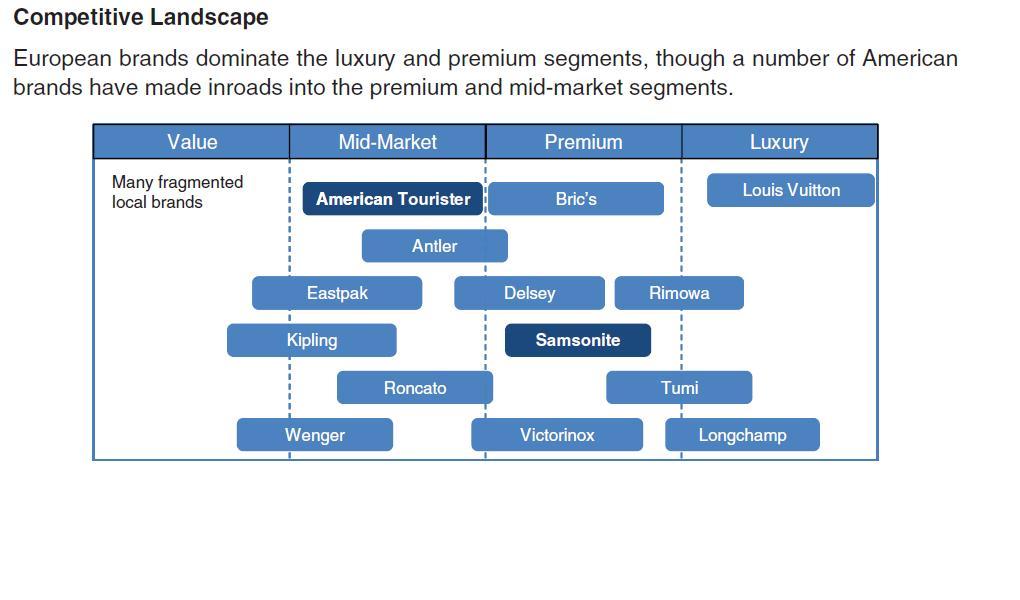
Our biggest global competitor in the travel goods category is Rimowa, a German company. We also compete with Samsonite in Europe, the Middle East, Africa and Asia-Pacific. In the premium luggage and business cases category, we compete with Bally, Dunhill, Ferragamo, Gucci, Louis Vuitton, Montblanc, Porsche and Prada. In the business case category, we also compete with smaller brands in specific markets. In the U.S., our main competitors are Victorinox and Briggs and Riley. In Europe, the Middle East and Africa, our key competitors are Mandarina Duck and Piquadro. In the Asia-Pacific region, competition is fragmented. In Japan, our two key competitors are Porter and Ace Brand. We also compete with Coach across the luggage, business cases and accessories categories.

We believe that our primary competitive advantages are favorable consumer recognition of our brand amongst our targeted demographic, consumer loyalty, product development expertise and widespread presence in premium venues through our multi-channel distribution. We may face new competitors and increased competition from existing competitors as we expand into new markets and increase our presence in existing markets.

So again, we do not see any “hard” moats but rather some fuzzy brand recognition and customer loyalty aspects.

Even more interesting is the very detailed IPO prospectus of Samsonite. This is a “treasue trove” of interesting market data.

The “1 million dollar quote” however can be found at page 95:

Barriers to Entry and Benefits of Scale and Leadership in the Luggage Market
Barriers to entry into the luggage market are generally low, which has contributed to the fragmented nature of the industry. Key challenges for an entrant or an existing company are investment in brand awarness, innovation in new products, access to quality producers, and developement of an effective national / local retail network.

So here the “market leader” tells us there are no barriers to entry. So no “moats”. Period.

The Industry overview section of the filing is really interesting and comprehensive (p-90).

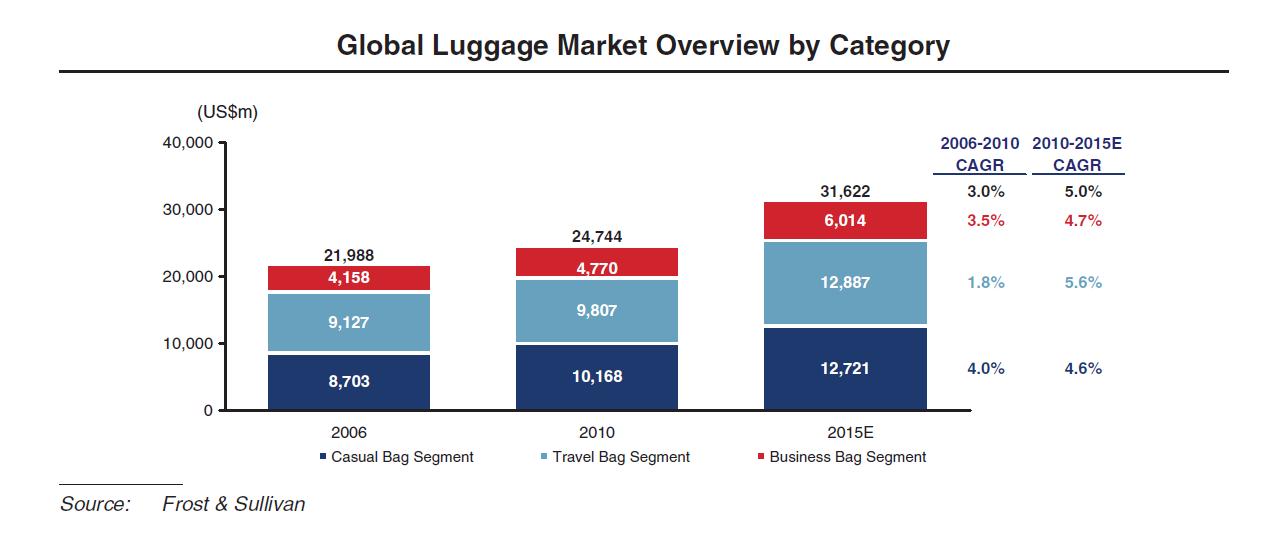
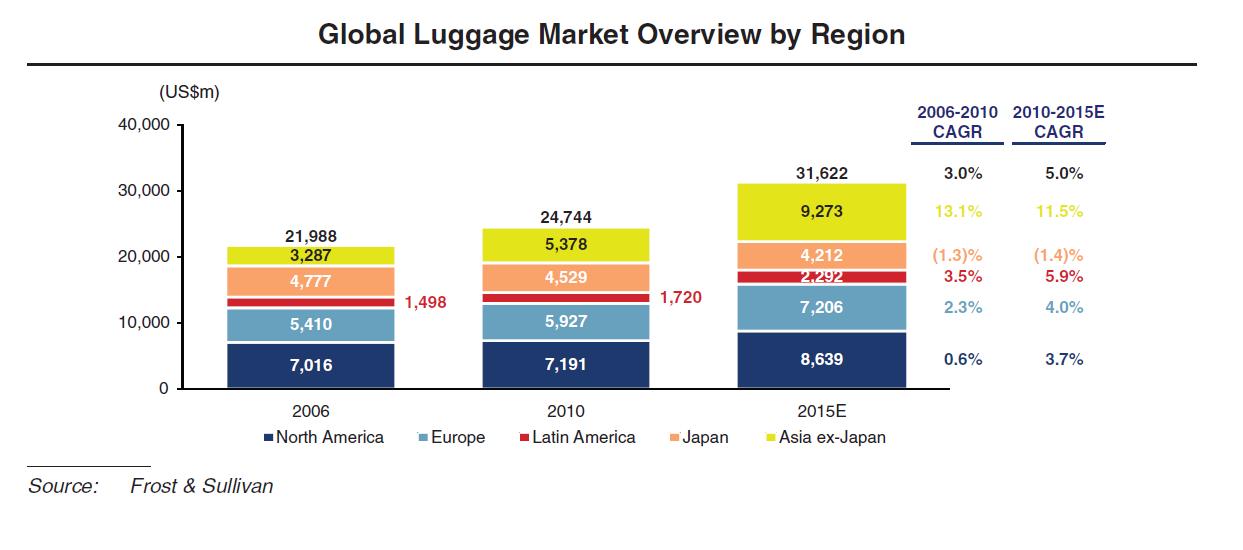
The market itself is supposed to grow at quite an attractive overall rate:

Samsonite itself does not yet realise Piquadro as competitor, neither Mandarina Duck. Piquadro and Mandarina Duck are only mentioned among others which are shown having a combined market share of 74.5%.

Howver, Samsonite places itself directly into the “Premium” category in contrast to Piquadro and Tumi themselves:

Side remark: Anyone who had the problem at an Airport baggage claim to find out which of the 25 identical black Samsonites is the own bag knows that this is more “mass market” than anything else.

The luggage market according to Samsonite can be segmented into 3 product segments:

Samsonite also has an interesting “market share” slide for Europe which shows the high fragmentation:

So the big question is now: Should I stop now with analysing Piquadro because there is definitely no “objective” moat ? I would say, no, because for some reason, Piquadro has been able to grow, maintain high margins and produce free cashflow. When we continue to evaluate the company we should however incorporate a certain “normalisation” of returns anad margins.

Also the whole market segment seems to be quite attractive as even in “good old Europe” some nice growth is expected in the coming years as indicated before which can be incorporated int he valueation to a certain extent..

Strategy

Tumi has a very interesting passage in its IPO filing regarding marketing:

We do not employ traditional advertising channels, and if we fail to adequately market our brand through product introductions and other means of promotion, our business could be adversely affected.
In 2010, we spent approximately 3% of our net sales on advertising and promotion expenses. Our marketing strategy depends on our ability to promote our brand’s message by using store window campaigns, product placements in editorial sections, social media to promote new product introductions in a cost effective manner and the use of catalog mailings. We do not employ traditional advertising channels such as newspapers, magazines, billboards, television and radio. If our marketing efforts are not successful at attracting new consumers and increasing purchasing frequency by our existing consumers, there may be no cost-effective marketing channels available to us for the promotion of our brand. If we increase our spending on advertising, or initiate spending on traditional advertising, our expenses will rise, and our advertising efforts may not be successful. In addition, if we are unable to successfully and cost-effectively employ advertising channels to promote our brand to new consumers and new markets, our growth strategy may be adversely affected.

Interestingly, the “Market leader” Samsonite spent almost 9% of revenues on marketing in 2010(see IPO fact sheet), Piquadro around 5%.

Samsonite focuses basically to almost 100% on the wholesale sales channel, Tumi has reached a 50/50 split between wholesale and single brand stores.

Very interisting is the fact, that Piquadro just hired a seasoned TUMI executive for international brand expansion.

Peer Group comparison

Let’s just make a quick comparison with regard to profitability. As one could expect for PE owned companies, both TUMI and Samsonite show quite a messy capital structure and “real profits” don’t really exist. So let’s work with what they call “adjusted” EBITDA (Samsonite & Tumi in USD, Pqiadro in EUR):

Samsonite TUMI Piquadro
Sales 1,215.0 252.8 61.8
Total assets 1,665.0 321.0 29.6
NWC 372.0 80.2 16.1
EBITDA adj 191.9 40.6 16.4
       
EBITDA/Sales 15.8% 16.1% 26.5%
EBITDA/Assets 11.5% 12.6% 55.4%
NWC/Sales 30.6% 31.7% 26.1%

This is really interesting. Piquadro is the most efficient and most profitable company of this “Peer group” based on “simple” metrics.

Summary: A quick view into the market and competitors show the following:
– the market is quite fragmented, no real barriers to entry exist and therefore no “classical” moats
– nevertheless all companies seem to be able to generate at least currently some decent returns on assets
– Picadro itself seems to be the most efficient of the 3 companies. It is therefore likely that no strong “economies of scale” exist in this market

I will follow up with a valuation approach in the next days.

« Older Entries Recent Entries »