Autostrada – another Italian job ?

As an investor in Italian companies, one should always be prepared for some surprises, as the EMAK example showed. In the case of Autostrada, it is the following news from the Week end:

Italian toll-road operator Atlantia SpA (ATL.MI) said it has gained complete control of Autostrade Sud America Srl, a subsidiary in South America, in the latest of a series of deals that will enable it to generate a third of its profit from activities overseas in the coming years.

And:

Through its unit Autostrade per l’Italia SpA, it acquired a 45.8% stake from the Gavio family’s holding SIAS SpA for EUR565.2 million.
It gave SIAS a call option to buy 99.98% of Autostrada Torino-Savona SpA for EUR223 million.

Autostrade Del Sur was one of the Peter Cundil like “hidden” Assets of SIAS / Autostrada. Last year, they estimated it to be worth 640 mn EUR, now they sold it for ~15%. Less. Nevertheless, this represents almost 2 EUR cash in per share which in my opnion was not adequatly reflected in the valuation.

For some reason, they did not publish anything on their website, however there was a press release at SIAS, the operating subsidiary.

Interestingly, the full text reads as follows:

The sale price of the stake in Autostrade Sud America S.r.l. being sold under the above mentioned sale-purchase agreement has been agreed in the amount of Euro 565.197.750; the execution of the agreement will imply, for SIAS the discharge of about Euro 180 million of guarantees (value as at December 31st, 2011) issued in connection to the Chilean subsidiaries; consequently the benefit concerning the “consolidated financial net debt” of SIAS Group will amount to about Euro 750 million.

So I read this as a total consideration of 750 mn EUR, as consolidated debt is transfered to Atlantia as well, which is GREAT NEWS !!!!

If we compare this to the disclosure from the 2010 report of SIAS:

The “consolidated net profit” of the ASA Group for FY 2010 totalled EUR 38.2 million (with an increase of EUR 11.1 million compared to the corresponding “pro-forma” figure for 2009).

We can see that 100% of the South American business made 38 mn EUR profit, the 46% stake of Sias translates into ~18 mn “at equity” profit of this participation in SIAS books. The participation had a book value of 130 mn EUR in SIAS books as of December 2010, so the sale for 565 mn EUR translates into a gain of potentially 435 mio EUR for SIAS or around 2 EUR per share.

I am not sure what to make of the purchase option:

The potential exercise of the call option by SIAS (that has reserved for itself the right to appoint a subsidiary as the
purchaser of the above mentioned stake) can occur by September, 30th, 2012 for a price consideration equal to Euro
223 million. The execution is subject to, amongst other conditions, the issue of all the possibly necessary authorizations from the
competent authorities, ANAS and Antitrust authority included. ATS manages a motorway concession of about 130 km expiring in 2038. According to the reported figures as at December 31st, 2012, “net toll revenues” amount to Euro 68 million and “EBITDA” amounts to Euro 31 million; the “net
financial debt” amounts to Euro 36 million.

At about 8 times EV/EBITDA, it is not really cheap but operationally it might be a great fit for the existing toll road network. SIAS itself is valued at 7x EV/EBITDA, so its a small premium. From a technical point of view it might be intersiting tosee that for only 40% of the proceeds SIAS and Autostarda will show more profit in the P&L than the previous at equity participation.

Interestingly, the stock price of Autostrada didn’t move at all, wheras SIAS slightly increased.
Read more

Housekeeping Magyar Telecom, Tonnelerie and Vetropack

As posted on Friday, I fully exited the Magyar position already on Friday at the VWAP of 589.6 HUF,or 2.03 EUR per share.

Part of the liquidity (currently 13 %) will be used to increase Tonnelerie and Vetropack to full positions of 5% from currently 3.2% and 2.8%. This is also a “self controlling” effort in order not to “waste” the free liquidity on any half baked ideas. In my opinion, you are much more focused if you have to sell an old position first before you buy the new position.

HT1 Funding – Hedgefund edition

Last week I quickly outlined the tender offer for the HT1 funding.

In short, Commerzbank is offering 71% for HT1, however in shares based on the VWAP of the shares in a certain time period.

Today, almost 2 mn EUR of nominal HT1 have been traded at 68.85% on average, well below the 71% offer price.

So a (small) hedge fund could make the following arbitrage:

– buy the HT1 at 68.85%
– sell the respective shares at VWAP over the relevant period (which is no problem to achieve as institutional investor)

Share lending for Commerzbank currently costs 4-5% p.a. so for the roughly 2 weeks the payoff would be (71-68.85)-transaction cost. If we assume a transaction cost of overall 0.5% we still would have an “arbitrage” gain of 2.5% for 2 weeks. This could be in theory leveraged a couple of times to make it more interesting.

The only risk factor is that it is not clear how much Commerzbank will effectively accept or how much of the total packageis actually offered to Commerzbank.

In comparison, the UT2 bond which has a higher priority, is trading at 81,4%, a lot closer to the offer price of 82.5%. Based on my “gut feeling”, the

So in theory one could calculate the implict acceptance quotas for the different tranches based on those quotes relative to their offer price.

For any normal investor this sounds like peanuts, but for hedgefunds this is really an interesting opportunity to make non-market related returns within a very short time horizon.

For the portfolio, I would have joined the “party” if it wouldn’t be too much work to execute the transaction.

Updates – Magyar Telecom, Walmart

Magyar Telecom

Magyar issued 2011 results some days ago. The stock reacted positively on this. Some analysts seem to have expected less. If one looks at the “Normalized” numbers and cash flowws, both, free cashflow and “underlying EBITDA” decreased slightly in HUF terms (2-3%). With inflation in Hungary at around 5%, we see a real shrinkage of 7%.

If we look back to the initial case, we are somewhere between case 1 and case 3 with a fair value range between 416 HUF and 717 HUF, the more optimistic cases seem to be rather unrealistic, especially concerning the new entrant into the Hungarian mobile market. At a current price of 600 HUF, I actuallay think that the stock might be more or less fairly priced.

If one wants to bet on the Hungarian Forinth or an improvemt in the politival risk, Hungarian Government bonds with a yield of 8-9% might be the easier bet.

So starting today, I will sell down the Magyar Telecom stake with the usual restricitions.

Walmart:

Walmart has missed expectations with its 2011 earning release. Although I don’t care about analyst expectations, it is also intersting to see that the stockprice didn’t manage to surpass a kind of 15 year trading range if one looks at the long term chart:

As this is a rather “low conviction” play from my side, Walmart will be one of the next stocks to go if I find better opportunities.

Lingotes Especiales SA – comparable European Auto part suppliers

In my first post about Lingotes Especiales, the spanish auto parts producer, Chiru made a very valid comment:

Lingotes Especiales looks like a typical cyclical auto supplier to me. Such cyclical companies trade most of the time below book value. So I wouldn’t say they are extremely cheap. It’s rather a normal valuation given that there is some downside risk in the european auto market.

I tried to collect a sample of “traditional” European auto part suppliers with a market cap between 10-100 mn EUR. If we look at the table, we see that Chiru is right:

Short Name P/B P/E EV/EBITDA Div.Yield
         
ACE 0.89 17.46 4.0 4.4%
SCANDINAVIAN BRA 0.00 4.53 5.6 0.0%
MGI COUTIER 0.90 4.41 2.3 1.3%
FRAUENTHAL HOLDI 0.92 4.69 5.4 1.1%
MONTUPET 0.42 3.78 3.7 2.1%
LE BELIER 1.01 4.05 2.6 0.0%
GEVELOT SA 0.42 4.75 1.7 2.8%
DELFINGEN INDUST 0.53 142.27 4.6 2.6%
STREIT IND 1.58 3.57 0.9 0.0%
         
Avg 0.74   3.42 1.6%

One can clearly see thath especially the French companies look really really cheap.

On that basis, Lingotes (P/E 6, EV/EBITDA 3.0, P/B 0.9) looks kind of “average”. Only the current 8% dividend yield stands out.

So we identified one of the reasons why Lingotes is cheap: This is that ALL the smaller traditional autoparts companies are relatively cheap. This is important, as my initial thesis was that Lingotes is cheap because it is a Spanish company.

One could argue that Lingotes might need to trade higher than the Peer Group, as most of the peers had at least 2 loss years over the last 10 years, but at the end of the day one would need to make the industry analysis first. Intuitively I would also agree that there are cyclical risks to th car industry and if the big car producers suffer, the suppliers suffer even more.

As a result, Lingotes and the other cheap autt part suppliers will move some positions to the back of my research pile.

Commerzbank HT1 Tender offer

Good times for my “special Situations” investments.

After Draeger came out with an 210 EUR offer last week, Commerzbank today announced that they will make a tender offer (among others) for the HT1 Bond at 71%..

The exchange offer invitation by the Offeror includes the following hybrid capital instruments, subordinated debt securities and other capital instruments:

Instrument Aggregate Principal ISIN Minimum Theoretical Order of
  Amount outstand-   Nominal Purchase Priority**
  ing   Amount Price  
Commerzbank Capital Funding Trust I EUR 189,550,000 DE000A0GPYR7 50000 31500 1
Commerzbank Capital Funding Trust II GBP 115,600,000 XS0248611047 £ 50,000 £ 30,500 1
UT2 Funding p.l.c. EUR 750,000,000 DE000A0GVS76 1000 825 2
HT1 Funding GmbH EUR 1,000,000,000 DE000A0KAAA7 1000 710 3
Eurohypo Capital Funding Trust I EUR 306,425,000 XS0169058012 1000 690 4
Lower-Tier-2-Anleihe (bearer bond) EUR 502,150,000 DE000CB07899 50000 € 41,000*** 5
Lower-Tier-2-Anleihe (bearer bond) EUR 272,850,000 DE000CB8AUX7 50000 € 42,500*** 5

The only caveat is the point that the inevstors will not get cash but Commerzbank shares.

The Offeror plans to contribute the securities it acquires as a contribution in kind to Commerzbank in exchange for new shares issued from the authorised capital (“genehmigtes Kapital”) of Commerzbank. There will not be a placement of the new shares with investors, as qualified holders of the selected securities will receive the shares directly in exchange for the securities tendered.

To make things more interesting, the amount of shares (and the implicit exchange price for the shares) will be determined in the following way:

The price of these shares will be determined based on the average of the daily volume weighted average price in XETRA during the period starting on February 24 and ending on March 2, 2012.

Th eoffer is limited to the number of new shares created (511 mn shares at 2 EUR would mean around 1 bn EUR), the securites affected have a total volume of 3.1 billion. If more people tender, the acceptance will be on a proportional basis:

In the event that the total volume of securities for which tenders have been submitted to the Offeror exceeds the authorised capital of 511,342,904 shares, the Offeror will accept the tenders on a pro rata basis as set forth in the Exchange Offer Memorandum dated February 23, 2012.

A technical side remark: Commerzbank has announced that the local GAAP result will be a hefty loss of 3.5 bn EUR, however they will use reserves to prevent any writedown on profit participating securites, including HT1.

Summary: The tender offer will boost the price significantly. I am however not sure if I want to sell at that price.

Lingotes Especiales SA – Hidden Spanish Champion ?

On my “quest” for small, obscure but interesting “GIPSI” companies, I stumbled upon Lingotes Especiales SA (ISIN ES0158480311) from Spain.

The company produces cast iron parts mostly for the Automobile industry. Fundamentally, the company looks extremely cheap:

Market cap 29 mn EUR
P/E 6.5 (based on 2010 EPS of 0.46 EUR)
P/S 0.4
P/B 0.9 (no intagibles)
EV/EBITDA 3.3
Dividend yield 8.2%

Net debt at 0,66 Cent per share (end of 2010) or 20% of total assets looks managable.

Further checks for the “obscurity” factor of the stock:

– There seems to be no analyst coverage for the stock (positive)
– financial information is only available in spanish (positive)
– shareholders do not include any “famous” names (positive)

A quick glance ar historical figures shows a relatively volatile picture, however the comapny managed to show a profit in each of the last 11 years form 1999-2010:

TRAIL_12M_EPS DVD_SH_12M SALES_PER_SH PROF_MARGIN RETURN_ON_CAP
31.12.1999 0.3413 0.1603 4.4678 7.6385 12.1374
29.12.2000 0.3055 0.1683 5.7244 5.3374 9.4819
31.12.2001 0.234 0.1803 5.9373 3.9405 7.2021
31.12.2002 0.186 0.1803 5.9111 3.1526 6.0903
31.12.2003 0.438 0.1765 7.0747 6.1958 11.029
31.12.2004 0.1853 0.2706 6.9367 2.6716 5.1811
30.12.2005 0.4127 0.1765 7.2769 5.6717 10.0944
29.12.2006 0.1277 0.2706 7.182 1.7785 3.939
31.12.2007 0.349 0.1 7.3892 4.7235 8.3868
31.12.2008 0.3287 0.2439 7.9795 4.1191 7.6808
31.12.2009 0.0715 0.2439 4.745 1.5067 2.309
31.12.2010 0.4602 0.2439 6.7386 6.8286 10.6053

Looking back, the Graham & Dodd P/E (current price / average 10 year earnings) doesn’t look extremely cheap at around 11. However if we check for a “normalized price” calculated as “current sales times avaerage net margin times average P/E” we see a “fair value of around 6,50 EUR.

The current year doesn’t look bad either, based on the Q3 report, Lingotes managed to increase sales significantly, although margins seem to have deteriorated a little. Nevertheless, 9 month profit is already 0.43 EUR a share, 5% more than in 2010.

A very interesting sentence in the Q3 report is the following:

Los riesgos de incremento del precio de la materia prima no son tales, pues los precios de venta del producto terminado están indexados a los de la evolución de aquélla.

Based on my little Spanish and Google translate, this means that increasing costs on the material side are not a problem because sales prices are indexed to this.

Another interesting point from the Q3 report is the fact that 70% of sales are exports outside Spain. I read an interesting post at the highly recommended IBEX salad blog, which showed that Spanish exports aren’t that bad and that they are improving significantly compared to imports.

The stock price chart doesn’t look pretty but one could imply some sort of bottom based on the historic chart:

Summary: A quick and dirty check shows that Lingotes might be one of the cheap overlooked GIPSI equities I have been looking for. A low valuation combined with a high dividend payout might companesate for any missing short term “catalysts”. So I think the stock definitely deserves a closer inspection following the usual methodology.

Efficient markets – Quick check Greece 2012 bond

So we have a new “PSI” package for Greece.

If I understood everything correctly, as a current holder of the March 2012 bond, one will receive the following securities (example: 10.000 EUR nominal):

– 15% or 1.500 EUR in EFSF securities, which should be as good as cash
– 430 EUR or 4.3% of accrued interest in EFSF securities
– 31.5% in 20 different (!!!!) new Greek Government bonds. This means one will get 20 different bonds at a nominal value o EUR 157.50 each !!!
– a currently undefined “warrant” on the Greek GDP developement

At the German stock exchange, the march bond is currently selling around 37%. The August 2012 bond is selling at 26%, the longer bonds around 23%.

It seems that still a lot of people seem to believe that they will be paid in full in march. Because if you calculate the implict expected price of the new bonds at the 35% price tag, you would end up with a value of ~57% for the new bonds which is totally unrealistic.

The implict price for the new bonds priced into the longer bonds is more like 20% of the (new) nominal value.

There is no reason that the new Greek bonds should tarde significantly above the old bonds as the amount of debt will more or less remain constant and since last Friday, every private bondholder is effectively subordinated to the ECB.

So as a relative value trade, one could now short the march 2012 bond against the August 2012 bond if this would be theoretically possible.

For any “small money” gamblers, the transaction costs for having to sell at least 22 different investments after the exchange will further diminish any possible gains.

On the opther hand, this could open up some interesting opportunities AFTER the exchange, I am especially looking forward to the “GDP warrant”.

Spin-off watch – TNT and Cable & Wireless

Following last years oposts about spin-offs (part 1, part 2, part 3), I tried to keep track of some of the more interesting spin off situations.

TNT Express

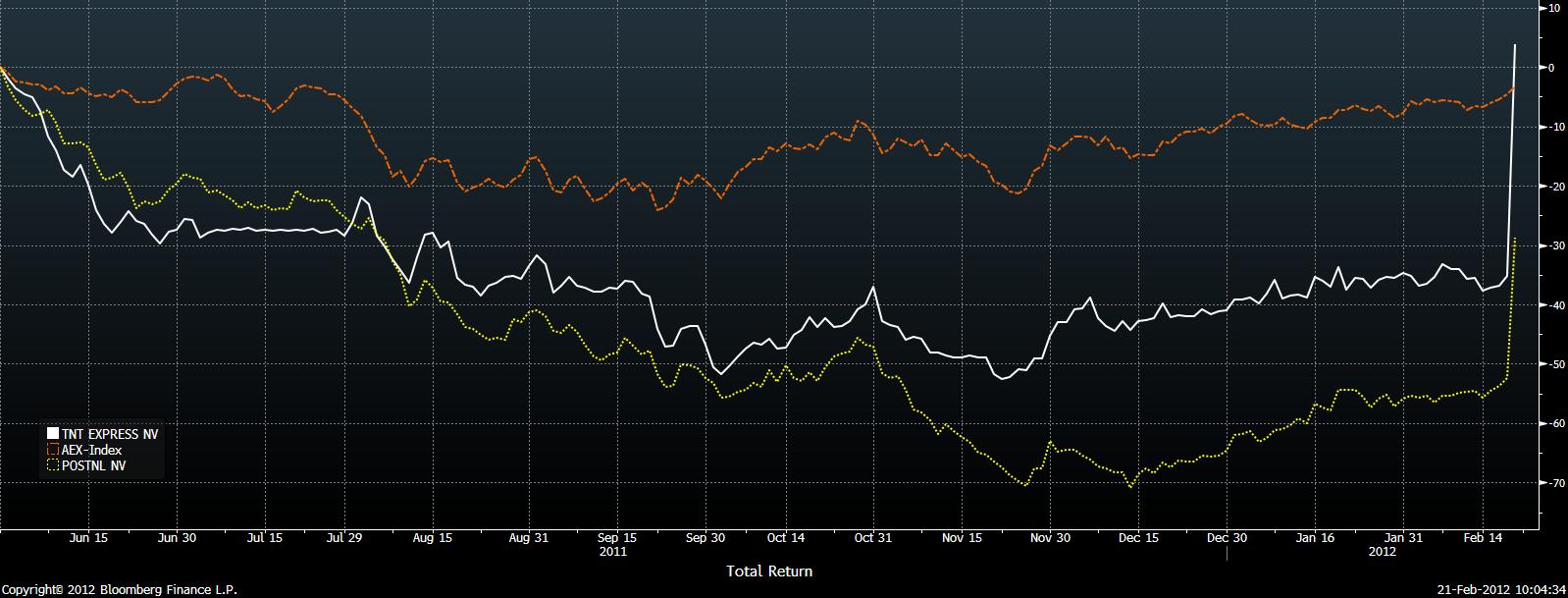
TNT Express was the express service spin-off from the Dutch Postal company. I had them on my research pile somewhere at position 10 to 15. However on the weekend, UPS made a 9 EUR per share offer for TNT Express, roughly a 50% premium on the previously traded price.

If we look at the chart, until last week, both shares significantly underperformed the index since the spin-off happened, only TNT Express made it above the index after the offer.

The 30% stake of TNT Express which PostNL owns, has almost the same value as PostNL’s market value. So PostNL might be an interesting company to look at.

Cable and Wireless

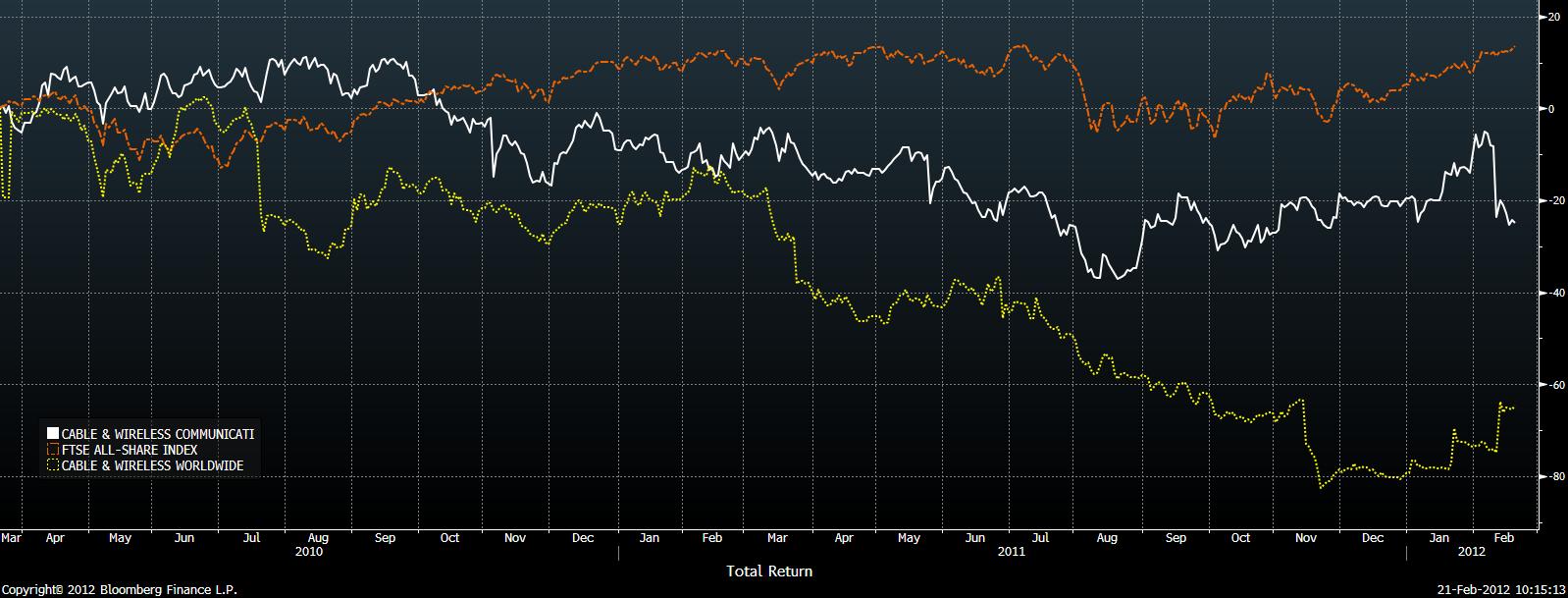
Cable and Wirless, the UK telephone company spun off the “international” part into Cable and Wireless Worldwide in February year. The international part was supposed to be the sexy part, but due to management and accounting issues, the stock suffered.

Last week, there was the rumour that Vodafone might be interested in hte “boring” part, the UK fixed line operations. However there was no confirmation from Vodafone and so the shares didn’t manage to rise as TNT Express did.

Again, as with TNT/PostNL, both parts underperformed the index significantly, as the chart shows:

So is there something to learn form this ?

Both cases show that spin offs per se are not a sure thing at all. In the case of C&W it rather looks like a desperate measure of a desperate company. In both cases, the performance after the spin-off event was relatively bad, so there is no need to hurry aftger spin offs are executed. As with all other “special situation” investment startegies, patience is required.

« Older Entries Recent Entries »