Tag Archives: Special Situation

Rocket Internet Post Mortem, SpaceX (again) and the strange Google capital increase

Rocket Internet Post Mortem

Last week I mentioned in the comments on the blog and on Twix that I got some “bad vibes” and decided to liquidate my Rocket Internet position even before the planned SpaceX IPO next week.

There were overall 3 things that kind of spooked me and let me to take the profit (+30%) instead of waiting the one more week. Here are the 3 items:

  1. I mentioned initially, although it was not part of my investment thesis, that there might be a chance of a special dividend. Now it has become clear that there will be no special dividend. However, it also became clear that Rocket Internet intends to limit information flow to shareholders even more in the future which is clearly not positive
  2. SpaceX: Another news item that spooked me was that SpaceX is aggressively pitching via German brokers for German retail investors. German investors had never access to  US IPOs before. Some might find this positive, I find that rather “surprising” and potentially a hint that demand is not high enough for Elon’s appetite.
  3. Another surprising event was the “surprise Capital increase” from Alphabet/Google. Interestingly, this represented the largest capital increase of all time at 85 bn USD but there was only very limited coverage about it in the financial news and mostly about Berkshire’s participation. But more on this later

Overall, I decided that the “easy money” was now made with Rocket internet and I was able to sell at around 25,80 EUR per share, netting a profit of 30% within 5 months, which is clearly one of my better “Special situations” investments.

I am not 100% sure that the share price increase was driven by SpaceX, maybe the rapid increase in the value of the Kalshi stake helped as well. I am not sure if there are a lot of other “plays” to benefit from KalshI’s incredible growth.

One could argue that I left some upside on the table here but the success of this investment is almost 100% depending for some time on someone else paying me more for the shares that I paid for, which is something I don’t feel too comfortable for a special situation investment.

Overall, I was clearly lucky with the timing on this one.

2. More SpaceX thoughts: Hyperliquid Perps and Damodaran

Since I wrote my update on Rocket Internet and SpaceX a few days ago, quite some things happened.

As mentioned above, we now know that Elon loves Germany so much that at the time of writing, German retail investors can now access this IPO via 8 or 10 different retail brokers.

Interestingly, SpaceX kind of already trades in a synthetic for as a “perpetual future” on a crypto exchange called Hyperliquid:
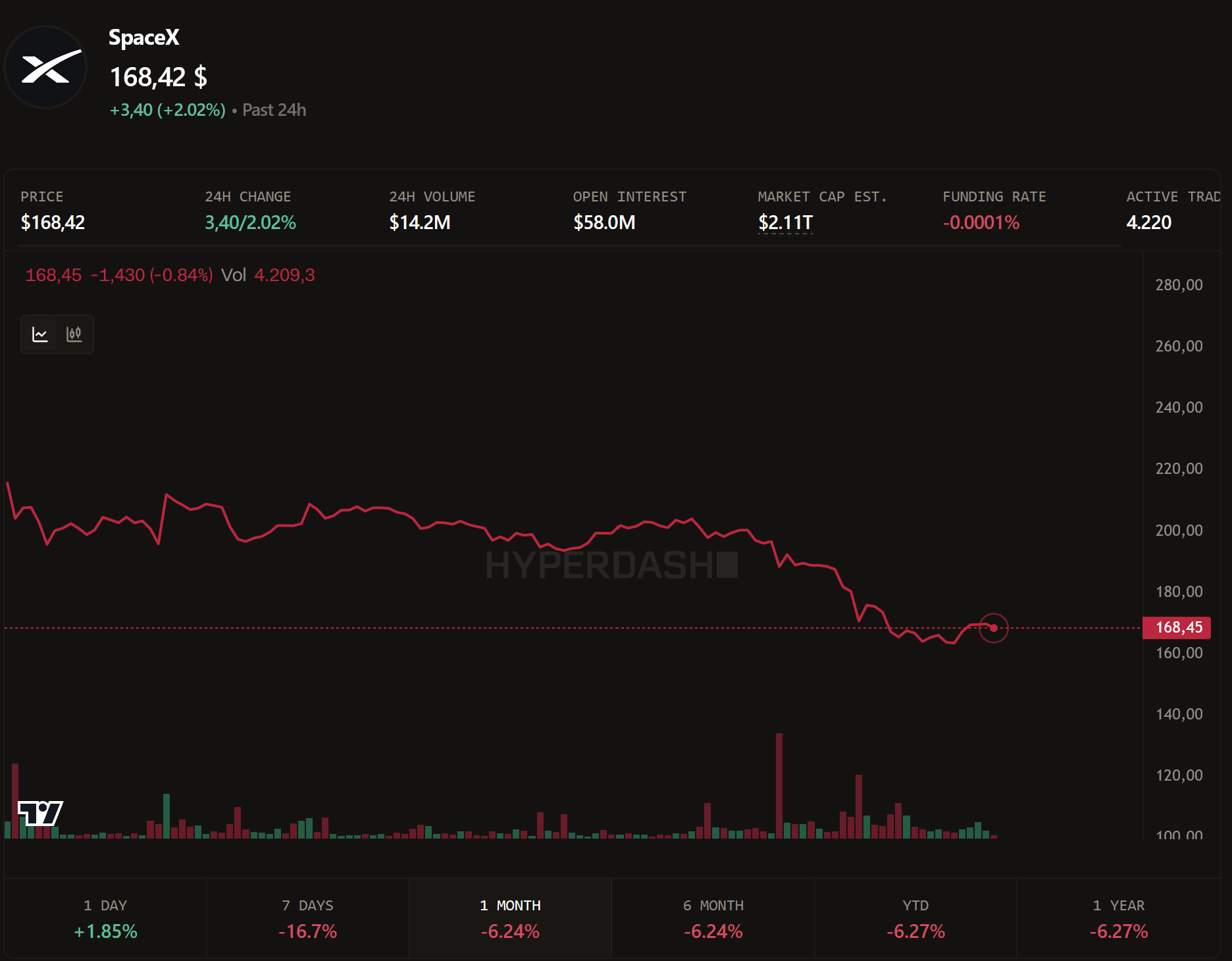
According to some sources, in order to compare apples to apples, one would need to discount the price by 10% to make it comparable to the actual SpaceX shares. That means on this “grey market”, a synthetic SpaceX share only trades at ~153 USD, above the 135 USD “sticker price” but inside the 135-162 USD bookbuilding range.

Although no one knows for sure if this has any relevance, it is at least a reference point and it seems to be traded quite liquid.

Another interesting source is the attempt of a valuation by Prof. Damodaran. What I like about Damodaran is that he at leasts tries to put values on these kind of situations and is very transparent with his assumptions. I know most tech bros laugh about these attempts but I think avery serious investor should read what Damodaran writes because there is always a lot to learn.

In a nutshell, Damodaran values SpaceX at about 100 USD per share. The ain changes to his initial, pre prospectus valuation is that he increased the margins for the Space and Starlink business, but significantly decreased the expected margins for the AI business.

My biggest shift is in my estimated target margin is for the AI business, where the dynamics that are pushing gross margins down, i.e., increased competition and high costs of delivering AI services, will persist; my estimated operating margin drops from 45% to 25%.

Damodaran is also smart enough to mention that in the first days after the IPO, valuation clearly doesn’t matter at all. But within the first 12 months or so, even for SpaceX, reality will need to be met somehow.

For me however the main take  away is the significantly reduced margins for the AI business which leads me to the:

Surprising 85 bn USD Capital increase of Alphabet

Being a Corporate Finance/Treasury guy by training, the news that Alphabet is raising 85 bn USD via a capital increase really surprised me.

The “package” itself is quite complex. After announcing initially 80 bn USD in total proceeds, Alphabet ended up with ~85 bn.

According to the FT, this is the largest capital increase in the history of capital markets, the second largest was Petrobras in 2010 at around 70bn.

The financial press focused mainly on the 10 bn stake that Berkshire Hathaway took as part of the package. To be honest, this is a very small amount of money for Berkshire’s current size. It is also hard to really judge how good of an investor Greg Abel actually is.

The interesting thing about this capital increase is that so far, at least in the ~40 years that I follow stock markets, capital increases in size only occurred in the following situations:

  1. Primary share portion in an IPO
  2. Emergency capital raising in a crisis ( e.g. Banks in the GFC)
  3. Major M&A transaction where the acquiring company pays with new shares (Paramount)

In Google’s case, clearly none of the three situations applies. According to TIKR, Alphabet still has net cash despite ~100 bn in bonds outstanding. So in theory they could issue a lot more debt. 

I heard the argument that Equity is “cheaper” than debt as the interest rate on a debt offering would be 5% whereas the “earnings yield” at the current 30x P/E is “only” 3,3%. However this does not reflect the tax shield from interest and especially not the fact that Alphabet’s earnings will most likely increase for the foreseeable future and that very soon that “earnings yield” for the issued shares will be much higher than the current 3,3%.

This is the main “justification” of Alphabet for the capital raise besides a 30 bn additional tax bill:
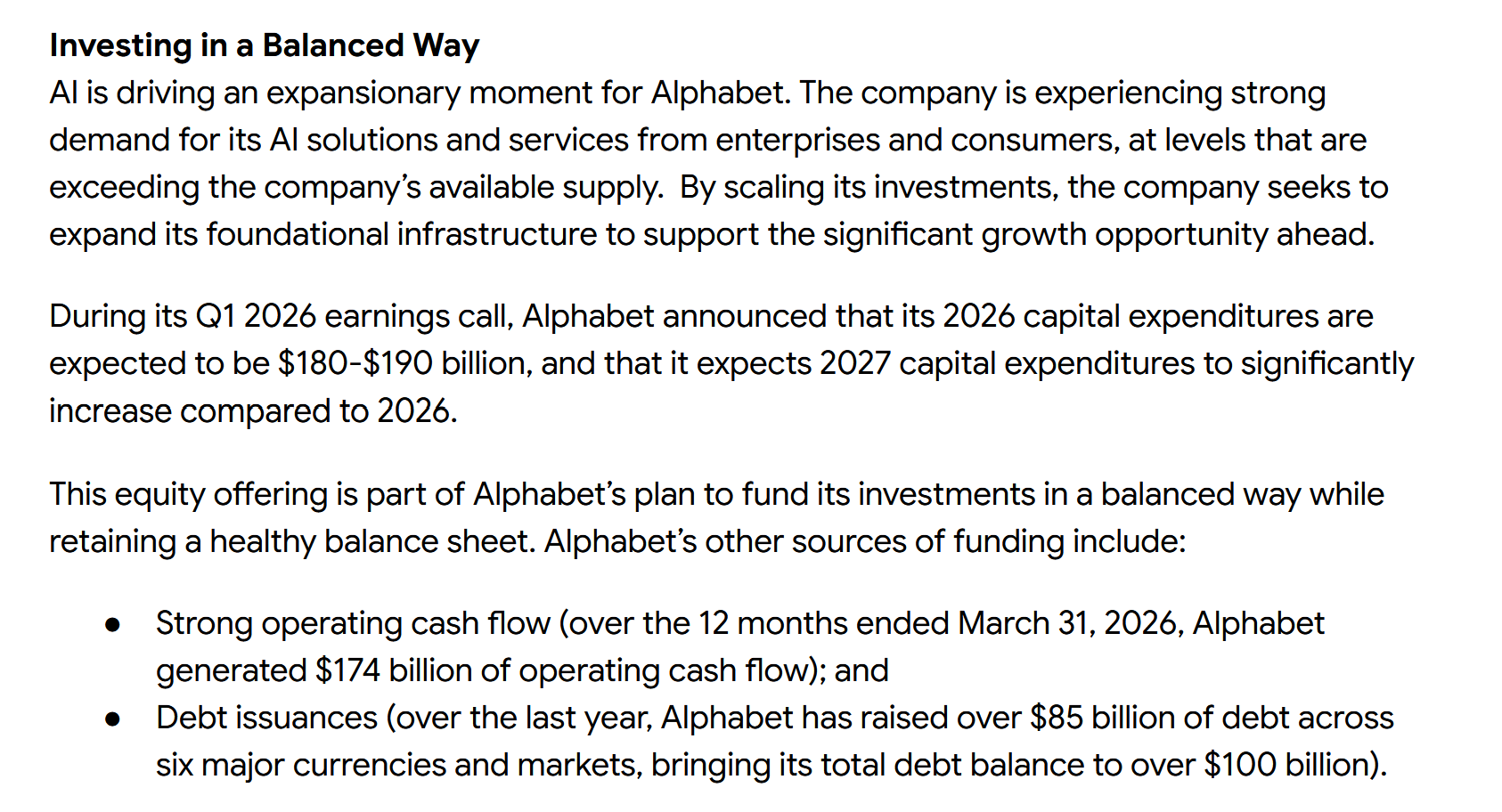
If you read this carefully, it is clear that they could still fund the 2026 Capex more or less with operating cashflow, but already in 2027, they plan to spend much more than that. 

The really interesting thing is clearly: What are their plans beyond 2027 ? My best guess is that they plan with even larger investments that are not offset by operating cash flow. 

But even so, why not wait until 2027 or so when they have a clearer point of view ? And I think here comes something into play which in my old Corporate Finance days was the golden rule of financing: “Raise when you can, not when you must”.

I think the Alphabet guys might have seen SpaceX’s announcement, they know that OpenAI filed for an IPO and that Anthropic will come to the capital markets as well.

As large as the listed capital markets are, there is only so much appetite for capital increases. Maybe they even fear a significant market correction which would require them to issue a much larger number of shares for the same amount of money.

Funnily enough, there were rumours that even Meta seems to think about raising large amounts of capital to fund their AI Capex programs.

One other factor that might also play a role here is that both, Private Credit and Private Equity which have been offering significant amounts of capital so far fight with redemptions themselves and are potentially overallocated to data centres already

To me it is pretty unclear where all this is going. However one thing now is clearer to me: 

The capital required to scale up this technology is larger than even the latest and best funded players like Google expected.

In my opinion, this means that it is very unlikely that we see 5 companies scaling this in parallel on their own (Alphabet, Meta, OpenAi, Anthropic & SpaceX). 1,2 or even 3 of those players might fold at some point in time or would need to collaborate really closely with someone like Microsoft or Apple to stay in the race. Or get help from the Orange guy in some sort.

Scrutinizing Data Centre Infrastructure orderbooks

For ordinary investors this might also mean to better scrutinize order books of companies that are supposed to profit from a further AI build out and trade at high multiples themselves.

At the moment, it is enough if a company releases “AI data centre” contracts to justify sky high multiples. I guess going forward, maybe even sooner than later, one really needs to understand from which counterparts those contracts are. Because not all of them might be actually turn out to be valuable.

In any case, as someone who loves capital markets, this is a great time to be alive and witness what is going on at the moment.
DCC – Interesting “Special Situation” following KKR potential buyout offer at 58 GBP ?

Disclaimer: This is not investment advice. PLEASE DO YOUR OWN RESEARCH !!!!!

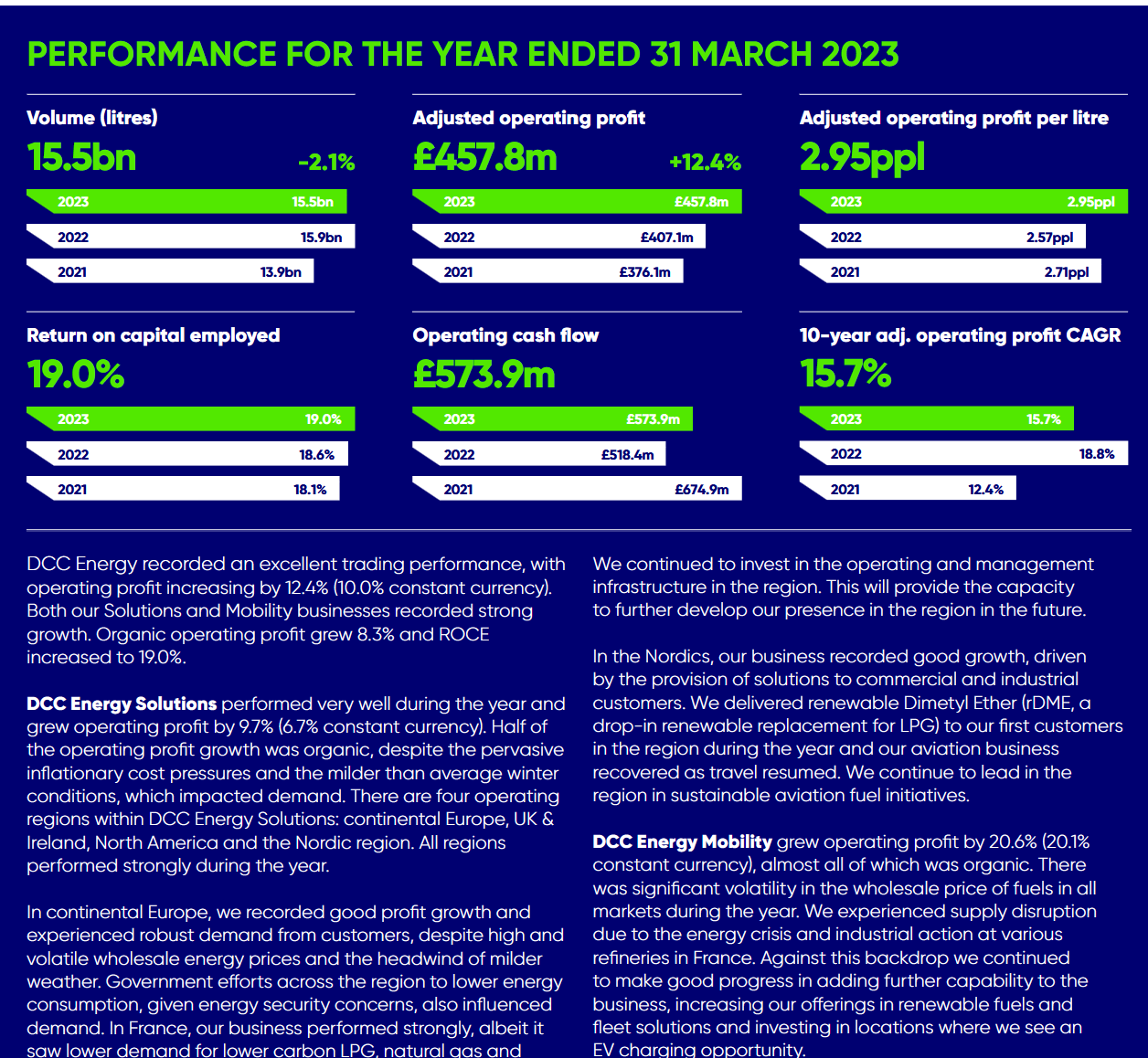
DCC is an investment I made back in December 2022. The investment thesis back then was that it was a successful compounder/serial acquirer that had the opportunity to grow further through its 3 platforms (Energy, Healthcare, Technology).

In the meantime, a lot of unexpected things happened. After issues in the non-Energy segments, DCC is currently transforming itself back into the original Energy distributor and sold already a significant part of its non.Energy businesses. The transformation has progressed well including a share buy back tender but is not finished yet.

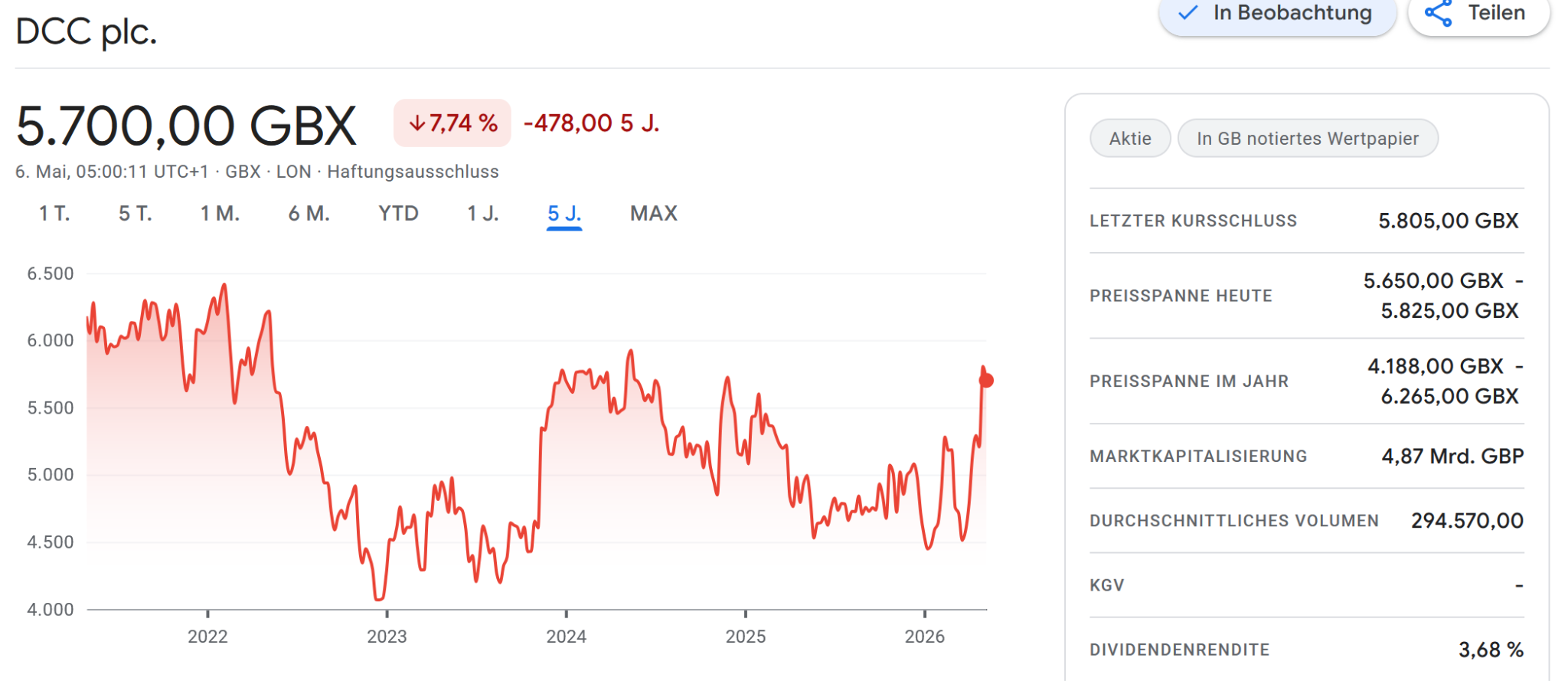
Looking at the share price, we can see that not much happened over the last 5 years but that the timing for buying into DCC in Dec 2022 retrospect was quite lucky:

After the recent jump to 58 GBP, I am up 42% in total (in EUR, including dividends) which is not spectacular and rather at the lower end of my expected outcome. However, given the “Pivot” it is still a decent result and mostly attributable to the low entry point and the relevant dividends.

Now fast forward to last week: 

Private Equity behemoth KKR and another energy focused PE called Energy Capital Partners approached DCC and seem to have informally offered to take over DCC at 58 GPB per share which only represents a 15% premium over the average share price for the last few months.

DCC immediately declined the offer as “too low”.

Energy Capital Partners is a pretty large Energy focused US PE/Infrastructure investor that owns a lot of “Energy Transition” businesses. AuM seems to be north of 40 bn USD.

Although KKR did not disclose which fund is bidding, it looks that both KKR and ECP see this as an infrastructure play which makes a lot of sense.

58 GBP per share is clearly a low ball offer and no formal offer has yet been made. Under the applicable Irish laws, KKR has time until June 10th to either submit a formal offer or walk away.

From a shareholder perspective, I assume that maybe a lot of investors have been frustrated that the stock only went sideways for the last 5 years or so and are maybe happy to exit at that level.

The “asset heavy” Infrastructure PE playbook

DCC so far has operated as a relatively capital light distributor, but I think it is relatively easy to pivot them into an Infrastructure like business that usually enjoys significantly lower cost of capital.

In contrast to “normal” Private Equity, Infrastructure Private Equity still enjoys a pretty good time. Many players have raised large funds and are eager to deploy money. Infrastructure is often considered “AI safe” these days.

So I guess there might be a chance that some other players might look very closely at this situation. DCC is a very obvious target and the timing is quite nice from a PE perspective. The refocusising on Energy at DCC is still underway and the results don’t look so “clean” at the moment,

DCCs business model, especially the LPG distribution business has a lot of potential to get easy access to many SME companies and sell them solutions.

Especially the current volatility in fossil energy prices opens up a unique selling opportunity for solutions that offer less exposure like rooftop solar etc. 

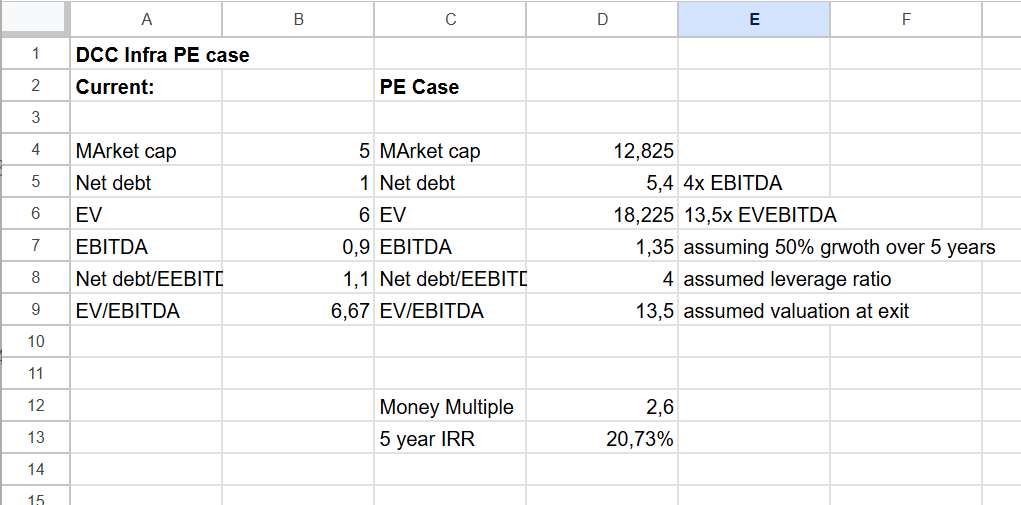
According to TIKR, DCC’s Net debt to EBITDA ratio is only around 1,2x. The company is valued at around 7xEV/EBITDA. The typical infrastructure playbook would be to make the company more “asset heavy”. Due to the low gearing, this could be financed by more leverage. A typical “asset owning” infrastructure company with longer term contracts can be easily levered 4-5x Net debt/EBITDA, 

In DCC’s case, with around 900 mn in EBITDA, increasing the leverage ratio to 4x would allow them to issue almost 3 bn in debt which could finance a lot of assets. Those assets then will automatically increase EBITDA,

A stabilized infrastructure like company can then be sold at much higher multiples, usually at 12-15x EV/EBITDA. So the value creation potential for a good Infrastructure PE shop is significant. 

Just for fun I did a high level calculation how that exercise would look from this perspective (I just took the current numbers from TIKR, before further disposals):

A potential IRR of above 20% p.a. is highly attractive for an Infrastructure fund and as I have written before, PE’s have some more levers to “juice up” the IRR and earn even higher performance fees.

Is DCC now an interesting special situation play ?

There is clearly the risk that DCC might reject even higher offers, but I do think the 58 GBP low ball offer provides a decent “floor” for the stock (“Anchoring effect”).

For one, DCC should expect some positive operational tailwinds. Volatile and high energy prices in the past have been good for DCC’s energy business. As we can see every day “at the pump”, distributors like normal Petrol stations immediately increase prices although they often have inventories for some weeks/months and often drop prices much slower.

Looking back to the last energy price shock in 2022, we can see that this was DCC’s best year, especially for the energy business:

Although there is no guarantee that the same will apply to 2026, there is a high likelihood that 2026 will look good for DCC from an operational perspective.

In addition, I do expect that the transformation will be more or less completed in the 2026 calendar year. 

So all in all, 2026 seems to look pretty good for DCC. I think this also explains the timing of KKR and ECP, as they don’t want to wait until this improvement shows in the results of DCC.

Even in case, DCC gets sold relatively quickly at 58 GBP per share, one would still get the Dividend that will be recorded end of may.

Quick handicapping exercise:

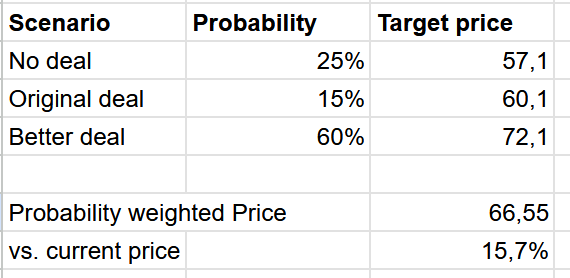
Overall, I would see the probabilities as follows until the end of the year::

25% probability of no deal with 55 GBP as the outcome (plus dividend, currently estimated at 2,10 GBP/share)

15% of a deal at 58 GBP (plus dividend)

60% probability of a better deal. My guess here would be 70 GBP plus Dividend

This is the quick and dirty calculation:

So based on my assumptions, my probability weighted expected return is around 16% until year end. This looks attractive to me, as in my opinion, the downside is very limited.

Of course, all the assumptions can be challenged and changed.

Summary:

So in total I see the following situation here:

  • The bid of 58 GBP is clearly too low
  • DCC’s short term operational results are supported by increasing energy prices
  • in addition, the full effect of the transformation “back to energy” will materialize in the following quarter
  • Other Infrastructure funds might also be interested in DCC

So even if the bid from KKR would not be successful, I do think that the share price has much more upside than downside potential at the moment.

From that perspective, I decided not to sell any DCC shares but rather increase my position by ~1,5 % of total portfolio value at around 57,50 GBP per share.

Quick (and dirty): Cie Bois Sauvage Special Situation

This is not Investment Advice. PLEASE DO YOU OWN RESEARCH !!!

Bois Sauvage is a Belgian Holding Company that I owned in the past and have written several times about:

2014 Write-up Bois Sauvage

2014 Update on Bois Sauvage and Ackerman

In essence it’s main business is high-end Belgian Chocolate (Neuhaus, Jeff de Brugges) and a variety of other assets, from real estate, listed Belgian stocks and some VC/PE like investments.

What created my renewed interest in the stock was this passage in a recent “Newletter” sent out by the company:

These topics are part of a broader transformation. For several months now, we have been conducting an in-depth strategic review of all our holdings. This review will result in concrete announcements in March 2026. It reflects our desire to better focus our efforts on our areas of expertise, align our portfolio with our ambition for sustainable growth, and enhance the clarity of our investment profile.

Read more

Bombardier – A potentially successful Aerospace turnaround shot down by Trump Tariffs ?

Disclaimer: This is not investment advice. PLEASE DO YOUR OWN RESEARCH !!!!

Background:

Bombardier is a Canadian company that after a colorful past as a conglomerate and an “almost bankruptcy” in 2020 is now fully focused on manufacturing Private Jets and until recently has been a poster child of a very successful turn-around. My friend @Govro12 from the Wintergems substack has written a very nice post on Bombardier just a few weeks ago which I highly recommend to read.

High level Presentation:

Although I only could convince myself to buy a small starter position (<1%, to keep me interested), I presented Bombardier as a potential interesting investment case in a private investor meeting some days ago. Here is the presentation which I admit is pretty high level. Spoiler alert: I would not recommend to invest right now.

Read more

Broedr. Hartmann (ISIN DK0010256197): A truly Egg-citing Special situation ?

Disclaimer: This is not investment advice. PLEASE DO YOUR OWN RESEARCH !!!

  1. Introduction
  2. “Catalyst”: Lowball bid from Majority shareholder
  3. Delisting in Denmark – what I found so far
  4. Majority Shareholder Thornico
  5. What is Thornico’s ultimate goal ?
  6. Scenario Analysis, Risks & Summary
  1. Introduction

Broeder. Hartmann (not to mistake with Paul Hartmann AG) is a company I looked at during my All Danish Shares series in last July. I think it would be fair to call it a “hidden champion”. Their business model is focused almost 100% on egg packaging which as such is already something I like a lot. Their main product looks like this (only the box, not the content):

Read more

Ahlsell (ISIN SE0009155005) – Interesting pre-Christmas Special Situation ?

Disclaimer: This is not investment advice, only the personal opinion of an anonymous blogger. PLEASE DO YOU OWN RESEARCH !!!!

Background:

Ahlsell is a Swedish company that distributes building / renovation related products mainly to craftsmen in the Nordic Region. In 2012, the company was taken private by private equity house CVC.

In 2016, Ahlsell was IPOed again by CVC at SEK 46 per share. They sold 1/3 of their shares in the IPO and then down to 25,1% just some weeks ago.

Then more or less out of the blue a few days ago, CVC offered again to take Ahlsell private at 55 SEk/share which translates into a valuation slightly north of 2 bn EUR for the equity.

Read more

Special situation: Whole Foods (WFM) – “free options” anyone ?

A few days ago, Amazon famously announced to take over Whole Foods Market for 42 USD per share (representing a premium of around 27%).

Markets enthusiastically welcomed this move from Amazon, with the Amazon share jumping almost 4% or ~13 bn USD, which coincidently was almost equal to the deal amount.

Whole Foods itself was “under siege” from activist investor Jana which had built up a 9% stake in the company. Just 2 days before the takeover, Whole Foods CEO called Jana “greedy bastards” indicating that he was not happy having such a shareholder.

Read more

Special Situation Updates: Actelion/Idorsia, Gagfah, SAPEC & Stada

A lot has happened over the last few weeks for my 4 largest special situation investments:

Actelion / Idorsia

The original Actelion idea was very simple: Buy an M&A target at a small discount which is relatively safe and get something (the Idorsia spin-off) extra which no one seemed to have noticed.

Although the case played out exactly as I thought and Idorsia even seems to be worth more than I assumed, I only made around +4% on it. Not bad for around 5 months but not great either.

Looking back I think I made 3 mistakes:

Read more

HP Enterprise (HPE) – Spinning-off its way to happiness ?

DISCLAIMER: THIS IS NOT INVESTMENT ADVICE. PLEASE DO YOUR OWN RESEARCH !!!!!

Management summary:

  • HPE, the enterprise arm of the old HP looks attractive on a sum-of-part valuation
  • following 3 spin-offs in 2 years, my model indicates an upside of ~40% in the base case and ~70% in an optimistic case
  • Some “soft catalysts” are on the horizon such as the upcoming Software “spin -off merger”, further share buy backs and a “normal” financial year
  • management acts shareholder friendly, has a clear strategy and has created significant shareholder value since 2011
  • major risk is clearly a further detoriation of the Enterprise solution business which had a bad start into fiscal 2017

Read more

« Older Entries