Category Archives: Anlage Philosophie

BioNTech: The Founders announced their exit – what’s next ?

Disclaimer: This is not investment advise. PLEASE DO YOUR OWN RESEARCH !!!!

I wrote this post this morning (CEST) when the stock price was around 73-74 EUR. I then had to run some errands before being able to post and the stock price moved already significantly. All calculations etc. are based on a stock price of 73,50 EUR.

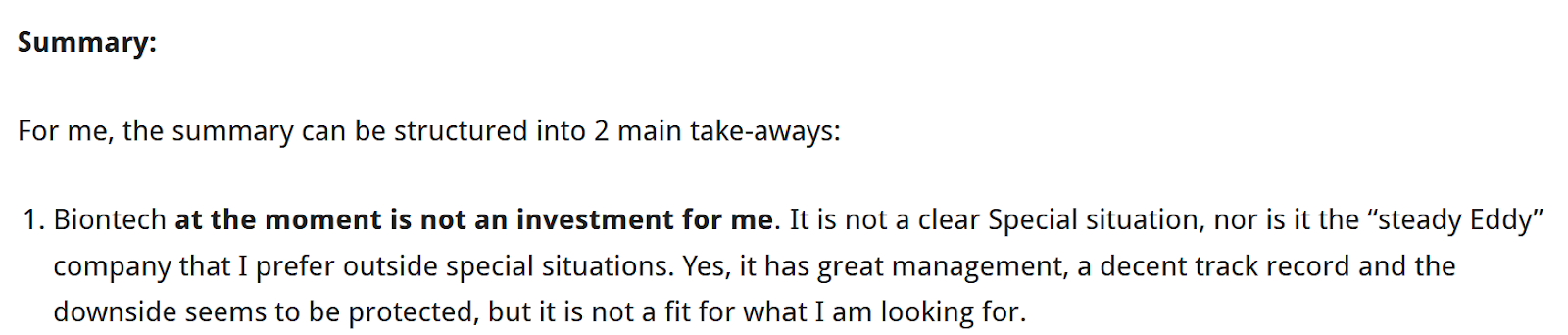
By coincidence, I just wrote about Biontech a few weeks ago. Luckily my summary back then was not to invest:

Now two things happened yesterday on March 10th, when they were supposed to talk about Q2 earnings:

  1. The two founders announced that they will leave by the end of 2026 in order to start a new company
  2. The share price dropped significantly after the announcement

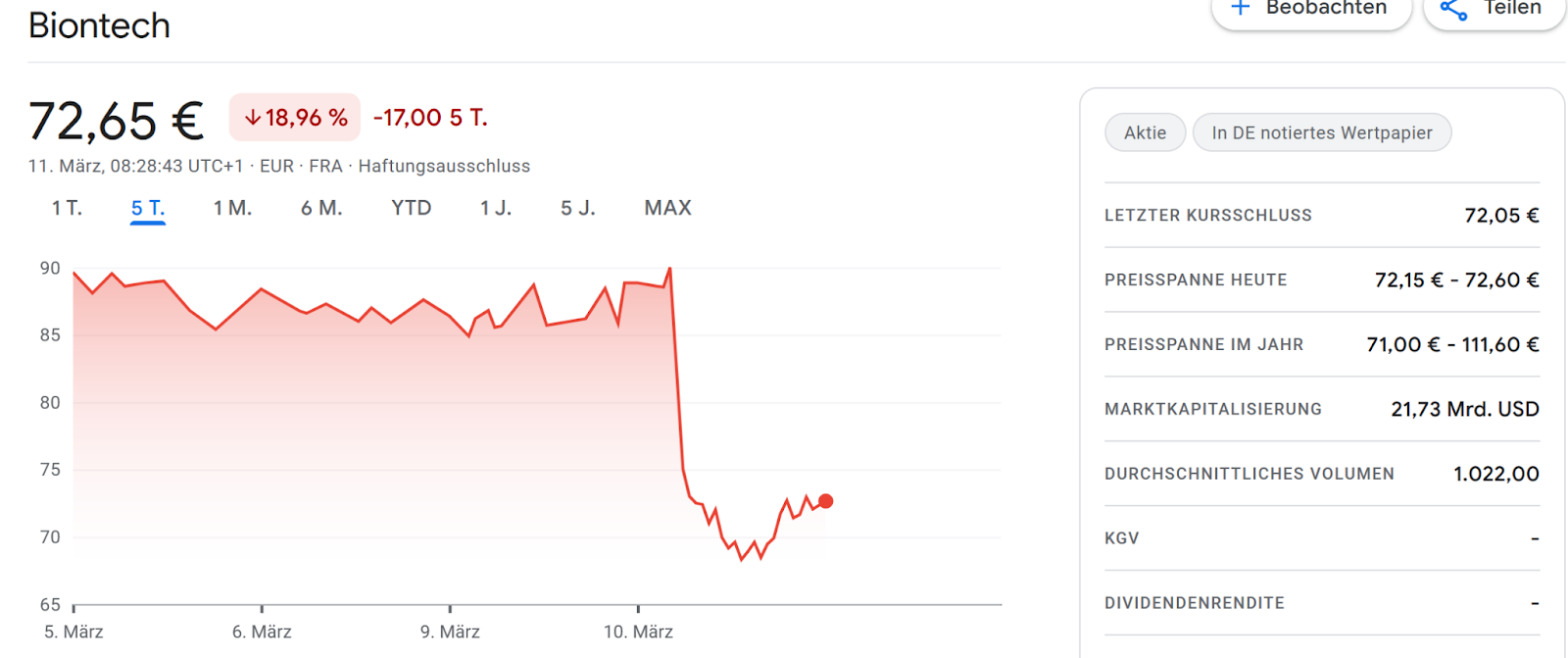
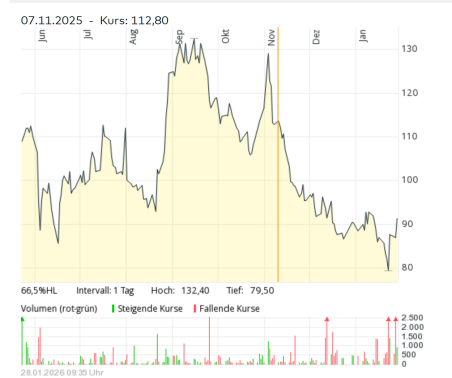
This is the stock chart in Germany (in EUR):

After a low of around 68 EUR, the shares currently trade at 73-74 EUR at the time of writing.

Funnily enough, this is almost exactly the current net cash per share and even 10% below my “worst case” assumption:

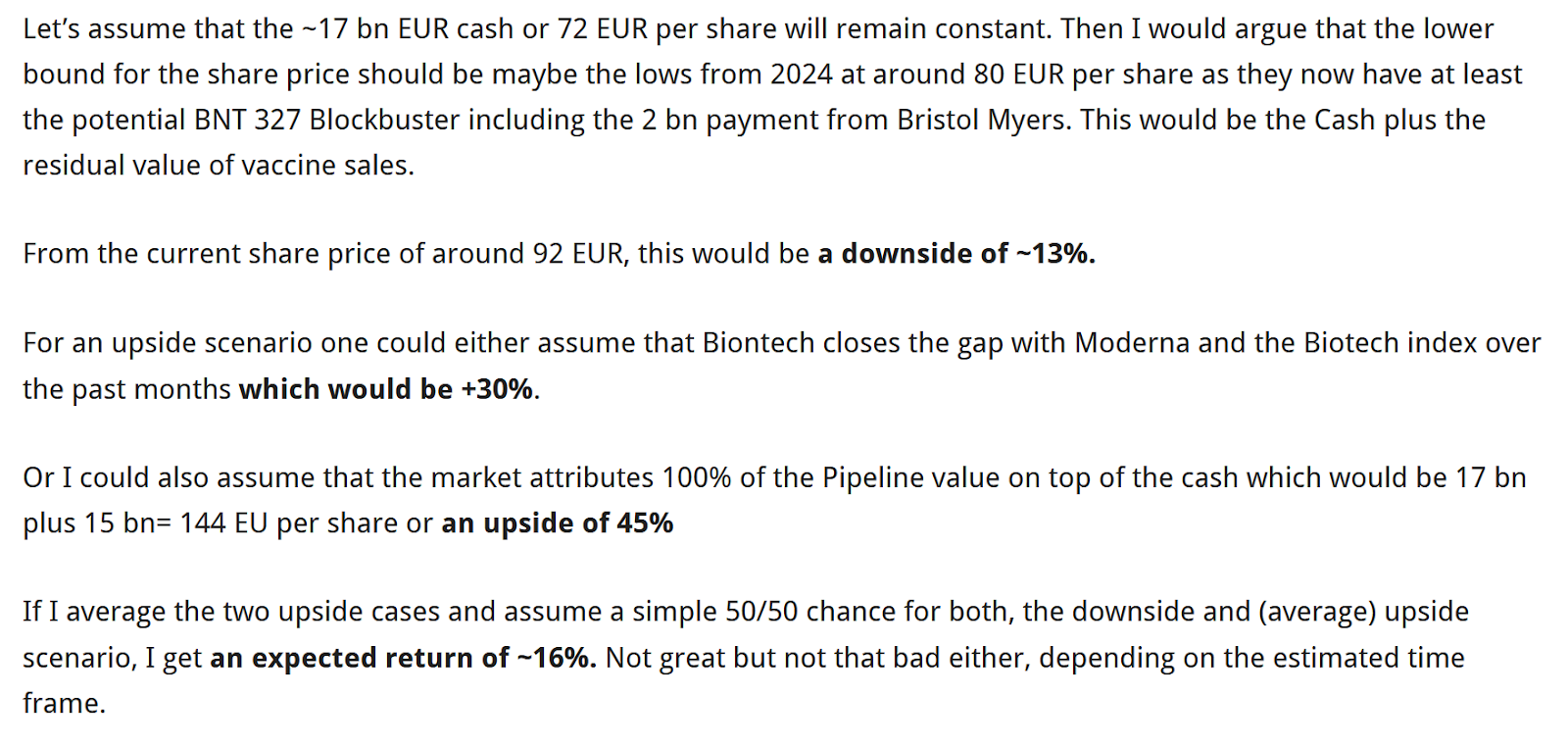
Using my “old” scenario, the potential upside would now be obviously a lot higher.

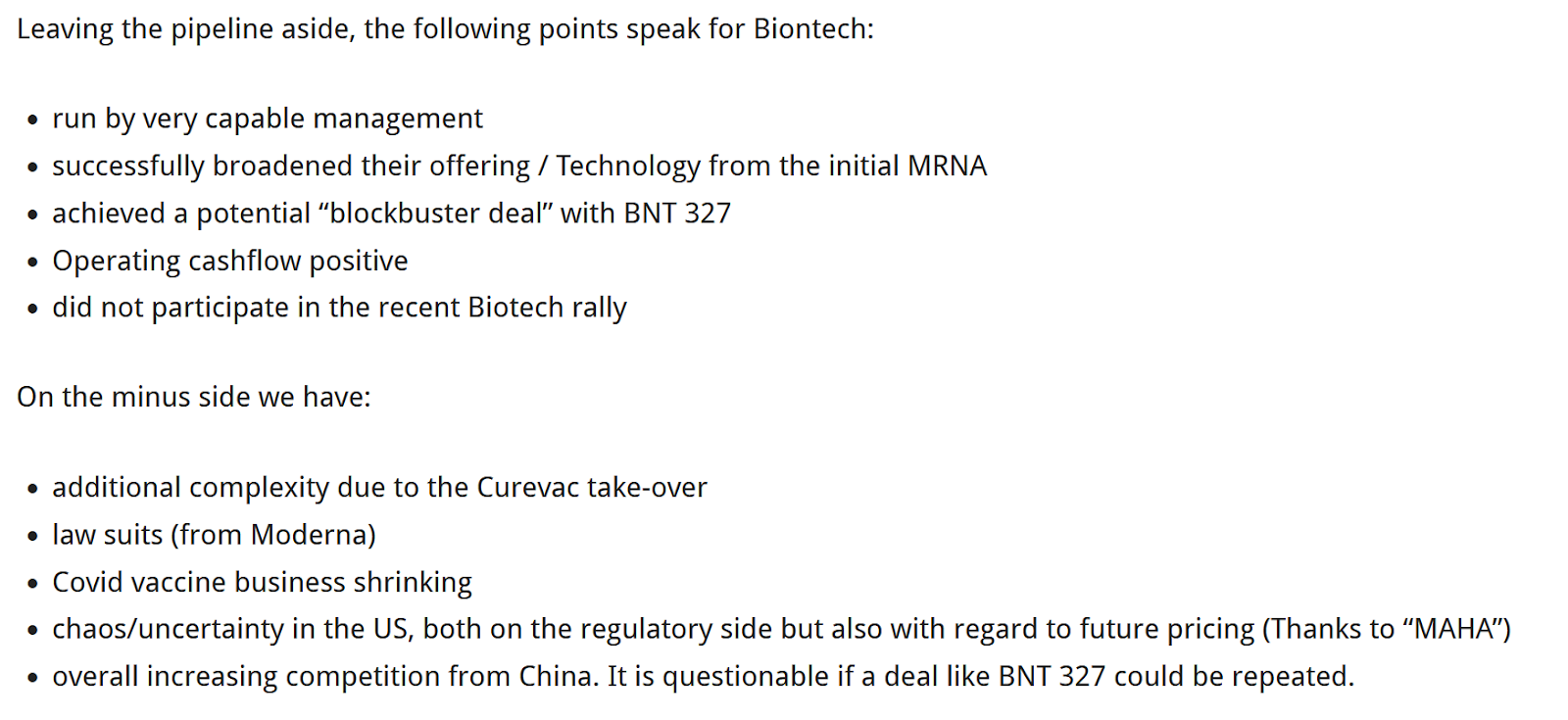
But, and this is a BIG BUT: With the founders leaving, one of the main qualitative arguments became a lot weaker. This was my Pro & Con list back then:

We just don’t know who will run the company from next year onwards. Initially this was a big negative news for me.

What did the founders actually announce:

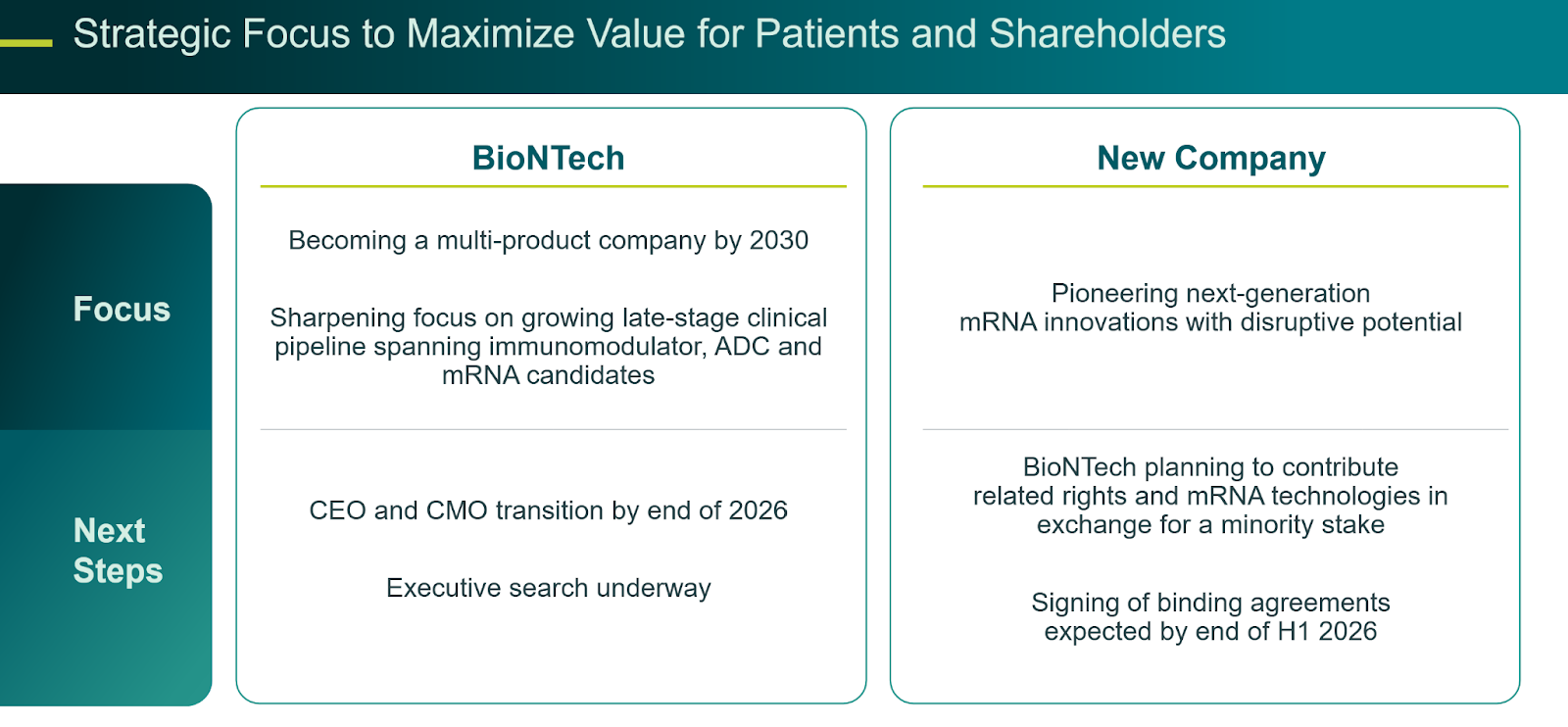
I haven’t listened to the call yet, so I stick to the slide from the results presentation from yesterday:

So Sahin and his wife will leave by the end of the year and basically take some (or most ?) of the mRNA technology in exchange for a minority stake into a new company. We do not know if they also get cash or not. I would assume not.

Normally, one sees such “deals” only after a Biotech company is taken over by a big Pharma company and a founder wands to make sure that early stage projects are not getting killed.

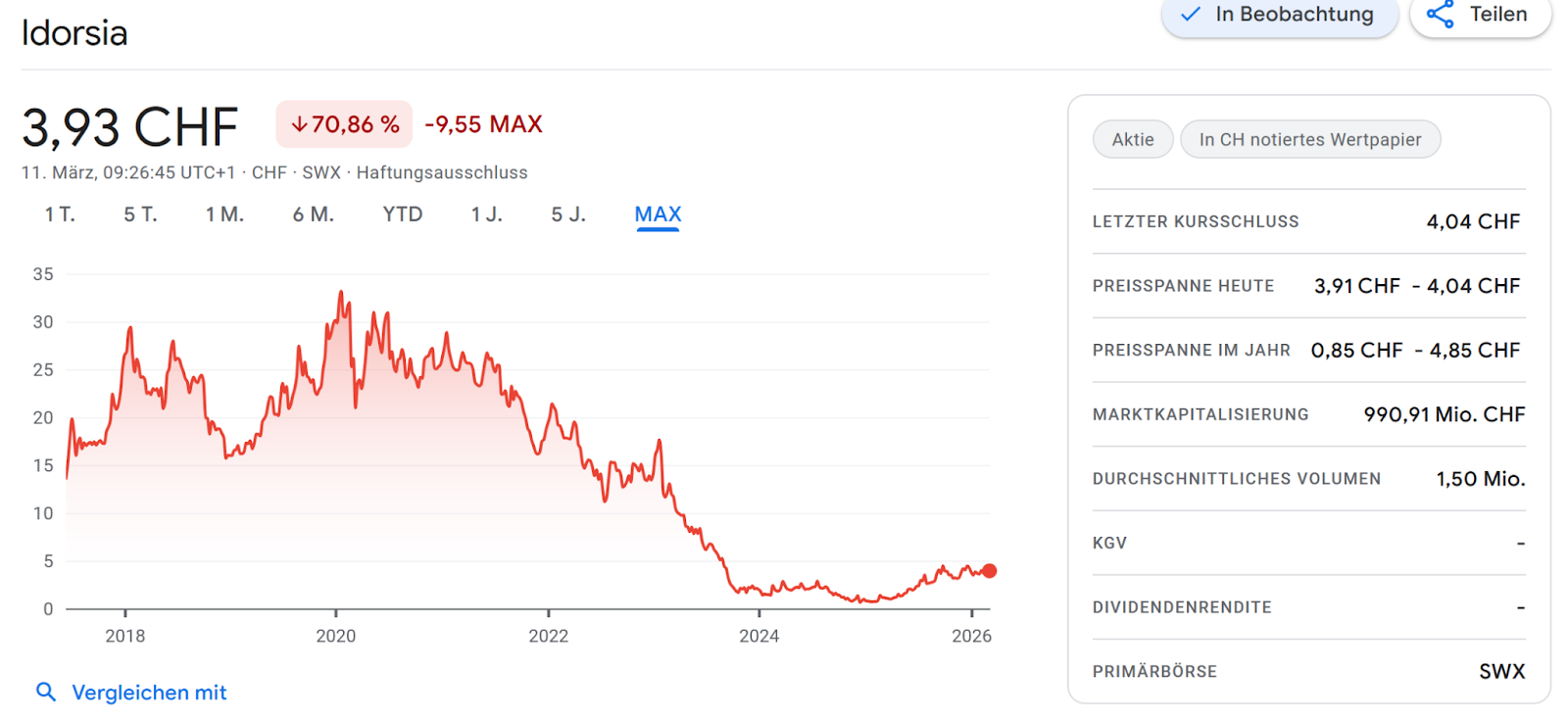
One such situation was the Actelion/Idorsia Special Situation I invested 9 years ago, where after the take-over of Actelion by Johnson & Johnson, the founder Clozel took the whole development department including the early stage pipeline into a new company called Idorsia which was then spun-off to shareholders.

Interestingly, Idorsia, even after 9 years didn’t do too well and trades significantly below the value right after the spin-off:

In the German press, there are some rumors that the founders have made that move because a sale of Biontech to a bigger Pharma company might be imminent, although officially the founders have said this is not the case.

What I find most striking is the issue that they haven’t announced a successor for the founders yet.

Without a potential sale of Biontech on the horizon, the founders could have just “hired” or promoted someone to CEO who takes care of commercializing the late stage pipeline and continue to do their research within Biontech.

I get the impression that maybe, after 18 years, the billionaire Strüngemann Brothers who put up the initial funding and still own 40% do not agree anymore with the founders who own around 15%. In some older articles, both the Strüngmanns and Sahin always made the point that they want to create a “full blown” BioPharma company that can play in the first league internationally.

At least Sahin and his wife now decided that they actually prefer to do research.

Another dicey issue is that the founders will basically negotiate the transfer of the mRNA technology with themselves as they want to close this before the end of the next quarter, maybe specifically before a new CEO is installed. My impression is that they are honest people and really interested in research, but it is of course not ideal if they negotiate with themselves.

Also the announcement that Biontech will only get a minority share seems to indicate that this time, Sahin and his wife want to have the full control which they currently don’t have.

It will be also interesting to see if and how many of Biontech’s R&D staff will follow them to the new company. 

What is the worth of a charismatic founder ?

Yesterday’s announcement is also an interesting datapoint regarding the question: What is the worth of a charismatic founder? In this case, for most shareholders, the announcement was clearly a big surprise.

The -20% clearly indicate that at least in the short term, investors think that the company is worth less without its founders.

So what about Biontech now ?

As I mentioned in the beginning, the share price is now around -25% lower than in January. On the other hand, without the founders, a lot of things could be more difficult, especially if a lot of people follow them to the new company..

As a compensation, the possibility of a take-over/sale of the company to a large international player has clearly increased, I would assume that in the case of a takeover, the pipeline value would be paid to a large extent by an acquirer.

I have asked various versions of LLMs who the most likely acquirer would be. The favorites were Merck (US), Bristol Myers (with which they partnered) and Roche. All of them could make use of Biotech’s pipeline and have the means to do the transaction.

I also think that once the mRNA deal is signed, a subsequent sale of the company could happen rather sooner than later.

New scenario:

My new downside case would be 80% of net cash which is a level that many loss making Biotech firms trade at.

My upside scenario would be the 144 EUR with the pipeline value from the last post.

If I use a 50/50 scenario this would translate into (-20%+100%)/2= +40%

That looks a lot better than in January. 

Of course anyone could add a lot of other cases but I like to keep it simple.

There is still the issue that we don’t have a “hard” deadline for a potential deal, but on the other hand, the year end deadline for their exit could be interpreted as a deadline for the Strüngmanns to find a buyer.

Playbook:

My assumption is that this situation doesn’t escalate totally between the founders and the Strüngmann brothers. One big warning sign and red flag would be, if the agreement for the new company would not be signed until the end of June. 

Summary:

In a nutshell, Biontech now looks much more like an interesting “Special situation” than in late January.

Yes, the founders will be gone by year end, but the stock is 25% cheaper and we now have a “soft deadline” for a potential M&A announcement.

My “back of the envelope” calculation indicates and expected average return of 40% for roughly one year which is attractive. I therefore allocate 1,5% of the portfolio into Biontech at current prices of 73,50 EUR/Share.

Bonus Soundtrack:

I imagine that the founders will play that Soundtrack if the walk into their new company in 2027: Jon Batiste – Freedom

Jon Batiste – FREEDOM

Paypal – Too old for Rock n’ Roll and too young to die ?


Management summary:

In this post I try to explore if Paypal is suffering only from temporary issues or if they have structural problems. My take away from a rather short analysis is that the problems are indeed structural and therefore the stock is not of interest to me for the time being.

Introduction

Paypal is one of those stocks that is both very present on my “”TwiX” timeline as well as has been mentioned in a couple of recent discussions with investors that I value highly.

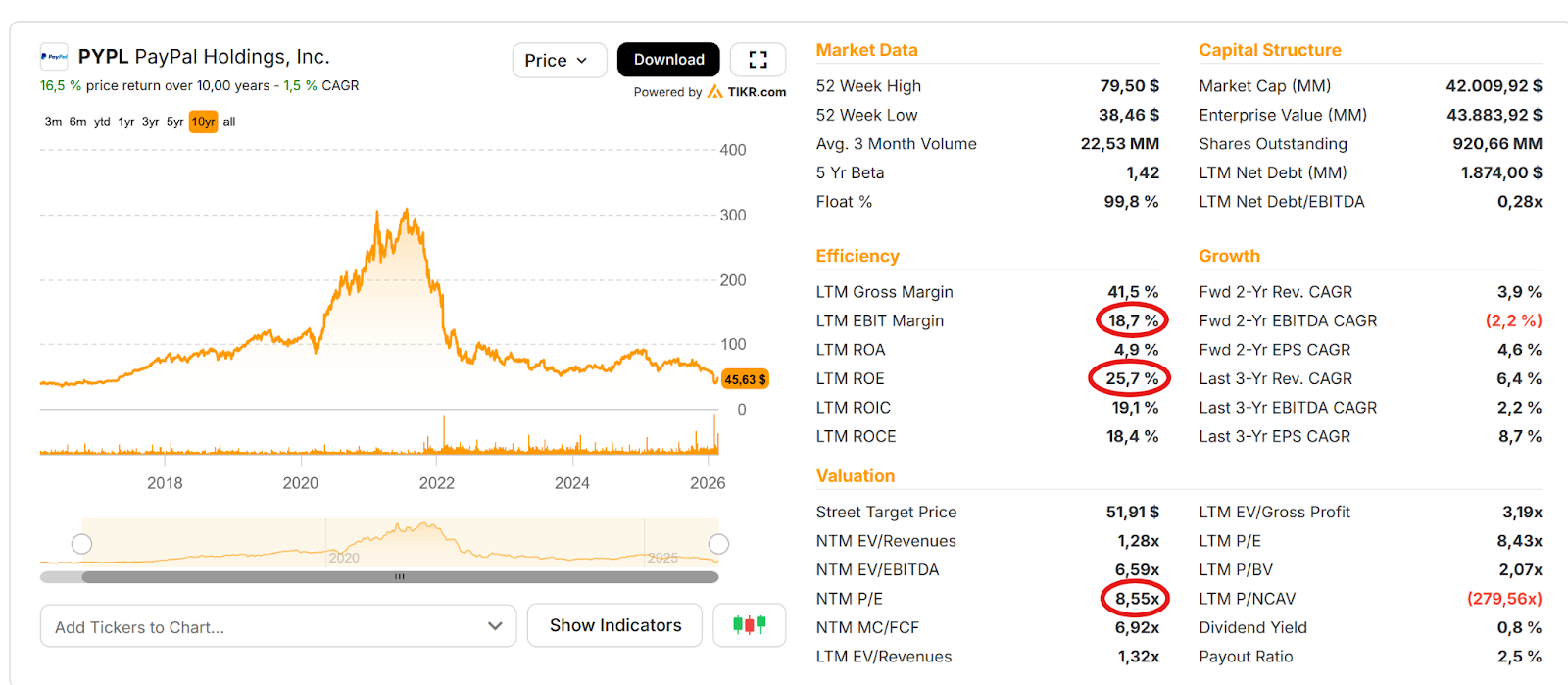
At first sight it looks like a decent “Value” stock. Single digit P/E, large share buy backs, high free cash flow, good margins, decent ROE, hundreds of millions of clients etc. So what is not to like ? Here is the TIKR overview:

Paypal is also one of those stocks where everyone has an opinion as almost everyone has a Paypal account or is using other payment services frequently So at first sight, it looks like an easy to understand business which might lower their “barrier to entry” even for more inexperienced investors

Personally I have to admit that I find the payment space super complex and not easy to understand.

What problem does Paypal solve ?

Paypal’s main business is to allow retail customers to pay online for E-commerce activities and/or send money from one user to another within the Paypal network or via their additional  P2P service Venmo. 

Paypal has become successful because for consumers it used to provide a very convenient way without a lot of friction as compared to typing in your credit card details every time you use a new online merchant for instance. Paypal was also one of the first widely available services to send P2P money. You just need to know the Email address of the recipient.

Paypal describes itself as a “2-sided market place” connecting retail clients with E-commerce merchants.

For merchants, this was initially also very attractive as Paypal removed friction and increased the probability that a customer would actually finalize the purchase.

What Problems does Paypal have ?

When a widely known stock such as Paypal looks obviously cheap, my first thought is always the following:

What obvious problems does that company have and do I have a “variant perspective” ? 

Especially for larger US stocks, assuming that everyone else is just stupid and you are the only one who can identify a single digit P/E ratio is naive to say it in a friendly way.

For me, temporary problems would be an invitation to dig deeper, whereas structural problems are much harder to handicap.

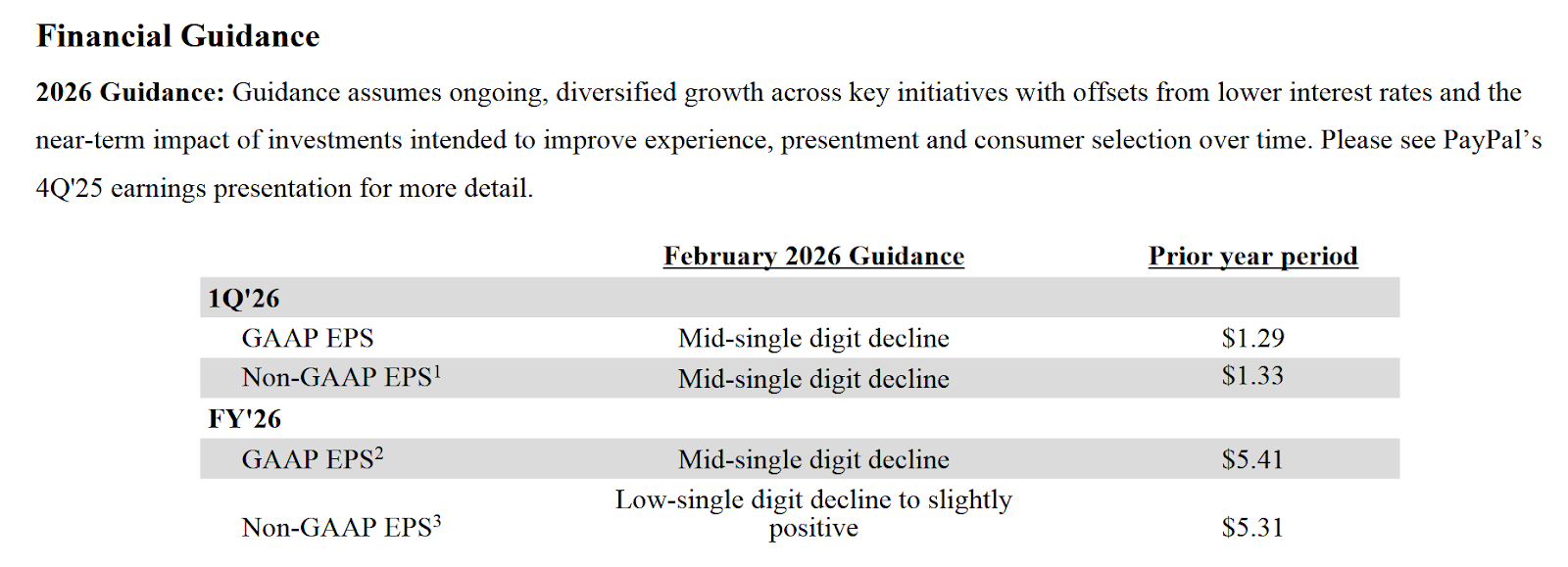
Paypal has some obvious issues, one of them being having a new CEO with little experience in the actual business and having guided to lower sales and profits in 2026

The new CEO since March 1st, Enrique Lores, is a long time HP Executive, who, according to Linkedin, has no direct payment or financial services experience.

Lores has some strong incentives directly linked to the share price. He will achieve the maximum amount if the share price hits 125 USD until 2029. His maximum compensation would be ~125 mn USD. This sounds like a large sum, but for Lorres, an long term HP executive, even that might not be life changing.  He seemed to have earned around 19 mn USD and his net worth is estimated to be at least 50 mn USD. So he is rich already.

The bigger problem is clearly that the 2026 outlook looked very bleak. Especially compared to competitor Adyen which guided to 20% revenue growth in 2026 and beyond and not to speak of Stripe which has grown gross transaction volume by +34% in 2025.

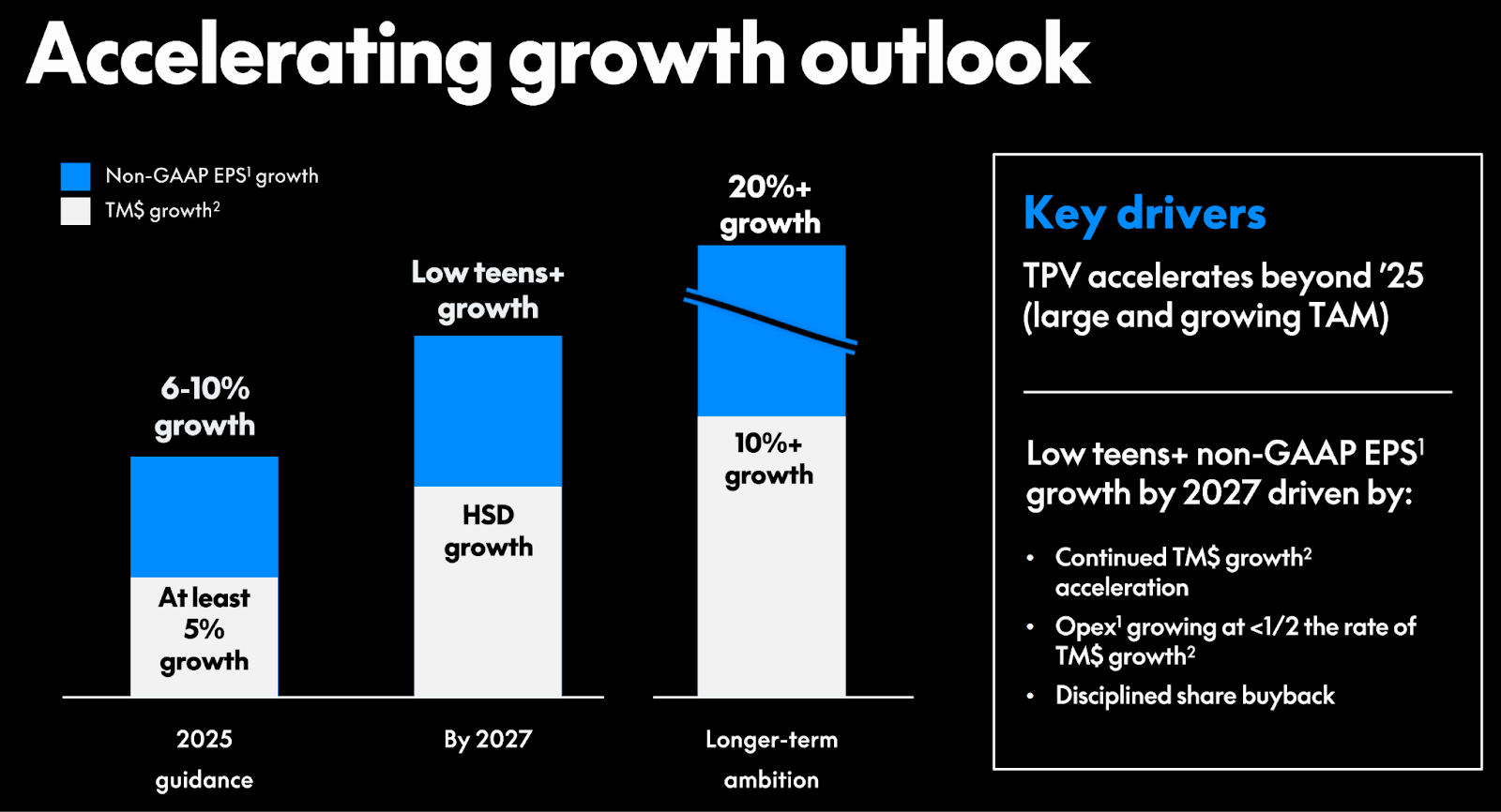
It’s especially interesting to look at the 2025 investor day presentation. Back then, the former CEO Alex Chriss, who had at least some financial services background from Intuit actually made a pretty convincing pitch positioning Paypal as a “commerce platform”. This was their ambition back then:

After shrinking in 2023, Paypal delivered some growth in 2024 and also some growth in 2025 but as mentioned above, next year looks like shrinking again.

2025 results looke d“okayish” but on a quarterly basis, growth decelerated each quarter which most likely led to the dismissal of the old CEO-.

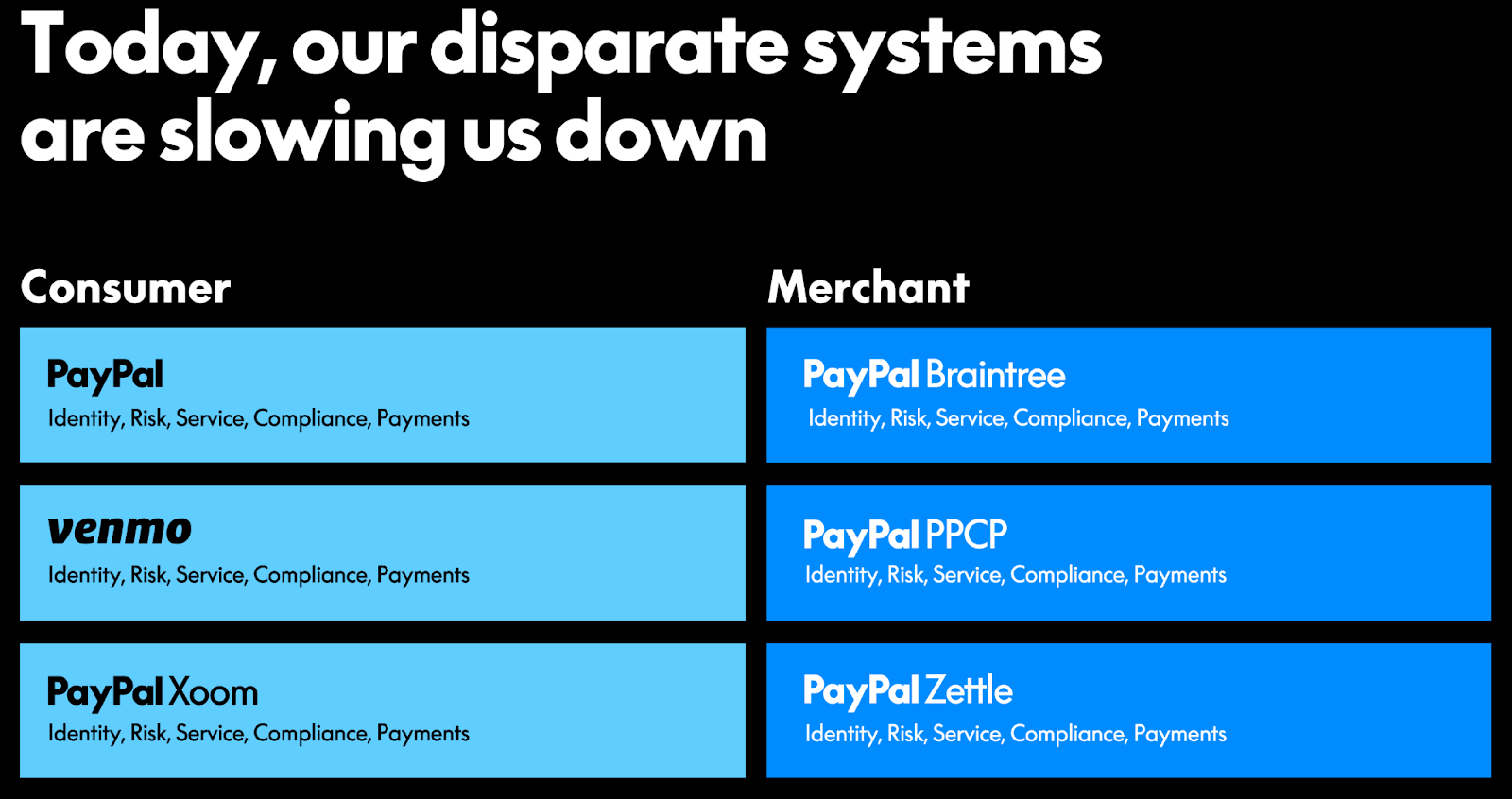
One of the major issues seems to be that Paypal runs at least 6 different platforms within Paypal according to this slide:

According to this slide, one user might have 4 different IDs across the Paypal services which are not connected so far:

Technical debt: Separate & outdated technical infrastructure vs, competitors on the merchant side

The chart points to one of the main weaknesses of Paypal: Paypal can be considered already a legacy player in the payments space. They have created separate platforms for separate use cases that are now just very difficult and expensive to handle.

The newer competitors from the merchant side like Stripe or Adyen all have one platform that runs all of their activities which makes it a lot easier to react and improve upon.

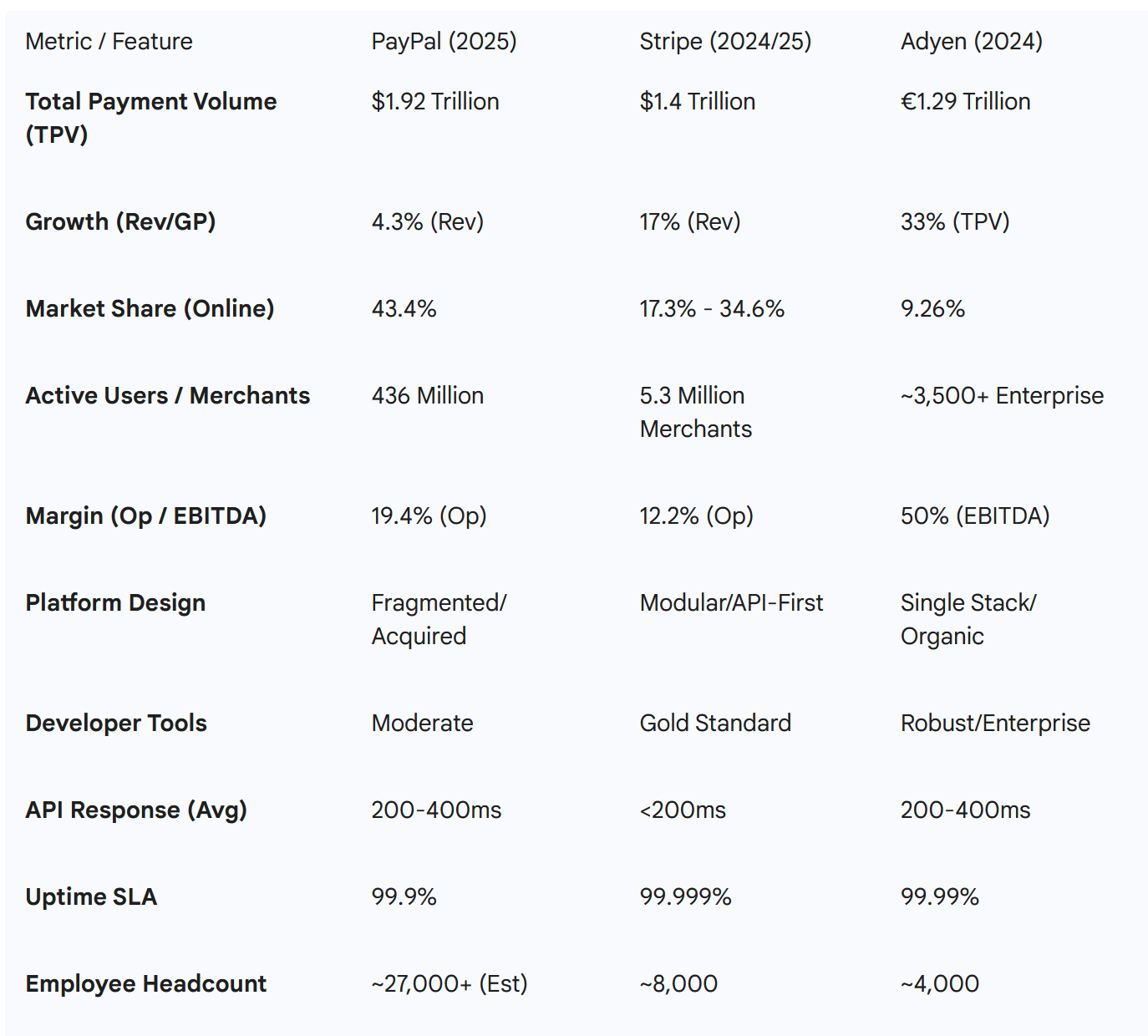
What is also interesting is that Paypal employs more than twice the employees of Stripe and Adyen combined. This is a table that Gemini compiled for me.

Additional attacks on the retail client side: Google Pay & Apple Pay, Revolout, Wise, Cash App etc.

As a “2 sided market palace”, Paypal unfortunately is also subject to massive disruption on the retail customer side.

If you are a mobile user, the probability is high that if you purchase something offline or online it is most likely down directly via your phone. You either hold your phone to a POS terminal in a physical shop or you confirm the purchase with a finger print or face scan of your phone which is even more convenient thant the Paypal Check-out.

At P2P level, both Paypal services are subject to a lot of competitors, such as Block’s Cash app, Revolut’s free transfers or Wise’s international transfers.

So simply said: there is no place to hide for Papyal.

Paypal is the most expensive option

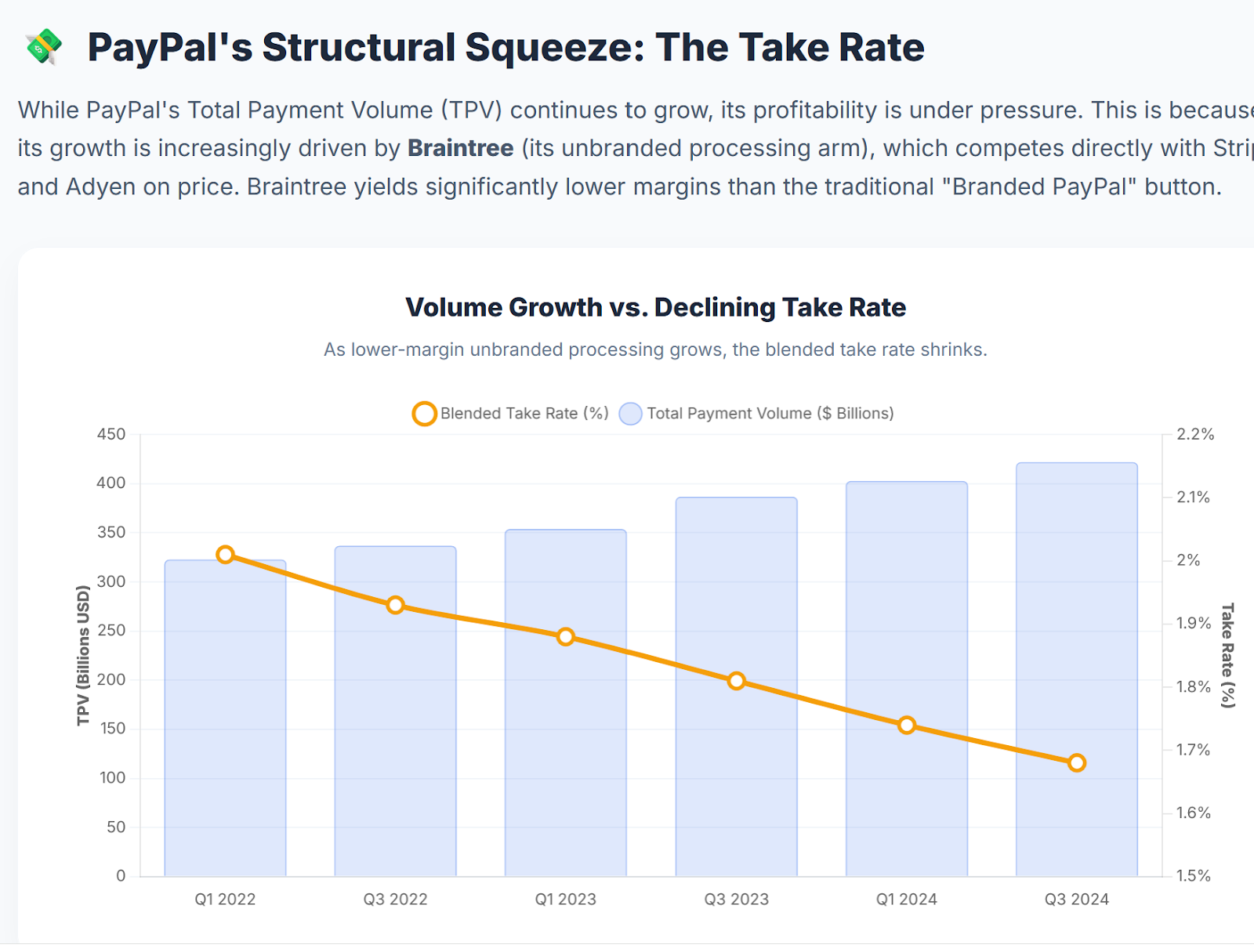
Some people will argue that Paypal is currently maybe the most profitable of the payments players. The main driver of this profitability is that Paypal charges significantly higher prices, both to merchants but also for instance for international transfers.

What looks now as a strength could turn out to be a weakness. “Your margin is my opportunity” was the famous motto of Jeff Bezos. The “take rate” of Paypal is heading down for quite some time (Chart from Gemini) as growth comes mainly from lower margin products:

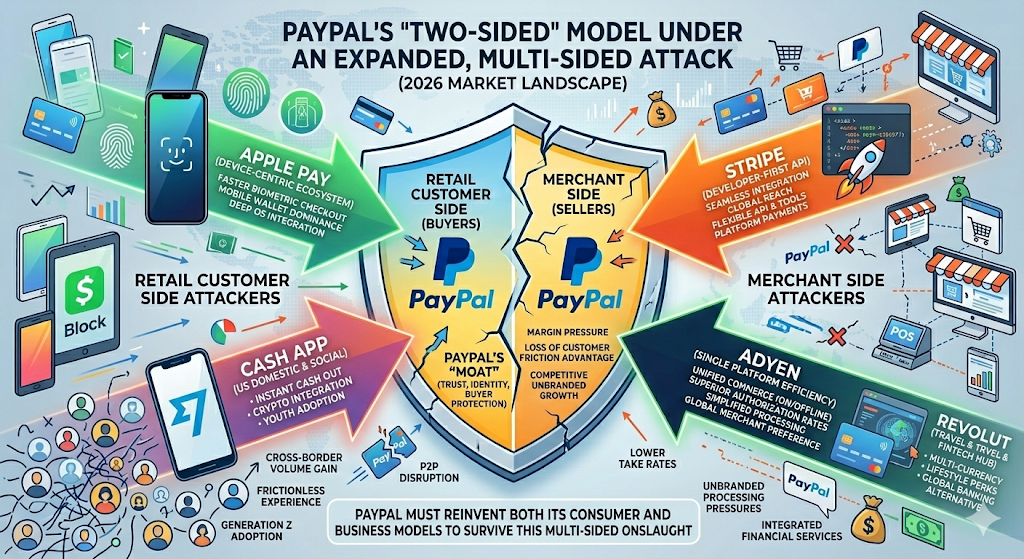
Paypal is under attack from all sides

Bringing it altogether is this graph that I asked Nano banana to create:

Paypal is the legacy player that gets attacked from all side from very agile and large competitors who have a much more modern infrastructure,

That’s the reason why Paypal is cheap. The last CEO tried to counter that but obviously was not very successful.

The Stripe take-over rumour

In the past few days, suddenly a rumour came up that Stripe might buy Paypal. To be honest, these kind of “someone told Bloomberg” rumours are often false.

As far as I understand Stripe’s business model, Stripe would have little to gain from a takeover. As a pure B2B company, I am not sure that the retail client base is of interest to them and if they could leverage that.  And on the B2B side, Stripe can already do what Paypal is doing and I am not sure if they want to clean up the technical debt.

I guess Paypal would be a more interesting target for someone who might be able to leverage the retail customer base, but at 40 bn plus market cap plus premium it is maybe to big to be swallowed by most of the Fintech players.

“Too hard” for me

For me, the outcome of this quick exercise is that Paypal’s problem seems to be much more structural than temporary which for me makes it “too hard” to invest into.

Maybe the new CEO will pull all the levers and manage to turn around the business. But maybe he will not. It will be interesting to see if he will be able to implement a “kitchen sink” approach and maybe sacrifice a few quarters with really bad results or if the pressure is high to keep up share buy backs which will make it difficult to pay off the “technical debt”.

For the time being, Paypal looks similar to the hero of Jethro Tull’s song “Too old to Rock’n Roll”:

The old rocker wore his hair too long

Wore his trouser cuffs too tight

Unfashionable to the end

Drank his ale too light

Death’s head belt buckle, yesterday’s dreams

The transport caf’, prophet of doom

Ringing no change in his double-sewn seams

In his post-war-babe gloom

Now he’s too old to rock and roll

But he’s too young to die

Yes, he’s too old to rock and roll

But he’s too young to die

But anyway, this does not look like something that I would be comfortable to be invested in despite the superficially attractive “value KPIs”.

If someone has a very different view from the business perspective with regard to the competitive landscape, I am willing to listen 😉

Bonus Soundtrack:

Of course my choice is Jethro Tull – Too old to Rock n’Roll

Jethro Tull – Too Old To Rock’n’ Roll (Supersonic, 27.3.1976)

Private Equity Series (8): The “Stonepeak precedent”, a “Dirty PE Industry Secret” and what it could mean for the Industry 

No one has asked for it, but here it is, the next episode of my Private Equity series. Previous episodes of the Private Equity series can be found here:

Private Equity Mini Series (1): My IRR is not your Performance
Private Equity Mini series (2) – What kind of “Alpha” can you expect from Private Equity as a Retail Investor compared to public stocks ?
Private Equity Mini Series (3): Listed Private Asset Managers (KKR, Apollo & Co)
Private Equity Mini series (4) : “Investing like a “billionaire” for retail investors in the UK stock market via PE Trusts
Private Equity Mini Series (5): Trade Republic offers Private Equity for the masses (ELTIFs) -“Nice try, but hell no”
Private Equity (Mini) Series 6: Private Equity for the masses – Y2K edition
Private Equity Series (7): Secondaries – The Magic Money Machine for the PE industry 

Background:

Everyone in the alternative (non-listed) investment space has been talking about the Blue Owl Private Debt “redemption gating” event lately, but in my personal opinion, another story which has not been so widely reported is much more interesting.

The case of the first Stonepeak Infrastructure Flagship fund is at least equally interesting for the whole Private Equity sector and I will try to explain why.

Traditionally, the Private Equity business model can be summarized from the the perspective of the Asset Manager or General Partner (“GP”) as follows:

GPs take a big junk out of any upside (usually 20% ,sometimes more) but themselves have very little downside risk as they charge a hefty 2% p.a. fee in any case and only, if at all, invest relatively little money themselves into the funds they manage.

So let’s look at Stonepeak. Stonepeak is one of the leading Alternative Infrastructure Equity Asset Managers in the world and has 89 bn USD Assets under Management. It is still privately owned.

Infrastructure was actually one of the few bright spots in the Private Equity space in the past few years, where fundraising still works, in contrast to the “normal” private Equity funds.

Although the dividing line between Infrastructure and Private Equity is a little bit blurry, Infrastructure investments are often “capital heavy” and considered more safe despite usually significant leverage. Typical assets are ports, Airports, railways, toll roads but also stuff like container leasing, warehouses etc. (among others Stonepeak bought the Canadian Port Operator Logistec which I owned)

Target returns for Infrastructure funds are usually a bit lower than for Private Equity (usually maybe 10-15% p.a. vs. 15-20%)  and fund duration is often a bit longer. But infrastructure should be also be more robust, i.e. have less downside than a PE fund.

Stonepeak was founded in 2011 and launched its inaugural “Flagship” fund in 2012. 

Now comes the interesting part: 

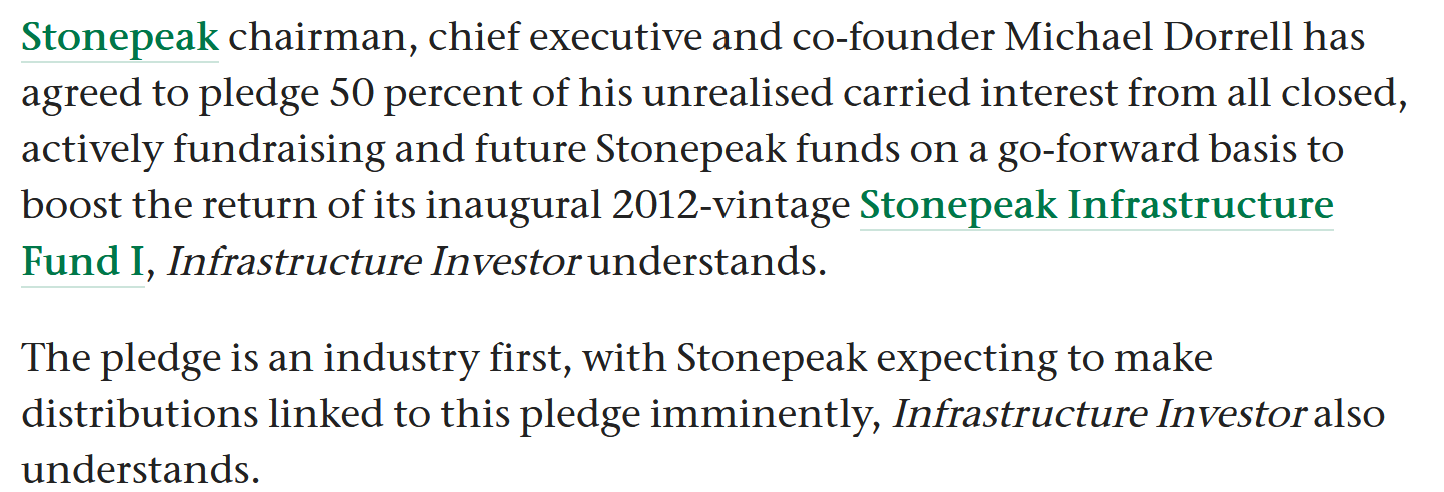
A few weeks ago, the founder of Stonepeak, Mr. Dorrell, pledged personal support for the rather badly performing initial flagship fund.

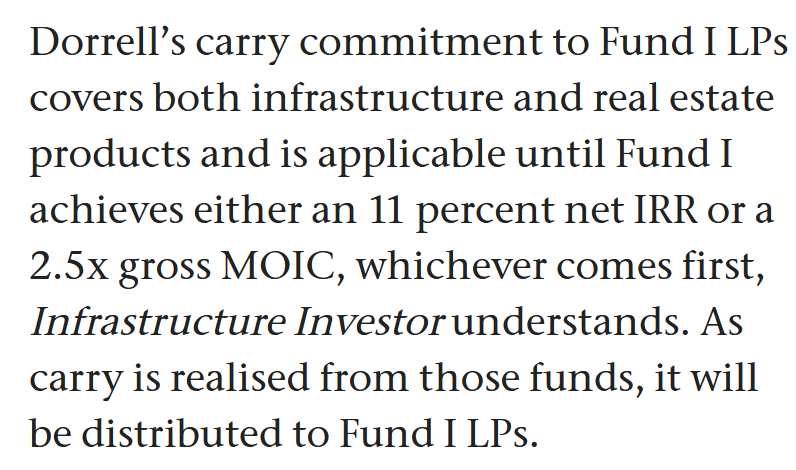
Although it is not unusual that Alternative Assetmanagers might maybe reduce fees going forward if a fund performs really badly, this is the first time that I have actually seen that an owner actually puts in personal money to make good on the not so great performance of the investors. Here is how it should work:

According to the article, the initial fund had “promised” 12% net IRR to investors at launch but currently, after 14 years it only shows an IRR of 7,4%. Not a catastrophy at first glance but also not great either for such a vintage that should have benefitted from a significant decline in interest rates which was especially beneficial for “long duration” infrastructure assets.

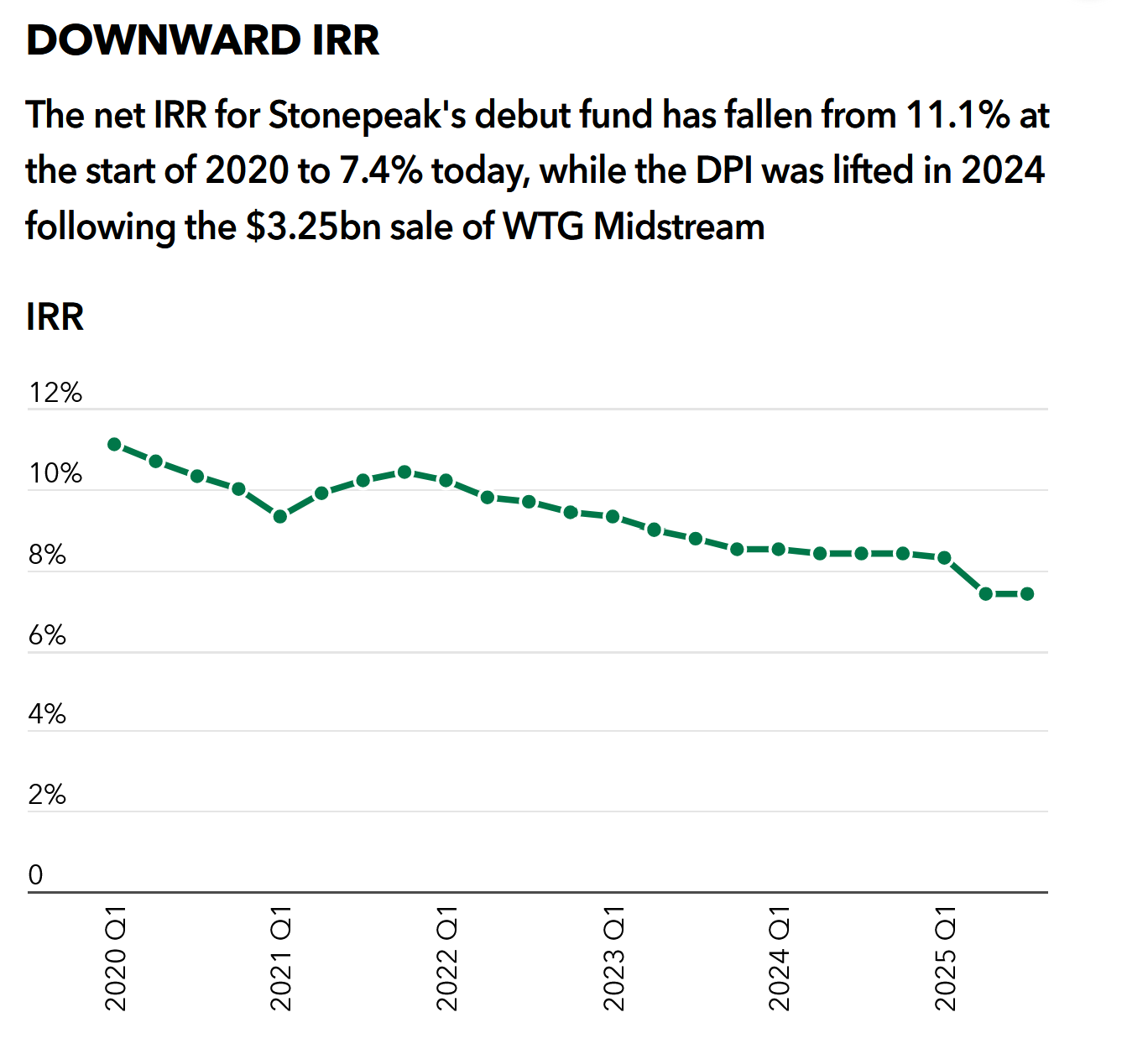
What is also really interesting is that graph that shows how calculated IRRs have developed in the last years from the perspective of investors in this fund:

Until 2020, i.e. for the first 7-8 years everything looked fine. But what happened then ? And why is this relevant ?

I guess it’s now time to tell you a little bit about a “dirty secret” of the Private Equity (and Private Infrastructure) world.

Whenever a new firm gets created and launches an initial fund, it takes a long time until investors can see actual results. On average, in the infrastructure space, investment are sold maybe 6-10 years after they have been bought.

However, Asset Managers don’t want to wait until then to raise a new fund. They want to raise funds more frequently in order to earn more fees. Normally the “fund raising” cycle is ~ 3-4 years. 

Even professional investors invest mostly based on past performance, often just simply extrapolating those past numbers in the future.

So what do you do when you have no exits to show ? Of course, you just mark up your portfolio yourself based on some loosely defined metrics which often is coincidently very close to the target return. So just to say this again: In the beginning, almost all PE/Infrastructure funds are marking up their investments “at will” to show a decent performance, of course with the hope that later on, they will actually realize those returns or even more.

You then can present this (unrealized) return to investors and they happily invest into the next fund and the next etc.

In Stone Peak’s case they were quite busy and raised another 3 funds during the time when performance was looking still OK for the initital fund in 2020 as we can see here:

The funds got bigger and bigger, Fund III was ~7 bn and Fund IV 14 bn. And they are currently raising fund V with a target size of 15 bn,

Most of that money got raised with investors looking at the track record and saying: Fund I looks good at 11% p.a. (or maybe even more in the beginning) and I guess Stonepeak was telling them that this was marked “conservatively” (GPs always say that about unrealized values).

But it turned out to be wrong and clearly overvalued. And this is clearly embarrassing for Stonepeak. 

If I were a potential Stonepeak investor doing Due Dilligence, I would ask: “How can I trust all the other performance numbers of your funds when the only one which is almost realised seems to have been significantly overvalued ?”

I guess that’s why Dorrell wants to make those investors “whole” with personal money:

As the first fund is significantly smaller than the follow up funds, this will not bankrupt him, but anyway, this is an industry first.

The industry relevance in my opinion is the following:

We can expect a lot more such cases where the initial, very positive performance will turn out not so positive at all or even funds may lose money (2019 to 2021 vintages for instance). 

So far, this has always been the sole problem of the investor, never for the GP.

Michael Dorrell now created a high profile precedent that will be taken up with gusto by many disappointed investors.

The smart LPs will use the Stonepeak precedent to ask their GPs for the same “Commitment” to make good on their initial promise. 

Otherwise they will not invest into a subsequent fund. Some GPs, especially the very big ones will resist, some will maybe just close up shop, but I guess a lot of GPs will get under a lot of pressure. 

Overall, this might be a first step to change the relationship between GPs and LPs going forward.  If you are an investor in any listed Alternative Asset manager, I think you should really pay attention to this. It could be that in the future, results might get even more volatile and in general lower if funds underperform.

Another relevant point is the following:

This case also puts a spotlight on how arbitrary especially early valuations are for these investments. Already last year, I heard rumors that auditors have begun to challenge valuations of PE funds as they see secondary transactions with large discounts.

I could also imagine that investors want better disclosure of unrealized return figures during Due Diligence and how those seemingly great early performance numbers got cooked up, or maybe not 😉

In any case, I am sure that there willl be a lot of interesting discussions already going on between disappointed investors and GPs, that’s for sure.

Timing wise, this comes at a pretty inconvenient time for most PE firms anyway. As this chart shows, the last year was not so good for the share price performance of the big shops:

Maybe we will see a turn-around at some point in the future, but for the moment I see more headwinds than tailwinds for the industry overall. If more GPs are forced to compensate investors, then valuations for those guys would need to come down significantly.

Some thoughts on Vibe Coding, SaaS vs AI (10 Moats) and Guidewire Software

Executive Summary:

This post does not contain any actionable investment advice but rather some personal ramblings on Vibe coding and the attempt to analyze a specific Software company (Guidewire) according to a Template of 10 Moats for Software companies and their vulnerability to the AI threat.

Introduction:

My track record as a Software investor is to put it mildly, very poor. My best Software Investment so far is Chapters Group which I bought as a net-net before it even became a VMS Serial Acquirer. My blog and portfolio archive also tell me that I sold Microsoft in 2011 at ~25$ per share with a 4% gain because I thought that the Office products had no future. So please take everything I say about Software with a grain of salt or even better, just ignore it.

I do have a background in Software development. Although I would not call it Software development but “Code butchering”. It started as a teenager on a C64 with Basic and Assembler and ended in the late 1990s with Cobol/PLSQL working for a large US Consulting Company (yes, I was young and needed the money). Knowing the speed of financial institutions, I would not be surprised if some of my Spaghetti code would still be running somewhere….

Why am I saying this ? Because of course, Software stocks have been doing quite poorly over the past weeks/months. In addition, I also had the opportunity to play around with Claude Code first hand. 

Frosta AG – Defining their own Category the Hard Way

Disclaimer: This is not Investment advice. The stock discussed is very illiquid and trades at the unregulated market (Freiverkehr). If you want to buy this stock, work very carefully with strict limits. The author owns the stock and might buy/sell it without giving prior notice. And as always: PLEASE DO YOUR OWN RESEARCH !!

After having two (relatively) exciting stocks in the last two weeks with Rocket Internet and Innoscripta, I decided to tune down the exitement a little bit and focus on a very boring, family run German small cap this time. In order to not fall asleep, you might want to listen to the Soundtrack while reading:

Elevator Pitch:

This write-up is special in two ways. For one, I have privately bought the stock already a few months ago. Secondly, I base this write-up on another write-up from my friend Jon from abilitato.de. So please read that one before you read my “mini-writeup” where I only focus on a few specific aspects.

In a nutshell, Frosta is a boring, under-the-rader German family owned and run frozen Food company that does not do a lot of investor relations but runs a very convincing strategy focusing on additive-free ready made frozen meals. Inventing this category more than 20 years ago, the main Frosta brand is now growing with solid “mid teens” percentage rates p.a., has succesfully managed to enter and grow in neighbouring countries and with profitability that is steadily increasing. For the quality of the company and the potential growth prospects, the stock is still relatively cheap in my opinion at around 12×2025 P/E (ex net cash).

Here ist the write-up. Best read it after having a decent “Chicken Paella” from Frosta 😉

Innoscripta SE: 60% EBIT margins & rapid growth but why did the 2025 IPO flop ?

Management summary: 

Innoscripta, a young German “SaaS company” which IPOed in 2025 came to my attention because it is extremely profitable (EBIT margin 60%) and growing like crazy (10x in sales since 2020). However, because of the unique revenue model (success fee instead of software fees) and a rapid decrease in quarterly growth in 2025, I am currently not investing, although the stock is not super expensive at 21x trailing P/E. But I will keep a close watch. 

The 2025 IPO 

Innoscripta was one of the few “official” IPOs in Germany in 2025. If we look at the share price, it was not a very successful one: 

Read more

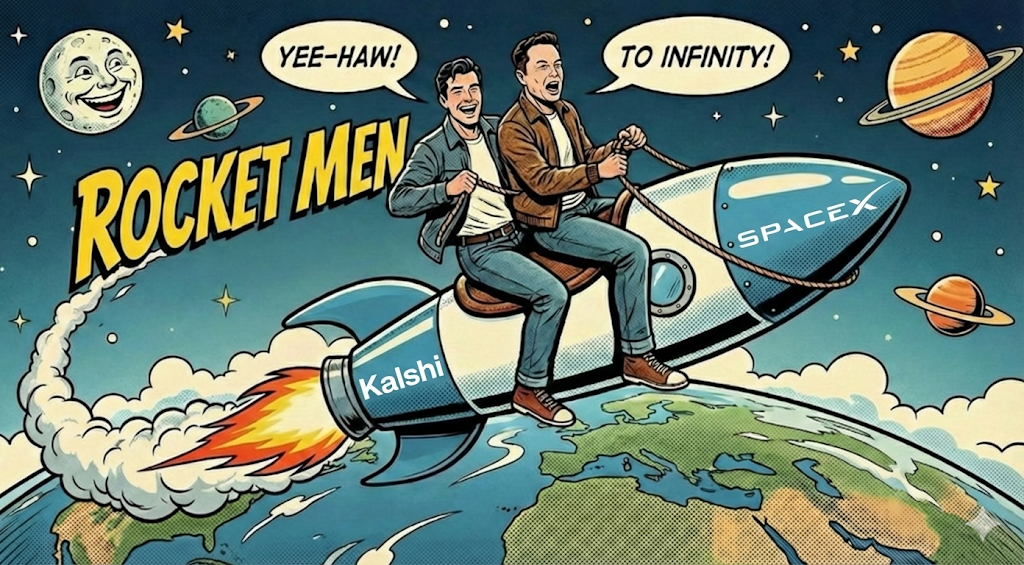
OTC Adventures: Rocket Internet AG – Jump on this Rocket and get some Kalshi & SpaceX exposure for free ?

HEALTH WARNING & DISCLAIMER
This is not Investment Advice. The stock discussed in this post is a “Pink Sheet” OTC stock with limited liquidity and almost no reporting. The author may own, buy or sell shares in this company without pre-warning. DO YOUR OWN RESEARCH !!

As a change to previous write-ups, I will start with the sound track for this write-up. And of course it is “Rocket Man” from Elton John. It fits in more than one way to this Special situation and you maybe want to listen to it while reading the write-up.

Elton John – Rocket Man (Official Music Video) 

As again, this write-up became a little bit longer, I’ll just show the “elevator pitch” here but will embed the PDF document.

0. Elevator Pitch

Rocket Internet AG,  a former German Venture Capital super star company run by the Samwer brothers has gone “dark” and delisted in 2020. Since then, the stock price languished until more recently, when a German activist sent an open letter to Management and the auditors criticizing the “low balling” of accounting numbers. Diving a little bit deeper, some true gems are hidden in Rocket Internet’s portfolio, especially a participation in SpaceX and prediction market superstar Decacorn Kalshi. The current share price reflects most likely less than 50% the current NAV. In my opinion, the upcoming SpaceX IPO and further positive development of Kalshi could maybe act as a “catalyst” and lead to a higher share price. In addition there is a (low) chance that Rocket Internet might distribute another special dividend as they did in 2024.

Some links 03/2026

Great write-up on UK discount retailer B&M fro the Sector Stories Substack

Update from the Curious Investor with some good stock summaries

According to the FT, the US stock market sees “a flight to Garbage”

A large study of a fleet management software provider shows that EV Batteries are holding up quite well over time

A pretty good summary of Buffett’s secret sauce over the decades from Larry Swedroe

Prediction markets like Kalshi are becoming mainstream in The US despite all the issues. And Kalshi seems to be leading.

An interesting profile of Coupang, the “Amazon of South Korea”

Biontech: Checking in once again & using LLMs to value the Pipeline

Disclaimer: This is not Investment advice. PLEASE DO YOU OWN RESEARCH:

Management summary (Spoiler):

After selling Biontechs a few years ago, I reviewed Biontech once again by using LLMs to evaluate the development pipeline. Although this was an extremely interesting exercise, it is not an investment for me for the time being.

Background:

Biontech is a company I have owned in the past and written about. It became famous because they were the first to develop a MRNA based vaccine against Covid which they sold worldwide together with Pfizer.

My initial write-up can be found here, a follow up here.

Read more

Alcoholic Update: TFF Group 6M results & Mercosur-EU Trade agreement

Disclaimer: This is not investment advice. PLEASE DO YOUR OWN RESEARCH !!!!

TFF Group 6M numbers

No matter how you put it, TFF Groups 6M release on January 7th was pretty bad.

Sales down ~-25%, net profit down -33%. The only positive aspect is that the operating leverage (i.e. how much more profit declines than sales) is surprisingly modest.

Last year for instance, a -9% decline in sales led to a -40% decline in profits as we can see in the respective report form last year:

Read more

« Older Entries