Author Archives: memyselfandi007

Emerging markets series part 1: Ashmore Group PLC (ISIN GB00B132NW22)

As I have written a few weeks ago, I am trying to extend my circle of competence a little bit with regard to Emerging markets. The first company in this series is Ashmore Group.

Ashmore Group is a kind of “intermediate” step in this regard: They are a UK-based asset manager who specialises exclusively in Emerging markets.

The history of the company is well described on their homepage:

Based in London, the business was founded in 1992 as part of the Australia and New Zealand Banking Group. In 1999, Ashmore became independent and today manages $75.3bn (as at 31 December 2013) across a range of investment themes in pooled funds, segregated accounts and structured products. Ashmore Group plc has been listed on the London Stock Exchange since 2006.

Asset Management as a business

Asset management in general as a business used to be as good as it gets. Asset Management is an “asset light” business model. You collect fees and sometimes even participate if things work out well. Once money is invested, it is often surprisingly “sticky”. So it is no surprise that among the richest people in the world, a surprisingly large number of people are Hedgefund asset managers.

On the other side, “normal” active portfolio management is squeezed from different sides. Cost efficient Index ETFs from one side and hedge funds from the other. Also, with overall lower yields it is clearly more difficult to achieve the same fee levels as relative to the yield they represent a much bigger percentage

Back to Ashmore, this is how they have done historically since they went public:

EPS FCF ROE Net margin
2006 0,14 0,15 62,5% 60,7%
2007 0,21 0,22 60,2% 58,3%
2008 0,17 0,15 39,6% 46,8%
2009 0,24 0,26 47,1% 56,9%
2010 0,28 0,21 43,5% 55,1%
2011 0,27 0,18 35,0% 54,3%
2012 0,30 0,18 34,7% 56,9%

So no complaints here, ROE went down somewhat as equity was built up, but nevertheless it looks like very very attractive business. Compared to those numbers, Ashmore’s current valuation looks like a joke (at 330):

P/E 11.1
Div. Yield 5.35%
EV/EBITDA 7.8
EV/EBIT 8.3
P/B 3.8
Mkt Cap 2.4 bn GBP
No debt, net Cash 500 mn GBP or~0.71 GBP per share

Plus there is more to like:

– the CEO owns 42% of the shares and with an age of 54 not close to retirement
– they seem to have some sort of “Outsider” qualities for instance fixed salaries are capped at 100 k GBP which keeps down fixed costs

But there is of course a reason why the stock is “cheap”:

– clients are pulling money from the funds
– average fees have been declining for 5 years in a row (until recently compensated by higher AuM)
– Performance fees will be low or non-existent for the foreseeable future
– revenues will decrease with falling market valuations for EM

Why I like the company anyway:

+ It is an easy way to “play” the entire Emerging market universe without incurring country specific risk
+ the company does not have any valuable own assets locked in difficult emerging markets, the assets are owned by the clients
+ long-term, EM capital markets will grow
+ EM are difficult to replicate via index ETFs, especially for bonds. Index ETFs are not really a competitor in the EM bond area (too illiquid, to many different bonds per issuer etc.)
+ As an EM specialist, they are much more credible than a large asset management company with some EM funds among many other offerings

Is there a “moat” ?

In theory, setting up any fund management company is relatively easy. Yes, one needs licences but they are easy to obtain. However, Emerging markets are a little bit different. While it is relatively easy to gain exposure to some assets, like EUR or USD bonds from EM issuers, getting access to local markets is much harder. Ashmore with its long EM market experience does have some advantages here, for instance they are the first non-Hongkong based fund manager to get a license to invest directly into the China “On shore” market early this year.

The current problems with EM led already to the exit of some high-profile AM companies from that area, among others, famous hedge fund Brevan Howard closed its once high-flying EM funds just recently.

Ashmore doesn’t have any “star portfolio managers” who might be able to jump to another company and take a lot of client money with them. Still, the single most important factor for any asset manager ist the historic track record. Performance is normally measured both in absolute and relative terms. For many so-called “asset allocators”, relative performance to other asset managers is the most important number. In order to find out how Ashmore scores in this regard, I looked at the publicly traded Ashmore funds. Bloomberg shows the relative ranking of such funds within their category over different time horizons. Those are the results for the traded Ashmore funds:

mn USD 1y 3y 5y fee
Ashmore Emerging Markets Corporate Debt 3690 84% 69% n.a. 1,15%
Ashmore Emerging Markets Liquid Investment Portfolio 3910 78% 96% 81% 1,50%
Ashmore Emerging Markets Local Currency Bond 2340 5% 23%   0,95%
Ashmore SICAV – Emerging Markets Debt Fund 1400 46% n.a. n.a. 0,95%
Ashmore SICAV – Emerging Markets Global Small-Cap Equity 100 86% n.a. n.a. 1,50%
Ashmore Asian Recovery Fund (“ARF”) 224 37% 1% n.a. 1,50%
Ashmore Emerging Markets Total Return 684 32% n.a. n.a. 1,10%
AshmoreEMM Middle East Fund 449 97% 97% 79% 1,50%

The number have to be interpreted the following way: The 84% under the 1Y column for the Ashmore Emerging Markets Corporate Debt fund says that the fund performed BETTER than 84% of all fund in that category , which, by the way is a very very good score. We can see that not all the funds are doing well, but at least the big flagships are doing well and some of the smaller specialist funds. Overall, from a performance perspective, it looks like Ashmore has at least some “edge” in its core mandates which will help them a lot, once money is flowing back into EM mandates.

Funnily enough, everyone knows that past performance is not a very good indicator of future performance, bt the majority of institutional money gets allocated based only on past performance.

How much would I be prepared to pay ?

To keep ist simple, I would think a “full” price for a company like Ashmore would be around 15x P/E. If I could buy it for (cash adjusted) at 10 x P/E based on potentially depressed next 2-3 year earnings levels, this would leave a decent upside.

Current estimates for 2014 are ~ 0,24 GBP per share, including 0.70 GBP net cash per share, this would mean I would be a buyer at around 310 pence per share or some -10% lower against the current share price to give me my required upside. So for the time being I will stay on the sidelines and watch and buy only below 310 pence per share.

As I am not a Chartist it is still interesting to look at the chart:

My target level for the purchase does look a little bit like a “support” level for the stock, which, if broken, might lead to a larger drop in the share price. So for the time being, I will watch Ashmore going forward but wait if either, business turns out to be better as expected or the price drops below 310 pence.

Portfolio Management: EMAK, Sol SpA, Rhoen & Concentrating ideas

As many other investors, I think it is currently much more difficult to find new convincing ideas. On the other hand, many of my portfolio stocks performed very well and are now near or past my inititial target. Let’s look first at some of the portfolio stocks:

Rhoen Klinikum

As I have said before, once the share price of Rhoen approaches the initial bid price of 22,50 EUR, I will sell this “special situation” investment which I did last week with an overall return of +32%. Clearly, it would be tempting to “ride” the current momentum, but honestly, I do not know why investors are suddenly so “hot” about the stock.

Fundemantally, at least in my opinion, Rhoen is now fairly valued. Compared to the initial deal, the “rest Rhoen” has to prove if they are a valid company. Sure, it looks like that the party is just getting started but still, the risk/return profile was a lot better at 15 EUR ……

EMAK

I also sold out the remaining EMAK stake. Unfortunately, EMAK did not profit so much from the “January effect” as much as I hoped. As with Rhoen, the “special situation” status has now expired somewhat and long term, EMAK is for me only an “average” company at an “average” price, so no reason to hold it further. I sold yesterday at around 0.85 EUR per share with a total profit of +89% for the whole position.

Sol Spa

Finally, I sold out of Sol Spa last week at well at a price of ~6,10 EUR per share, netting a 55% gain over a holding period of around 14 months. Sol Spa was a hard stock for me to hold. Although I really like the company, the stock price advanced much qicker than the business. Since I looked at them back in April 2012, clealry the health care business continued to grow, but the traditional gas business has to struggle much harder than i thought. The profit declined both, in 2012 and 9m 2013, but the share price still increased by 50%.

At a current P/E of 19, P/B of 1.5 and EV/EBIT of 14, I think the risk/return relationship is not exciting any more. Again, I will most likely regret this in the short term, but mid- to longterm, I cannot justify the investment.

What now ?

The above mentioned transactions generate ~9% additional cash. As I do not have any investible new ideas available, should I just let the cash lie around until I find something better ? Well, thankfully I still have room in my already existing portfolio positions. For two of the stocks I do have a very positive opinion:

TGS Nopec

TGS Nopex has issued surprisingly good Q4 numbers plus they announced a new stock buy back. So a good opportunity to upgrade this to a full (5%) position which I did at around 177,5 NOK per share

MIKO

As I have written before, I expect MIKO to significantly improve profitability for 2013. Therefore I increased the stake in February at a price of around 68,20 EUR per share to increase the stake from around 3.5% to 4.2% of the portfolio. Unfortunetly, there is not enough trading to make it a full position yet.

That still leaves me, even after the new Energiedienst position, with around 19% in cash which suspicously looks like market timing but is not or only indirectly. It is just hard these days to find good stocks at cheap prices. But I am working hard on new (or old) ideas. Further candidates for a potential postion increases are Van Lanschott and Trilogiq.

Some links

Must read: 10 thoughts on becoming an indpendent fund manager from RV capital

Frenzel & Herzing have a 2 part mini series on 3U (part 1, part 2), a potential German (very) deep value situation plus a great study on soon-to-be-taken-over Kabel Deutschland.

A great review of the book “The art of short selling”

Another must read: The annual Credit Suisse Investment Returns yearbook 2014

Long story how Abercrombie & Fitch lost it (not every maniac CEO guarantees success…)

Finally, the new interesting blogs:

Contrarianville, a blog with some great, “deep thought” posts on Value investing in general
Otakuinvest, a relatively new value Stock picker blog with blog portfolio

Short cuts: G. Perrier, Tonnellerie, Thermador, Verbund

G. Perrier

Already a few days ago, G. Perrier issued 2013 sales figures which were better than expected. Especially interesting was the accelerating growth from quarter to quarter, with 17% qoq growth in the last quarter and over 30% growth in the final quarter in the energy segment. As the energy segment used to be the most profitable, one could expect even higher growth in profits than in sales, all other things equal. That might also be the reason why the stock price jumped to a new all time high after the numbers. A great result in a very difficult environment.

Thermador

Thermador already reported 2013 results yesterday. Although they did rebound as well from a weak first half-year, the rebound was not as strong as for G. Perrier. The 2013 result in total was therefore ~-6% lower than in 2012 but based on a very high tax rate of 37%. Still a very good result in a tough environment.

Tonnellerie (TFF Group)

No new numbers here but still a surprise: They actually issued their first ever English language annual report for 2012/2013. At least they used such a bad font style that it is still hard to read for potential Anglosaxon investors 😉

Verbund

Verbund, the Austrian hydro power utility issued a quite unusual 2014 profit warning today, before they even announced their 2013 results. The outlook was horrible, although they did not specify where and why. So we do not know if the troubled Italian subsidiary, the Austrian core business or the Eastern European subsidiaries are the problem.

Nevertheless a good reminder, especially after I have presented Energiedienst on monday as a new investment, that the road for all European utilities is still very “bumpy” and clearly we should not expect a V-shaped recovery.

Verbund’s diverse (and unsuccesful) subsidiaries are also the reason why I didn’t consider them as an adequate “electricity price bet” like Energiedienst. Similar to other big Austrian companies, they made the mistake in trying to build up a “KuK style” empire without thinking about the prices paid and potential profits. Politically driven empire building is always bad for shareholders.

Energiedienst Holding (CH0039651184) revisited

Almost exactly one year ago, I looked at Energiedienst Holding, the Swiss/German Hydropower utility.

That was my summary from last time:

The current system for renewable energy in Germany (selling renewable electricity into the market at any price with the consumer paying the difference) is hell for “traditional” utilities including hydro power.

The German utilities have maybe underestimated the extent of renewable production, otherwise they could have done the exactly same thing themselves. Now however, the are in a kind of “death grip” between having to run their expensive black coal and gas plants for peaks and the artificially low electricity prices. Combined with unfavourable natural gas delivery contracts, especially for E.on the air will remain quite thin.

So unless something changes significantly, German utilities (including Energiedienst) will need a long long time to adjust capacity and change their business models.

So the first questions is of course: Did something change ?

Well, firstly, the stock price of Energiedienst dropped a further -25% form around 38 CHF to currently around 29 CHF. So just from the pure valuation point of view, the stock clearly looks cheaper:

P/B 0.86
P/E 12
EV/EBIT 12
EV/EBITDA 7
Div. Yield 5.1%.

Energiedienst released preliminary numbers for 2013 today. At a first look, it doesn’t look pretty. EPS came in at 1.99 EUR per share, the third consecutive decline since the peak at 2.70 EUR in 2010.

Looking further into their preliminary numbers, I was especially surprised by this:

  2013 2012 change in %
EBIT in Mio. € 79 99 -20%
EBIT Segment Deutschland in Mio. € 53 56 -6%
EBIT Segment Schweiz in Mio. € 27 43 -38%

Profit in Germany was only slightly lower, but we see a big drop in Switzerland which is surprising. In the text they mention that they took a special charge for long-term electricity purchases in the first half-year so one can assume that this has to do with the Swiss business. So not surprisingly, Free Cash Flow looks better than earning:

  2013 2012 change in %
Free Cash Flow in Mio € 79 83 -5%
Bruttoinvestitionen in Mio. € 44 57 -23%

This results in a total net cash balance of 146 mn EUR at year-end or 4.40 EUR per share which is almost 20% of the current market cap. So “cash adjusted” P/E is around 10. Additionally, they announced some kind of strategy change and review, however without any real details

OK, so we do have a relatively cheap but declining business, why bother ?

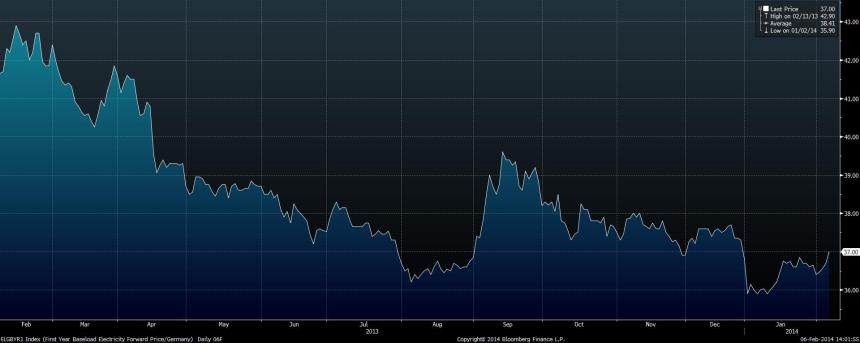
First, at least to me it looks that Electricity prices have at least for now stopped their free fall as those two charts show:

I am clearly not an expert on electricity prices, but with the currently mild winter (or no winter at all), I would have expected a further drop but that doesn’t seem to happen at least for now.

Political environment

Since last year, again some things have changed. We have now the “GroKo” in Germany, the coalition between the two large parties, conservative (CDU) and Social democrats (SPD). Interestingly, the boss of the junior party SPD, Sigmar Gabriel, has taken over the responsibility for Energy.

As I described a year ago, under the current system, mostly retail clients have to pay a surcharge in order subsidize above-market prices offered to the owners of solar and wind power plants. Many large companies are not subject to this “tax”.

The surcharge is increasing every year, both because of lower wholesale prices and additional capacity. However, pressure is building up against this system from many sides. Clearly, the established utilities are fighting against this as hard as they can and threaten to switch of expensive gas-fired power plants which are essential for net stability. But now, also the EU commission started to look into the exceptions for large companies already in December.

Also the core voters of the SPD are mostly lower-income recipients which are most effected by increasing electricity prices along rising rents. So Sigmar Gabriel, the SPD energy minister has to do something in order to stop further retail price increases or he will have no chance of winning the next election. Some ideas were already floated, mostly a limitation of future renewable capacity and lower rebates in the future. The concept drew a lot of critic from all side, although some parts, especially the requirement for direct marketing of renewable power doesn’t seem to be that bad.

In parallel, the bankruptcy of wind energy “pioneers” like Prokon shows that even under current high transfer payments, the big boom in new renewable energy seems to be mostly over and I guess investors will be much more careful in the future.

On top of that, the big utilities are taking out a lot of conventional capacity in Germany, party also in order to increase the pressure on the politicians.

So without being an expert in those issues, it looks like that the “tide might be turning” at some point in time in the future with regard to electricity prices or at least that they are not falling that much more. But this is clearly my own opinion and cannot be supported by a stringent theory or facts.

But why Energiedienst ?

As I have written before, the big traditional utilities like RWE, EON etc. have a lot of other problems, like too much debt, nuclear liabilities, pensions, problematic foreign subsidiaries etc. Even Verbund, thy Austrian Hydro Power utility has a lot of issues with Italian and other foreign investments. Energiedienst, on the other hand does not have those additional issues.

Energiedienst still looks more expensive than its peers:

Name P/E EV/T12M EBIT EV/EBITDA T12M P/B Dvd 12M Yld – Net Net D/E LF
             
ENERGIEDIENST HOLDING AG-REG 11,8 10,2 5,9 0,8 5,2 -7,8
VERBUND AG 9,4 9,8 4,8 1,1 3,8 70,5
RWE AG 108,3 7,2 3,0 1,5 7,4 77,9
MAINOVA AG 15,4 50,5 23,3 2,3 2,4 76,4
E.ON SE 12,2 8,2   0,7 8,3 45,2
ENBW ENERGIE BADEN-WUERTTEMB 51,0 13,0 6,1 1,4 3,1 43,0
LECHWERKE AG 21,7 21,6 14,7 3,1 2,8 -55,8

They do not jump out of this comparison table as the “super cheap” utility. But if we look at Lechwerke in comparison, a comparable, regional, Hydropower utility in Bavaria owned by RWE, sometimes quality is honored with very rich valuations.

In my opinion, the quality of Energiedienst, especially in comparison to EON, RWE & Co is not reflected in the share price. Clearly they suffer as well from current electricity prices and they are not a growth stock, on the other hand, as a hydropower generator without variable input cost, they will benefit the most from increasing prices.

The downside at the current level is in my opinion relatively protected, unless they do something really stupid with their net cash. This is in my opinion the key issue to watch going forward. Energiedienst will generate a lot of cash as reinvestment requirements will be rather limited. If they owuld actually start ti buy back shares, this couldbe a nice surprise but there is no indication that they willdo so.

I am aware that buying a German utility stock now is a pretty contrarian play and many people will say EON and RWE are cheaper and could more speculative upside or not to invest in utilities at all. My focus however is more on the downside, where I think Energiedienst is much better protected than the big, indebted players. So overall, I think the “full” risk/return relationship of Energiedienst is better.

Summary:

An investment into Energiedienst is clearly a bet on constant or higher electricity prices based on potential political changes, so it is rather a “special situation” investment with regard to potential regulatory changes from the current, unsustainable status quo. What I like about this bet is that to a large extent this will be driven by political actions which will be either uncorrelated or even negatively correlated to the overall economic situation and hence, to the rest of my portfolio.

My return target over 3 years would be the annual dividend of currently 5% plus a stock price increase of ~30% which would indicate a target P/E of 13-14 at current Earnings (ex then cumulated cash).

So for the portfolio, I will initiate a 2.5% position for the “special situation” bucket at ~29.50 CHF / 24.50 EUR per share.

Some links

Good overview and outlook for the beaten down Emerging Market countries from Prof. Cowen

Interesting analysis on Delisting from German stock exchanges (Frosta BGH Urteil, German)

Alphavulture likes MAgix AG, the German media software company

Cullen Roach explains why waiting for the fat pitch is not for everyone

Great post on Alleghany from HoldCo expert Brooklyn Investor

Fascinating book review “The panic of 1819” from valueprax (already ordered…)

Finally Nate from Oddball with some insights on sharing investment ideas.

Compagnie Du Bois Sauvage & Ackermans Van Haaren update

A friendly reader has sent me a recent research report from KBC about Belgian holding companies, including “sum of parts” valuations for both holdings I looked at, Cie Bois Sauvage and Ackermans & Van Haaren. Just for fun, I wanted to compare my valuations with those valuation:

Cie Bois Sauvage

Here is the comparison table:

Prt Value Comment KBC Valuation
Neuhaus Chocolate 100,00% 300,0 PE 25 265,0
Behrenberg 12,00% 54,0 at 1.5 times book 63,0
Umicore 1,56% 60,5 At market 59,0
Recticel 28,89% 53,4 at market 51,0
Noel Group 29,37% 4,6 PE 10 12,8
Other   20,0 as disclosed 26,7
         
Codic Real Estate 23,81% 24,5 at book 23,1
other reals estate   60,0 as disclosed 66,8
cash etc.   20,0   11,5
         
Sum   597,1   578,9
Net debt   -80,0   -61
NAV   517,1   517,9
         
shares our   1,6   1,6
NAV per share   323,2   323,7

Strangely enoungh, the final valuation per share differs only marginally, despite some divergences, most notably did they value Neuhaus 40 mn lower than I did. Interestingly they have a target price of “only” 235 EUR and consider it as a “hold” position.

Ackermans & Van Haaren

Value Method KBC  
DEME 550 Implicit val. Takeover 995  
Van Laere 26 0.75 book 44  
rent-a-port 5 at book 9  
Maatschappi 20 At book 28  
Sipef 130 market cap 482 137  
Delen 522 1.5 book 970  
van Breda 336 1.2 book 470  
Extensa 80 0.8 book 187 Extensa + Leasinnv
Leaseinvest 108 Traded 0  
Financiere duval 40 at book 45  
AnimaCare 40 2x book 21  
MAx Green 70 10x Earnings 10  
Telemanod 30 10x Earnings 9  
Sofinim 255 75% of NAV minus cash 362  
GIB     41  
Other     39 Belfimas
         
Net cash holding 148 Q3 -93  
         
         
Total 2360   3274

Here we can see that they came out clearly much higher than I did. Especially the private banks were valued much more richly at 1.44 bn vs my 850 mn. I think that this could be a little bit aggressive. The other big difference is DEME/CFE. Where I used the initial valuation before the merger, they use the current market value, which is clearly better. This is partly off set by the lower cash balance where I used the balance before the transaction.

Interestingly again, they apply a discount to the NAV, however in Ackerman’s case only -20% vs the -30% at Cie Bois Sauvage. Their target price is 86 EUR and they rate the stock surprisingly as a buy despite an upside of less than 10%.

Overall it is interesting to see their valuation, but honestly I am not overly impressed and it does not change anything in my conclusions.

Performance review January 2014 – “Taking responsibility”

Performance:

January was a very good month for the portfolio. The portfolio gained 3.68% vs. -1.86% for the benchmark (New benchmark since 1.1.2014: Eurostoxx 200 Small 25%, Eurostoxx50 25%, Dax 30% MDAX 20%).
Major positive contributors were April SA (+12,8%), Cranswick (+10.2%), Installux (+9.6%), Draeger Genußscheine (+8,0%) and Hornbach (+7.1%). Overall, the portfolio benefited from a January small cap effect more than anything else.

Portfolio transactions:

As discussed, I sold the entire Celesio position. Additionally, I started to sell down a quarter of Rhoen at around 21.95 Eur. On the sell list as well is the remaining stake in EMAK. Unfortunately the January effect did not help the EMAK share a lot.

Cash is currently at 15.6% of the portfolio. The portfolio as of January 31st can be found here.

Comment: Taking responsibility

Currently, two complete former management boards of two infamous German banks are standing trial. In both cases, HypoReal Estate and BayernLB, the boards made large acquisitions just before the financial crisis (Depfa, Hypo Alpe Adria) which turned out to be disastrous and sank both banks.

Of course, both boards and CEOs do not see themselves responsible for what happened. Hypo Real Estate’s former boss Funke blames the former German Finacne Minister Steinbrück for everything, the BayernLB CEO Kemmer blames of course the financial crisis for everything.

Taking credit personally for success and blaming others for failure seems to be common today in most management boards. As an investor however this kind of behaviour is very dangerous in many ways. In order to compound wealth long-term, investors need to avoid mistakes much more than trying to pick the next Apple or Google.

Blaming others for bad investments is in my opinion a sure way NOT to compound well in the long run. Blaming others and not oneself increase the risk that the same mistakes are made over and over again. Clearly, luck plays a big role in investing as well, but in the long run skill and especially the avoidance of “Unforced error” will dominate luck.

A good example is the current Prokon “scandal”. Many people now are blaming the German authorities that they didn’t step in and closed the scheme long ago. No, it was not the fault of the investors, which ignored all the warnings, it was the fault of others. Thinking like this leaves the door wide open for the next Ponzi scheme and then the next and the next etc.

If I make a (big) loss with an investment, my first question always is: What did I do wrong ? What did I miss ? Did I ignore facts or did a fall into a behavioural trap ? Unlike a CEO, the only person I can possibly fool is myself, so no need to blame the financial crisis, incompetent politicians, bad weather etc.

The same goes for greate investments. One should also ask oneself: What part was luck and what was skill ? History is full of failed investors which made one lucky trade and then lost it all because the thought that they actually knew what they were doing. The Celesio trade is a good example. Yes, I made a quick nice profit, but my initial assumptions were wrong. So instead of thinking: Hey, merger arbitrage is easy, I should ask myself if this is really a game I should play in the future as I do not seem to have better insights than anyone else.

So to make the long story short: For long term investment success, it is far better to take the opposite strategy of a typical Bank CEO: Take full personal responsibility for failures and only partial credit for success. I will almost guarantee that this will lead to a much better outcome than the typical “Bank CEO” approach for your personal portfolio.

Prime Office AG (DE000PRME020) – Strange rights issue

I have linked to the “special situation” stock Prime Office already in the past. The story in short:

Oaktree has effectively taken over a struggling German Office Reit by contributing a portfolio of office assets of their own. They then changed the status from REIT to “normal” company. In order to reduce the debt level, they started a rights issue a few days ago.

However this rights issue has a strange twist: Although the subscription rights are already traded (ISIN DE000PRME1B7), they did not publish the subscription price of the new shares yet.

Just as a reminder, let’s look how the value of a subscription right is calculated (from Stockopedia)

The calculated value of a subscription right. The theoretical value of a right during the cum rights period – which is the interval after the announcement of the rights offering but before the stock trades on an ex-rights basis – is calculated by the formula:

(Stock Price – Rights subscription price per share) / # of rights required to buy one share + 1

What we do know is that there will be 8 new shares for 23 old shares, that they are offering (up to) 46.58829 mn shares and that they want to raise 130 mn EUR. So one could calculate a theoretical subsrciption price of (130/46.59) = 2.70 and a value of the subscription right at the time of writing of (2.81-2.70)/(23/8+1)= 0.0283 EUR which is silghly lower than the traded prcie of 0.031 EUR per right.

But what I am asking myself is the following: Why did they do this in such a strange way ? Why didn’t they fix the price in the beginning as in very rights issue I have seen up to now ? I have no idea but I will watch that one closely.

Random thoughts on Emerging Markets, Contrarian investing and Circle of competence

Since I have started the blog, I have been actively avoiding (or even shorting) anything which has significant Emerging markets exposure. This was quite a controversial strategy as for the last few years, investing in Emerging markets or companies with high Emerging market exposure was considered to be one of “THE” no-brainers in investing, along with commodities and residential real estate. Who doesn’t remember the famous “cleanest dirty shirt” slogan from Pimco’s El Erian ?

The momentum of Emerging markets carried them over the Eurozone crisis up until the end of 2012. Interestingly, even after first warning signs emerged like falling commodity prices, free-falling orders for companies like Caterpilar, the Batista bankruptcy etc. last year, the story of the “Emerging market consumer” and the swift transformation from investment led economies into happy consumer countries seemed to be still alive.

Now however, at least in the public perception, people are surprised that the infamous “decoupling” of the BRICs & Co was (as always) more wishful thinking than anything else. Interestingly again, the mood quickly turns from “no brainer” to “full panic”. On the other hand, European stocks, which 2 years ago were seen as total disaster, are touted as the most promising asset class despite being now much more expensive than 2 years ago.

As a contrarian investor, this is the time when one should pay attention and prepare oneself. On the one side, current sentiment tells me that I should become more careful with my high percentage of European stocks, on the other hand, I think it will be a good time trying to expand my circle of competence and start to look more into stocks with Emerging Markets exposure.

However, as a contrarian investor, one should be aware that one is always too early, both in the way in and the way out. This is basically the opposite side of the momentum investor. Psychologically, in my experience, most stock investors seek “instant” gratification. If you buy a new stock, you want the stock go up directly in order to have positive feedback on your thesis. Very few people can stomach declining share prices especially for new investments. In institutional environments there is a very high implicit pressure to invest into stocks with positive momentum as this increases the likelihood to look good in the short-term and this is all that counts, even in many so-called “value investing” outfits.

Back to Emerging markets: The truth is, I know very little about Emerging markets. I have documented one attempt with Pharmstandard as a special situation, where I was clearly luck to get out in time. So one clearly needs to have some sort of strategy.

In principal, there are various ways to gain exposure to Emerging markets:

1. diversified funds/ETFs of Emerging market stocks
2. single emerging markets stocks which are traded on accessible stock exchanges
3. Companies in developed markets with significant EM exposure

Personally, I think it makes most sense to extend the circle of competence in little steps. So investing in a company based for instance in China, where I have no clue how the market works and which is active in an industry where I don not have a lot of experience might be a very bad idea or the equivalent of pure gambling. One should also avoid obvious “compromised” sectors like German listed Chinese companies as the likelihood of systematic fraud is too high in my opinion.

The diversified approach has also big problems. In many markets, for instance Turkey, banks have a huge weight in the indices. As banks are the most vulnerable companies in a real crisis, index investing often turns out to be a suboptimal approach.

This leaves in my opinion two alternatives:

A) Invest in EM companies where I know the sector / business very well
B) Invest in developed market companies with significant EM exposure

Strategy B) in the current stage is relatively difficult, as especially in the consumer and automobile sector, people seem not to believe in any crisis or downturn. Yes, companies like Adidas, Yum or Volkswagen have underperformed the DAX this year, but they are not cheap.

Strategy A) has the drawback that often only a few companies are easily available to invest. In Turkey for instance, there is only a handful companies traded outside Turkey and one might not easily find traded ones in the prefered sectors.

One important caveat: In my experience, both booms and busts take longer to play out as everyone thinks. So there is absolutely no hurry to fully jump into EM stocks now. On the other hand it is very unrealistic to actually identify the low point. So once a certain investment is identified which is attractive, one should buy without trying to time the market.

In any case, for the rest 2014 I will try to look at the one or another company with significant EM exposure instead of chasing the few remaining undervalued European or American stocks. I might even start positions in some and prepare for a lot of pain, both for missing a continuing rally in Europe and for losses in new investments. But that is what contrarian investing is all about.

« Older Entries Recent Entries »