Category Archives: Anlage Philosophie

Performance review June 2016 – Comment: “Brexit, Excuses and Risk Premiums”

Performance Q2 2016:

In the second quarter, the portfolio gained +0,6% against -3,5% for the Benchmark (25% EUR Stoxx 50, 25% EUR Stoxx small, 30% DAX, 20% MDAX). YTD the score is -1,4% for the portfolio against -9,5% for the Benchmark. On a rolling 1 year basis, its +1,0% for the portfolio and -8,4% for the bench.

Just for fun, here is the YTD/1 Year performance of some small funds that I follow and where I know the managers (I will track them in future reviews just to see how I am doing against the “Pros”, data from Bloomberg):

Partners Fund TGV: +1,71% / +7,20%
Profitlich/Schmidlin: -3,86% / -4,35%
Squad European Convictions -1,19% / +7,85%

Read more

AQ Group (ISIN SE0000772956) – a 15 year “42- bagger” without a Moat ?

Would you consider to invest into a company which at every occasion states the following:

AQ possesses no amazing patents or other security, we rely on having the best crew.

For a “Buffett/Munger” style value investor, this would be tough as there is clearly no moat or anything close and according to Buffett, the business economics always win in the long run, no matter how well a company is run.

Welcome to AQ Group, a Swedish “non moat” manufacturing company


large

Read more

Exor SpA: Buying a Reinsurance company doesn’t mean that you’re the “next Bershire”

Following my Old Mutual “sum of parts” valuation I saw the following Ira Sohn presentation of Exor Spa, the Agnelli family holding (FiatChysler, CNH etc.) as a potential  “Sum of part” value investment.

exor_logo_dec_2013

To summarize the presentation  in my own words:

  • Exor Spa is basically a “Berkshire like” company at a “Graham” valuation
  • Exor is managed by a “great capital allocator” and trades at a discount as people see it as an Italian company
  • After the acquisition of Reinsurance Partner Re Exor should trade at similar valuations as Berkshire or Markel
  • Big upside potential as FiatChrysler, Ferrari (and CNH) are severely undervalued (“Coiled springs”)

The study sees a potential upside of several times the current share price. They forecast a 150 EUR NAV per share (vs. ~50 EUR now and 30 EUR share prices), driven by a quadrupling in value of the FCA and the CNH stakes.

Read more

Book review: Louis V. Gerstner- “Who says Elephants Can’t dance ?”

51uczyiatql-_sx335_bo1204203200_

“Who says Elephant’s can dance” is the book from the former CEO of IBM who took over in 1993 when IBM was struggling hard and then turned around the company until he left in 2002.

Interestingly he wrote the book himself without the help of a professional writer, which is very rare for such kind of memoirs, but makes the book very interesting.

Gerstner came to IBM from RJR Nabisco but he did spend most of his previous career ar Amex and was shocked how bureaucratic the company was. The book then describes in detail how he managed to focus the company on the then little known internet and “e-business” segment away from the focus on the traditional mainframe computers.

The most interesting chapters come towards the end of the book where he reflects on company culture and strategy.

A few of my take aways from Louis Gerstner’s insight:

  • Alignment of interest is important. He required managers to hold multiples of their salaries in company stocks
  • One company: bonuses only based on total company targets, no divisional targets
  • Company culture is many times a reflection of the personality of the founder and endures a long time (in IBM’s case almost 100 years)
  • If a company is struggling, focus on the core business. Don’t di”worsify” and try “transformational” M&A transactions
  • Processes are overrated. Lead by principles to maintain flexibility
  • capital management within a company is hard. Succesful units want to reinvest their profit and not share it with others
  • Centralization vs. decentralization is always a struggle, find the right balance, don’t go to either extreme
  • revenue decreases during a turn around can be actually a sign of strength

At the end of the book he even gives some advice to stock analysts and proposes 5 questions to ask (and answer) when considering an investment:

  1. Is the company a major force in a growing market (Segment) ?
  2. Is the company holding or increasing market share by using sustainable advantages (cost, technology, quality)
  3. Is the growing market share reflected in growing cash flow after ALL costs (forget adjustments)
  4. Is the company using the cash flow wisely (Avoid “macho” acquisitions, concentrate on R&D, marketing)
  5. Is the management aligned with shareholders. Do executives hold meaningful amounts of stock ? Does the company distribute dividends and/or buy back shares ?

Coming from a manager and not an investment guru, I think this 5 points pretty much capture everything.

Overall, I found the book one of the best “Business books” I have ever read and I can only recommend it highly.




Hornbach Baumarkt AG revisited- Where are the market share donators ?

Hornbach Baumarkt is one of my few remaining initial position after almost 5 and a half years.

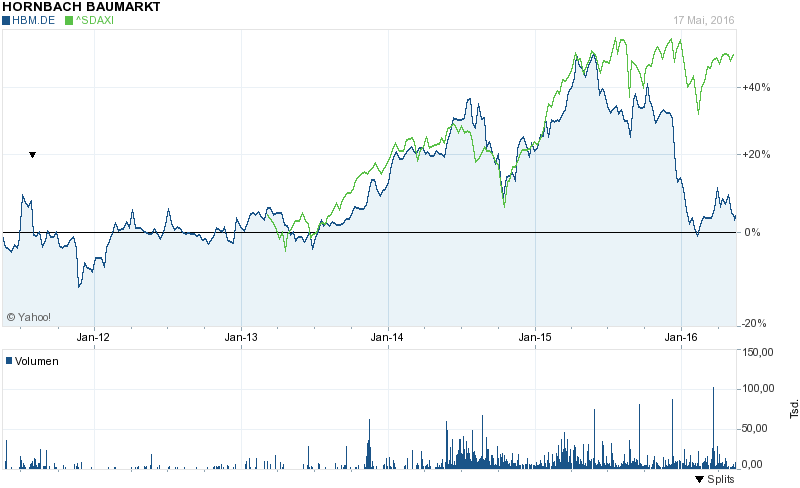
Looking at the stock chart we can see that compared to the German small cap index, Hornbach looks pretty lame:


horni

At the time of writing, within my portfolio Hornbach clearly was a drag on performance with a total performance of 13,7% since 01.01.2011 vs. 109,5% for the portfolio and 73% for the SDAX.

Read more

Silver Chef (ISIN AU000000SIV4) – The “Better Grenke” from Down Under ?

Following my previous posts on Australian stocks and Australian leasing companies in particular, it is not a big suprise that my first Australian investment is an Australian leasing/financing company called Silver Chef.

The company / the business

Print

Silver Chef is an Australian company which according to the website “delivers equipment funding solutions that help small businesses reach their full potential.”

The company went public in 2005. Some key figures (at 9,20 AUD/stock)

Market cap: 323 mn AUD
P/E 2014/2015: 15,2,
P/B 3,11
Div. Yield 5,7%EV/EBIT 20,2
EV/EBITDA 4,9

Read more

Good or Bad Capital Allocation: Example SAP SE (ISIN DE0007164600)

In my previous post on capital allocation, I had mentioned SAP as a company which might have overpaid for an acquisition. A reader commented that SAP is a good capital allocator because they increased EPS over the last 10 years.

Increasing EPS itself in my opinion is not a “proof” for good capital allocation. Actually, this itself says nothing at all. If you have a stable business, just retaining earnings and doing nothing will increase EPS as long as interest rates are positive. Good capital allocation is when you create value from retained profits.

The best way to find out if value is created is to look at how returns on equity and return on capital develop over time.

Let’s take a look at SAP over the past 17 years with some per share numbers:

Read more

Deutsche Pfandbriefbank (ISIN DE0008019001) update

In July last year I introduced Pfandbriefbank as a “forced IPO” special situation. That’s what I wrote at the end of the post:

As I have said in the beginning, PBB is a simple case: I do think that the “forced IPO” of PBB from the German Government has created a typical special situation with good upside potential. This is clearly no “shooting out the lights” grand slam home run. In golf terms I would say that this is a “solid 6 or 7 iron” shot.

Looking at the perfomance of the stock since then, it looks like in Golf language that my “solid 6 or 7 iron” nevertheless “landed in the rough” with the stock being down -23% vs. -9% in the CDAX.

Read more

Capital Allocation & Capital Management – What is good and what is bad

Everyone who has read Thorndikes book “The Outsiders” clearly knows that capital allocation& capital management is one of the most important factors in creating long term shareholder value. After I watched Thorndike give a briliant talk at Google on this topic, I decided to write down my own thoughts on the topic.

What is CAPITAL ALLOCATION & CAPITAL MANAGEMENT anyway ?

CAPITAL ALLOCATION is simply what you do with your profits/cash inflows once they are in your account. You can do a lot of things with it. Thorndike in the talk above uses 5 uses, I would add another 2 (in bold)

1. Reinvest: Maintain your existing assets/infrastructure/operations
2. Grow organically: Expand your business by buying more machines/outlets/opening stores etc.
3. Expand your business by M&A
4. Pay back liabilities (debt, payables, pension liabilities etc.)
5. pay dividends
6. buy back shares
7. just leave the cash on your account and wait for better opportunities

Read more

« Older Entries Recent Entries »