Category Archives: Anlage Philosophie

Kinder morgan (KMI): Asymmetric upside potential

So let’s move on from focusing on the bad things and look at the the things that I like at Kinder Morgan. While I was writing this post, I found a very good blog post from Glenn Chan from 2 years ago which I can only recommend and includes a lot of interesting points about Kinder Morgan.

The Management:

Rich Kinder, age 71 owns 11% of the company and was famous for paying himself only 1 USD salary during his time as CEO.

620x434

Read more

Kinder Morgan (KMI): Slow moving train wreck or Contrarian opportunity ?

In late 2014 I started looking into oil related companies. I have looked at a couple of energy related companies like explorer Peyto, LNG liquification terminal Cheniere , Consol Energy and Gaztransport. I only bought Gaztransport which I then sold 6 weeks later. As I am still interested in the Energy sector, I will cover some stocks from time to time.

Kinder Morgan, the US pipeline owner/operator looks like another typical potential contrarian “Value investment”.

799px-kinder_morgan_logo-svg

What I liked at first sight: Read more

Free cashflow reporting: Doing it “Grenke style” (Grenke, Silver Chef)

After my post about Australian Leasing companies a few days ago, I decided to start with Silver Chef, a company I found interesting.

Negative Free cash flow at Silver Chef

As many other value investors have, I have incorporated the concept of Free Cash flow into my investment process. A company which produces great earnings but no free cash flow is often a big red flag (see for instance the Globo Plc case)

So a first look at Silver Chef seems to indicate that they  have a big problem. Great earnings but negative free cash flows and increasingly so:

Read more

Some thoughts on (Australian) Leasing / Equipment rental companies

One very interesting aspect about Australian stocks is that there are many listed companies whose main activity is some sort of leasing. Those companies are all quite profitable and relatively cheap.

So far I only had looked at one leasing company, AerCap, the US based Aircraft leasing company.

Leasing business

The leasing business simply stated is asset based lending without a banking license. The client, instead of buying something outright and recieveing a loan from a bank, “leases” the good, pays installments and hands over the good after some time back to the lessor.

The leasing company therefore has the following main risks to bear:

Read more

Australian stocks: Contrarian opportunity or too early ?

kaenguruh2

Up until now, I only looked at one single Australian stock: Australian Vintage two years ago. I didn’t like it mainly because I thought the interests between Management and shareholders were not aligned. Interestingly the stock jumped in the last weeks after doing nothing for 2 years.

Australian stock market facts

Let’s start with some facts about the Australian stock market. According to Bloomberg, there are 2.059 Australian companies listed on the Australian stock exchange, total market cap is 1.59 tn AUD.

Read more

What to do if a stock which you just bought is rising quickly ? (Gaztransport)

This is clearly a luxury problem: Imagine you bought a stock and for some reason the stock price goes up very quickly let’s say by +40% or so within a few weeks.

What are you going to do ? Sell, buy or do nothing ?

In my case, this “problem” now hit me with Gaztransport. I reviewed Gaztransport first in January 2016 at a price of around 34 EUR. This is what I said back then:

Under those assumptions my results were the following:

10% discount rate: 20,80 EUR per share

15% discount rate: 14,26 EUR per share

So now one could clearly challenge my “model” and tweak it somehow, but in general it looks like that GTT is not a bargain at current prices (34 EUR). To me it rather looks like that the current valuation already implies a certain value for the LNG ship fuel “option”. Therefore GTT at current prices is not interesting to me as an investment.

Read more

Guest post: Investment Theory: RoCE – some thoughts on a helpful, but sometimes misleading concept

I am happy to present one of the infrequent guest posts. This time a very interesting general post on RoCE (Return on Capital Employed) and Brand value by contributor Knud Hinkel.

Executive Summary:

The RoCE is an important ratio for value investors. However, as it regularly relies on balance sheet data, the concept is susceptible for at least two inconsistencies: (1) Items on balance sheet are not correctly reflected in the EBIT, and (2) items that contributed to EBIT are not reflected in the capital employed. My hypothesis is that the RoCEs of industries with significant self-created intangibles like consumer and software companies are subject to a systematic upward bias and this might light lead to a wrong judgment of (1) the underlying company performance, (2) acquisitions, and (3) the capital intensity of the business model.

Read more

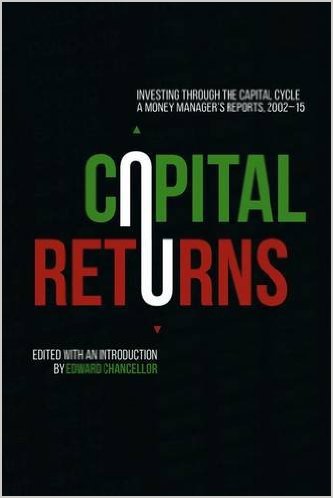
Book review: “Capital Returns” – Edward Chancelor / Marathon Asset Mgt.

41nijcbufal-_sx331_bo1204203200_

“Capital Returns” is an edited collection of investor letters from UK based Marathon Asset Management. Before reading the book,I actually didn’t know much about Marathon.

On their website, they summarize their strategy as follows:

At the heart of Marathon’s investment philosophy is the capital cycle approach to investment.  It is based on the idea that the prospect of high returns will attract excessive capital (and hence competition), and vice versa.  In addition, an assessment of how management responds to the forces of the capital cycle and how they are incentivised are critical to the investment outcome.

This capital cycle approach is very interesting. As mentioned above, the book has no direct narrative. The investor letters are however clustered together in chapters with similar main topics:

  • Capital cycle, sectors (automoblie, commodity, cod fishing, beer, oil)
  • Growth (Colgate, Geberit, Intertek, Amazon, digital moats, Rightmove, Baidu)
  • Management (incentives,  pro cyclicality, capital allocation, Sampo, Scandinavia, family ownership, Richemont, management meetings, culture)
  • Crisis (Anglo Irish, securitizations, private equity, Spanish property, German banking, Northern Rock, Handelsbanken)
  • After the crash (Spanish construction, Bank of Ireland, PIIGS, low interest rates
  • China
  • Funny “Greedspin” Christmas letters

The book is not so easy to read because the letters themselves, despite very well written, are very condensed with a lot of deep insights. I always had to take a kind of a mental break after one or two letters in order to digest everything

Overall, I would characterize their approach as follows:

  • International with an European focus
  • generalist approach, all sectors, differenent business models
  • transformation from “cheap” to “quality” over the years
  • they also invest into financials
  • the invest relatively diversified


Essential personal learning experience

The main take away for me was that their supply focused capital cycle model enabled them to see and avoid many of the problems (CDOs, housing, commodities, PIIGS, China) well in advance. Most analysts focus on the demand side only and forget about supply.

This is something to keep in mind for the future. As a bottom up investor, I think their approach can improve decision making without going into useless macro analysis. If you just look at single companies, one might miss some of the overarching issues in the sector (TGS Nopec…..).

Marathon Track record

The question always is: Talk is cheap, how about their returns ? At least from their website, it seems that their funds made 3-5% outperformance p.a.  constantly  on a 3, 5, 10 and 20 year basis. This is very remarkable for a manager with a couple of billion under management.

For me it was also interesting to see that they not only share many of my personal opinions about investing, but that there is also a nice overlap of companies I find interesting and what they found interesting, for instance Lloyds Banking, Admiral, Handelsbanken and Koc as a well managed family owned company. Clearly there is some “confirmation bias” at work from my side, but still interesting.

Recommendation:

Overall, the book is an essential”MUST READ” for any investor. The major drawback is that it is currently only available as hard cover at around 37 EUR.

The “value option” is to be found on their webpage where they published some of their investor letters for free.

There is also a similar book on the time period from 1993-2002 called “Capital Acocunt” which costs around 80 EUR on Amazon.

Overall, for me Marathon is clearly one of the “Gurus” in investing and it makes a lot of sense to pay attention to what they are doing. Especially if and when they re-enter oil and commodities.

P.S.: the editor, Edward Chancelor has also written one of my all time favourite financial books: “The Devil took the hindmost” from 2000. If you like financial history, this is also a “must read”:


51-cgsquhml-_sx328_bo1204203200_


« Older Entries Recent Entries »