Category Archives: Bilanzanalyse

Some thoughts on discounts for Holding structures (Porsche SE, Pargesa, Autostrade Torino)

In my post about Porsche SE, I concluded the following:

However on a relative basis I don’t think that there is a lot of upside in the Porsche shares, as I don’t see a quick “real” catalyst and a certain structural discount (20-30%) is justified due to holding structure and non-voting status of the traded shares.

Geoff Gannon used this summary to come up with his view on holding company discounts:

I do know something about holding companies that trade at a discount to their parts. And I don’t agree with that part of the post. If the underlying assets are compounding nicely – you shouldn’t assume a holding company discount is correct just because the market applies one to the stock.

So he is basically saying one should ignore the holding structure and look at the underlying only.

Interestingly, we had such a discussion on the blog about the same topic in the Bouygues post. Reader Martin commented that “one usually applies a 20-30% holding/conglomerate discount” which I didn’t apply in my sum-of-parts valuation.

So far this seems to be quite inconsistent from my side, isn’t it ?

I have to confess that especially for Porsche, I did not mention all my thoughts about why I applied a discount there. However maybe I can shed some light on how I look at “holding structures” and when and how to discount them.

For myself, I distinguish between 3 forms of holding companies:

A) Value adding HoldCos
B) Value neutral HoldCos
C) Value destroying HoldCos

A) Value adding HoldCos

This is in my opinion the rarest breed of HoldCos. Clearly, Berkshire Hathaway is an example or Leucadia. Those HoldCo’s add value through superior capital allocation capabilities of their management. In those cases I would not apply any discount on the underlying assets, however I would be hesitant to pay extra.

B) Value neutral HoldCos

Those are holding structures which exist for some reason, but most importantly are transparent and do nothing stupid or evil to hurt the shareholder. Ideally, they are passing returns from underlying assets to shareholders.

A typical example of such a company would be Pargesa, the Swiss HoldCo of Belgian Billionaire Albert Frère. They are quite transparent and even report their economic NAV on a weekly basisandpass most of the dividends received to the shareholders. Nevertheless, the share trades at significant discount to NAV as their own chart shows:

At the moment, we see a 30% discount for Pargessa. So one should ask oneself, why such a discount exists for such a transparent “fair” holding co ? I can think of maybe 3 reasons:

– The stock is less liquid than the underlying shares
– people do not really trust Albert Frere despite being treated Ok so far
– no one wants to invest into this specific basket of stocks

Nevertheless, one has to notice that even for such a transparent company like Pargesa, a 30% discount does not seem to be the exception.

C) Value destroying HoldCos

Here I have the privilege to have documented such a case in quite some detail, Autostrada Torina, the Italian Holding company for toll road operator SIAS SpA.

As I liked the underlying business, I thought buying at a discount, following Geoff Gannon thoughts that a nice compounding business at a discount is an ever nicer business.

However, I had then to find out the hard way that the discount of the holding company was clearly a risk premium. In this case, the controlling Gavio family “abused” the holding to buy an interest in another company (Imprgilo far above the market price. They couldn’t do this in the operating subsidiary, as the sub was subject to regulation. The Holding co stock recovered to a certain extent but in this case the underlying OpCo was clearly the better and safer investment

My lesson in this was the following: Stay away as far as possible from such “value destroying” HoldCos. They are totally unpredictable and doe not have any margin of safety.

So going back to our Porsche example, what kind of Holding company is Porsche ?

Well, it is definitely not a “value adding” holding. The question now would be if it is a “neutral” or potentially even “value destroying” hold co ?

In my opinion there are already some warning signs:

– Porsche SE already communicated that they will not distribute the cash, but build up an additional portfolio of “strategic participations”
– Porsche only issues detailed reports twice a year, accounting is rather “opaque”
– in my opinion, Volkswagen has a lot of incentives to achieve a weak Porsche SE share price in order to then acquire their own shares at a discount (and swap them into VW pref shares if possible) at a later stage. Common shareholders (Porsche & Piech family might get a better deal. Under German law it is possible to treat pref holders differently

Compared to Pargesa for example, I would definitely prefer Pargesa with a 30% discount to a Porsche pref share at 35% discount.

So to summarize the whole post:

– With holding companies, it is very important to determine the intention and risks of the holding structure
– neglecting or even “evil” holding management can quickly turn a “discount” into a real loss
– better err on the safe side in such situations
– in doubt, assume there is a reason for the discount if you cannot prove the opposite
– however for skilled activist investors, those situations might create potential. So maybe Chris Hohn has a different game plan.But don’t forget that a lot of famous Hedgefund managers (incl. David Einhorn lost a lot of money with Porsche/Volkswagen already in the past.

Boss score harvest Bouygues family – back to Bouygues SA (FR0000120503)

After looking at one of the main subsidiaries Colas in the last post, let’s have a quick look back at Bouygues, the holding company itself.

Sum of part valuation

As I have mentioned in the initial post, Bouygues has 3 listed subsidiaries, Colas, TF1 and Alstom as well as 3 unlisted major subs which are Bouygues Construction, Bouygues real estate and Bouygues Telecom.

To get a feeling for a “sum of parts” valuation, we should start with the listed subs and then make assumption for the unlisted ones.

Read more

Reply SpA part 3 – Strange cashflow –> RED FLAG ALERT

In the last two posts (part 1, part 2) about Reply, I mentioned that there was some questionable provisioning for overdue receivables and that free cash flow generation in general looks relatively weak.

So let’s look at a further example, if and how reliable Reply’s accounting is.

In 2009, Reply made an interesting deal, as stated in the 2009 annual report:

Acquisition of Motorola Research centre
In February 2009 Reply Group, through the subsidiary company Santer Reply S.p.A., finalized the acquisition of the Motorola research centre based in Turin.
The acquisition, accountable as a “net asset acquisition” was purchased by Reply for a symbolic amount of 1 Euro and comprised 339 employees, 20.6 million Euros in cash, 2.9 million Euros of assets and liabilities for 23.5 million Euros. Reply has committed to the operation on the basis of the research perspectives outlined at the time of acquisition and the agreements defined with the public administrations (Region and Ministry of Development).

Such agreements foresee that the Piedmont Region finance through a free grant a maximum of 10 million Euros on the condition that the Research centre carries out projects within the research and development of Machine to Machine (“M2M”) and that proof can be provided. Furthermore, the Ministero dello Sviluppo Economico (S.M.E.) has made a commitment to grant the Research centre a loan for a maximum of 15 million Euros of which 10 million a free grant for research and development projects similar to those agreed with the Piedmont Region.
In the last months the Board of directors of Reply Group and Santer Reply S.p.A have outlined and defined organizational strategies of the course of business of the Centre. More specifically costs related to research projects have been quantified and the financial resources necessary for such research projects and means of disbursement have been defined by the Public Administrations.

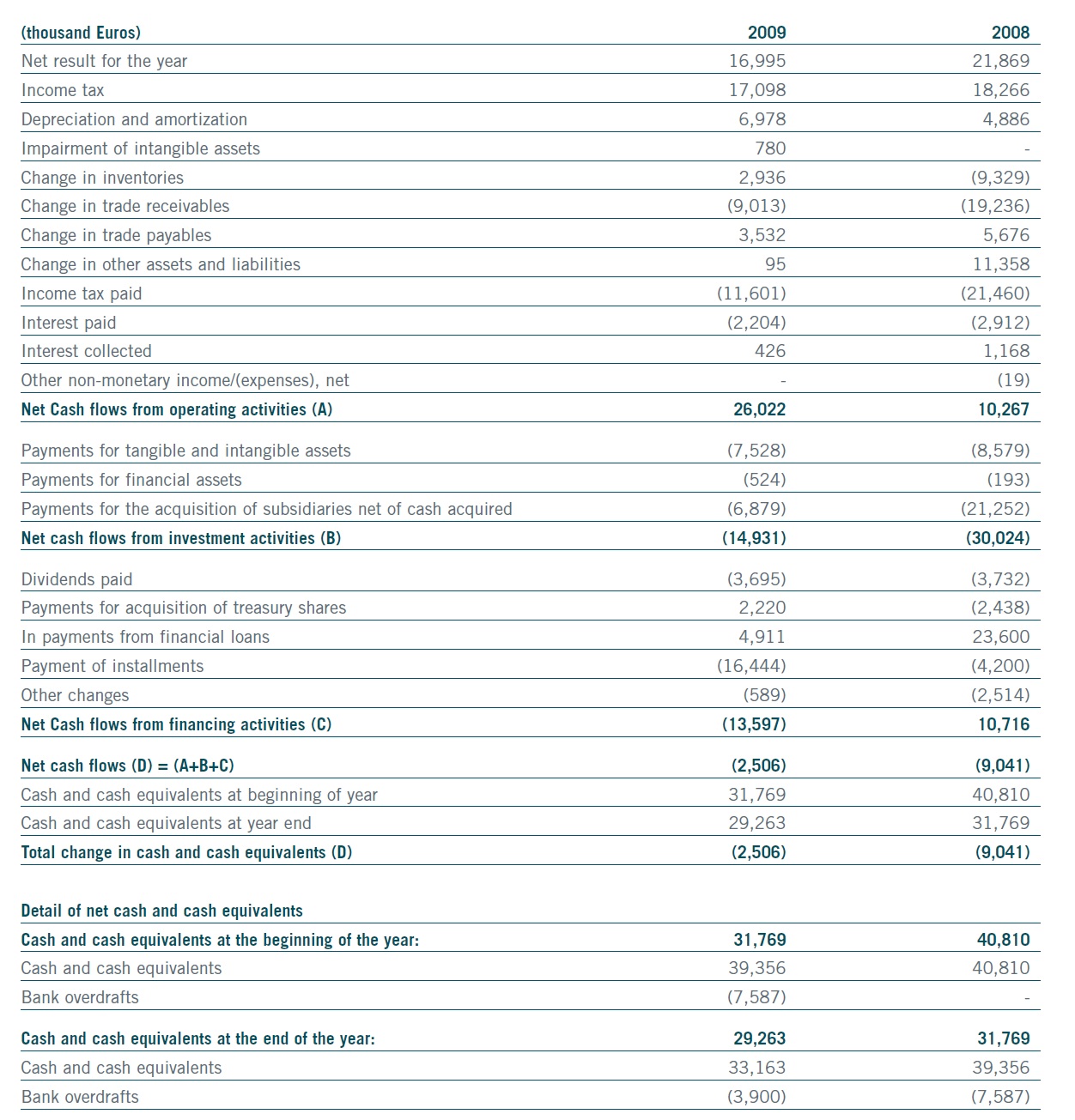
So they “bought” a company for 1 EUR which had 20.6 mn in cash. In theory, we should see this as a positive investing cashflow in the CF statement. Lets look at the 2009 statement:

Strangely, the stated “payments for the acquisition of subsidiaries net of cash received” is negative !! We know that they only paid 1 EUR, received 20 mn and didn’t do other big acquisitions in 2009.

I do not know where they actually booked the acquired 20 mn EUR liquidity, but this is very very strange.

The second part of the puzzle are the Government grants out of this deal.

In their notes, they state the following:

Government grants
Government grants are recognized in the financial statements when there is reasonable assurance that the company concerned will comply with the conditions for receiving such grants and that the grants themselves will be received. Government grants are recognized as income over the periods necessary to match them with the related costs which they are intended to compensate.

So what in theory should happen is the following:

-when they receive the money, the book a liability against the money (P&L neutral)
– then over time they reduce the liability by booking this release as profit

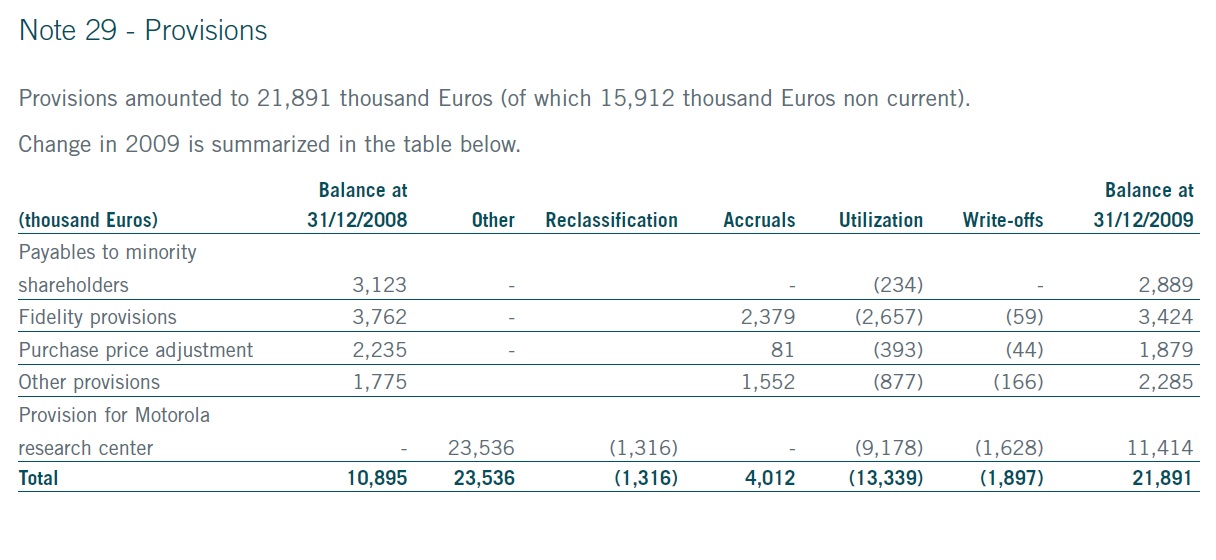
Based on Note 29, Reply booked already such a provision of ~23 mn EUR at the end of 2009, from where they used half of it again. I am not sure why,but again, where is the corresponding asset ? I would assume somewhere in other receivables (as they may not have received the Government money in 2009).

If one of the readers really understands what is going on here, then please help me.

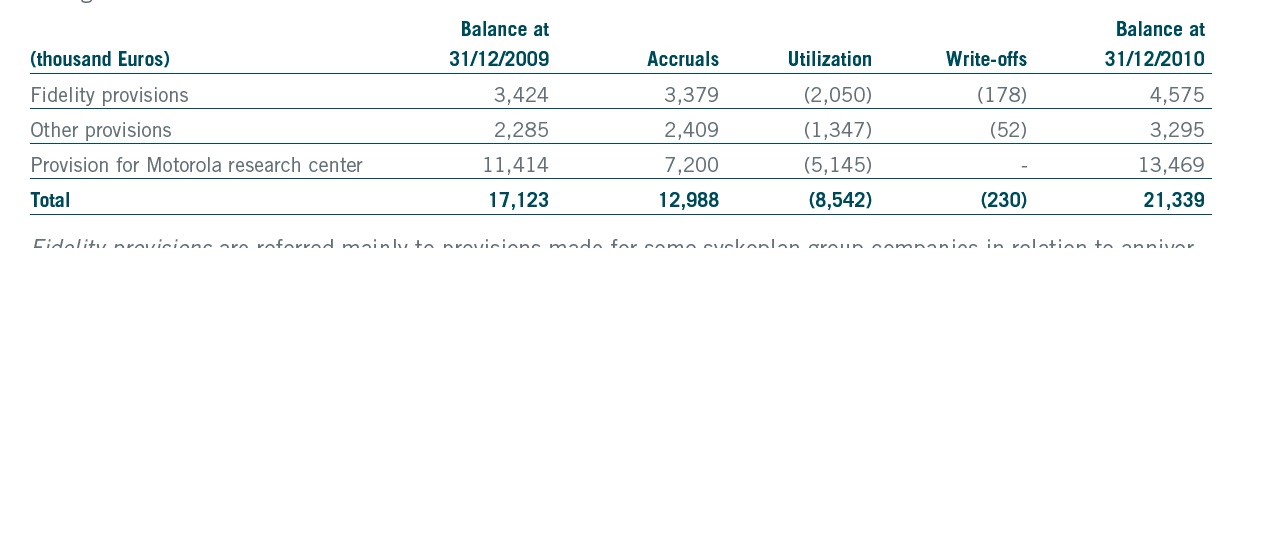
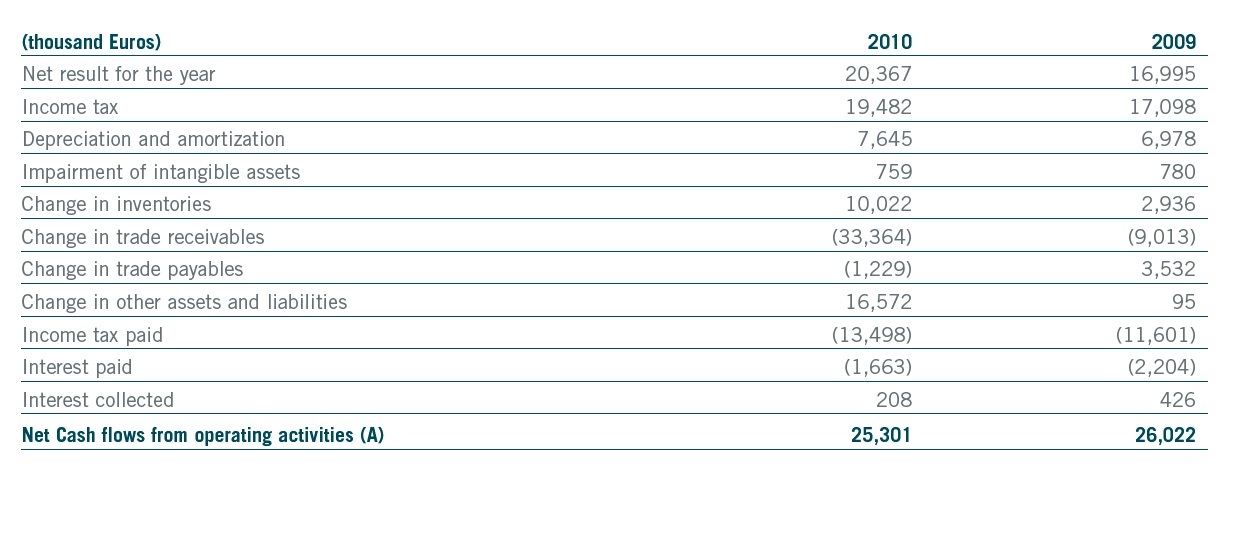
In 2010, the provisioning continues, it looks like the increase and use those provisions as they like to:

This might explain why the very unusual and unexplained line item “changes in other assets and liabilities” makes up 2/3 of Reply’s 2010 operating cashflow.

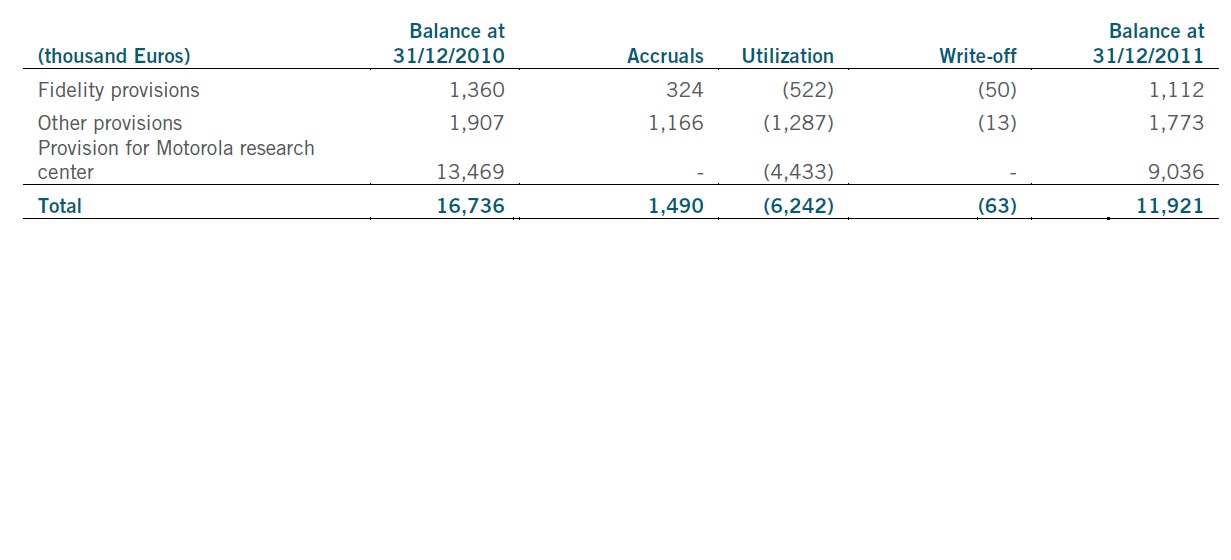
in 2011, the provision is still significant:

So what does that mean ?

In my opinion, there is poor visibility in the accounts and especially in the cash flow statements. We know now, that the Motorola transaction netted them around 40 mn EUR net cash, but didn’t show up in the investment cashflow. As it didn’t show up in financing cashflow neither, it has to be moved into operating cash.

As operating cash in total from 2009-2011 was only 55 mn EUR, basically a large amount of the operating cashflow in this period seems to be non-operating and coming from the acquired Motorola Research center.

At this point it is time to stop and summarize:

– at least to me, the accounting and cashflow treatment of the Motorola acquisition is not transparent
– together with the weak cash flow generation, large goodwill position and a large number of acquisitions this is A BIG RED FLAG

Maybe I am just not clever enough, but my philosophy to avoid companies with large intangibles and non-transparent accounting makes me stop here and not further investigate the company.

Additional thoughts about Mapfre SA (ISIN

Thursday’s post about Mapfre outlined the general idea behind the investment.

With this post I want to add some more details to the case

Time horizon & type of investment

Just to make it clear: I do not expect a quick solution to the EUR problems. So the time horizon for this investment should be at least 2-3 years (or even 3-5 years). The type of investment is what I would call a “sum of part” value investment with a contrarian aspect for the Spanish business

Insurance valuation

Some investors use “tangible book” as most appropriate vluation basis, for instance Bruce Berkowitz in his AIG case.

In my opinion “tangible book value” is only a very very crude meassure. The big problem with Insurance companies is the fact that not only the value of the assets are hard to value but also liabilities, esp. insurance reserves are by no means “fixed”.

Currently, this is most obvious for life insurance contracts with guarantees, where under normal GAAP, liabilities remain “at cost” whereas assets are marked to market. This had the perverse effect that after the big decline in interest rates, life insurers showed nice profits on their bond holdings, but the liabilities are severly under water. As the “gearing” of reserves to quity in life insurance is usually around 20 times, one can easily calculate how quickly any “tangible book” disappears if reserves would be marked to market.

With insurance, it is a little bit like cable television (and my unsuccessful Kabel Deutschland short): If no one cares (and especially the regulator), you can run the business without “real capital”.

Coming back to “tangible book”: Real mtm tangible book would be a helpful measure, but even industry or company insiders are not able to calculate this. So one should better take accounting tangible book value for insurers with extreme care…..

Spain is not Greece ?

A few quick thoughts: In my opinion, Spain is not Greece because of 3 major structural issues:

A) Spain didn’t have a spending problem before the crisis hit. So their problems are clearly a result of the crisis, not a structural (and maybe cultural) deficiency like in Greece.

B) Again, I would like to link to Ibex Salad which gives a more balanced outside view on what is happening in Spain. In my opinion, especially the developments in regard to exports show that a lot of positive things are happening in SPain below the “surface”. This will take time but it is not so hopeless like in Greece.

c) And one should not forget that Spain is the country with the highest population growth rate in Western Europe (apart from Luxembourg).

Capital increase

As one commentator rightly pointed out, MAPFRE did several right issues in the last few years:

2011: 77.2 mn shares at 2.466
2010. 94.4 mn shares at 2.008
11/2009: 63.63 mn shares at 2.58
03/2009: 124.8 mn shares at 1.41
11/2008 68.6 m shares at 2.21

One could indeed ask why they pay relatively high dividends and in parallel issue new stock. This is surely one of the reasons which negatively impacted the shares in the past. The only “excuse” is that they really managed to grow in this period while many others had to increase capital just to maintain their business.

Overall investment case:

Just in order to illustrate the “drivers” of Mapfre’s valuation a little bit better, I created a quick and dirty valuation metrics to show what impacts I expect both, for the Spanish and the International business:

Spain      
LatAm/Int   bad status quo Good
  bad 1.56 2.08 2.59
  Status quo 2.51 3.03 3.55
  Good 3.44 3.96 4.47

What this should show is that the developement in Spain is less relevant than the international developement. If LatAm continuous to perform well, the MArgin of Safety is quite high, no matter what happens in Spain.

EDIT: For some reason, the price of Mapfre now jumped at over 1,67. So I only got 1/5 of my planned allocation so far. Based on my learning experience with April SA, i will not increase my 1.50 EUR limit.

Quick check: KHD Humboldt Wedag (ISIN DE0006578008)

Several readers already mentioned KHD Humboldt Wedag as a potential “special situation” investment, so it might make sense to quickly check it out.

KHD Humboldt Wedag

KHD is planning and constructing cement plants world wide. The company has a quite interesting past. It used to be part of the big “Deutz” Group of companies but was sold.

In the meantime, the company has been taken over and then spun off again in some sort of form. The mastermind behing those transactions is financier Michael J. Smith. This guy himself seems to be a very interesting investor himself as this Seekingalpha post shows.

There is a very good Thread on Wallstreet Online covering the history of the company for the last 7 years or so.

The business itself is highly cyclical. If I look at how cement companies themselves are struggeling to even earn a small profit because of a large over capacity in the indutry, I am not sure how many new cement plants will be actually built in the coming years. Sales dropped 50% from 2009 to 2011. One could describe this as “extremely late cyclical”.

KHD is since a long time a favourit among “net net “investors as they carry a large cash balance on their balance sheet. However, cashflows are extremely volatile.In 2011, operating cashflow was around -80 mn EUR.

Again in Q1 2012 the comapny showed shrinking sales and a large net cash outflow of around -20 mn EUR reulting in a loss for the first quarter, although the orderbook seems to have improved. I have however no idea how the orderbook actually transforms into sales and profits.

In early 2011, KHD executed a capital increase for around 20% of the company to bring on board a Chinese company. At least for me it was not clear why they did it. Officially they said to increase their “footprint” in China. if one looks at the order intake in 2011, this cooperation didn’t really show any results, at least not in the line for China.

Some weeks, Paul Desmarais, the guy behind the “Canandian Berkshire” Power Cooperation has revealed a 3% position. Another activist investor, Sterling Strategic Value is on board with 12%.

In the invitation to the annual shareholders meeting, Michael J Smith was proposed to enter the supervisory board as the boss. Although the first news seems to be interesting, the second part, MJS returning might not be the best news for the uninformed minority investor.

Just a few day’s ago, the annual shareholder’s meeting was postponed due to “technical reasons”, although some investoirs seem to have received a surprise dividend therafter.

For me, KHD at the moment is something I would not invest into due to the following reason:
– I have no idea about the goals of the parties involved (MJS, Chinese guys).
– the business is extremely cyclical and at the moment fully depending on Emerging markets
– I have no idea how much of the cash is really “free” and what is needed to finance new projects
– I would rather prefer to buy cheap cement companies, because they will proft earlier from a revival in cement sales
– I do not have any (good) experience with activist campaigns, I am not sure that I have the nerves for that

Overall, I do not think that I can gain any “edge” in this situation and it is clearly outside my core competencies. In such cases I will rather pass however it might be a good learning experience following the further “proceedings” from the outside.

For the record, some special situations which I try to avoid:

– merger arbitrage (to many pros)
– distressed debt (complex, dirty stuff going on)
– activist campaigns (insider)

A few thoughts on Free Cash Flow (and how easy it is to arbitrage this number)

For many Value Investors, “Free Cashflow” has become the most important “mantra” in order to decide if a stock is attractive or not. Especially in the area of technology stocks (Dell, Microsoft, Cisco, HP), the stated large free cashflows are or were the the major arguments from some investors why the invested in those stocks.

A few examples:

Dell: In February, David Einhorn disclosed a stake in DELL (which however he just sold again…), Katsenelson is a big fan of Xerox because of its large free cash flow and of course many many value investors love Cisco and Microsoft.

Let us quickly look at how Free Cashflow is defined (from investopedia):

Definition of ‘Free Cash Flow – FCF’
A measure of financial performance calculated as operating cash flow minus capital expenditures. Free cash flow (FCF) represents the cash that a company is able to generate after laying out the money required to maintain or expand its asset base. Free cash flow is important because it allows a company to pursue opportunities that enhance shareholder value. Without cash, it’s tough to develop new products, make acquisitions, pay dividends and reduce debt. FCF is calculated as:

EBIT(1-Tax Rate) + Depreciation & Amortization – Change in Net Working Capital – Capital Expenditure

It is important to notice that “Capital expenditure” only includes “direct” expenditure, like actually buying machinery etc.

Investopedia adds a pretty important point:

It is important to note that negative free cash flow is not bad in itself. If free cash flow is negative, it could be a sign that a company is making large investments. If these investments earn a high return, the strategy has the potential to pay off in the long

I think this is a point, many market pundits tend to ignore, but more on that later.

An even more important point is not mentioned in this definition: Free Cashflow does not include cash outflows for M&A activity

So let’s look at a simple example for a model company:

Base case:

EUR
EBIT (1-tax rate) 10
Depr 5
Change WC -1
Capex -3
   
   
Free Cashflow 11
   
   
Financing cashflow 0
 
 
Total cashflow 11

So our company shows a free cashflow of 11 EUR in this period and a similar total cashflow.

Case 1: Old School – Buying a new machine at year end with a loan for 15 EUR (I use year end in order not to “disturb” depreciation etc.)

We get the following result:

EUR
EBIT (1-tax rate) 10
Depr 5
Change WC -1
Capex -3
Machinery -15
 
Free Cashflow -4
 
Loan 15
Financing cashflow 15
 
 
Total cashflow 11

Aarrrg, negative free cashflow many investors would say, negative free cashflow, stay away from this stock !!!!

So a clever company might do one of the 2 following things:

Case 2: Classic FCF arbitrage: Operating leasing

In this case the company enters into an “Operating lease” contract at year end. The machine gets delivered as in a direct contract, but if the contract is structured correctly, neither capex nor loan show up in the balance sheet in that year (only the lease payments in subsequent periods)

EUR
EBIT (1-tax rate) 10
Depr 5
Change WC -1
Capex -3
Machinery 0
   
Free Cashflow 11
   
Loan 0
Financing cashflow 0
   
   
Total cashflow 11
 
Off balance sheet  
– machinery 15
– operating leasing liability -15

On a reported free cash flow basis, without adjustment, going forward, the company will look quite asset and capital efficient. However, this kind of FCF “arbitrage” will end under IFRS when operating leases will become “on balance”.

Case 3: M&A transaction

Now consider the following: For some unknown reason, one competitor is currently selling a subsidiary which only owns the brand new machine we wanted to buy and nothing else. The competitor is selling the company for the same price as the machine. Again we finance this through a loan.

The simplified CF statement looks the following:

EUR
EBIT (1-tax rate) 10
Depr 5
Change WC -1
Capex -3
Machinery 0
   
Free Cashflow 11
   
Acquisition -15
Loan 15
Financing cashflow 15
   
   
Total cashflow 11
   
Off balance sheet  
– machinery 0
– operating leasing liability 0

So “Heureka”, we have the machine on balance without impacting the Free cashflow and everyone is happy.

To be honest, this example is somehow unrealistic, but on the other hand this is exactly what is happening with many technology firms at the moment. Those companies show high free cashflow because they don’t spend a lot on investments but acquire new technologies vie M&A transactions.

If they would build this on their own, the cost would run negatively through free cashflow in contrast to the M&A expense.

There is a good post at Seeking Alpha which shows free cashflows over the last 5 years for 6 tech companies (RIMM, MSFT,DELL, NOK, AAPL, HPQ) without and including acquisitions.

For companies with a clearly declining core business like DELL and NOK, those M&A cash outs definitley have to be treated as mainenance Capex, but to be on the safe side, M&A for tech companies and pharmaceuticals should always be included in free cashflow.

This is exactly the reason why Jim Chanos has identified Hewlett Packard as the ulitmate Value Trap despite a trailing 25% FCF yield at current prices. HPQ acquisitions are not “growth investments” but “maintenance Capex” to counter their declining core business or to say it differently: The current reported “free cashflows” are more like liquidation cash flows.

Summary:

– Free cash flow can be a good indicator for the value of a company
– however one should be aware that there are many ways to “arbitrage” free cash flow
– I have only shown a few of them relating to investments but many others exist
– one should be especailly carefull to use FCF for companies which do a lot of acquisitions or use Operating leases extensively
– calculating free cash flow after acquisitions and changes in operating leases is a crude but good way to identify “problematic” companies
– some companies might be very good investments despite negative Free Cash Flows because they have good investment opportunities and finacne “conservatively”
– it will be interesting to see with what the financial industry will come up if Operating leases will come “on balance”. I have seen already attempts to structure leases as payables…..

Why comprehensive income matters – Dart Group Plc

I have mentioned a couple of times that in my opinion, the so-called “comprehensive income” is a much better indicator for shareholder wealth created than net income or earnings per share.

In my experience, almost no one cares to look at what happens after the net income line. Usually, comprehensive income is stated on a separate page anyway.

A good example to turn this into an interesting practical exercise is the most recent preliminary annual report from Dart Group, one of my Portfolio holdings

The first thought is of course “Yippie yeah”, a really significant earnings increase, P&E of 4 etc etc.

Richard Beddard at the excellent Interactive Investor blog even says the following:

The highest earnings yield ever calculated by the Human Screen is 35%. It’s so high, he’s wondering if air line and road-haulier Dart has bust his value yard-stick.

Highlights

Adjusted operating profit up 9%
Adjusted return on tangible assets: 4%
Net profit of £23m compared to net cash flow of £95m (£48m after net capital expenditure)
Net cash after approximate capitalised lease obligations of £125m is £34m, 5% of tangible assets
Per-share dividend up 7%

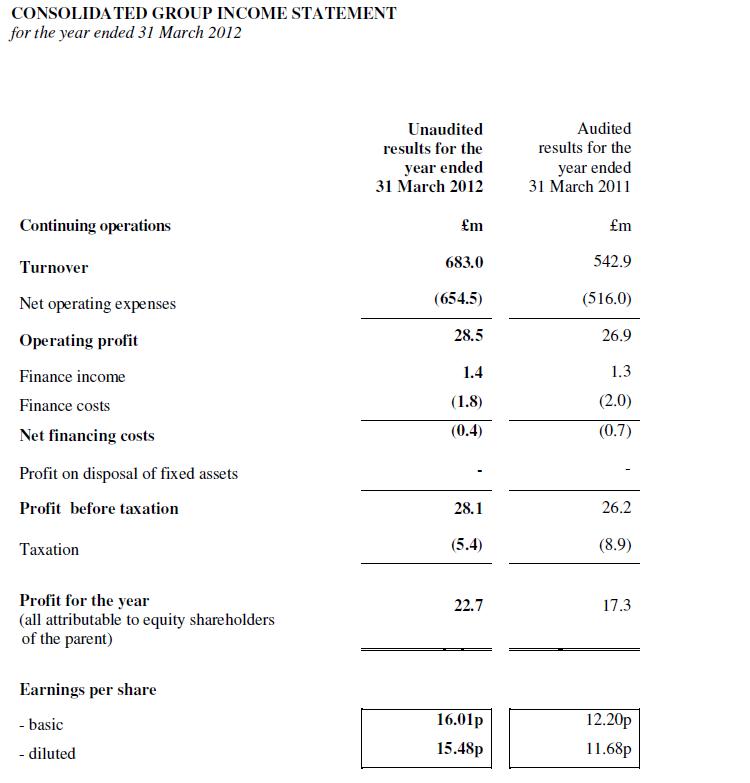
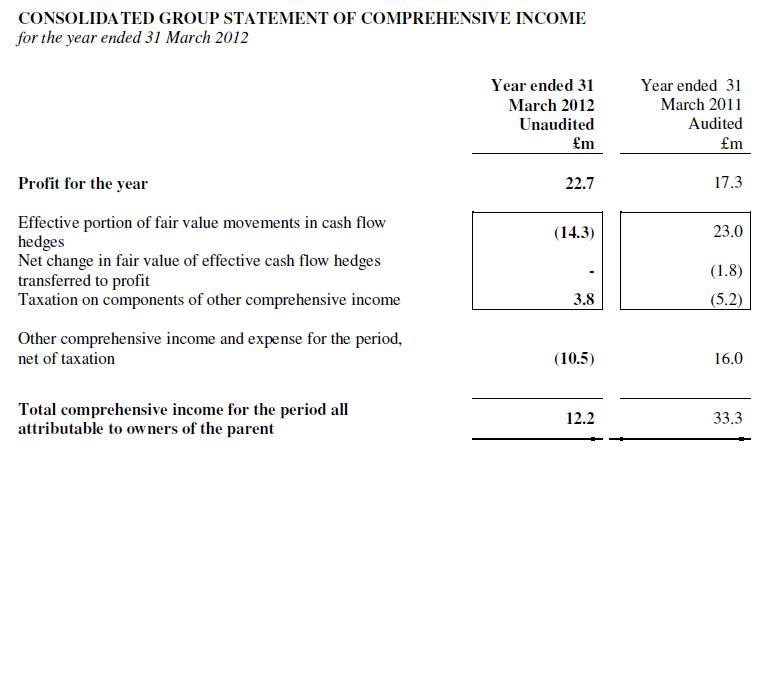
Not so fast. I guess that Richard stopped at page 9 of the interim report and didn’t bother to read that strange stuff at page 10 which looks as follows:

So we have additional items which significantly decreased shareholders equity but didn’t need to be recorded in normal earnings but comprehensive income. In this case we are looking at fuel hedges.

Items which can be recorded in comprehensive income are:

– Unrealized holding gains and losses on available for sale securities ( a trick often used by banks and other financials)

– Effective portion of gain or loss on derivative instruments (cash-flow hedge);

– Foreign currency translation adjustments (i.e. change in value of a foreign subsidiaries net asset value)

– Minimum pension liability adjustments.

Normally people would argue that those items are “non operating” and therefore not or less relevant. However, as it affects shareholder value, in my opinion it is very important to look at those item to determine real value creation for the shareholder.

Coming back to Dart Group: The fuel hedging is an essential part of the business model. Fuel costs are around 20% of sales and cannot be passed directly too customers, especially for the prepaid part. I will have a separate post on how to interpret the fuel hedges but for now the important point is:

The result of the fuel hedges should be treated as part of the normal business of Dart Group.

Therefore real 2011/2012 earnings for Dart are rather around 9 pence per share and not the 16 pence recorded in the income statement. Still cheap (PE of 9) but not “busting any value yardstick”.

Summary:

Any value investor interested in the total value creation of a company for shareholders should include all items of the comprehensive income statement into his valuation. Many companies are very good in shifting all unpleasant stuff into this section. Especially for financial companies, recorded earnings are more or less meaningless without the items in comprehensive income. Also fuel hedges for airlines or other fuel cost eexposed companies should be viewed as relevant.

Quick check: Cairo Communication (ISIN IT0004329733) – 12% dividend “wonder” or liquidation ?

A reader pointed out that Italian company Cairo Communciations might be an interesting investment.

Company description per Bloomberg:

Cairo Communication S.p.A. carries out its activities in the communication field as an advertising broker for a variety of media, such as commercial television, analog and digital pay television, press, and the Internet. The Company also publishes magazines and books and operates an Internet portal through its own search engine, Il Trovatore.

Cairo looks relatively cheap on an earnings basis (2011):

P/E 8.5
EV/EBITDA 4.5
P/S 0.7
P/B 3.13

The company doesn’t have any debt but significant net cash (0.70 EUR per share against a share price of 2.56 EUR).

ROCE and ROE are both above 30%, so is this a value investor’s wet dream ?

Cairo is listed since 2000, so let’s look at some figures from the past:

BV Sh EPS DPS NI Margin Sales pS ROIC
29.12.2000 1.62 0.09 0 5.6% 1.5348 3.03%
31.12.2001 1.70 0.08 0 4.8% 1.7509 2.84%
31.12.2002 1.73 0.07 0.04 4.7% 1.5929 1.93%
31.12.2003 1.72 0.07 0.24 3.8% 1.7299 2.74%
31.12.2004 1.65 0.09 0.16 3.6% 2.3745 3.54%
30.12.2005 1.58 0.08 0.16 3.5% 2.3161 3.81%
29.12.2006 1.19 0.15 0.30 0.0% 2.7983 7.74%
31.12.2007 1.11 0.15 0.25 5.4% 2.9956 11.34%
31.12.2008 0.91 0.17 0.40 5.6% 2.9527 14.22%
31.12.2009 0.86 0.16 0.20 5.3% 2.9259 15.12%
31.12.2010 0.90 0.27 0.20 8.3% 3.2273 27.67%
30.12.2011 0.82 0.30 0.40 8.3% 3.6192 31.81%
             
Total   1.67 2.35    

The numbers look really interesting. On the one side, it looks like a liquidation, with dividends being constantly higher than earnings. On the other hand, Cairo managed to more than double their sales with almost half of the equity and at the same time increase their margins to a healthy 8%.

Together, this of course leads to a dramaticv increase in ROE and ROIC.

Interestingly the stock price hovers only slightly above the post internet bubble prices:

Summary:

I think this really looks interesting and worth a deeper look into the drivers of the sales increase and profitability development. If this would be “sustainable” then Cairo might indeed be an attractive opportunity.

Piquadro SpA – Competitors, market analysis and strategies

Normally it is quite difficult for a private investor to get hold of comprehensive market information. One could try to google and try to collect some articles, but “hard data” is usually only available if you pay.

However, many listed companies include some market and competitor info in their analyst presentations. Piquadro provides us with a nice graphic of competitors in its 2011 April Analyst presentation:

Interestingly, in it’s own presentation one can see that the “Premium / Performance” segment is also the most crowded one.

An even better source for market data are IPO filings. In an IPO prospectus, companies usually provide a lot more information than in annual reports, as they have to persuade new investors that this is a exciting market.

Luckily, competitor Samsonite actually was IPOed last year on the Hongkong stock exhange after filing bancruptcy in 2009 (and also in 2002 if I remember correctly). The Samsonite story also shows the biggest risk for those companies: Overexpansion and too much lease liabilites, in this case driven by a Private Equity owner.

Tumi, currently owned by PE firm Doughty Hanson is currently on the path to an IPO and has already filed its documents for an IPO. To make things more interesting, Samsonite already anounced its interest purchasing TUMI.

So we have to additional sources for market information in this case.

For Mandarina Duck, the other major competitor from the Piquadro Matrix, currently no financial information is available. It seems to be owned by a PE shop as well.

Let’s start with the “Competitor” section of the TUMI IPO prospectus:

Competition

We have a variety of competitors in the categories and geographic regions in which we operate. We believe that all of our products are in similar positions with respect to the number of competitors they face and the level of competition within each product category. Depending on the product category involved, we compete on the basis of a combination of design, quality, function, price point, distribution and brand positioning.

Our biggest global competitor in the travel goods category is Rimowa, a German company. We also compete with Samsonite in Europe, the Middle East, Africa and Asia-Pacific. In the premium luggage and business cases category, we compete with Bally, Dunhill, Ferragamo, Gucci, Louis Vuitton, Montblanc, Porsche and Prada. In the business case category, we also compete with smaller brands in specific markets. In the U.S., our main competitors are Victorinox and Briggs and Riley. In Europe, the Middle East and Africa, our key competitors are Mandarina Duck and Piquadro. In the Asia-Pacific region, competition is fragmented. In Japan, our two key competitors are Porter and Ace Brand. We also compete with Coach across the luggage, business cases and accessories categories.

We believe that our primary competitive advantages are favorable consumer recognition of our brand amongst our targeted demographic, consumer loyalty, product development expertise and widespread presence in premium venues through our multi-channel distribution. We may face new competitors and increased competition from existing competitors as we expand into new markets and increase our presence in existing markets.

So again, we do not see any “hard” moats but rather some fuzzy brand recognition and customer loyalty aspects.

Even more interesting is the very detailed IPO prospectus of Samsonite. This is a “treasue trove” of interesting market data.

The “1 million dollar quote” however can be found at page 95:

Barriers to Entry and Benefits of Scale and Leadership in the Luggage Market
Barriers to entry into the luggage market are generally low, which has contributed to the fragmented nature of the industry. Key challenges for an entrant or an existing company are investment in brand awarness, innovation in new products, access to quality producers, and developement of an effective national / local retail network.

So here the “market leader” tells us there are no barriers to entry. So no “moats”. Period.

The Industry overview section of the filing is really interesting and comprehensive (p-90).

The market itself is supposed to grow at quite an attractive overall rate:

Samsonite itself does not yet realise Piquadro as competitor, neither Mandarina Duck. Piquadro and Mandarina Duck are only mentioned among others which are shown having a combined market share of 74.5%.

Howver, Samsonite places itself directly into the “Premium” category in contrast to Piquadro and Tumi themselves:

Side remark: Anyone who had the problem at an Airport baggage claim to find out which of the 25 identical black Samsonites is the own bag knows that this is more “mass market” than anything else.

The luggage market according to Samsonite can be segmented into 3 product segments:

Samsonite also has an interesting “market share” slide for Europe which shows the high fragmentation:

So the big question is now: Should I stop now with analysing Piquadro because there is definitely no “objective” moat ? I would say, no, because for some reason, Piquadro has been able to grow, maintain high margins and produce free cashflow. When we continue to evaluate the company we should however incorporate a certain “normalisation” of returns anad margins.

Also the whole market segment seems to be quite attractive as even in “good old Europe” some nice growth is expected in the coming years as indicated before which can be incorporated int he valueation to a certain extent..

Strategy

Tumi has a very interesting passage in its IPO filing regarding marketing:

We do not employ traditional advertising channels, and if we fail to adequately market our brand through product introductions and other means of promotion, our business could be adversely affected.
In 2010, we spent approximately 3% of our net sales on advertising and promotion expenses. Our marketing strategy depends on our ability to promote our brand’s message by using store window campaigns, product placements in editorial sections, social media to promote new product introductions in a cost effective manner and the use of catalog mailings. We do not employ traditional advertising channels such as newspapers, magazines, billboards, television and radio. If our marketing efforts are not successful at attracting new consumers and increasing purchasing frequency by our existing consumers, there may be no cost-effective marketing channels available to us for the promotion of our brand. If we increase our spending on advertising, or initiate spending on traditional advertising, our expenses will rise, and our advertising efforts may not be successful. In addition, if we are unable to successfully and cost-effectively employ advertising channels to promote our brand to new consumers and new markets, our growth strategy may be adversely affected.

Interestingly, the “Market leader” Samsonite spent almost 9% of revenues on marketing in 2010(see IPO fact sheet), Piquadro around 5%.

Samsonite focuses basically to almost 100% on the wholesale sales channel, Tumi has reached a 50/50 split between wholesale and single brand stores.

Very interisting is the fact, that Piquadro just hired a seasoned TUMI executive for international brand expansion.

Peer Group comparison

Let’s just make a quick comparison with regard to profitability. As one could expect for PE owned companies, both TUMI and Samsonite show quite a messy capital structure and “real profits” don’t really exist. So let’s work with what they call “adjusted” EBITDA (Samsonite & Tumi in USD, Pqiadro in EUR):

Samsonite TUMI Piquadro
Sales 1,215.0 252.8 61.8
Total assets 1,665.0 321.0 29.6
NWC 372.0 80.2 16.1
EBITDA adj 191.9 40.6 16.4
       
EBITDA/Sales 15.8% 16.1% 26.5%
EBITDA/Assets 11.5% 12.6% 55.4%
NWC/Sales 30.6% 31.7% 26.1%

This is really interesting. Piquadro is the most efficient and most profitable company of this “Peer group” based on “simple” metrics.

Summary: A quick view into the market and competitors show the following:
– the market is quite fragmented, no real barriers to entry exist and therefore no “classical” moats
– nevertheless all companies seem to be able to generate at least currently some decent returns on assets
– Picadro itself seems to be the most efficient of the 3 companies. It is therefore likely that no strong “economies of scale” exist in this market

I will follow up with a valuation approach in the next days.

« Older Entries Recent Entries »