Category Archives: Bilanzanalyse

Why comprehensive income matters – Dart Group Plc

I have mentioned a couple of times that in my opinion, the so-called “comprehensive income” is a much better indicator for shareholder wealth created than net income or earnings per share.

In my experience, almost no one cares to look at what happens after the net income line. Usually, comprehensive income is stated on a separate page anyway.

A good example to turn this into an interesting practical exercise is the most recent preliminary annual report from Dart Group, one of my Portfolio holdings

The first thought is of course “Yippie yeah”, a really significant earnings increase, P&E of 4 etc etc.

Richard Beddard at the excellent Interactive Investor blog even says the following:

The highest earnings yield ever calculated by the Human Screen is 35%. It’s so high, he’s wondering if air line and road-haulier Dart has bust his value yard-stick.

Highlights

Adjusted operating profit up 9%
Adjusted return on tangible assets: 4%
Net profit of £23m compared to net cash flow of £95m (£48m after net capital expenditure)
Net cash after approximate capitalised lease obligations of £125m is £34m, 5% of tangible assets
Per-share dividend up 7%

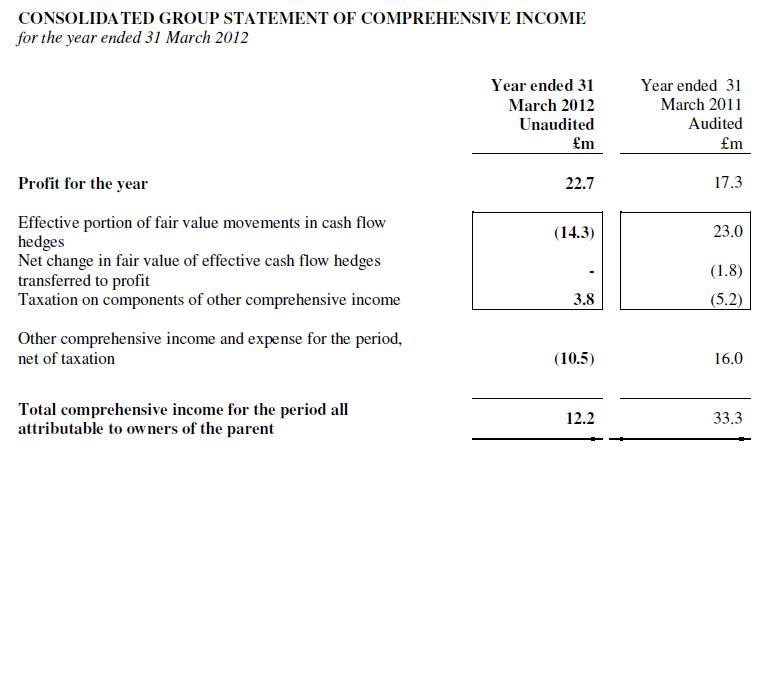
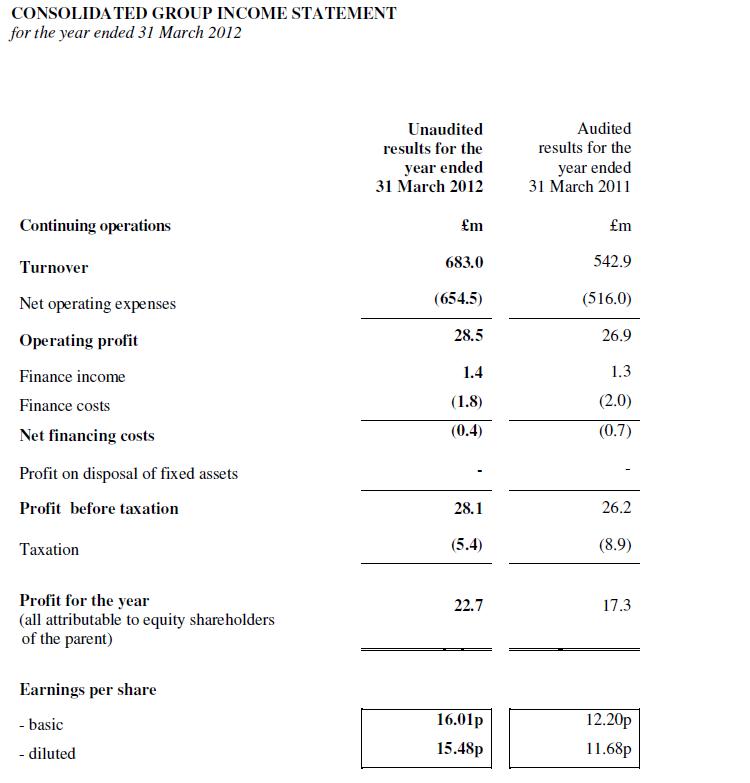
Not so fast. I guess that Richard stopped at page 9 of the interim report and didn’t bother to read that strange stuff at page 10 which looks as follows:

So we have additional items which significantly decreased shareholders equity but didn’t need to be recorded in normal earnings but comprehensive income. In this case we are looking at fuel hedges.

Items which can be recorded in comprehensive income are:

– Unrealized holding gains and losses on available for sale securities ( a trick often used by banks and other financials)

– Effective portion of gain or loss on derivative instruments (cash-flow hedge);

– Foreign currency translation adjustments (i.e. change in value of a foreign subsidiaries net asset value)

– Minimum pension liability adjustments.

Normally people would argue that those items are “non operating” and therefore not or less relevant. However, as it affects shareholder value, in my opinion it is very important to look at those item to determine real value creation for the shareholder.

Coming back to Dart Group: The fuel hedging is an essential part of the business model. Fuel costs are around 20% of sales and cannot be passed directly too customers, especially for the prepaid part. I will have a separate post on how to interpret the fuel hedges but for now the important point is:

The result of the fuel hedges should be treated as part of the normal business of Dart Group.

Therefore real 2011/2012 earnings for Dart are rather around 9 pence per share and not the 16 pence recorded in the income statement. Still cheap (PE of 9) but not “busting any value yardstick”.

Summary:

Any value investor interested in the total value creation of a company for shareholders should include all items of the comprehensive income statement into his valuation. Many companies are very good in shifting all unpleasant stuff into this section. Especially for financial companies, recorded earnings are more or less meaningless without the items in comprehensive income. Also fuel hedges for airlines or other fuel cost eexposed companies should be viewed as relevant.

Quick check: Cairo Communication (ISIN IT0004329733) – 12% dividend “wonder” or liquidation ?

A reader pointed out that Italian company Cairo Communciations might be an interesting investment.

Company description per Bloomberg:

Cairo Communication S.p.A. carries out its activities in the communication field as an advertising broker for a variety of media, such as commercial television, analog and digital pay television, press, and the Internet. The Company also publishes magazines and books and operates an Internet portal through its own search engine, Il Trovatore.

Cairo looks relatively cheap on an earnings basis (2011):

P/E 8.5
EV/EBITDA 4.5
P/S 0.7
P/B 3.13

The company doesn’t have any debt but significant net cash (0.70 EUR per share against a share price of 2.56 EUR).

ROCE and ROE are both above 30%, so is this a value investor’s wet dream ?

Cairo is listed since 2000, so let’s look at some figures from the past:

BV Sh EPS DPS NI Margin Sales pS ROIC
29.12.2000 1.62 0.09 0 5.6% 1.5348 3.03%
31.12.2001 1.70 0.08 0 4.8% 1.7509 2.84%
31.12.2002 1.73 0.07 0.04 4.7% 1.5929 1.93%
31.12.2003 1.72 0.07 0.24 3.8% 1.7299 2.74%
31.12.2004 1.65 0.09 0.16 3.6% 2.3745 3.54%
30.12.2005 1.58 0.08 0.16 3.5% 2.3161 3.81%
29.12.2006 1.19 0.15 0.30 0.0% 2.7983 7.74%
31.12.2007 1.11 0.15 0.25 5.4% 2.9956 11.34%
31.12.2008 0.91 0.17 0.40 5.6% 2.9527 14.22%
31.12.2009 0.86 0.16 0.20 5.3% 2.9259 15.12%
31.12.2010 0.90 0.27 0.20 8.3% 3.2273 27.67%
30.12.2011 0.82 0.30 0.40 8.3% 3.6192 31.81%
             
Total   1.67 2.35    

The numbers look really interesting. On the one side, it looks like a liquidation, with dividends being constantly higher than earnings. On the other hand, Cairo managed to more than double their sales with almost half of the equity and at the same time increase their margins to a healthy 8%.

Together, this of course leads to a dramaticv increase in ROE and ROIC.

Interestingly the stock price hovers only slightly above the post internet bubble prices:

Summary:

I think this really looks interesting and worth a deeper look into the drivers of the sales increase and profitability development. If this would be “sustainable” then Cairo might indeed be an attractive opportunity.

Piquadro SpA – Competitors, market analysis and strategies

Normally it is quite difficult for a private investor to get hold of comprehensive market information. One could try to google and try to collect some articles, but “hard data” is usually only available if you pay.

However, many listed companies include some market and competitor info in their analyst presentations. Piquadro provides us with a nice graphic of competitors in its 2011 April Analyst presentation:
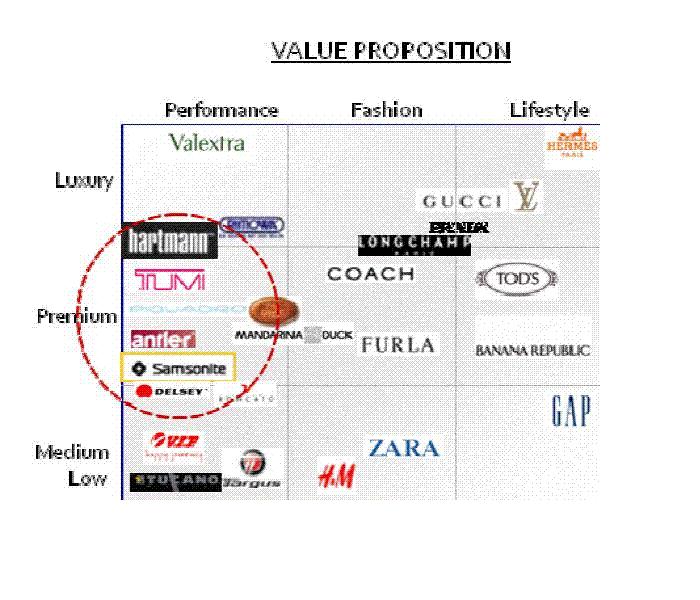
Interestingly, in it’s own presentation one can see that the “Premium / Performance” segment is also the most crowded one.

An even better source for market data are IPO filings. In an IPO prospectus, companies usually provide a lot more information than in annual reports, as they have to persuade new investors that this is a exciting market.

Luckily, competitor Samsonite actually was IPOed last year on the Hongkong stock exhange after filing bancruptcy in 2009 (and also in 2002 if I remember correctly). The Samsonite story also shows the biggest risk for those companies: Overexpansion and too much lease liabilites, in this case driven by a Private Equity owner.

Tumi, currently owned by PE firm Doughty Hanson is currently on the path to an IPO and has already filed its documents for an IPO. To make things more interesting, Samsonite already anounced its interest purchasing TUMI.

So we have to additional sources for market information in this case.

For Mandarina Duck, the other major competitor from the Piquadro Matrix, currently no financial information is available. It seems to be owned by a PE shop as well.

Let’s start with the “Competitor” section of the TUMI IPO prospectus:

Competition

We have a variety of competitors in the categories and geographic regions in which we operate. We believe that all of our products are in similar positions with respect to the number of competitors they face and the level of competition within each product category. Depending on the product category involved, we compete on the basis of a combination of design, quality, function, price point, distribution and brand positioning.

Our biggest global competitor in the travel goods category is Rimowa, a German company. We also compete with Samsonite in Europe, the Middle East, Africa and Asia-Pacific. In the premium luggage and business cases category, we compete with Bally, Dunhill, Ferragamo, Gucci, Louis Vuitton, Montblanc, Porsche and Prada. In the business case category, we also compete with smaller brands in specific markets. In the U.S., our main competitors are Victorinox and Briggs and Riley. In Europe, the Middle East and Africa, our key competitors are Mandarina Duck and Piquadro. In the Asia-Pacific region, competition is fragmented. In Japan, our two key competitors are Porter and Ace Brand. We also compete with Coach across the luggage, business cases and accessories categories.

We believe that our primary competitive advantages are favorable consumer recognition of our brand amongst our targeted demographic, consumer loyalty, product development expertise and widespread presence in premium venues through our multi-channel distribution. We may face new competitors and increased competition from existing competitors as we expand into new markets and increase our presence in existing markets.

So again, we do not see any “hard” moats but rather some fuzzy brand recognition and customer loyalty aspects.

Even more interesting is the very detailed IPO prospectus of Samsonite. This is a “treasue trove” of interesting market data.

The “1 million dollar quote” however can be found at page 95:

Barriers to Entry and Benefits of Scale and Leadership in the Luggage Market
Barriers to entry into the luggage market are generally low, which has contributed to the fragmented nature of the industry. Key challenges for an entrant or an existing company are investment in brand awarness, innovation in new products, access to quality producers, and developement of an effective national / local retail network.

So here the “market leader” tells us there are no barriers to entry. So no “moats”. Period.

The Industry overview section of the filing is really interesting and comprehensive (p-90).

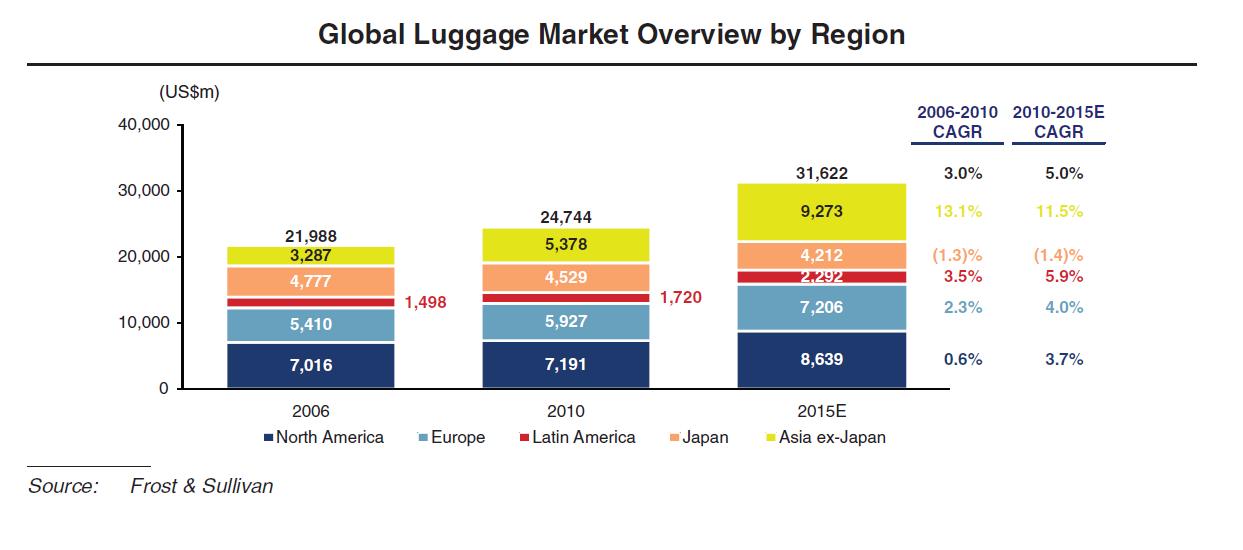
The market itself is supposed to grow at quite an attractive overall rate:
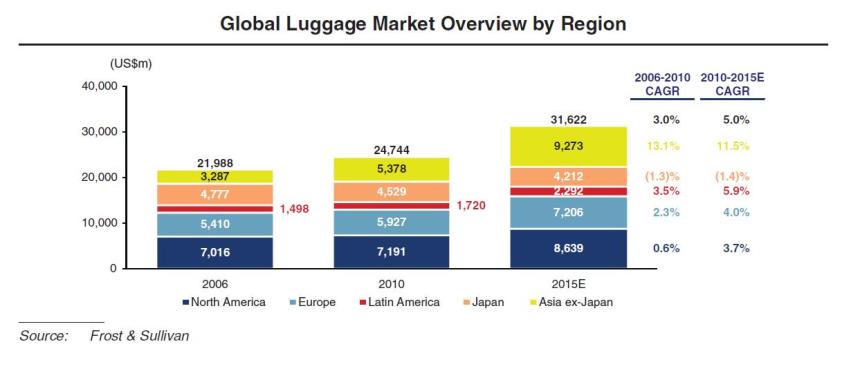
Samsonite itself does not yet realise Piquadro as competitor, neither Mandarina Duck. Piquadro and Mandarina Duck are only mentioned among others which are shown having a combined market share of 74.5%.

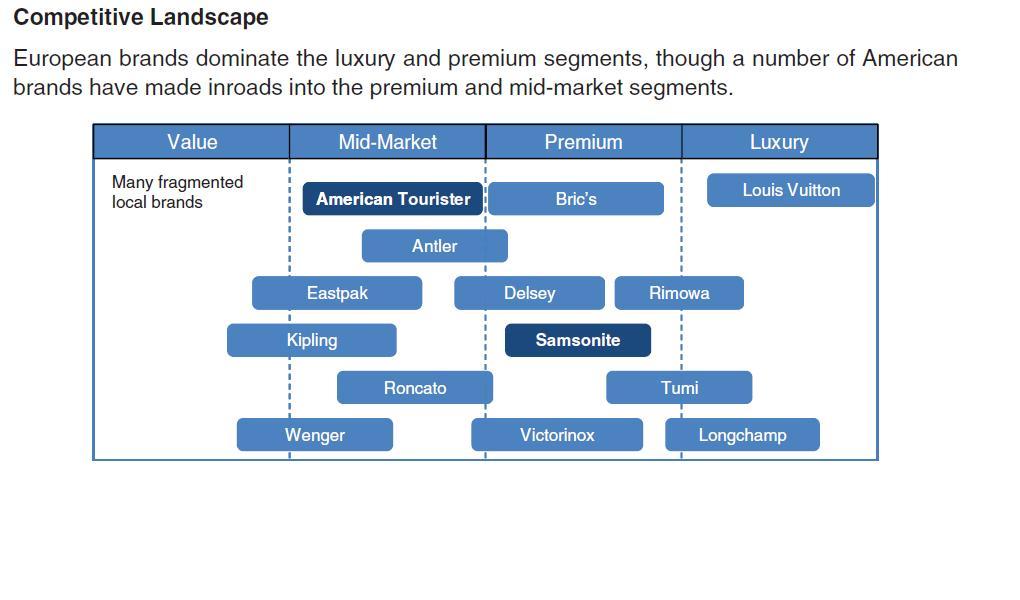
Howver, Samsonite places itself directly into the “Premium” category in contrast to Piquadro and Tumi themselves:
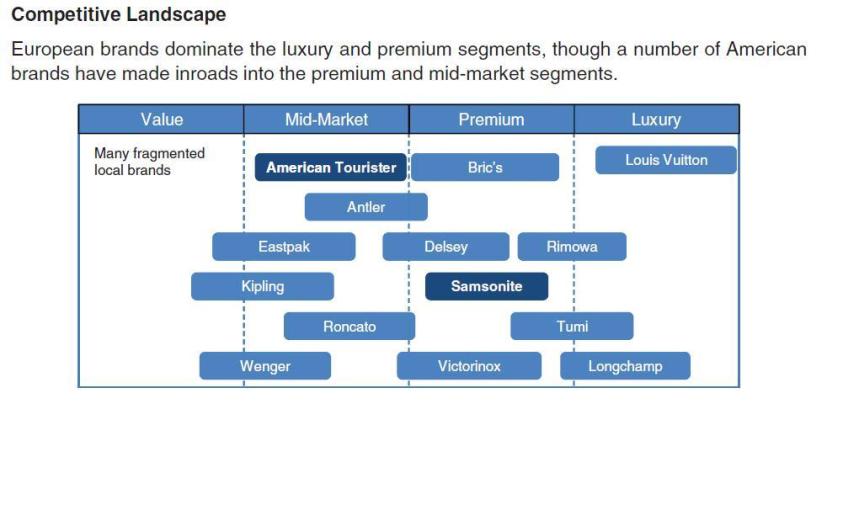
Side remark: Anyone who had the problem at an Airport baggage claim to find out which of the 25 identical black Samsonites is the own bag knows that this is more “mass market” than anything else.

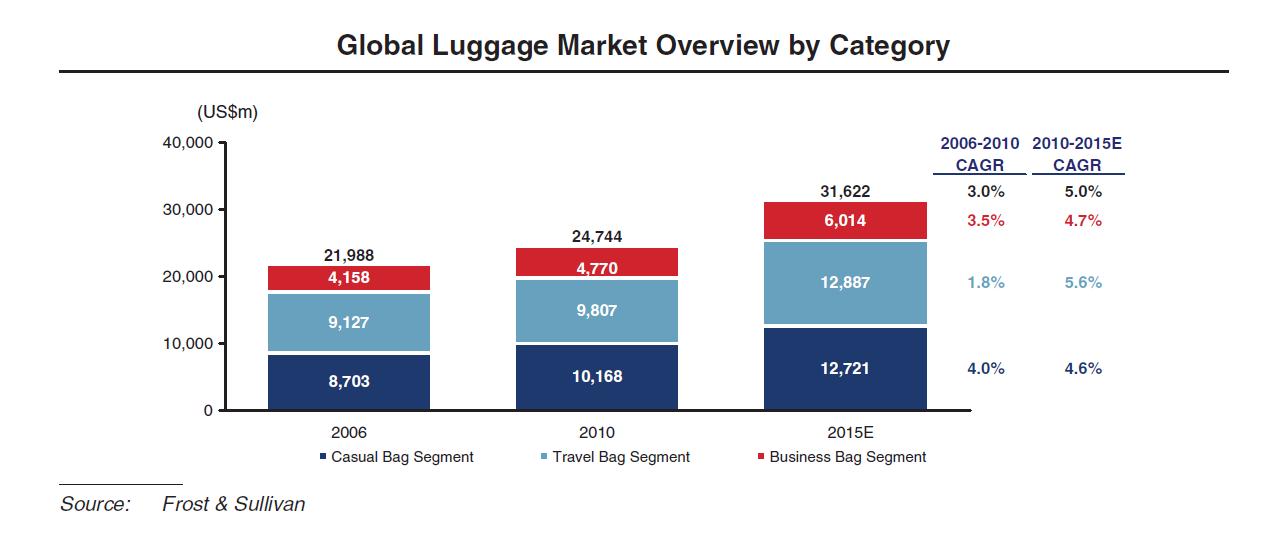
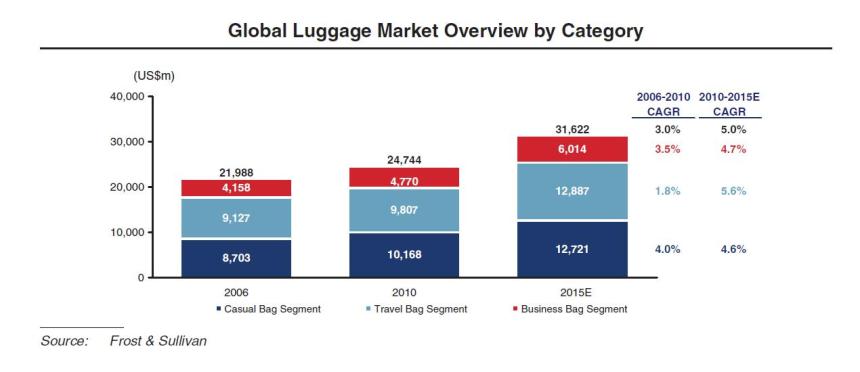
The luggage market according to Samsonite can be segmented into 3 product segments:
Samsonite also has an interesting “market share” slide for Europe which shows the high fragmentation:
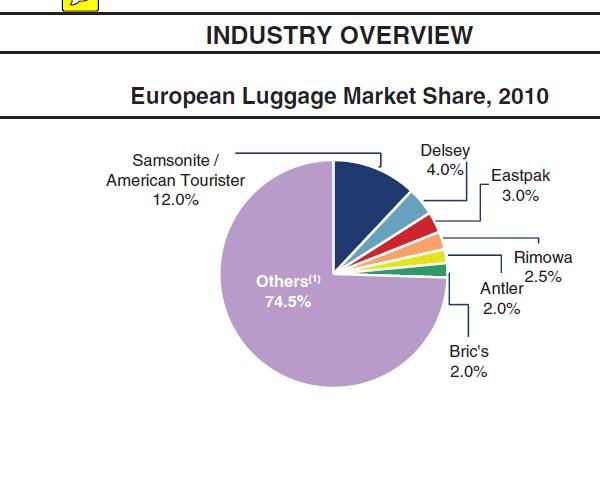
So the big question is now: Should I stop now with analysing Piquadro because there is definitely no “objective” moat ? I would say, no, because for some reason, Piquadro has been able to grow, maintain high margins and produce free cashflow. When we continue to evaluate the company we should however incorporate a certain “normalisation” of returns anad margins.

Also the whole market segment seems to be quite attractive as even in “good old Europe” some nice growth is expected in the coming years as indicated before which can be incorporated int he valueation to a certain extent..

Strategy

Tumi has a very interesting passage in its IPO filing regarding marketing:

We do not employ traditional advertising channels, and if we fail to adequately market our brand through product introductions and other means of promotion, our business could be adversely affected.
In 2010, we spent approximately 3% of our net sales on advertising and promotion expenses. Our marketing strategy depends on our ability to promote our brand’s message by using store window campaigns, product placements in editorial sections, social media to promote new product introductions in a cost effective manner and the use of catalog mailings. We do not employ traditional advertising channels such as newspapers, magazines, billboards, television and radio. If our marketing efforts are not successful at attracting new consumers and increasing purchasing frequency by our existing consumers, there may be no cost-effective marketing channels available to us for the promotion of our brand. If we increase our spending on advertising, or initiate spending on traditional advertising, our expenses will rise, and our advertising efforts may not be successful. In addition, if we are unable to successfully and cost-effectively employ advertising channels to promote our brand to new consumers and new markets, our growth strategy may be adversely affected.

Interestingly, the “Market leader” Samsonite spent almost 9% of revenues on marketing in 2010(see IPO fact sheet), Piquadro around 5%.

Samsonite focuses basically to almost 100% on the wholesale sales channel, Tumi has reached a 50/50 split between wholesale and single brand stores.

Very interisting is the fact, that Piquadro just hired a seasoned TUMI executive for international brand expansion.

Peer Group comparison

Let’s just make a quick comparison with regard to profitability. As one could expect for PE owned companies, both TUMI and Samsonite show quite a messy capital structure and “real profits” don’t really exist. So let’s work with what they call “adjusted” EBITDA (Samsonite & Tumi in USD, Pqiadro in EUR):

Samsonite TUMI Piquadro
Sales 1,215.0 252.8 61.8
Total assets 1,665.0 321.0 29.6
NWC 372.0 80.2 16.1
EBITDA adj 191.9 40.6 16.4
       
EBITDA/Sales 15.8% 16.1% 26.5%
EBITDA/Assets 11.5% 12.6% 55.4%
NWC/Sales 30.6% 31.7% 26.1%

This is really interesting. Piquadro is the most efficient and most profitable company of this “Peer group” based on “simple” metrics.

Summary: A quick view into the market and competitors show the following:
– the market is quite fragmented, no real barriers to entry exist and therefore no “classical” moats
– nevertheless all companies seem to be able to generate at least currently some decent returns on assets
– Picadro itself seems to be the most efficient of the 3 companies. It is therefore likely that no strong “economies of scale” exist in this market

I will follow up with a valuation approach in the next days.
Core Value WMF AG – Hidden “Mittelstand” Champion – Part 1

WMF AG is one of the “core value” stocks, I have only mentioned briefly. WMF was founded over 150 years ago (wikipedia). The company is well known for generations in Germany for producing excellent kitchen supplements, especially cooking pots and pans, cuttlery and other “kitchen helpers”. Additionally they started at some time in the sixties to produce coffee makers, especially for the professional area like restaurant, company cafeterias etc.
Read more

Esso S.A.F. – less attractive at a second glance

After having quickly analysed “Magix Six” stock Esso S.A.F a few days ago with some encouraging results, I dived a little bit into the company.

Despite beeing a subsidiary of ExxonMobil, the homepage is “french only”.

Luckily, I managed to understand at least the two investor presentations they have on their website.

Both, the 2011 and the 2010 show a quite depressing picture.

Read more

IVG capital increase

IVG is an interesting example for a “distressed” company, where the position as Senior bondholder is much more comfortable than being a shareholder.

After announcing relatively good Q3 numbers on which I commented earlier this month, they announced today the following:

The management board of IVG Immobilien AG, Bonn (ISIN DE0006205701) has, with the consent of the supervisory board, resolved to increase the registered share capital of the company from € 138,599,999 by € 69,283,885 by issuing 69,283,885 new ordinary bearer shares.

The new shares will be offered to existing shareholders by means of indirect subscription rights at a subscription ratio of 2:1, meaning that two existing shares will entitle a shareholder to subscribe for one new share. The subscription price is € 2.10.

A lot of people bought IVG shares because they trade well below book value, howver, issuing such a huge amount of new shares at an ever larger discount to book value is a clear dilution for existing shareholders. The result was a 15% drop in the shareprice.

For the 2014/2017 Convertible bond, this is in contrast good news which shows in a steadily increasing bond price:

From my point of view, there are a few take aways from this situation:

– looking at price to book ratios for distressed companies should always include the possibility of massive dilution
– especially when banks are involved who can use loan covenants as a tool the force capital increases, shareholders will normally suffer
– in such cases buying senior bonds at a large discount looks like a much better position compared to stocks
– stock or subordinated debt of distressed companies will only become intersting, once liabilites are reorganized in a way that no refunding is necessary for an extended amount of time (e.g. through long term bond issuance)

In my opnion, we will see more or less similar actions for Praktiker.

Praktiker – Restrukturierungsplan

Ich hatte in den vergangenen Monaten ja diverse Posts zu Praktiker gschrieben mit dem Resultat, dass aufgrund der hohen Verschuldung und der Mietverbindlichkeiten kein “Margin of Safety” erkennbar war.

Insbesondere die Cashflow Problematik hat die Handlungsfähigkeit der Firma extrem eingeschränkt.

Mein Votum nach den Halbjahreszahlen war:

Zwischenfazit: Insgesamt darf man also mit weiteren „Sondereffekten“ rechnen, sollte ein neuer CEO mal anfangen aufzuräumen und unprofitable Standorte zu schliessen. Auch die Marge dürfte unter dem Lagerverkauf und den dazu notwendigen Sonderaktionen im 3ten Quartal deutlich leiden.

Jetzt ist der neue Chef Thomas Fox mit seinem Sanierungsprogramm an die Öffentlichkeit gegangen. Da ich kein Sanierungsexperte bin, kann ich relativ wenig zum Inhalt sagen,aber generell macht es sicher Sinn, nur eine Zentrale zu haben und unprofitable Standorte zu schliessen.

Interessant ist diese Aussage aus einem FTD Artikel:

Konkret will er in den kommenden Wochen mit Arbeitnehmern, Vermietern und den Kapitalgebern, die eine Praktiker-Anleihe gezeichnet haben, über einen Verzicht verhandeln. Die Höhe des Verzichts wollte er nicht benennen. “Ich habe für jede Gruppe sehr genaue Vorstellungen”, sagte er dazu lediglich. Einigen Vermietern drohte er außerdem mit dauerhaften Einschnitten oder Kündigungen, weil ihre Mieten überhöht seien.

Das ist doch sehr interessant. Ich bin zwar kein Distressed Debt Spezialist, aber solange Praktiker keine Insolvenz anmeldet gibt es keinen Grund für Anleihegläubiger auch nur einen Cent nachzulassen. Insbesondere da die Anleihe ja die durchaus werthaltige “Change of Control” Poison Pill besitzt.

Praktiker will ja 300 Mio investieren, die Aussagen im Conference Call zur Finanzierung waren sehr vage.

Ohne eine klare Vorstellung der Refinanzierung ist meines Erachtens auch die Anleihe nach wie vor “uninvestierbar”. M.E.ist auf jeden Fall eine massive Kapitalerhöhung unvermeidbar, wahrscheinlich dazu noch eine Wandelanleihe o.ä.Auf jedne Fallwerden die Aktionäre nch weiter verwässert werden, insofern ist der Kursrückgang der durchaus gerechtfertigt.

Interessant ist die Tatsache, dass nach der Veröffentlichung des Plans der Kurs zuerst gestiegen ist, um dann nach dem Call wieder stark zu fallen.

Das ist aber m.E. kein Wunder, der CFO macht meines Erachtens keine gute Figur und fasselt nur allgemein daher,man hat nicht das Gefühl dass man das Thema Finanzierung wirklich im Griff hat.

Merke: nicht nur Berichte lesen sondern auch die Calls anhören.

Fazit: Die Aktie ist m.E. nach wie vor für Valueinvestoren nicht investierbar, es dürfte noch eine signifikante Verwässerung durch Kapitalerhöhung bevor stehen. Die Anleihe selbst könnte bei einem wirklich geringen Preis (unter 50%) interessant sein werden.

« Older Entries Recent Entries »