BMPS update & Quick look at Turkey (Koc Holding, Depfa TRY Zero bond)

BMPS

Today I sold my BMPS “special situation” position at 1,80 EUR per share, a small loss compared to my 1,80 EUR entry price when I factor in transaction costs. The subscription rights stopped trading already yesterday. Overall, the case did not work out very well. The stock was volatile only the very first day and didn’t do a lot ever since as the chart shows:
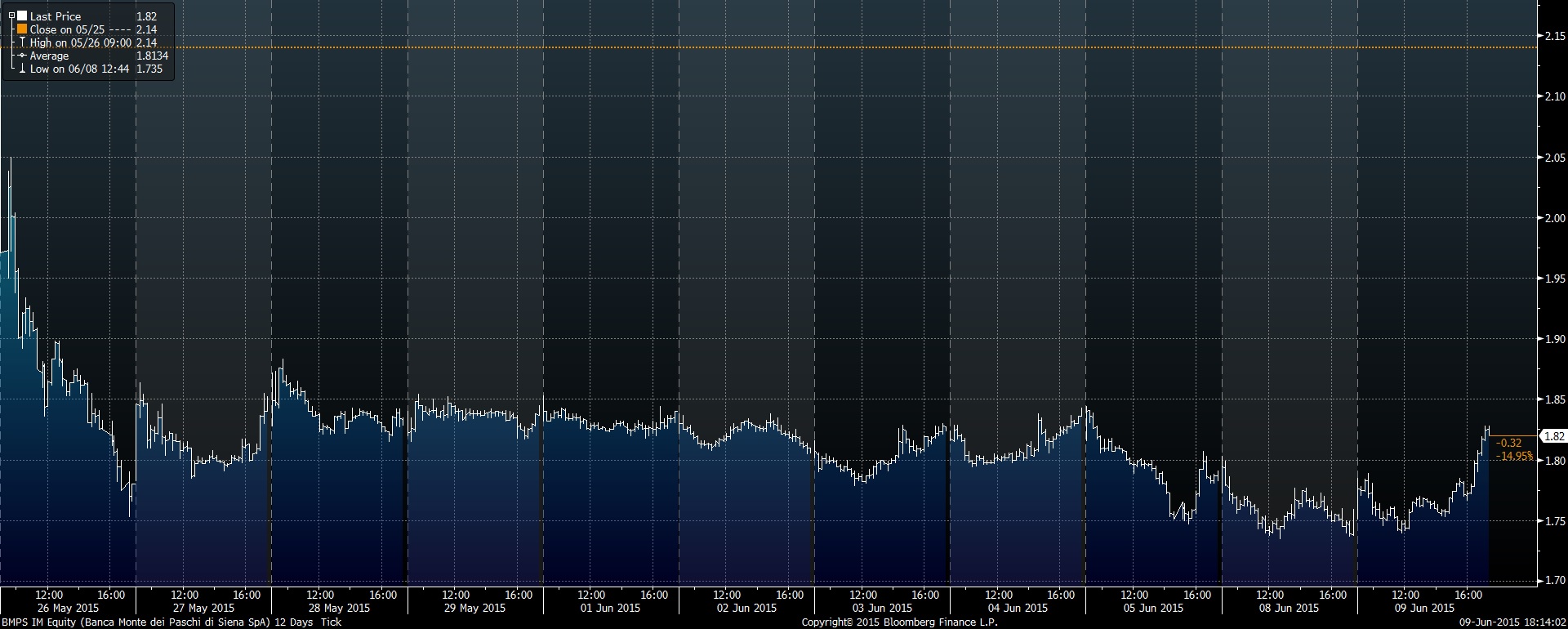
bmps 11 close

It seems to be that the regulator has been quite succesful this time to warn market participants against any kind of option based short squeezes. So no “Italian Job” this time. As I have mentioned in the comments of the last post, I do not consider BMPS as a longer term investment. I do think the risk/reward profile of this special situation was good but it just didn’t work out. For the record, I consider the whole transaction as one trade so I still have one potential transaction open or June 😉

Quick look at Turkey

The Turkish Lira and the stock market got hit hard this week as the ruling party did not get the majority of votes.

Politically, one might say that this was actually good news because it clearly enforced democracy in Turkey. Or how the linked Reuters article said:

Erdogan loses his chance to become Turkey’s Vladimir Putin

Financial markets in the short-term however seem to prefer potential dictators to democracy. Although I really like the FT guys, this video shows clearly the opinion of many “pundits”. Especially the currency got clobbered and is almost back (in EUR levels) to early last year’s levels:

In the long run I do believe that a functioning democracy is positive, both for the country and business despite “uncertainties” due to elections. Especially as a public shareholder it is very important that the institutions in a country are properly working. With Erdogan gaining more and more power, I did have my doubts. I don’t know that many positive examples that stock markets with dictators in charge do really well.

Koc

My Turkish stock investment Koc Holding is still doing well. In EUR Term, I am still up around +50%. This is mostly due to a quite lucky entry point back in February last year. I still could not motivate myself to increase the position as Q1 results haven been operationally good but net income was lower yoy because of one-offs.

For Koc, a weaker Erdogan/AKP should be clearly positive in the long run as it reduces risk.

Depfa “Kebap bond”

My second “Turkish” investment is the 2020 Depfa TRY Zerobond which I bought almost exactly one year ago. Again I was lucky with the purchase timing. Although I bought at a more expensive exchange rate (2,85 TRY/EUR), I made some money on the bond price so that I am only slightly down.

The interesting thing is the following: Relatively speaking, the bond has become more attractive. This is what I wrote back then:

At a current yield of ~13% p.a., the bond trades around 4% p.a. wider than a 2 year longer EIB Zero bond and around 3% wider than similar Turkish Government (coupon) bonds.

Well, one year later, the bond actually trades 4,2% wider than Turkish Govies and 4,3% wider than the EIB bond. I still believe that there is very little credit risk in a senior Depfa Bond and that at around 50% and a yield of 13,8%, the bond is good value at an Exchange rate of 3,10 TRY/EUR. I might increase the position slightly in the next few days.

Altamir SA (ISIN FR0000053837) – French PE at an attractive discount or CEO “self-service” vehicle ?

Altamir is a French holding company whose main purpose is to invest into private equity funds. Such a structure is called in general “listed private equity”.

To be more specific, this is what they state as the company strategy:

Altamir invests exclusively with Apax Partners, in three ways:

In the funds managed by Apax Partners France:

€200m to €280m committed to Apax France VIII;

In the funds advised by Apax Partners LLP: €60m in Apax VIII LP;

Occasionally, in direct co-investment with the funds managed and/or advised by Apax Partners France and Apax Partners LLP

As investing in only one Private Equity fund company is a quite special arrangement, one asks oneself only one question: Why ? Well, this is explained in the annual report:

Apax Partners was founded in 1972 by Maurice Tchenio in France and Ronald Cohen in the UK. In 1976, they teamed up with Alan Patricof in the United States, bringing the independent entities together under a single banner, Apax Partners, with a single investment strategy and similar corporate cultures, and applying the rigorous standards of international best practices. In 1999, Apax Partners began to merge its various domestic entities into a single structure (Apax Partners LLP), with the exception of the French entity, and reoriented its mid-market investment strategy towards larger transactions (enterprise values between €1bn and €5bn). Apax Partners France opted to remain independent and conserve its mid-market positioning, targeting companies between €100m and €1bn. There are currently no cross-shareholdings or legal relationships between Altamir on the one hand and Apax Partners MidMarket and Apax Partners LLP on the other, nor between Apax Partners Midmarket and Apax Partners LLP

This closes the circle: Maurice Tchenio is the CEO of Altamir and was the founder of Apax Partners in France.

Tchenio retired from Apax only in 2010, so for quite some time he was running Altamir in parallel to being actually part of Apax himself. Maybe to provide stable funding to APAX France ? i don’t know.

So why could this be interesting ?

Looking at Altamir, there were some very positive aspects to be found:

+ CEO owns 26%, is buying (2009: 22%)

+ transparent documentation, reporting. Quarterly NAVs, detailed asset lists

+ French Midcap PE is attractive

+ discount vs. NAV (~30%, 11,20 EUR vs. ~16 EUR NAV). The discount is relatively high compared to other listed P/E stocks (currently on average ~10-15%)

+ no double leverage, net cash

+ paying dividends

+ valuation of unlisted assets relatively conservative, sales prices always higher than last valuation

+ the legal structure seems to be tax efficient for long-term holders (no tax on dividends for French shareholders if one commits to hold > 5 years)

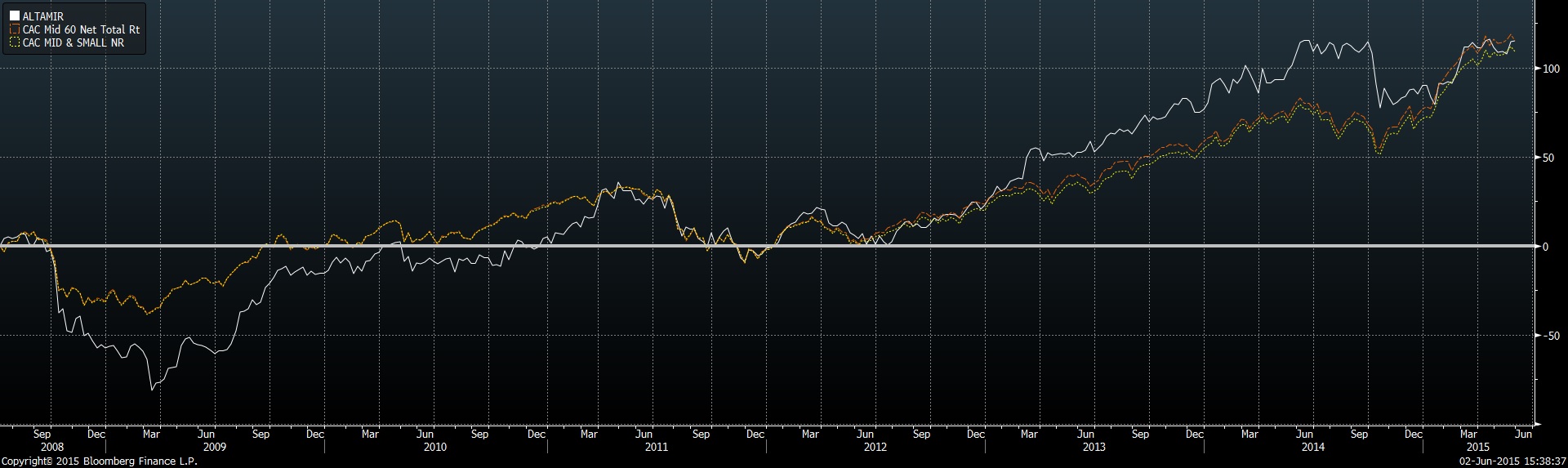
+ track record is pretty OK as we can see in the chart: They did manage to outperform the CAC Mid& Samll cap index since inception based on their stock price, although only at a relatively small margin:

altamir vs cac mid

Actually, those points, especially the “juicy discount” in connection with the large CEO share holding makes this quite interesting

However, the most important thing in looking at such vehicles is the question: How much cost do they add and how much aligned are the interests of management and shareholders ?

And this is where things get a little bit messy. According to the annual report, direct fees are around 17 mn EUR or 2,9% of NAV. This includes in my understanding also the underlying APAX funds. This is not cheap but most likely “in line” with other “fund of fund” PE structures. But the real “fun” starts with the following issue:

The Company has issued Class B shares that entitle their holders to carried interest equal to 18% of adjusted net statutory income, as defined in §25.2 of the Articles of Association. In addition, a sum equal to 2% calculated on the same basis is due to the general partner. Remuneration of the Class B shareholders and the general partner is considered to be payable as soon as an adjusted net income has been earned. Remuneration of these shares and the shares themselves are considered a debt under the analysis criteria of IAS 32.
The remuneration payable to the Class B shareholders and the general partner is calculated taking unrealised capital gains and losses into account and is recognised in the income statement. The debt is recognised as a liability on the balance sheet. Under the Articles of Association, unrealised capital gains are not taken into account in the amounts paid to Class B shareholders and the general partner.

So this is in fact a 18% “carried interest” of the general partner (i.e. the CEO) on any realized profits of the company. So for 2014 for instance, 87 mn EUR of realzed income “shrink” to 57 mn EUR shareholder income as first the management fee gets deducted and then further 18% profit share.

So the “privilege” of a shareholder to invest into APX via Altamir is purchased quite expensively. This also puts the CEO investment a little bit in perspective. Yes, he has invested around 100 mn of his own money into Altamir, but in 2014, the management fees and profit share netted him close to 30 mn EUR direct, whereas the proportional profit of his share position was “only” 15 mn EUR.

Ok, maybe being the Ex Founder of APAX France opens the door to invest into APAX, but charging “3% and 18%” for this privilege (all in) looks quite expensive and explains some of the discount.

Activist angle:

The whole fee issue might also explain why French asset manager Moneta seems to have started in 2012 and “activist campaign” against altamir, see here and here.

They seemed to have pushed for a run-off of the company but so far only succeeded in pressuring to pay a higher dividend than before (increase from 0,10 EUR 2012 to currently 0,50 EUR).

According to Moneta’s homage, they are still active. To me it looks like that the increase in the CEO’s share position has much more to do with control than with actually believing that the shares are undervalued, but of course this could be wrong.

Summary:

In principle, a listed PE vehicle specializing in French mid-market Private Equity could be interesting if the discount is significant. At Altamir however, as I have described above, the structure takes out a lot of money and one needs significant Alpha over time to break even compared to a “do it yourself” portfolio of French small and midcaps.

Tha activist involvement is interesting, but I don’t know enough about French Governance rules to assess the chances of a fundamental change.

So for the time being no investment, however if for some reason (market stress), the discount becomes really large I might be revisiting the case.

Bouvet ASA Update – Annual report & Q1 2015

Bouvet is a Norwegian IT consulting company which I unfortunately “discovered” last year in August before the oil price began its free fall in autumn 2014.

Not surprisingly, the stock price suffered along the other oil dependent stocks. Despite the recent small rebound, the stock is still a relative loser for me, especially compared to the huge rally taking part in German stocks:

To add insult to injury, I lost even on the currency side as the NOK became even weaker than the EUR:

Annual Report 2014:

Let’s look at the 2014 annual report first.

Diluted EPS fell in 2014 from 6,75 NOK to 5,45 NOK. If we look at quarterly earnings over the last 2 years, we can see that already Q2 2014 showed a clear decline which then continued the rest of the year. The profit is now at 2012 levels. With a current P/E of around 14 and EV/EBIT of ~10 Bouvet is not that cheap anymore,.

Also, receivables and “work in progress” increased, resulting in a Free Cash Flow before acquisitions of only ~80% of net profit which is very low for Bouvet.

The most interesting part of the annual report was the info on the CAP Gemini acquisition. They paid 12,5 mn NOK, mostly Goodwill for Cap Gemini’s Norwegian business. This is what they say is the impact:

The acquired company has an estimated contribution with NOK 6.0 million to the Group turnover and NOK 0.6 million to the Group’s profit before tax in the period between the purchase and the balance sheet date.
Included in the value of goodwill are employees and expected synergies with Bouvet Norge’s existing business.

Had the acquisition been carried out on 1 January 2014, the Group’s estimated total turnover for the entire period would have been NOK 1 159.4 million and the Group’s estimated profit before tax would have been NOK 85.5 million.

With this information,we can easily calculate the acquisition multiple:

Stated 2014 sales of Bouvet were 1.132 mn NOK and EBT 81,6. So without the “partial” contribution, Sales would have been 1.126 and EBT 81,0. So the 12,5 mn NOK bought 33,4 mn NOK Sales and 4,5 mn NOK EBT.

Overall this looks like a pretty good deal for Bouvet. Buying at a trailing EBT Multiple of 3,5 is clearly a "bargain purchase" although it's clearly relatively small.

Q1 2015

After the pretty bad last months in 2014, I was quite surprised that they showed really strong Q1 figures for 2015. At 2,32 NOK, Q1 profit is +26,5% against Q1 2014 and EBIT margin was 9,8%, pretty close to their target.

However, Q1 always looks volatile at Bouvet, from 2012 to 2013 for instance, Q1 results dropped by 23% and Q1 2014 was around +16% against 2013.

So I do think it is too early to call a “turn around” at Bouvet, although their tone is quite optimistic:

Demand for Bouvet’s services is good and stable in Norway, and growing somewhat in Sweden.
Bouvet’s turnover is highest in the oil and gas sector, where the company has tailored its range of services and increasingly delivers to the core processes of its clients. That means the decline in sales to clients in this industry has flattened out

I found this quite interesting, as in other oil related industries (drilling etc.) we only start seeing cost cuts and project delays now in 2015. In the Q1 presentation, Bouvet gives additional information.

From my side, the most interesting developments were:

– they diversified their client base

Client portfolio

The 10 largest customers represent 39.3 percent of total revenues – down from 48.8 percent in Q1’14
The 20 largest customers represent 52.5 percent of total revenues – down from 63.6 percent in Q1’14

– they used less “hired” consultants which might explain the increase in margins to a certain extent.

Other stuff

There has been some movement in the shareholder base in the recent week. According to Bloomberg, DNB sold down around -2,5% via several funds. Handelsbanken however increased in their funds the overall position by around +2% of market cap. So overall no big net movemnet.

Summary:

2014 was clearly not a good year for Bouvet and when I bought the stock, I didn’t expect the oil price to drop and their oil related business to suffer so much. On the other hand, Q1 looks very solid although one has to look if this trend really continues. Overall I do think Bouvet is a good “hold” position and if they continue to perform well I might add to the position later in the year.

Overall their strategy to be a “local Norwegian” consultant seems to work and might help them to secure more Government contracts going forward. I do expect that Norway will try to pump money into their local economy if oil stays weak and Bouvet might profit from this.

Groundhog day: Another BMPS (ISIN IT0005092165) deeply discounted rights issue “Italian style”

Health warning: Do not try to trade in such situations unless you know exactly what you are doing. This is not investment advise, do your own research.

Almost exactly 1 year ago, I already looked at last year’s deeply discounted rights issue of struggling Italian Bank BMPS. Well, the same time in the year again and of course, BMPS is again in the market…. somehow this reminds me of this great movie:
Read more

Some links

Good Bloomberg article on Danaher plus a Danaher slidedeck (via Valuewalk)

Interesting “introperspective” from Quan (Gannon) on writing a monthly newsletter

An interesting presentation by Frank Martin, a very cautious value investor (via Valueinvesting World)

Watch out Warren, “big (packaged) food” might be on a permanent decline.

A good summer reading list frome Cove Street Capital and of course the one from Bill Gates

Great interview with Brunello Cucinelli about how differently he runs his business.

Updates: Admiral CEO, Lloyds Banking, Cranswick + Editorial (Comments)

Editorial stuff:

While I was away (without access to my account) some people complained that their comments were not shown while other comments went through. The reason is the WordPress commenting system. If you comment for the first time, I need to manually approve this first comment. Once you are approved, further comments appear automatically if you login and comment the same way than you had done for the first time. So for anyone who commented for the fist time in the last 2 weeks, the comments were still in the “to be approved queue”.
Read more

Double Book review: Tim Clissold “Mr. China” & “Chinese Rules: Mao’s Dog, Deng’s Cat, and Five Timeless Lessons from the Front Lines in China”

Tim Clissold is an English guy who happened to go to China just when China was opening up to the Western world in the early 1990s. His first book “Mr. China” tells the story how he tried to set up and invest a 400 mn USD private equity fund in China together with an US Wall Street veteran.

This was clearly not an easy task. When, after visiting 100 or more companies, he finally found some to invest in, the real problems only began. Ownership rights in China are quite flexible and in his book there are a couple of in-detail stories what can go wrong in China. As a short summary I would say that actually almost everything can go wrong in China for a foreign investor. Contracts are worth nothing and more than once a manager disappeared with most of the money. In other cases, the old owner just built a new factory next to the old one and all the workers left for the new factory and so on and so on. An interesting details was the importance of company seals (“chops”). Those company seals are much more important than anything and the one who has those seals in possession can do anything.

It might be a severe case of confirmation bias but after reading this book I felt fully vindicated for not even considering to invest in any German or US listed Chinese companies (and yes, this includes Alibaba, Baidu etc.). If you can’t even control what’s happening when you are in the country how should you have any chance if you are only invested via several questionable legal constructs.

Clissold makes it especially clear that Chinese thinking is entirely different from western thinking when it comes to business and rules that we take for granted just do not apply or even exist in China.

The second book is a more focused story on his second attempt in China, where he was called in to solve a difficult situation with regard to a big Carbon credit project and then started out to set up his own Carbon Credit investment fund in the mid 2000s. Of course he encountered the same problems as in the first try but he tried to counter them with more typical Chinese tactics which seemed to have worked better. In the end this project didn’t work either as the price of Carbon credits collapsed during and after the financial crisis.

The second book also includes more historical and philosophical background on China which makes it a “deeper” read than the first one.

Overall I can recommend both books to anyone who is interested in China in general and investing or working in China specifically. Although they are a lot of “How China thinks” books out there, this is one of the few with really first hand experience. And the books are quite well written, too.

Book review: “King of Capital: The Remarkable Rise, Fall, and Rise Again of Steve Schwarzman and Blackstone”

The title of the book is actually a little bit misleading. Yes, Blackstone and Steve Schwarzman play a large role in the book, but the book also covers the story of the whole private equity industry pretty well.

After working for DLJ and Lehman, Schwarzman started Blackstone as a 2 person M&A advisory boutique in the 1980ties. As the M&A advisory business was somehow limited, Schwarzmann and his partner decided trying to get into the then fledgling private equity business. Just before they were out of money, they got their first investor money and then became on of the most succesful Private Equity players.

What I liked the book ist that it looks not only at Blackstone but at the development of Private Equity since the 1980ties in general. There is also a lot of interesting detail to be found on specific deals which I found very interesting. For instance how Blackstone failed in Germany in the Cable sector and many more deals. Blackstone in contrast to some other players invests often in cyclical companies where timing is quite important.

Most recently they also branched out big time into Real Estate. A funny side story is the fact, that Larry Fink started Blackrock as a division of Blackstone and relatively early bough the company out for a couple of hundred million USD. Blackrock is now a 65 bn USD market cap company, almost 20 bn more than Blackstone, its former parent.

The author hinself seems to be relatively neutral or even slightly positiv on the general role of private equity and collects some good arguments.

Overall, private equity investors like Blackstone are very close to what I would call “value investors”. Clearly, sometimes they extract that value petty quickly but many times they also create and grow companies like Blackrock. Overall those guys clearly have longer time horizons than most equity fund managers and one of their strengths is that they are not meassured against benchmarks on a monthly or quarterly basis. I guess that is the main reason why they can act very countercyclical.

However, Private Equity is not a one-way street to success a s the side story of Forstmann-Little shows. In the 1990s, they were the predominant player but than went all in into telecom and technology and finally did not survive. Blackstone did some Telco deals as well but nothing which would harm them big time.

As a summary, I can highly recommend this book who has a some interest on how Private Equity works and how those guys think.

« Older Entries Recent Entries »