UPM Kymmene – Relacement Value analysis

Based on the positive results from the “quick check”, I will follow up with the first step of my standard analysis process, the so called “Replacement Value” analysis.

As a starting point, I will use the Net Equity position from the 2010 Annual report of UPM.

Then as a standard I would normally subtract the following entries from the Net Equity:

– minority interests (small, only -16 mn EUR)
– Goodwill (-1.022)

However, if we look at the goodwill breakdown in the annual report, we see the following:

Goodwill by reporting segment
As at 31 December
EURm 2010 2009
Pulp 202 197
Forest and Timber 1 1
Paper 799 799
Label 7 7
Plywood 13 13
Total 1,022 1,017

If we look at the segment numbers of the pulp business on page 90 of the report, we can easily see that the pulp business (basically the pulp mill acquired in Urugay in 2007) was extremely profitable in 2010, providing a significant share of UPM’s profit. So in this case I would consider the goodwill of the acquisition not as worthless, but include it into the replacement value. (remark: It looks like that the investment into the Uruguayan pulp mill was really perfectly timed, UPM got back most of its investment already after one year !!!)

Next in line are the “other intangible assets”, worth 424 mn EUR. The largest portion of this position are “intangible rights”, with ” water rights” (189 mn EUR) having the largest share.

These water rights are explained as follows:

Intangible rights include EUR 189 million (189 million) in respect of the water rights of hydropower plants belonging to the Energy segment. The water rights of power plants are deemed to have an indefinite useful life as the company has a contractual right to exploit water resources in the energy production of power plants. The values of water rights are tested annually for impairment based on expected future cash flows of each separate hydropower plant.

Any other company which would like to start a similar Hydro Power project would have to buy those rights as well, so we can assume that this part of the “Intangible Assets” has value. The rest of the intangibles seem to be software licences and carbon rights, so in the absence of fancy stuff I would not make any further deductions.

This results in the following adjusted value for equity after minorities, Goodwill and intangibles:

FY 2010 mn EUR per share
Equity 7,109 13.67
-minorities -16 -0.03
-goodwill -1,022 -1.97
+ goodwill pulp 202 0.39
-intangibles 0 0.00
adj. Equity 6,273 12.06

Next are “special” balance sheet items such as pensions, land and buildings etc.

Pensions:UPM has 424 mn EUR pension liabilities on-balance sheet. According to the notes, the total pension liabilities including funded schemes are around 1 bn EUR.

The underlying assumptions (~ 4.4% discount rates, 6.5% assumed yield on plan assets) seem to be OK, however the large percentage of stocks in the pension funds (60%) results in a certain risk to the sponsor of those plans. So as a conservative approach, I will deduct 100 mn EUR (or 10% of gross pension liabilities) from UPM’s net equity as “buffer” for pension plan asset risk.

Buildings:
Other than for example a REIT, a company like UPM which owns most of their buildings outright has to write them down to zero over the term of their “economical life”. As everyone knows this appoach is quite conservative, as even 25 or 40 year old building keep some of their value if they are properly maintained.

If one looks at private equity buyouts, own real estate is often one of the “quick wins” for LBO investors if they sell and lease back the written down real estate at a large profit.

So as a rule of thumb I usually add back 50% of the cumulative depriciation on buildings. UPM has 1.505 mn EUR of buildings on its balance sheet, with an original cost of 3.207 mn EUR. So 50% of 1.702 mn EUR is 851 mn EUR which I add back to the equity value of UPM.

Biological Assets:
As UPM owns ~ 1 mn hectares of timber land, we see ~ 1.4 bn of biological assets. As the discount rates (7.5% for Finland, 10% for Urugay) seem to look OK, I don’t adjust this position. However this is something worth to be monitored closely.

“Extra Assets”:

UPM shows 573 mn of investments in “associated” companies. The largest by far with around 540 mn EUR is the participation of 43% in a company named “Pohjolan Voima Oy, FI”.

The homepage of the company states the following:

Pohjolan Voima produces energy at cost for its owners and manages the entire lifespan of power plants reliably, cost-effectively and in an environmentally friendly manner.

In another section of the homepage, the business model is explained as follows:

Pohjolan Voima supplies electricity and heat to its shareholders at cost, and the shareholders cover the costs of the operations – this operating model is also called the “Mankala principle”. The name is derived from a ruling issued by the Supreme Administrative Court in the 1960s, constituting a precedent. In this ruling, the shareholders of a company called Oy Mankala Ab were found not to have received taxable income when Mankala generated and supplied them with electricity at a price lower than the market price and the shareholders covered the company’s costs on the basis of its Articles of Association.

So this is really interesting. UPM carries the participation “at Equity”, but what would be a fair price ? Any new competitor would have to purchase electricity at market prices. One easy answer would be to look at Fortum. The big Finish utility with approx. the same mix of energy assets (nuclear/hydro) trades around 1.8 times book value. If we apply a more conservative multiple of 1.5 book value, we should add 270 nn EUR to UPM’s replacement value in order to reflect the value of the Pohjolan Voima participation.

R&D + Marketing / Branding

Last but not least we have to look at R&D and marketing expenses, if there is some “hidden” replacement value in the form of brand value or “off balance know how”. For acompanylike UPM,the value of the brand is moreor less neglectible, however we can attach some value to R&D.

UPM spends 40-50 mn EUR peryear on R&D. If we use as a rule of thumb 50% of the R&D expenses of the last 5 years as additional “replacement value”, we should add (5x45x0.5) = 112.5 mn to UPM’s replacment value.

So bringing all this together we get the folowing replacemnt value for UPM:

FY 2010 mn EUR per share
Equity 7,109 13.67
-minorities -16 -0.03
-goodwill -1,022 -1.97
+ goodwill pulp 202 0.39
-intangibles 0 0.00
adj. Equity 6,273 12.06
-pensions -100 -0.19
+ real estate 851 1.64
+ at Equ.part 270 0.52
+ R&D 122 0.23
Repl.Value 7,416 14.26

Summary: UPM is a very asset rich company. A relatively conservative approach results in an replacement value of ~ 14.26 EUR per share, mostly the result of undervalued real estate and at-equity participations. This alone would be an interesting investment case, as based on a current share price of 8,25 EUR, this equals a discount of 42% to replacement value or an upside of 72%.

In the following days I will take a closer look at free cash flows and “Earnings Power Value”.

AIRE KGaA – Neuer Aktionär

Eben hat die AIRE folgende Meldung herausgegeben:

Mitteilung nach § 21 Abs. 1 WpHG (Aktie)

Angaben zum Mitteilungspflichtigen:
———————————–

Name: Urs Meile

Staat: Schweiz

Veröffentlichung gem. § 26 Abs. 1 WpHG

Herr Urs Meile, Schweiz, hat uns nach § 21 Abs. 1 WpHG mitgeteilt, dass sein

Stimmrechtsanteil an unserer Gesellschaft am 1. November 2011 die Schwelle von

3% überschritten hat und zu diesem Tag 3,01336% (127.274 Stimmrechte) beträgt.

Davon sind ihm 3,01336% (127.274 Stimmrechte) nach § 22 Absatz 1 Satz 1 Nr. 1

WpHG zuzurechnen.

Eine schnelle Internetrecherche über Herrn Urs Meile zeigt eine erstaunliche Vielfalt. Nach diesem Link hier ist er anscheinend u.a. an einerm Motorboothersteller, einer Viehzuchtgenossenschaft und einem Medienunternehmen beteiligt, anscheinend hat er auch bei einem Fussballclub, den Young Boys Bern mitgenischt.

Zuletzt hat er sich in der Medizintechnik betätigt.

Früher scheint er CEO bei Charles Vögele gewesen zu sein.

Damit dürften die Hauptversammlungen auch zuküftig interessant bleiben.

Gute Nachrichten bei IVG

Ausnahmsweise mal positive Nachrichten von IVG (nach unserer Erstanalyse hatte ich ja erst im August eine halbe Portion gekauft):

Zum einen hatte man schon gestern gemeldet, dass man 2 Mrd. Kredite erstmal verlängern konnte:

Die IVG Immobilien AG hat deutliche Fortschritte im Rahmen der Optimierung ihrer Finanzierungsstruktur erzielt. Zum einen hat die IVG Immobilien AG sich mit den Konsortialbanken des Syndicated Loan aus 2009 (der sogenannte „SynLoan II“) auf Basis einer rechtlich verbindlichen Vereinbarung über eine vorzeitige Verlängerung des im 4. Quartal 2012 auslaufenden syndizierten Kreditvertrags vorab verständigt. Die Prolongation dieser Konsortialfinanzierung unter Beteiligung von 12 inländischen Banken wird eine Laufzeit bis Ende des 3. Quartals 2014 haben. Sie umfasst ein Volumen von aktuell 1.047 Mio. Euro unter Fortführung einer Tilgungsstruktur auf Basis der Erlöse aus dem vertraglich fixierten Abverkauf von Kavernen an den IVG Kavernenfonds aus dem Kavernen-Portfolio der IVG. Die IVG rechnet mit anfänglich geringfügig steigenden, über den Zeitablauf jedoch sinkenden Kosten dieser Finanzierung.

Zum anderen hat sich die IVG Immobilien AG wiederum vorzeitig über eine Verlängerung der im 3. Quartal 2012 auslaufenden „CORE“ – Finanzierung in Höhe von 933 Mio. Euro mit den drei beteiligten Banken verständigt. Der Kredit wird bis Ende Dezember 2015 verlängert. Die IVG rechnet hier mit sinkenden Kosten dieser Finanzierung.

Das ist eigentlich nicht schlecht, wir erinnern uns: Die Wandelanleihe kann vom Anlegher per Ende März 2014 gekündigt werden.

Mit Hilfe von Marktwerterhöhungen scheint man anscheinend im 3. Quartal in die Gewinnzone gekommen zu sein.

Der Kurs der Wandelanleihe hat daraufhin heute auch schön reagiert:

Etwas ärgerlich ist allerdings die Tatsache, dass ich die Meldung mit der Verlängerung gestern schon gesehen hatte, aber nicht rechtzeitig reagieren konnte.

Fazit: Die Verlängerung der Kreditlinien über das Kündigungsdatum der Wandelanleihe hinaus ist definitv positiv zu sehen, auch wenn evtl. Covenants noch nicht bekannt sind. Mit aktuell 14,5% Rendite für eine Laufzeit von 2,5 Jahren ist die Anleihe aber nach wie vor attraktiv. Sollte der Kurs an “schlechten” Tagen nochmal Richtung 70 zurückkommen, wird auf eine volle Position aufgestockt.

Green Mountain Coffee – Hohe Erwartungen & tiefer Fall

Es sieht tatsächlich so aus,als würde es Green Mountain jetzt richtig erwischen.

Anscheinend hat man trotz hohen Wachstums die noch höheren Analystenprognosen verfehlt.

David Einhorn wird schon als “the man” gefeiert, weil er Punktgenau in den Verfall geshorted hat.

Nachbörslich notiert die Aktie jetzt bei 45 USD.

Green Mountain Coffee Roasters, (NasdaqGS: GMCR )
Nachbörslich: 45,14 -21,88 (-32,65%) 23:18

Wir waren zwar mit unserem Short etwas früh dran, aber mittlerweile ist auch der im Plus.

Wie Netflix und Asian Bamboo gezeigt haben, dürfte auch hier gelten: wenn es mal fällt, dann geht es ganz schnell und tief nach unten.

Luft nach unten wäre lt. Chart genügend:

Edit: Hier noch der nachbörsliche Chart von Zerohedge zum “geniessen”:

Magix Sixes – Quick Check UPM-Kymmene OYJ (ISIN FI0009005987)

One stock which has been popping in and out of the Magic Sixes Screen several times is the Finish Paper Company UPM Kymmene.

Current “simple” value metrics are (stock price 8,30 EUR):

P/B 0.60
P/E Trailing 2010 5.4
Dividend Yield: 6,65%

Market Cap is 4.4 bn, there are no majority shareholders. The stock is fairly liquid.

Some standard quick qualitiy checks:

Tangible Equity: Tangible book value per share is 10,86 EUR (YE 2010), which represents ~80% of book value, so no issues here
Debt: Net debt per share is relatively high at ~7.1 EUR per share, however with ~2.5 EUR trailing 12M EBITDA per share, total EV/EBITDA at ~6.8 looks OK.
Free cashflow: Free cashflow is positive as far as I can look back (1999).

If I find a stock interesting, I try to do a quick check of historical earnings quality and cashflow usage based on Bloomberg numbers:

Year Earnings Dividends Free Cashflow Debt per share
2001 1.93 0.75 1.62 10.52
2002 1.06 0.75 1.67 10.53
2003 0.61 0.75 1.26 10.21
2004 1.76 0.75 0.70 9.58
2005 0.50 0.75 0.31 9.62
2006 0.65 0.75 1.11 7.92
2007 0.16 0.75 0.37 7.96
2008 -0.35 0.40 0.14 9.12
2009 0.33 0.45 1.97 7.74
2010 1.08 0.55 1.43 7.14
Total 7.73 6.65 10.57  
In % of Earnings   86.1% 136.8%

In this case, the result looks quite good. UPM seems to generate much higher free cashflows than earnings (137%). Also 86% of Earnings have been distributed to shareholders via dividends and the company has significantly reduced debt until 2010.

First summary after this “Quick check”: From a “semi mechanical” point of view, the stock might be a interesting Contrarian investment, so it makes sense to more deeply research the company.

Magic Sixes – Quick Check Iren SpA (ISIN IT0003027817)

One of the companies which recently appeared in the Magic Sixes Screening (P/B < 0.6, P/E 6%) is another Italian Company named Iren Spa.

Based on “simple” criteria, the Share seems to be really cheap:

P/B 0.58
P/E 4.59
Div. Yield 9,15% (!!)

The description of the business in Bloomberg reads as follows:

IREN S.p.A. generates, distributes, and sells electricity and district heating. The Company manages natural gas distribution networks, markets and sells natural gas and electricity, and manages water services.

Based on available data, the bulk of the business seems to be energy distribution, geographically 100% of the business is done in Italy.

Market Cap is around ~ 1bn EUR– There doesn’t seem to be a single majority shareholder.

The company was IPOed almost exactly 11 years ago at 2,70 EUR. Even taking into account dividends, the performance from the initial IPO was around -6% p.a., which is better than the Italian BM index (9% p.a.).

However, the first thing I usually check is the debt load and free cashflows.

Currently, they have around 2.14 EUR per share net debt per share, which results in an enterprise value of ~3,50 EUR per Share. Based on trailing 12M EBITDA of 0,43 EUR, this results in 12M trailing EV/EBITDA of 8,8x, which for a Italian utility seems to be quite rich.

Based on Bloomberg, free cashflow has been negative for every single year since IPO.

Last but not least, only 0,42 EUR of the 1.42 EUR book value is “tangible”. One would have to check, if certain infrastructure licenses are included in the intangible part.

However at this point I can already stop summarize:

For me, the combination of a large debt pile, negative free cashflows and a significant portion of non-tangible book value makes Iren SpA more or less uninvestible. Based on the pure financials without any further analysis there doens’t seem to exist any Margin of Safety despite qualifying as “Magic Sixes” stock. For the time being, Iren will not be analyzed further as there seem to be more attractive “targets”.

WestLB Update – Erstmal kein Verkauf des Firmenkundengeschäfts an Trinkaus

Die Meldung schon vor einigen Tagen hatte ich glatt übersehen. Interessant ist m.E. der Grund:

HSBC Trinkaus wollte ursprünglich das WestLB-Geschäft mit großen Firmenkunden sowie 600 Mitarbeiter übernehmen. Am Dienstag war die Bank dann aus den Verhandlungen ausgestiegen und hatte dies damit begründet, dass die geforderte Exklusivität bei der vertieften Buchprüfung ihr nicht zugesagt worden sei. Hintergrund: Das Sparkassenlager hatte plötzlich ein eigenes Interesse an dem Geschäftsfeld entdeckt – will aber nur einen kleineren Teil des Geschäftes übernehmen, als ihn HSBC hätte übernehmen wollen.

Aha, könnte da vielleicht die Fälligkeit der Geußscheine, die vmtl. zum großen teil in Händen des “Sparkassenlagers” sind eine kleine Rolle gespielt haben ?

Damit hat man vmtl. eine Abschreibung für das aktuelle Geschäftsjahr verhindert, was m.E. eigentlich nur positiv für die 2011er GS sein kann.

A different take on Performance Measurement – FPA /Crescent Fund

One of my quarterly “must reads” are the FPA Crescent quarterly letters.

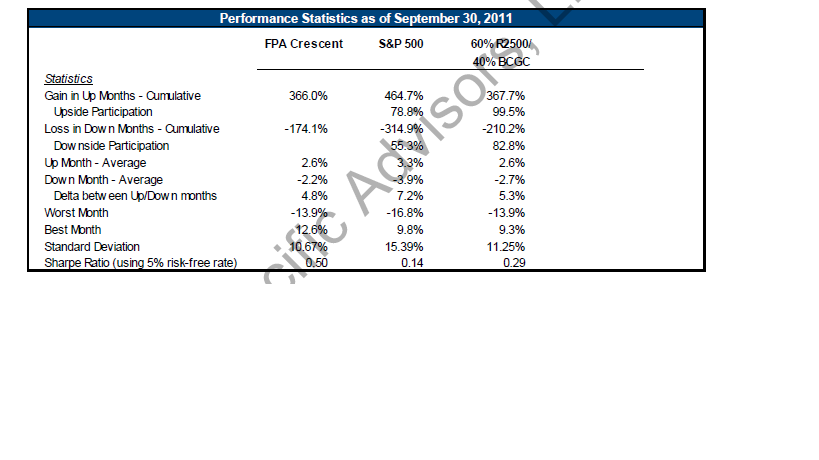
In the current one, they show in the attached slides a very interesting way of presenting performance (page 5).

What they are doing is the following:

– they seperate up and down months in a first step
– in a second step they look how much they particpate in up periods and how in down periods
– the goal over the long run is of course to participate relatively more in up periods than in down periods

For me this is very interesting, as their investment style is very similar to my own strategy.

Unfortunately, I have only 10 months of data, but here are the monthly performance numbers against the Benchmark:

Start Jan Feb Mrz Apr Mai Jun Jul Aug Sep Okt
Bench 6394 6567 6645 6559 6833 6645 5646 6486.69 5504.92 5154.68 5667.92
Portfolio 100 101.46 102.49 103.92 105.07 101.23 95.35 99.03 91.73 92.75 95.46
Perf BM   2.7% 1.2% -1.3% 4.2% -2.8% -15% 14.9% -15.1% -6.4% 10%
Perf Portf.   1.5% 1% 1.4% 1.1% -3.7% -5.8% 3.9% -7.4% 1.1% 2.9%

In the first 10 months of 2011, the benchmark had 5 down months and 5 up months whereas the portfolio had 7 up months and only 3 down months. So far so good.

Howver if we look at the cumulated numbers:

 
Cum Months up  
BM 33%
Portf. 10.4%
Participation: 31.52%
   
   
Cum months down  
BM -40.6%
Portf. -14.4%
Participation: 35.47%

One can clearly see, that the relative “particpation rate” in down months is higher then in up months.

I interpret this as follows:

– the portfolio outperformed, because it was more defensive than the benchmark and the benchmark went down.
– However, if the benchmark would have been zigzaging and ending flat, I would have most likely underperformed

I am not sure where this comes from, but one of the reasons could be the short side. The short of the momo stocks actually added volatility in the down months because those stocks where outperforming the BM by a large margin. Usually the short side should reduce volatility.

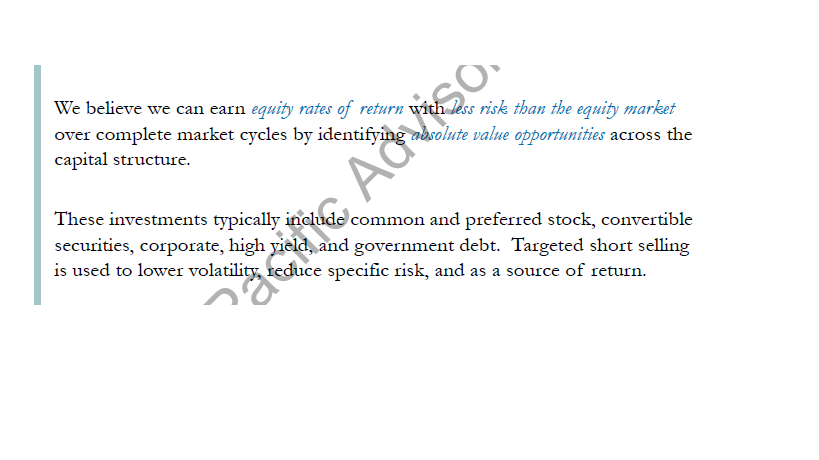
If we look at the FPA statement in the same presentation they say the following:

So this is something to remember that shorts primarily should help to reduce the volatility. Shorting explicit momentum stocks might not be the best implementation of this goal.

Another reason could be that the portfolio is geared towards special situations, which are expected to “sleep” for some time before they are hopefully “exploding” to the upside.

In any case I will look from time to time into this measure, if I can improve those relative ratios somehow.

AS Creation Q3 Bericht

Wie bereits gestern berichtet, kam heute nach der Gewinnwarnung der Bericht zum 3. Quartal raus.

Aus meiner Sicht die wichtigsten Punkte:

+ Die Umsatzentwicklung bei Tapeten in Deutschland war ausserordentlich positiv
– der Cashflow ist durch die Erweiterungsinvestitionen nach wie vor negativ, das Cashpolster schmilzt, die Schulden steigen
– die gestiegenen Rohstoff und Energiekosten haben richtig reingehauen

Ganz interessant ist die Tatsache, dass Preise anscheinend immer nur einmal im Jahr festgesetzt werden und dann nicht mehr nachadjustiert werden können. Das ist natürlich ein gewisses operatives Risiko, was mir so nicht bewusst war.

Laut Analystenpräsentation vom März diesen Jahres wollte man dieses Jahr 26 Mio EUR investieren, bislang sind 16 Mio. geflossen. D.h. auch im 4 Quartal wird dann nochmal cash abfliessen.

Zudem wird man nächstes Jahr wenn die Produktion in Russland anläuft, erstmal noch in Working Capital investieren müssen.

Dennoch ist bei aktuell 20 EUR der Kurs sehr günstig, wenn AS Creation zu seiner “durchschnittlichen” Marge zurückfinden sollte.

Ich überlege mir dehalb enrsthaft, bei diesen Kursen nachzufassen und auf eine volle Position (5%) aufzustocken. Vielelciht sollte man aber evtl. noch die ANkündigung einer evtl. Divdendenkürzung abwarten AS Creation hat ja immer so 40-45% des Nettoergebnisses geschüttet. In der jetzigen Situation sollte man vielleicht etwas Cash sparen.

« Older Entries Recent Entries »