Category Archives: Uncategorized

UPM Kymmene part 3: Qualitative aspects, Value Trap check and conclusion

So after the quick check, the Replacement Value analysis and the calculation of the EPV we have the following result:

Replacement Value ~ 14 EUR
EPV between 9.2 and 13.5 EUR depending on the assumption for future Capex.

Reader Weljo grouv however made a very good comment: The lower Capex seems to be an industry wide developement, so actually projecting the currently low capex expenditures into the future might be aggressive.

If we then just try to explain, why a conservative EPV is so much lower (maybe ~10 EUR) than the replacement value, the simple answer could be that I falsely took all the machinery at book value instead of applying a discount.

At this point in time it makes also sense to check for characteristics of a value trap. I posted already the great presentation from Jim Chanos and like to use now as a exercise.

I will start with the first mentioned characteristic:

Cyclical and/or Single Product
• Cycles sometimes become secular (Steel, Autos)
• Fad does not equal sustainable value (Coleco,Salton, Renewable Energy)
• Illegal does not equal value (Online Poker)

The first point is really the key: Will demand for paper (especially magazine paper where UPM is market leader) really recover ? Or will the Ipad take over. I am not an expert in this, but this is definitely a “red light”.

Hindsight Drives Perceived Value
• Technological obsolescence (Minicomputers,Eastman Kodak, Video Rental)
• Rapid prior growth – “Law of Large Numbers”(Telecom Build-Out)

This is also an interesting point. Although UPM is not a technology company, its major product magazine paper could be a victim of technolgy change. Let’s call this an “yellow light”.

Marquis Management and/or Famous Investor(s)
• New CEO as a savior – ignoring Buffett’s maxim(Conseco)
• The “Smart Guy Syndrome” (Take your pick!)

No problem here, “green light”.

Cheap on Management’s Metric
• EBITDA…Arrgh! (Cable TV, Blockbuster)
• Ignore restructuring charges at your own peril(Eastman Kodak)
• ‘Free’ cash flow…? (Tyco)

This could be a problem. Management stresses “free cashflow” based on current low Capex. We don’t know how sustainable that is. “yellow light”.

Accounting Issues
• Confusing disclosure (Bally Total Fitness)
• Nonsensical GAAP (Subprime lenders)
• Growth by acquisition (Tyco, Roll-ups)
• Fair value (Level 3 assets)

“Green Light” here I would say.

So all in all, that makes 2 green lights, two yellow one red.

So basically we can stop at this point. Especially based on the EPV analysis, UPM doesn’t really offer a “hard” Margin of Safety. It also shows several characteristics of potential value traps. The relativley high free cashflow could be at least partly more a liquidation than a going concern.

Despite some very positive characteristics like

– transparent use of free cash flow
– strong market position
– some upside due to consolidation (recent takeover of smaller competitor)
– vertical integration
– some “extra assets”

the risk of ending up with a value trap in a secular declining industry is not offset by the margin of safety.

As a result, I will still follow UPM and maybe look at other paper companies (SCA is maybe a better choice), but for the time being I will not buy any shares of UPM at the current price.

Green Mountain Coffee – Hohe Erwartungen & tiefer Fall

Es sieht tatsächlich so aus,als würde es Green Mountain jetzt richtig erwischen.

Anscheinend hat man trotz hohen Wachstums die noch höheren Analystenprognosen verfehlt.

David Einhorn wird schon als “the man” gefeiert, weil er Punktgenau in den Verfall geshorted hat.

Nachbörslich notiert die Aktie jetzt bei 45 USD.

Green Mountain Coffee Roasters, (NasdaqGS: GMCR )
Nachbörslich: 45,14 -21,88 (-32,65%) 23:18

Wir waren zwar mit unserem Short etwas früh dran, aber mittlerweile ist auch der im Plus.

Wie Netflix und Asian Bamboo gezeigt haben, dürfte auch hier gelten: wenn es mal fällt, dann geht es ganz schnell und tief nach unten.

Luft nach unten wäre lt. Chart genügend:

Edit: Hier noch der nachbörsliche Chart von Zerohedge zum “geniessen”:

A different take on Performance Measurement – FPA /Crescent Fund

One of my quarterly “must reads” are the FPA Crescent quarterly letters.

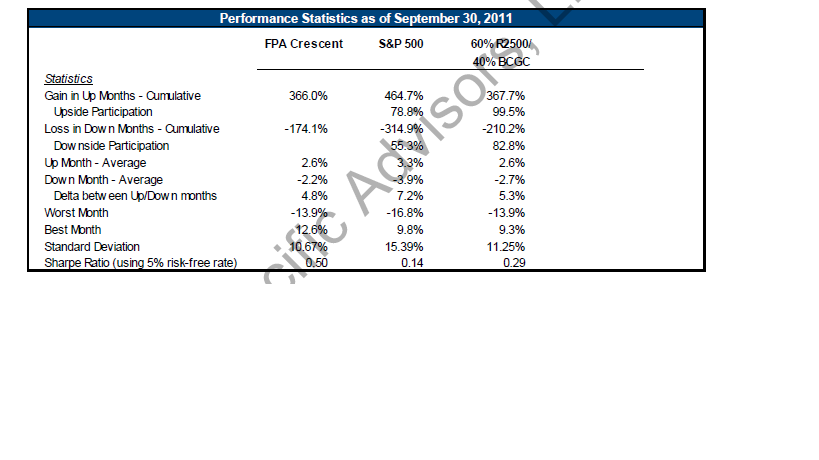
In the current one, they show in the attached slides a very interesting way of presenting performance (page 5).

What they are doing is the following:

– they seperate up and down months in a first step
– in a second step they look how much they particpate in up periods and how in down periods
– the goal over the long run is of course to participate relatively more in up periods than in down periods

For me this is very interesting, as their investment style is very similar to my own strategy.

Unfortunately, I have only 10 months of data, but here are the monthly performance numbers against the Benchmark:

Start Jan Feb Mrz Apr Mai Jun Jul Aug Sep Okt
Bench 6394 6567 6645 6559 6833 6645 5646 6486.69 5504.92 5154.68 5667.92
Portfolio 100 101.46 102.49 103.92 105.07 101.23 95.35 99.03 91.73 92.75 95.46
Perf BM   2.7% 1.2% -1.3% 4.2% -2.8% -15% 14.9% -15.1% -6.4% 10%
Perf Portf.   1.5% 1% 1.4% 1.1% -3.7% -5.8% 3.9% -7.4% 1.1% 2.9%

In the first 10 months of 2011, the benchmark had 5 down months and 5 up months whereas the portfolio had 7 up months and only 3 down months. So far so good.

Howver if we look at the cumulated numbers:

 
Cum Months up  
BM 33%
Portf. 10.4%
Participation: 31.52%
   
   
Cum months down  
BM -40.6%
Portf. -14.4%
Participation: 35.47%

One can clearly see, that the relative “particpation rate” in down months is higher then in up months.

I interpret this as follows:

– the portfolio outperformed, because it was more defensive than the benchmark and the benchmark went down.
– However, if the benchmark would have been zigzaging and ending flat, I would have most likely underperformed

I am not sure where this comes from, but one of the reasons could be the short side. The short of the momo stocks actually added volatility in the down months because those stocks where outperforming the BM by a large margin. Usually the short side should reduce volatility.

If we look at the FPA statement in the same presentation they say the following:

So this is something to remember that shorts primarily should help to reduce the volatility. Shorting explicit momentum stocks might not be the best implementation of this goal.

Another reason could be that the portfolio is geared towards special situations, which are expected to “sleep” for some time before they are hopefully “exploding” to the upside.

In any case I will look from time to time into this measure, if I can improve those relative ratios somehow.

Hans Einhell AG (ISIN: DE0005654933) – Undervalued or Value Trap ?

Hans Einhell AG was part of the initial portfolio and is still there, however with 1.8% weight being the smallest position. Although the stock was mentioned briefly in some posts, I haven’t done an “in depth” analysis yet.

Company Profile:
Einhell sells a diverse range of gardening tools and other “do it yourself” tools mainly for “non professional” users. Production ist completely outsourced to China. 40 % of the products are sold in Germany, another 40% in the EU mostly through DIT chain stores like OBI, Hornbach or Praktiker.

The Einhell tools are sold cheaper than brands like Bosch or Black & Decker, however they are more expensive than no-name products. The company strategy as stated in this 2010 sell side research piece is “cheaper than the best, better than the rest”.

In an Investor presentaton from 2010 (only in German), Einhell defends its business model against a pure “importer”.

Stock & Simple Valuation metrics

The listed shares are preferred shares without any voting rights. In total, 1.68 mn preferred shares are outstanding plus 2.094 mn voting shares which are all privately held, most of them by the founding family.

At currently 35 EUR per share and assuming the same price for the voting shares, this would result in a market cap of 132 mn EUR.

Using “traditional” value metrics, the stock looks very cheap which was the main reason for putting it into the portfolio:

 
P/B 0.89
P/B Tangible 0.92
P/E 2010 8.26
P/E trail 12M 7.75
EV/EBITDA 6.71
EBIT/EV 13.02%
P/S 0.36
Div. Yield 2.29%

A quick glance to the earnings of the last 5 years shows relatively stable earnings with a small drop in 2009:

2006 2007 2008 2009 2010 Avg
EPS 4.31 4.42 3.96 2.88 4.24 3.96

Based on those simple valuation metrics the stock looks relatively cheap, so let’s move on to a more detailed analysis.

Stage 1: Replacement Value

As a first step, I routinely eliminate any goodwill and minority interest. This results in the following “tangible” net equity:

Per Share
NAV 39.43
– minorities -0.63
– Intangibles -2.38
Tangible NAV 36.42

Next are the “usual suspects” for direct adjustments, especially:

pension liabilities: Einhell only has a very small amount of pension liabilities (1.2 mn EUR) with relatively conservative discount factors ( no adjustment necessary

real estate: Einhell owns most of the real estate it uses. Gross purchase value of real estate (land and buildings) is 26 mn EUR, it has been written down to currently 10.5 mn EUR. As Einhell doesn’t produce any chemical or otherwise dangerous substances, one could assume that the current market value of these assets is a lot higher than current book value if sold. My conservative standard assumption would be that we can add back 50% of the writedowns or ~8 mn EUR

Other than that I could not locate any special items like “extra assets”, Einhell has a relatively simplye structure with holding only majority owned and therefore consolidated subsidiaries

Now let’s look at additional adjustments required for calculating a “replacement” value::

– R&D expenses: Einhell expenses around 90% of their R&D (~4 mn EUR per year). Although Einhell is not a producer, at least part of this R&D should be viewed as an investment, as a new competitor would need to spend some time and money to gain the same know how like Einhell with regard to this business. As a proxy, I would use 1.5 mn EUR per annum for the last 5 years as “capitalized” R&D

– marketing & branding: For a consumer product company one usually treats some of the marketing expenses as “invetsment”. Einhell however does not spend anything on advertising. Based on personal experience with Einhell tools I would not allocate any value on the Einhell brand.

So putting it all together, we get to the following result:

Per Share
NAV 39.43
– minorities -0.63
– Intangibles -2.38
Tangible NAV 36.42
+ real estat adj 2.12
+ R&D cap 1.99
Replacement Value 40.53

All in all not bad, but at 35 EUR this results only in a very small discount to the Replacement Value of 40.53 EUR. So from a pure asset point of view, Einhell doesn’t look too exciting

Stage 2: Earnings Power Value (EPV)

Now we try to determine, how much cashflow to equity can Einhell generate on a “steady state” assumption. I have a slightly different way to do this. I start with reported operating cashflow and eliminate working capital movements before subtracting “maintenance” capex (as Einhell doesn’t state maintenance Capex, I use the regular depreciation as proxy). I do this to be able to compare cash generated with earnings booked.

Mn EUR 2006 2007 2008 2009 2010
Op. CF 6.585 0.455 13.907 51.111 -7.661
Working capital -13.613 -20.06 -8.031 41.029 -28.508
Op CF w/o WC 20.198 20.515 21.938 10.082 20.847
Capex -4.736 -4.532 -3.612 -3.425 -3.282
Free CF to Equity 15.462 15.983 18.326 6.657 17.565
per share 4.10 4.24 4.86 1.76 4.65

So ingoring working capital, free cash flow to equity is with the exception of 2009 equal or even higher than stated earnings, which could be a good sign.

The average free Cash flow to equity has been 3.92 EUR for those last 5 years. Discounted by an average 10%, this would also imply an intrinsic value somewhere near 40 EUR. I don’t see any reasons here to use a lower discount rate as history shows that there is significant volatility in Einhells cashflows.

But coming back to the Working Capital issue:

Over those 5 years, Einhell has produced 74 mn EUR free cashflow to equity. Over this 5 years, the cash has been used as follows.

– 13.3 Mn EUR as dividends to shareholdes
– Accumulated cash 20 mn EUR
– 30 mn increase in working capital
– the rest (10 mn EUR) went into smaller acquisitions

So only less than 20% of the free cash flow has been distributed to shareholders, whereas 40% went into the build up of working capital. Management has also indicated that 20% of net profit is their goal for dividends, so even with 5 EUR EPS one would only get 1 EUR or less than 3% in divídends.

If we look into the 2011 half year report, we can see that during the year the situation is even worse, the cash position has shrinked from 44 mn EUR at year end to only 6 mn at June 30th. This clearly shows that working capital requirements during the year are higher than at year end and therefore year end cash balances should not be deducted from any valuation efforts.

Net working capital at half year amounts an astonishing 175 mn EUR, 10% less than sales in the first half year.

This cash conversion cycle of ~6 months is described in the before mentioned research report:

Einhell usually converts inventory into cash in approx. 200 days. After having received orders for a number of different products from the subsidiaries or by clients directly. Einhell’s trading company in Hong Kong bundles orders and passes these on to the factories in China.
Depending on the product and batch size, manufacturing usually takes between six to eight weeks. After receiving the products for shipment Einhell pays its creditors i.e. factories in approx. 20 days. Including shipping time of 3-4 weeks the average inventory turnover is approx. 4 or 90-100 days. With DSO being ca. 65 days this means that inventories are recycled to cash in approx.
six to seven months.

So the big problem for Einhell is the fact that it has to pay its producers within 20 days, but receives the cash much later. With this business modell, every Euro growth in sales increases capital requirement by 50 cents.

As Einhell doesn’t want to or can’t use operational leverage (trade financing etc.), depending on the realised margins (4-5% net) and capital cost, any growth in Einhell could actually destroy value for the shareholder.

Unfortunately, there seems to be no catalyst for any change in the financing structure.


So summarizing the whole case in a couple of bullets we get the following result:
– Replacement Value and EBV are both around 40 EUR, shares are only slightly undervalued
– current business model with high working capital requirements financed mostly through equity does not create value after cost of capital
– free cash flow to equity has to be used mostly to finance increasing working capital requirements, a significant increase in dividends seems highly unlikely
– due to minority status of preferred shareholders, no catalyst (take over, activist etc.) is on the horizon

In my opinion, despite the cheap valuation from a “traditional” pont of view, Einhell does not offer a sufficient Margin of Safety. The risk of ending up with a typical “Value Trap” is not remote. The remaining position will be sold.

WGF – Halbjahresbericht und Genußschein

Nachdem in den Kommentaren zum ursprünglichen WGF Post auf den Halbjahresbericht hingewiesen wurde, habe ich mir mal den Zwischenbericht per 30.06.2011 angeschaut.

Wie schon im ersten Post angemerkt, kann man fundamental beim AG Bericht rein gar nichts erkennen, man sieht z.B. nicht wie hoch die Mieteinnahmen der Objekte sind, wie die Immobilien bewertet sind, wie hoch die Leerstände sind o.ä.

Auch die Objektpräsentation bringt einen keinen Schritt weiter.

Was man sieht ist, dass auf AG Ebene die Zahlen ziemlich grausam sind. Das Eigenkapital ist von 11 mio. EUR um mehr als die Hälfte auf 4,5 Mio. EUR geschrumpft.

Interessant ist dieser Satz aus dem Bericht, das zeigt schon ein wenig Humor:

Das Ergebnis vor Zinsen und Steuern (EBIT) in Höhe von -5,42 Mio. Euro stieg um 1,12 % zum Vorjahresberichtszeitraum (-5,36 Mio. Euro).

Aha, man hat also mehr verloren als im Vorjahreszeitraum, aber trotzdem ist man der Meinung dass das Ergebnis gestiegen ist ????

Die positive Seite darf aber nicht vergessen werden: immerhin wird darauf hingewiesen, dass die demnächst fällige Anleihe zurückgezahlt werden soll.

Kommen wir zu den Genußscheinen. Was ich schon mal komisch finde ist die Tatsache, dass das Genußrechtskapital in der Bilanz nicht separat ausgewiesen ist.

Es gibt anscheinend zwei, einmal den “alten” der an der Börse momentan ungefähr zu 60% gehandelt wird:

Der Neue hat über den Coupon hinaus anscheinend noch eine Gewinnbeteiligung. Interessant ist was auf der Beschreibungsseite dazu gesagt wird:

Seit dem 30.06.2011 läuft die Zeichnungsphase des neuen WGF 8 % Premium Plus Genussscheins (WKN: WGFH91). Anleger können ab sofort dieses hoch attraktive Wertpapier mit einer Rendite von bis zu 8 % zzgl. erfolgsabhängiger Komponente zeichnen. Dank eines transparenten Geschäftsmodells sowie der geplanten Verwendung der eingeworbenen Gelder zum Kauf werthaltiger deutscher Immobilien grenzt sich der WGF 8 % Premium Plus Genussschein wohltuend von vergleichbaren Finanzprodukten ab.

Hmm, also besonders transparent finde ich die Nichtveröffentlichung eines konsolidierten Abschlusses nicht.

Weiterhin interessant ist dieser Passus:

Während der Zeichnungsphase des Genussrechtskapitals ergibt sich der Bezugspreis aus der Einzahlungstabelle. Der Bezugskurs berücksichtigt die Tatsache, dass Anleger, die bis zum 30.06.2012 WGF Genussscheine erwerben, am 01.07.2012 ihren Gewinnanteil für das Geschäftsjahr 2011 ausgezahlt bekommen. Nach Abschluss der Zeichnungsphase, voraussichtlich am 30.12.2011, sind die Genussscheine an der Börse Düsseldorf zum jeweiligen Börsenkurs erhältlich.

Laut der verlinkten Tabelle muss man aktuell 102,3% für diesen Genußschein zahlen. Der Vorteil des “neuen” Genußscheins ist folgender:

Das Plus an diesem Produkt ist die Bonusausschüttung in Höhe von 15 %, des nach Abzug der Vorabausschüttung verbleibenden Bilanzgewinnes, welche die Genussscheininhaber für jedes Geschäftsjahr innerhalb der Laufzeit erhalten.

Als Neuanleger sollte man sich mal überlegen, wie hoch dieser Gewinnanteil ausfallen muss, damit ich bei einem Kurs von 102,7% genausogut weg komme wie mit dem “alten” schein zu 60& über die Börse.

Als Genußscheininhaber hat man natürlich ein kleines Problem: Der Genußschein partizipiert ja voll am Verlust. D.h. bei einem Verlust fällt nicht nur der Coupon aus, sondern es wird auch der Nennwert herabgeschrieben.

Wer jetzt den Genußschein kauft (oder hält) muss schon sehr optimistisch sein, was die Bilanzierungskünste der Gesellschaft angeht.

Das Risiko kann man sich auch so verdeutlichen: bei momentan 1,7% Eigenkapital (und einem hebel von 59x) muss der Wert der Immobilien nur um 0,02% sinken und schon ist das Eigenkapital futsch.

Fazit: Jeder der den Genußschein der WGF hält oder kaufen will sollte sich schon sehr genau überlegen, wie hoch die Wahrscheinlichkeit ist einen Coupon zu bekommen. der Kurs des gehandelten Genußscheins scheint zumindest einige Zweifel daran auszudrücken. In Anbetracht des Kurses des alten Scheins von ca. 60% scheint der neue zu 102% kein besonders guter Deal zu sein.

Best Ideas Summaries Part 1: Draegerwerk Participation Rights (ISIN DE0005550719)

One of my best investment ideas at the moment are the Dragerwerk “Genußscheine Serie D” (ISIN DE0005550719)

Draegerwerk produces medical devices, safety and aerospace equipment. Draegerwerk has managed to achieve a remarkable turnaround which resulted in a very strong performance of the shares

They have a fairly complicted capital structure, with normal voting shares, preferred shares and participation rights.

The most liquid securities are the Non-Voting Preferred Shares which trade at the following multiples:

Price/Book 2,2
Price/Sales 0.61
Trailing PE 15.3
EV/EBITDA 6.1
Dividend Yield 1.48%

They are up YTD 34.2%, making them the 4th best perfomer in the German Top 100 HDAX.

The numbers above don’t look too compelling, so what’s the deal here ?

So now let’s look at the “Genußscheine”: Draegerwerke has issued 3 different series, the most liquid beeing the “D series” (ISIN DE0005550719).

In contrast to “regular” German style particpation rights which are more like a subordinated bond, they have some special features:

– they don’t have a fixed coupon or nominal value
– instead they simply pay 10 times the dividend of the Preferred Shares
– they cannot be called or cancelled. In the initial terms the only way to redeem them by the issuer was to exchange them into 10 Preferred shares
– in the case of a capital increase holders will be “compensated” for dilution in the form of cash (no new participation rights)

The last point raised some issue when Draegerwerk issed new shares in 2010 in order to pay for an acquisition (50% of an existing Joint venture with Siemens). in my opinion they paid out the fair amount, however with a 9 month delay.

To sum up the situation: The so called “Genußschein” is very similar to a preferred share, the main difference being that it pays 10 times the dividend.

Now the “Genußschein” currently trades at around 160 EUR which is roughly 2.0 times the price of a preferred share.

Or put it differently, through the Genußschein one could gain exposure to Draeger at the following multiples:

Price/Book 0.44
Price/Sales 0.12
Trailing PE 3.1
EV/EBITDA 1.2
Dividend Yield 7.5%

Now this looks like a value investment to me. There are two ways to play this:

1. Outright Ivestment
2. Relative Value long / short

For the Blog Portfolio, I have combined the long position in the “Genuscheine” with a short Position in the Preferred Shares in order to establish a “market neutral” position while harvesting the positive carry of 8 preffered dividends (short 2 shares /dividends, long 10 dividends).

As one could see, the are not perfectly correlated, so a long short position requires some “buffer” for diverging prices:

Over the medium term, the Genußscheine should perform better than the Preferred shares, especially if Drager further raises the dividend. If I were the CFO or Treasurer of Draeger I would be desperate to buy back the Genußscheine at the current level, so we could see some tender offer going forward.

Summary: Although the Dragerwerk Genußscheine are not called shares, they offer the same Exposure to Draegerwerk than the widely held Preferred Shares at a 80% discount. A long Genußschein / short Preferred share position offers a interesing risk / return profile with a nice carry.

Wie findet man interessante Value Investments Teil 2: Erster Filter für Contrarian Investments

In Teil 1 hatte ich ja beschrieben, welche grundsätzlichen Möglichkeiten man nutzen kann um auf interessante Werte zu kommen.

Hat man sich z.B. durch ein erstes Screening eine Liste erstellt, muss man nun im 2ten Schritt versuchen, die Werte etwas einzugrenzen.

Aus meiner Sciht gibt es hier aber ähnlich wie in Teil 1 keinen allgemein gültigen Filter, sondern man muss abhängig von der jeweiligen “Kategorie” (Compounder, Contrarian, Special situation) vorgehen.

Im Folgenden möchte ich mich auf “Contrarian” Value Aktien konzentrieren.

Ein guter Screener für Contrarian Investments ist z.B. der Magic Sixes Screen.

1. Filterstufe: Market Cap, Branche, und “aberwitzige” Bewertungen

Obwohl ich durchaus ein Freund von Small Caps bin, lasse ich Werte mit einer Marketcap unter 1 Mio. EUR erstmal aussen vor, hierbei handelt es sich meistens um irgendwelche “fast pleite” Unternehmen. Für so etwas ist mir die Zeit zu schade.

Da ich bei den Contrarian Investments echte, aus der Mode gekommene operativ tätige Firmen suche, lasse ich auch alles weg was nach Finanz- und Immobilienholdings aussieht. Das könnte zwar auch eine Special Situation sein, aber eben kein Contrarian Investment.

Als letztes schaue ich mir in der Regel auch Unternehmen z.B. mit einem KBV von 0,1 oder Dividendenrenditen von 50% und mehr erst an, wenn ich sonst nichts weiteres finde, weil das auch eher “Specal Situations” oder potentielle Value Traps sind.

2. Filterstufe: Historische Bewertung / Entwicklung

Anmerkung: Für diese Schritt benutze ich ein Excelsheet mit Bloomberg Link, vmtl. kann man aber auch einen Servive wie MSN nutzen

Hier schaue ich mir v.a. an:
– KGV 10 (d.h. aktueller Kurs geteilt durch den durchschnittliche Gewinn der letzten 10 Jahre)
– Entwicklung der Netto- Verschuldung über die letzten 10 Jahre
– Entwicklung des Buchwertes pro Aktie über die letzten 10 Jahre
– Entwicklung des Tangible Buchwertes pro aktie
– Entwicklung des Free Cashflows pro Aktie

Ich hatte mal versucht, das alles in einer Kennzahl zu erfassen, aber so ganz happy war ich damit dann doch nicht.

Mittlerweile mache ich das eher “qualitativ”. Raus fallen in diesem Schritt v.a. Firmen bei denen diese 3 Kriterien erfüllt sind:
– der freie Cashflow längere Zeit negativ ist
– die Schulden pro Aktie zunehmen
– der Tangible Buchwert pro Aktie sehr niedrig ist oder stark abnimmt.

Somit konnte ich beispielsweise die Schlotts und Böwe Systechs dieser welt relativ problemlos rausfiltern ohne viel Aufwand in die Analyse rein zustecken.

3. Filterstufe: Qualitativer Schnellcheck

Hier prüfe ich folgende Aspekte:

– wird das Papier überhaupt gehandelt ? Wie groß ist der Freefloat ?
– gibt es auf Basis einer schnellen Google Suche bekannte Corporate Governance Probleme oder Accounting Themen ?
– ist das Unternehmen aus einer bekannten Problembranche (Solar, Internet o.ä.) ?
– wurden in jüngster Zeit viel Übernahmen durchgeführt ?

Wenn eine Aktie diese Kriterien überstanden hat, dann lohnt sich im nächsten Schritt eine detailliertere Fundamentalanalyse (Replacement Value, Earnings Power Value)

Fazit: Bei mir hat sich bislang ein qualitativer “Vorfilter” beim Screenen nach Unternehmen durchaus gelohnt um echte Problemfälle schon ohne viel Analyseaufwand erkennen zu können.

Lesenswertes – Wochenrückblick

Schöner Post über die “Evolution” von Big Short Michael Burry als Value Investor

Auch sehr guter Post zum Anlagestil von Buffet in seinen “Partnership” Jahren

Ein kleiner Blick in den Chinesischen Finanz Untergrund

Sehr interessanter Artikel zum Anlageprozess einer Hedgefonds Managerin

Mal was anderes: Negatives Kursziel für Premier Foods

Bronte zum Thema China Frauds und Analystenratings

Guter Artikel zu den unterschiedlichen Typen von Value Investoren

Historische Fehleinschätzung eine Politischen Ereignisses in einem Marktkommentar des Jahres 1914

EVN – Detailanalyse – Replacement Value

EVN ist ja Teil des “Core Value” Portfolios, ausser ein paar knappen Erwähnungen habe ich aber bislang ja noch keine Detailanalyse durchgeführt, was ich hiermit ändern möchte.

Als Schritt 1 erfolgt standardmässig der Blick auf die Bilanz. Ausgangspunkt ist erstmal der letzte Geschäftsbericht sowie der Aktionärsbrief zum 3. Quartal.

Anmerkung: GJ Ende ist bei EVN am 30.09.2011

Per 30.06. waren 179.878.402 Aktien ausstehend.

Man hat 3.488 Mio EUR Eigenkapital ausgewiesen. Davon sollte man standardmässig die Minorities sowie die immateriallen Vermögensgegenstände abziehen.

Mio. EUR EUR pro Aktie
Equity 3,488 19.39
Min. -340 -1.89
Imm -351 -1.95
Tangible Book 2,798 15.55

Somit kommt man (siehe Tabelle) auf 15,55 EUR Tangible Book pro Aktie was schon mal sehr erfreulich ist. Bei RWE beispielsweise ist dieser Wert negativ.

Als nächstes der Blick auf die Pensionsrückstellungen:

Die bilanzierten Rückstellungen betragen 235 Mio, lt. GB Seite 79 war man ungef- 20 mio unterreserviert. Vorsichtshalber rechnen wir mal mit 30 Mio. EUR Abzug

Spannend wird es jetzt natürlich im Anlagevermögen.

Beim “normalen” Anlagevermögen hat man von den insges. 6,2 Mrd. EUR Anschaffungskosten mit 3,5 Mrd. EUR mehr als die Hälfte abgeschrieben. Da könnte einiges an zusätzlichem “Relacement” Value drin stecken, aber vorsichtshalber nehme ich nur die halben Abschreibungen aus Grundstücken und Gebäuden als Adjustierung auf, also ca. 150 Mio EUR positive Adjustierung

Kleiner Exkurs: Wie ich vor kurzem erfahren habe, läuft eine gute KSB Kraftwerkspumpe durchaus mal 50 Kahre oder mehr, d.h. auch in der “technischen” Ausstattung könnten stille Reserven liegen.

Als nächstes sollte man sich die “at equity” bilanzierten Beteiligungen i.H. von 844 Mio EUR (Q3) anschauen. Hier verbergen sich oft “Extra Assets” wie im Beispiel Autostrade.

Bei “at Equity” Bewertung bestimmt sich der Wertansatz ja nicht am Marktwert oder Anschaffungswert, sondern am anteiligen Eigenkapital. Der Wertansatz erhöht sich dann um das anteilige Ergebnis abzgl. evtl. gezahlter Dividenden. Dazu kommen natürlich dann Käufe oder Verkäufe.

Auf Seite 72 des Geschäftsberichtes findet man die Gesamtzahlen. Einem Anfangswert zum GJ Ende von 670 Mio steht ein anteiliger Gewinn von 61,6 Mio. gegenüber, davon sind 54 Mio als Dividende geflossen. Das entspricht in der Bewertung einem KGV von 11 bzw. einer Dividendenrendite von 8%.

Auf Seite 95ff kann man sich anschauen, welche Beteiligungen darunter fallen. Liest man sich das so durch, dann kann man sich vtml. einen ganzen Tag damit beschäftigen.

Die interessanteste Gesellschaft ist sicher die “Rohöl Aufsuchungsgesellschaft” oder RAG. Näheres kann man hier und hier nachlesen. Saudi Arabien mitten in Österreich sozusagen. Interessanterweise konsolidiert man anscheinend die Beteiligungsgesellschaft, aber nicht die Gesellschaft selber. Wer hätte gedacht, dass EVN ausser Stromerzeugung auch noch Öl und Gas fördert und Gaslager betreibt.

Ich behaupte jetzte einfach mal, dass die Dividendenzahl von 54 Mio EUR relevant ist und nehme mal an, dass 6% Dividende eine faire Bewertung ist, dann komme ich auf einen fairen Wert der “at Equity” Beteiligungen von (54/0.06)= 900 Mio EUR oder +230 Mio EUR vs. Bilanzansatz vom GJ Ende.

Kommen wir damit gleich zur nächsten interessanten Position, den “sonstigen Beteiligungen”. Hier versteckt sich nämlich die allseits bekannte Verbund Beteiligung. Verbund wird “mark to market” bilanziert, die Kursveräderung wird gegen das Eigenkapital gerechnet, im Ertrag wird nur die Dividende gezeigt.

Insgesamt hält EVN 13,1% an Verbund, das sollten bei insgesamt 347 Mio Aktien dann 45,15 Mio Aktien machen. Zum aktuellen zeitpunkt bei 22,10 EUR pro Aktie ergibt das einen Wert von derzeit ca. 998 Mio EUR, zum Zeitpunkt des Quartalsberichts waren das noch 1.226 Mio EUR, d.h. hier muss man aktuell -228 Mio EUR vom “Replacement Value” abziehen.

Zuletzt noch die Position “übrige langfrisige Vermögensgegenstände”. Hier verbirgt sich auch was interessantes, nämlich “Leasing Forderungen”.

Die Erklärungen sind extrem kryptisch:

Die Forderungen und Abgrenzungen aus Leasinggeschäften stammen aus dem Projektgeschäft im Rahmen von BOOT-Modellen.
Aus laufenden Fertigungsaufträgen bestanden Forderungen in Höhe von 152.837,8 Tsd. Euro (Vorjahr: 54.444,5 Tsd. Euro). Die EVN
hat am 10. Dezember 2009 mit der OÜ Tabrin, Tallinn, Estland, und ihren ungarischen Tochterunternehmen Budagep-Budalux Kft.
EVN Zahlen, Daten, Fakten 2009/10 73
Erläuterungen zur Konzern-Bilanz Konzernanhang
Aktiva
und Budapro Kft., beide mit Sitz in Budapest, verschiedene Verträge zum Eintritt in den schwebenden Vertrag über die Realisierung
des Projekts zur Organisation der Finanzierung, zur Errichtung und zum Betrieb der Müllverbrennungsanlage Nr. 1 in Moskau geschlossen.
Bei der Gegenleistung für den Eintritt in den schwebenden Vertrag handelt es sich im Wesentlichen um die Aufwendungen
für den Erwerb des Auftragsbestandes in Höhe von 75.694,5 Tsd. Euro. Dieser Wert ist – neben den laufenden Umsätzen aus
Fertigungsaufträgen – in den Zugängen zu den Forderungen und Abgrenzungen aus dem Leasinggeschäften enthalten. Ebenso in
den Zugängen sind aktivierte Fremdkapitalkosten in Höhe von 251,6 Tsd. Euro (Vorjahr: 724,2 Tsd. Euro) enthalten. Der Aktivierungszinssatz
betrug 1,63 % – 4,60 % (Vorjahr: 4,60 % – 5,90 %).

Geht man davon aus, dass diese Leasingforderungen werthaltig sind, kommen wir insgesamt auf folgenden Replacement Value:

Mio. EUR EUR pro Aktie
Equity 3,488 19.39
Min. -340 -1.89
Imm -351 -1.95
Tangible Book 2,798 15.55
– Pensionsdefizit -30 -0.17
+50% AFA G&G 150 0.83
+at Equity 230 1.28
– abzgl MtM Verbund -228 -1.27
Replacement Value 2,920 16.23

Fazit: Auf Basis des Replacement Values wäre ein fairer Wert für EVN leicht über dem Tangible Book bei aktuell ca. 16,23 EUR pro Aktie. Das wäre schon mal eine ordentliche Upside von 6 EUR oder knapp 60% auf Basis des aktuellen Kurse. Im Gegensatz zu EON, RWE und Co. ist hier der Kurs in Form von “harten” Assets her gut nach unten abgesichert.

« Older Entries Recent Entries »