Category Archives: Uncategorized

Gaztransport & Technigaz (GTT.FP) – Wide Moat at a bargain price ?

Imagine you could invest into a company with the following characteristics:

– Global market leader with 70-90% market share (95% new built)
– Net margins after tax of 50% or more
– business protected by patents
– almost no capital requirement, negative working capital
– a potentially huge growth opportunity
– conservative balance sheet (no debt) and “OK” management
– at a very reasonable price (11x P/E, 7,8% dividend yield)

At a first glance, Gaztransport et Technigaz (GTT) from France seems to be the ideal cheap “moat company”. What do they do ?

Gaztransport is the global leader for “LNG containment systems”. LNG is liquified natural gas and is the predominant method to transport natural gas over long distances. In order to become liquid, natural gas has to be really cold,at least -162 degrees celsius. GTT’s technolgy is required to safely store and transport LNG on ships.

Problem Number 1

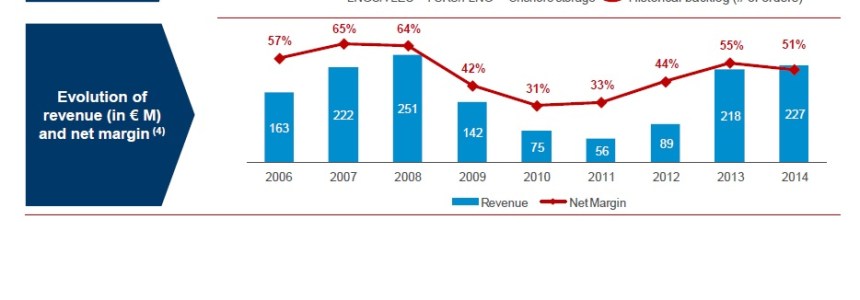
Before going into more details, it is pretty clear that GTT is an energy related company. But looking at this chart from their investor presentation we can clearly see what the real problem for GTT is:
gtt sales profit

Ultracyclical sales. We can see that within 4 years sales dropped -75% only to quadruple again in the next 4 years. Although the overall strength of the business model clearly shows in the fact that even after a -75% drop in sales, they still earned a 30% net margin.

So what do they actually do (The Moat) ?

Gaztransport has been IPOed in 2014 in France (although it was technically more a “carve out” as the company itself did not need any money. They have extremely good English language investor material, for instance the Q3 2015 report.

I try to summarize their businessin my own words:

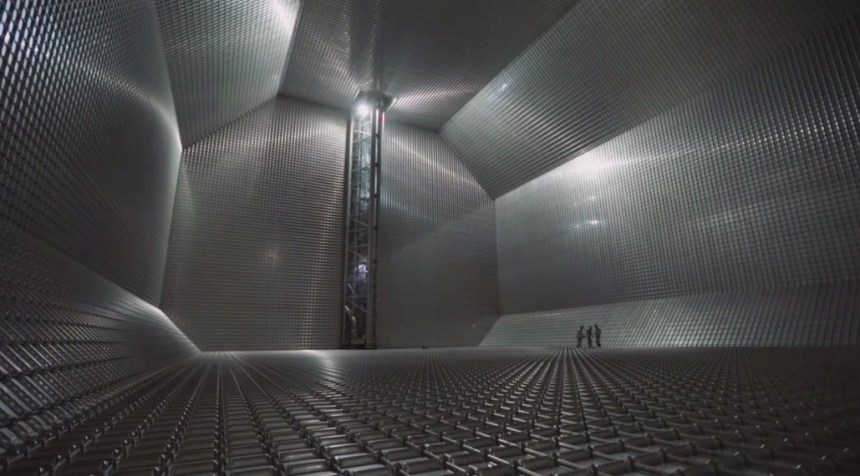
– if you want to build ship to transport LNG, there are effectively only 2 technologies available to ensure that the LNG is contained safely, one of them is owned and patented by GTT. From inside it looks like this:
lng-containerment-tanks
– there is a relatively large moat with regard to technology. GTT has developed that technology over the last 50 years or so and it is superior to the only competitor (“Moss”), both in price (for the total ship) as well as in utility (ships are lighter, easier to maneuver, overall cost is cheaper)
– GTT charges royalties, both, for the technology and “consulting” during the building of the ship. After the ship is finished, there are no royalties. Service is currently only a single digit percentage of sales
– Sales therefore directly depend on the number of LNG tankers being build
So the future of GTT clearly depends on the future of LNG. More LNG means more ships and more money for GTT and vice versa.

The Moat vs. new competitors

There are potential new competitors, mostly the handful of Korean companies who actually build the ships. The Koreans for some time now try to develop or copy their own version of the technology. I assume that they clearly know how much money GTT makes with the patent and that they woul love to cut GTT out of the process.

GTT themselves think that the threat is not so big in the near future. The ship certification companies would need to approve first as well as the oil companies who are finally responsible for the LNG tankers and the administrators of any harbour or docking station.

So far in the 50 year history both, Moss and GTT have a 100% safety record with no accidents. The cost for GTT technology within the overall price of a LNG tanker is around 4-5% of the total constructon price. So the question is really why should any energy company take on the risk for a new unproved technology when the potential cost savings are pretty low ? LNG Tankers do carry the equivalent “firepower” of dozens of nuclear bombs, so risk aversion is pretty high especially in developed world harbours.

The LNG market

There is a lot of material on LNG but most of them are very optimistic, some links:

BG LNG Global market outlook
McKinsey LNG study

Again in my own words my thoughts on LNG:

– LNG is considered “clean fuel” compared to oil and coal and should benefit from climate issues
– Natural gas is abundant and in many cases cannot be transported via pipelines
– A lot of the natural gas comes from “stable” countries like Australia and the US and is therefore strategically interesting

But clearly, low energy prices take a toll on LNG as the liquification, transport and regsification are expensive. A year ago I looked at Seth Klarman’s investment Cheniere Energy and I was not convinced. However a lot of money has been now invested into liquification facilities especially in the US and Autralia, so it is not unlikely that the amount of LNG to be transported might rise as projected and the need for transport and storage increases.

So just some rosy LNG projections alone would not be enough to make GTT interesting for me.

The “carrot on the stick”: Bunker fuel

Big Ocean going ships burn a fuel called “bunker” which is extremely filthy:

As ships get bigger, the pollution is getting worse. The most staggering statistic of all is that just 16 of the world’s largest ships can produce as much lung-clogging sulphur pollution as all the world’s cars.
Because of their colossal engines, each as heavy as a small ship, these super-vessels use as much fuel as small power stations.
But, unlike power stations or cars, they can burn the cheapest, filthiest, high-sulphur fuel: the thick residues left behind in refineries after the lighter liquids have been taken. The stuff nobody on land is allowed to use.

In the meantime however, stricter requirements for ship fuel have been installed. Current caps are mostly effective in Europe and North America, but starting 2020, globally much tighter rules will come into effect.

There are several possible solutions to the problem:

– using cleaner fuel which is however more expensive and limited
– cleaning the exhaust with expensive technology
– use LNG as alternativ fuel

If LNG would become popular in the future, GTT’s technology would suddenly be required everywhwere, from every port and every big ship, which would mean much more steady business than in the past and a strong structural growth over many years.

However, at current prices this is far from a sure thing, so in any case as an investor I would not want to pay for this at the moment.

Click to access 213-35922_LR_bunkering_study_Final_for_web_tcm155-243482.pdf

Stock Price

For an energy stock, GTT has held up quite well since their IPO until late 2015 but then got hammered, howevr as we can see less than TGS for instance:

gtt chart


How to value GTT ?

The problem is the following: GTT is a cyclical company and we are most likely at or near the top of the cycle with regard to the “core” business. One could argue that with an overall size increase of the LNG tanker fleet, the replacement requirement increases but with an expected life of around 40 years, the replacement cycle  for the current fleet is a long way off in the future.

So using current profits and saying” Wow the stock is cheap” clearly doesn’t help. Comparing it for instance with a less cyclical stock like G. Perrier and saying: 11x PE is better than G. Perriers 15x PE is nonsense.

As I said before, I would not be willing to pay for the “Option” of LNG powered shipping so I need to come up with a way to value the company based on the cyclicality of earnings.

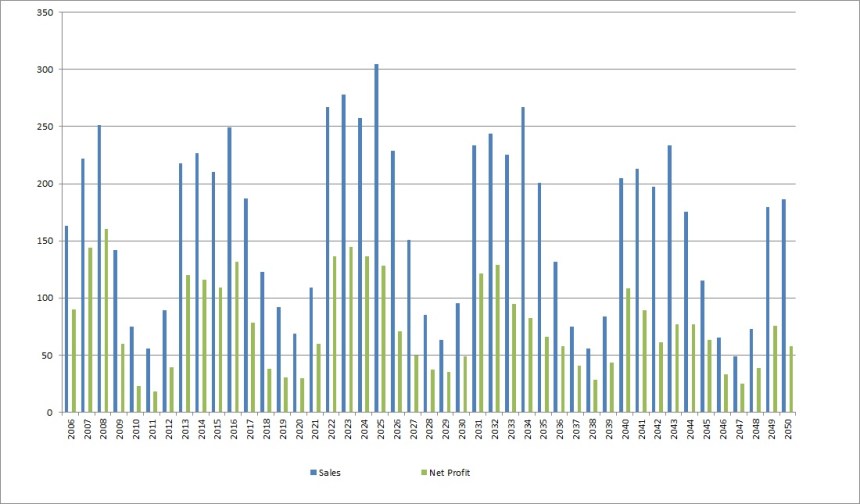
So what I did is that I tried to “simulate” future earnings with roughly the same kind of cyclicality that we have seen in the past 10 years. This is the resulting “Model” for the next 35 years:
gtt earnings

I have “modelled” somehow similar cycles as the current one, with the peaks increassing first and then trailing of somewhat in the future.

We can then discount this cyclical earnings stream by our “required rate of return” to see if GTT is a real bargain or not.

Under those assumptions my results were the following:

10% discount rate: 20,80 EUR per share

15% discount rate: 14,26 EUR per share

So now one could clearly challenge my “model” and tweak it somehow, but in general it looks like that GTT is not a bargain at current prices (34 EUR). To me it rather looks like that the current valuation already implies a certain value for the LNG ship fuel “option”. Therefore GTT at current prices is not interesting to me as an investment.

One important learning experience for me is that I guess one should value all cyclical stocks like this, i.e. really model the cycles and discount those cashflows instead of just looking at current multiples and say “wow that’s cheap”. I think I made that mistake to a certain extent with TGS Nopec.

Summary:

Overall, GTT is a very interesting, unique company. It combines a “wide moat” with regard to technology and patents with a very cyclical business.

Although the company looks cheap at current multiples, over the cycle there is more downside than upside at current prices in my opinion.

If LNG will become the dominant fuel for ships in general, than the investment case might change significantly to the upside but for me this is not given at current energy prices.

In the future, I will need to analyse and value cyclical companies the same way as I did here: With actually modelling cycles instead of (implicit) constant growth assumptions.



Book review: “The Shipping Man” – Matt McCleery

51vjqba-hnl-_sx310_bo1204203200_

This is a book reader “JJ” recommended to me somewhere in the comments. Its a very unique book as it says “A novel” on the cover but in effect is the best book I have read about the shipping industry.

The story is about a NY based hedge fund manager who decides that he wants to own a ship. He buys an old ship with his personal money from a strange Greek guy and then gets into the world of shipping. Along the way he loses his hedge fund, encounters many problems and sells his ship with a lot of luck at a profit.

By pure coincidence he ends up as the CEO of a Norwegian Oil Tanker company and tries to raise senior debt funding at Wall Street.

The book seems to be at least partially autobiographic. What I really liked about the book is that despite telling a funny and readable story, the author also manages to include many great insights on the shipping industry specifically and financing, cost of capital and other financial aspects of Wall Street along the way. 

One of the key messages is that financing ships economically sucks because a lot of the players think quite uneconomically. They want to have the biggest ships or the biggest fleet and always manage to lure in many gullible investors on the way. The whole industry seems to be like a big casino where some insiders always get their cut and all the oher “players” lose in the long term by design.

Actually I do think that the same principle applies for any other very capital intensive businesses.

Anyway, I can highly recommend this book. It is a good read and interesting for anyone who has ever thought about investing into something related to shipping.

At least for me, I am now completely “healed” from even looking into shipping companies or Off-shore drilling etc.


Some links

Muddy Waters is short Casino and thinks parent Rallye is worth zero. Good that I filtered Rallye out quickly. Last year, Rallye was still presented as a “value investment” (Never buy a story)

The Brooklyn Investor takes a look at Ametech, a stock held by Lou Simpson

A hard value investing lesson from the Oil & Gas sector

The big Fintech bubble already shows some weakness

John Hempton’s (Bronte) somehow sceptical November report

Finally a video of a lecture from “deep value” guru Peter Cundill (2005)

.

Book review: “Think like a Freak” (Levitt/Dubner)

think like a freak


“Think like a Freak” is not an explicit  finance book. I had read both predecessor books and I liked the original “Freakonomics” a lot, the second book not so much.

For those who haven’t read them: The Freakonomics books look at how every day life and real life problems can be explained by economic variables like incentives etc. often with very surprising and not really obvious connections.

The third book in my opinion is very good. They want to encourage readers to “think like a Freak”. This means among other things, trying not to tackle big problems head on but trying to solve little problems that might then have large effects or do things differently. And mostly the way to solve those problems is very unique.

One example for instance was David Lee Roth (the singer of Van Halen) who was famous for demanding a very detailed list of things for his concerts, among others a bowl of Smarties but without the brown ones.

The reason for this seems not to have been pure vanity but a test if the people organizing the concert halls actually had also read the other stuff, especially with regard to the technical equipment. So the first thing he did when he arrived at any stage was to check the Smarties bowl. If the brown ones were still in, they directly went to checking all the equipment really thoroughly, in order to make sure that everything really worked. If the brown Smarties were out, they just made a standard test and saved a lot of time and effort.

Interestingly, I actually could make a connection to investing when I read the book.

I do think that value investing is actually very similar to “Invest as a freak”. As a value investor, you don’t really care about the big problems like “will the stock market go up or down”, “what will GDP growth be” etc. Rather you concentrate on “small” problems, looking at company by company without caring so much about the “big picture”.

I think it is also important for an investor to develop some kind of “brown Smarties” test similar to David Lee Roth. For me for instance this is the comprehensive income line. If I see something strange there I know I have to be really really carefull when I further analyze the stock.

Anyway, even without making the connection to Value Investing, “Think like a Freak” is a very entertaining book. HIGHLY RECOMMENDED !!!


Romania update: Electrica (great !!). Romgaz (so so) & new Prime Minister

Romania new Prime Minister

A few days ago, following the fatal fire in a Bucharest nightclub, prime minister Ponta surprisingly resigned following massive protests on the streets.

Interestingly, instead of quick new elections, a “technocrat” Government was nominated, lead by a former EU commission member.

He has nominated young and independent experts for the key portfolios of the economy, justice, foreign office and health.

Ciolos selected Anca Paliu Dragu, an economic analyst at the European Commission, to take over the Finance Ministry and Cristina Guseth, chief of Freedom House Romania, as Justice Minister.

On the other hand, experienced diplomat Lazar Comanescu was proposed as Foreign Affairs Minister, while Mihnea Motoc, Romania’s ambassador to Britain, was nominated as Defence Minister.

The Economy Minister will be businessman Costin Borc, and sociologist Vasile Dancu will have the role of Minister of Regional Development.

Political commentators saw the proposed government as pro-reform.

Up until now there was a political deadlock between the newly elected president Johannes and Socialist Ponta.

It reminds me a little bit of Mario Monti’s technocrat government in Italy which came into power after Berlusconi was forced out in 2011. Most of the Italian reforms were made in that short period of time. Before and after, not much has happened there. So from an outside view I would consider this whole episode as a step into the right direction.

Now to my 2 Romanian holdings:

Romgaz

Romgaz released 9 month numbers already some days ago. The good news was that the presentation looks more professional than before, the bad news is that sales and profits went down by slightly more than -10% against 9M 2014. Additionally they had exceptional write-offs on receivables and exploration assets.

Interestingly, margins remained pretty stable, helped by the underlying price increases that will bring the local prices up to market prices over several years.

They also made a regulatory filing which already contains a detailed projection for the 2015 profits and dividends. Based on that projection, the 2015 profit will be 1.032 mn Lei or ~ 2,67 Lei per share, significantly lower than the ~3,60 lei for 2014.  However in my opinion, this sounds worse than it actually is. It seems to be that current Nat Gas consumption in Romania has declined, I honestly don’t know why. But as the local Nat Gas prices at the moment are still very low and supposed to rise, that means that the gas which has stayed in the ground and not sold is getting more valuable. So I think the issue of the lower sales volume has only a limited effect on the value of the company as those reserves then can be sold higher in the future. So my initial valuation of Romgaz from a year ago is still valid.

The share price clearly has suffered but less than other energy stocks. Interestingly, Fondul Propritatea dumped 4% of Romgaz a few days prior to the release which, looking back now seems to have been “very fortunate” for them.

Anyway, for me Romgaz is still in the early phase of the investment period and for me there is no reason to change anything

Electrica

Electrica also released Q3 numbers a couple of days ago. In contrast to Romgaz, Electrica’s numbers were excellent. The 9 month profit is already higher than the total 2015 profit I estimated last year in my initial case. The increase came exclusively from the distribution side which is very positive.

Additionally, Fondul Propritatae seems to have reopened negotiations on the minority stakes in the three operating companies. If Electrica could buy them at a valuation close to their own stock, this could create a lot of value for shareholders.

Overall, I think Electrica is one of my “highest conviction” ideas, the stock is extremely cheap and developing much better than I thought. It might take time until this get reflected in the stock price but I don’t have any reason to hurry.

One interesting detail: One of the supervisory board members had to resign because he became the new energy minister. Maybe this helps a little bit for better relationships with the regulator….


Some links

A look back how Buffett invested into special situations back in 1962

Meb Faber compares investing based on Buffett’s disclosures with the Berkshire stock

Driverless cars’ chances halted by tumbleweed (Paywall, Google for title)

Broyhill Capital likes Sea World

The short case for Union Pacific Railroad

Why a Chinese Billionaire paid for a 170 mn USD art purchase with his Amex

Interesting Michael Bloomberg interview from the Robin Hood 2015 conference:

Fossil (FOSL) – Share buy backs & Management (part 2)

This is a follow-up to my first post on Fossil. The short summary:

Fossil has a good but not great business with some issues, among others the potential success of smart watches. The reason to dig deeper was the unusual combination of CEO/owner with zero salary and capital allocation with a focus on share buy backs.

Share buy backs

There is a great collection of articles on Teledyne and Henry Singleton “available at CS Investing. One absolute gem inside is a classification of stock buy backs in order of usefulness to shareholders from Hedge Fund Honcho Leon Cooperman:

Read more

Globo – without further comments

From Globo’s website:

FOR IMMEDIATE RELEASE

GLOBO plc

(“Globo” or “the Group”)

Company Statement

Globo plc issues the following statement:

On Friday 23 October 2015 the Board of Directors of the Group became aware of a report published by Quintessential Capital Management (“QCM”).

Following the announcement by the Company on the morning of Friday 23 October 2015, an emergency Board meeting was convened as soon as practicable for Saturday 24 October 2015 to discuss the allegations in the report and to ascertain the actions that would be required to resolve the matter. It was intended that an appropriate independent forensic accounting team be appointed to investigate the claims.

However, at the Board meeting, Costis Papadimitrakopoulos the CEO of the Group brought to the attention of the Board certain matters regarding the falsification of data and the misrepresentation of the Company’s financial situation, and offered his resignation, as did Dimitris Gryparis the CFO of the Group.

Following the meeting and receipt of legal advice, a committee of the board was set up, comprising the non-executive Directors only (the “Committee”). The Committee has accepted the resignations of Costis Papadimitrakopoulos and Dimitris Gryparis from the Company with immediate effect. Gerasimos (Makis) Bonanos (the COO) has been suspended from his duties with the Company also with immediate effect, pending the outcome of appropriate investigations. All of the executive directors have agreed to make themselves available and fully co-operate with any investigations.

The Committee has initiated discussions with appropriate advisers in relation to the next steps and to ascertain the true financial position of the Company. In addition, the Committee has asked the Company’s lawyers to notify the matter to the appropriate authorities and the Committee has informed the Company’s principal bankers.

Further announcements will be made in due course. In the meantime the Company’s shares will remain suspended from trading as per the dealing notice on Friday 23 October 2015.

Edit: It keeps getting better:

http://www.morningstar.co.uk/uk/news/AN_1445849842100995200/update-globo-ceo-sold-shares-before-resigning-amid-financial-probe.aspx

Globo also said that Papadimitrakopoulos had informed the company that up to last Thursday he has sold 42.05 million shares in the company, and pledged 10 million shares under a personal loan agreement with Lantau Holdings Ltd – a loan that will default at close of business Monday due to two consecutive days of the suspension of the company’s shares from trading.

At Globo’s last quoted price before suspension of 29.45 pence, the share sale would amount to GBP11.9 million.

This means Papadimitrakopoulos’ holding in the company has been reduced from 18.67%, or 69.78 million shares, to 7.42%, or 27.73 million shares. Globo noted that it has requested additional details about these dealings, and does not yet “possess all relevant information about their timing and nature.” It will make a further announcement once this information is received.

Some links

Why fully autonomous cars might not be the future

Great post on Fastenal and if it might become interesting again

A long but very interesting story about Netflix vs. traditional media

Hedge Funds and Renewable Energy Yieldco’s don’t seem to match well

Interesting profile of Lei Zhang, a fund manager who was spectacularily succesful in China (H/T Valuewalk)

“Brandtech” – how Tesla & Co do things differently in order to build their brands

And of course, the Fall 2015 issue of the Graham & Doddsville newsletter (Columbia Business School)

Updates: MAN SE & Sold Trilogiq

MAN SE “Special situation”

In November 2013, I entered a special situation investment with MAN AG, arguing that the proposed compensation payment of Volkswagen might be too low and the court may decide to increase it.

Last week, the Munich court now decided to increase the compensation payment from 80,89 to 90,29 EUR. This is less than some investors hoped for, in the past 100 EUR or more were assumed to be realistic.

In my understanding, together with regulatory required interest and minus the already paid annual amounts, the fair value of the MAN share is around 95 EUR which is where the stock trades at the moment.

At ~95 EUR, this results in a yield of approx. 13,5% over 18 months, not spectacular but with very low risk as we can see in the chart:

I don’t think that there is much further upside although some hedge funds seem to be keen to get even more. I will wait and see but I think I will exit the position rather sooner than later.

Trilogiq

Trilogiq is a stock which I bought 2 years ago as a potential “hidden champion” and based on very good historic profitability.

However, pretty soon after I bought, things turned south. The official explanation was that they introduced a new product made out of graphite instead of the metal tubes they used before which should replace most of the existing installations. Sales went down by around -7% in 2014 against 2013 and profit halfed.

Lats week, Trilogiq released 2015 numbers (Year ends at 31.03.).

At a first glance, things seemd to have picked up sligtly. Sales are up slightly and also profit is up from 0,94 EUR per share to 1,06 EUR per share. Cash and Cash equivalents are at a healthy 23,7 mn EUR or ~6,35 EUR per share.

At currently 15 EUR per share, this results in a P/E ex cash of around 8. Still very cheap.

At a second glance however, things don’t look as good. The operating result (EBIT) actually deteriorated by -17% from 4,9 mn EUR to 4,1 mn EUR. Only a swing of +1,1 mn EUR in the financial result driven by FX gains led to a higher EPS.

What irritated me even more was that in they mention in this document that only 7% of sales in FY 2015 were the new graphite products. They way they presented it before one had the impression that more or less the majoriy of sales would have been switched.

Although the second half year looked better than the first, I do think that they have some fundamental problems in their business. Many of their clients (EADS, German automakers) work at full capacity and many automotive suppliers are doing very well.

At Trilogiq however, this is not the case.The US business for instance shrank if one accounts for FX movements. Wages and Salaries increased significantly, not really a sign of tight cost control.

Overall it is not easy to understand what is going on because they don’t provide a lot of information.

My initial thesis relied on the implicit assumption that if their clients are doing well (EADS, automakers), Trilogiq should do well. It looks however that this is not the case and Trilogiq does have individual issues.

As a consequence, I sold the position in the last few days at an average price of 15 EUR per share, realizing a loss of -17,88% against my purchase price as I do not have any visibility on what’s going on at Trilogiq.

It still could be that Trilogiq could be a good value investment as it is still cheap but now it looks rather like a potential turn around case which is very different from the assumed “hidden champion” I was hoping to invest in.

« Older Entries Recent Entries »